wayground logo

Free Printable Worksheets

Font size

S
M
L
XL
Worksheets

1st 9 Weeks Review - 7th

Total questions: 77

Worksheet time: 1hrs 23mins

Name
Class
Date
1.

The _______ is the smallest structural and functional unit of a living thing.

a)

cell

b)

metabolism

c)

nutrition

d)

defense

2.
Which statement is a part of the cell theory?
a)
all cells come from preexisting cells
b)
bacteria are prokaryotic cells
c)
eukaryotic cells are complex
d)
humans are multicellular
3.
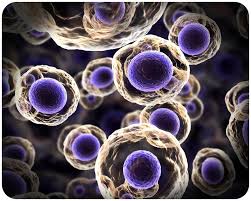
What kind of cell is this?
a)
Animal 
b)
Plant
4.
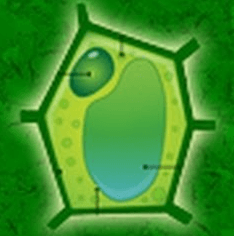
What kind of cell is this?
a)
Animal
b)
Plant
5.

Cell theory states that...

a)

cells are the basic building block of life

b)

cells are cool

c)

cells are microscopic

d)

cells cannot be destroyed

6.
Cells are often called "the ____ of life."
a)
bread
b)
road map
c)
building blocks
d)
meaning
7.

The _______ is the smallest structural and functional unit of a living thing. (this will be matching on the test)

a)

cell

b)

metabolism

c)

nutrition

d)

defense

8.

In what organelle is the genetic material found inside?

a)

Endoplasmic Reticulum

b)

Golgi Complex

c)

Nucleolus

d)

Nucleus

9.

What organelle is called the "powerhouse" of a cell?

a)

Endoplasmic Reticulum

b)

Nucleus

c)

Mitochondria

d)

Nucleolus

10.
Using this image, what organelle is C?
a)
Cell Wall
b)
Mitochondria
c)
Large Cell Vacuole
d)
Chloroplast
11.

What is the function of the mitochondria?

a)

Structure that manufactures ribosomes

b)

Structures that converts nutrients to energy

c)

Stack of membranes that packages chemicals

d)

Structure that contains DNA and directs the cell

12.
What is the function of the vacuole?
a)
Sac that stores water, nutrients, and waste products
b)
Sac filled with digestive chemicals
c)
Jelly-like substance within the plasma membrane
d)
stack of membranes that packages chemicals
13.

Where does photosynthesis occur?

a)

mitochondria

b)

stomata

c)

xylem

d)

chloroplast

14.
I store water in both plant and animal cells. What am I?
a)
cytoplasm
b)
ribosomes
c)
vacuole
d)
lysosomes
15.

I make proteins for the cell. What am I?

a)

ribosome

b)

mitochondria

c)

chloroplast

d)

lysosome

16.
What can only be found in plant cells?
a)
Cell membrane
b)
Vacuole
c)
Chloroplast
d)
Mitochondrion
17.
The two kinds of cells are Prokaryotes and Eukaryotes. How are they different?
a)
Prokaryotes have a nucleus.
b)
Eukaryotes have a nucleus.
c)
Prokaryotes are plant cells.
d)
There is no difference.
18.
What cell part is NOT found in all cells?
a)
Cell Wall
b)
Cell Membrane
c)
Cytoplasm
d)
Genetic Material
19.
Which part of the cell is often called "the brain of the cell"?
a)
nuclear membrane
b)
endoplasmic reticulum
c)
nucleus
d)
mitochondria
20.
A rigid layer that lies outside the cell's  membrane is...
a)
Cytoskeleton
b)
Cilia
c)
Cell Wall
d)
Flagella
21.

I am fluid filled within the cell

a)

Mitochondrion

b)

Vacuole

c)

cytoplasm

d)

Cell membrane

22.

How does a cell membrane keep harmful stuff out of the cell?

a)

Regulates what enters and leaves the cell

b)

Flexibility

c)

Protective barrier

d)

Structure and support

23.
What is the structure labeled #5?
a)
Vacuole
b)
Chloroplast
c)
Mitochondria
d)
Lysosome
24.
What is the structure labeled #8?
a)
Vacuole
b)
Golgi body
c)
Nucleus
d)
Lysosome
25.
What is the structure labeled #4?
a)
Vacuole
b)
Cell wall
c)
Cytoplasm
d)
Cell membrane
26.
What is the structure labeled #2?
a)
Lysosome
b)
Vesicle
c)
Ribosome
d)
Mitochondria
27.
What is the structure labeled #10?
a)
Cell membrane
b)
Cell wall
c)
Cytoplasm
d)
Centriole
28.
Which of the following structure can be found in a plant cell but NOT an animal cell?
a)
vacuole
b)
nucleus
c)
chloroplast
d)
mitochondria
29.
Which would be found in the cell of a sunflower plant but not in the cell of a chicken?
a)
cell wall
b)
vacuole
c)
mitochondria
d)
cell membrane
30.

Cell structures that perform specific functions are called

a)

tissues

b)

organs

c)

organelles

d)

organ systems

31.
Which of these is an example of a learned behavior?
a)
A cleft chin
b)
The color of a flower
c)
A toddler learning how to read
d)
A wolf with thick fur
32.
What is NOT an inherited trait of humans?
a)
Favorite type of music
b)
Freckles
c)
Hair color
d)
Height
33.

Every living thing has genetic information stored in the form of

a)

Ribosomes

b)

DNA

c)

Chloroplast

d)

Mitochondria

34.

If two alleles are the same for a certain trait they are considered

a)

Homozygous

b)

Twins

c)

Heterozygous

d)

Common

35.

Physical traits that are expressed are known as ____________

a)

Mutation

b)

Personality

c)

Genotype

d)

Phenotype

36.

Sections of DNA that have instructions for a specific trait are called _______________

a)

Blueprints

b)

Genes

c)

Heterozygous

d)

Fragments

37.

Chromosomes are

a)

Found in the mitochondria

b)

Made of 20 pairs

c)

Long strands of DNA that contain many genes

d)

Bundles of DNA that contain only one gene each

38.

Traits that are passed from parents to offspring are always

a)

Recessive

b)

Inherited

c)

Dominant

d)

Heterozygous

39.

The genetic difference between individuals in the same species is

a)

Interesting

b)

Harmful

c)

Variation

d)

Genetics

40.

The genes of an organism that are written with capital or lowercase letters

a)

Pant size

b)

Deoxyribonucleic acid

c)

Genotype

d)

Gretchentype

41.

If a gene is always expressed or always shown with a capital letter it is

a)

Bossy

b)

Recessive

c)

Yelling

d)

Dominant

42.

If a certain trait has two different alleles (one dominant and one recessive) it is called __________________

a)

Homozygous

b)

Confused

c)

Differentiated

d)

Heterozygous

43.

This variation of a gene can only be expressed if it is received from both parents

a)

Shy

b)

Heterozygous

c)

Variation

d)

Recessive

44.

Different versions of the same gene are called

a)

Jeans

b)

Editions

c)

Varieties

d)

Alleles

45.
A chart that shows all the possible combinations of alleles that can result from a genetic cross
a)
dominant allele
b)
codominance
c)
probability
d)
Punnett Square
46.
An organism's physical appearance or visible traits
a)
fertilization
b)
genotype
c)
phenotype
d)
homozygous
47.
An organism's genetic makeup, or allele combination
a)
fertilization
b)
genotype
c)
phenotype
d)
heterozygous
48.
Sexual reproduction requires _____ parents and asexual reproduction requires ___ parents
a)
1,1
b)
2,2
c)
2,1
d)
1,2 
49.

All of the offspring of an organism have the same genetic material, which is identical to the parent organism. From this, we can conclude that this organism -

a)

makes its own food

b)

is unicellular

c)

live in a marine habitat

d)

reproduces asexually

50.

California blackworms, also known as mudworms, are able to break apart. Each body section that broke apart is able to become an identical new worm. What type of reproduction does this example represent?

a)

Sexual reproduction

b)

Asexual reproduction

51.

Penguins lay 1-2 fertilized eggs that the male and female take turns incubating on their feet. What type of reproduction does this example represent?

a)

Sexual reproduction

b)

Asexual reproduction

52.

Reproducing asexually will produce offspring ...

a)

genetically different from each other

b)

genetically identical to the parent

53.
2 dogs reproduce, 2 sex cells join together & form offspring. The resulting offspring is likely
a)
to express only recessive traits
b)
to be identical to ONE parent
c)
to share some traits from BOTH of its parents
54.
What is a disadvantage of asexual reproduction?
a)
New species of organisms cannot come into being.
b)
The offspring does not multiply rapidly.
c)
The offspring does not live for long.
d)
All of these
55.
Which of the following describes the main advantages of sexual reproduction
a)
requires lots of time/energy
b)
no new gene combos can arise 
c)
diversity
d)
looks identical to the parent
56.
Which reproduction requires a mate?
a)
asexual
b)
sexual
c)
neither
57.
Identify the homozygous dominant genotype:
a)
FF
b)
Ff
c)
ff
58.
Dominant alleles are represented by a:
a)
Male gene
b)
lowercase letter
c)
recessive trait
d)
capital letter
59.
Aa, DD, bB, yy are all examples of
a)
genotypes
b)
phenotypes
60.
In a heterozygous genotype, the ___________ allele takes over in the phenotype.
a)
recessive
b)
dominant
c)
lower case letter
d)
both 
61.
What you see, or the physical appearance.
a)
Genotype
b)
Phenotype
c)
Homozygous
d)
Heterozygous
62.

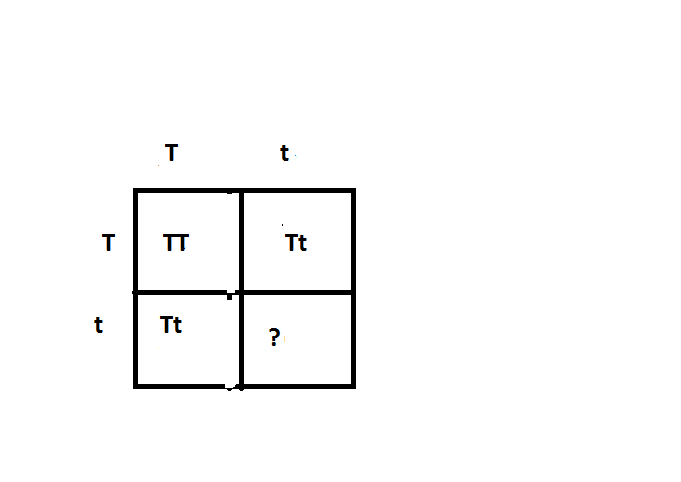
T - tall and t = short

In the punnett square below, what belongs in the missing square

a)

tt

b)

Tt

c)

Bb

d)

TT

63.

Which of the following genotypes is Purebred? Select 2 answers.

a)

aA

b)

Aa

c)

AA

d)

aa

64.

B = brown fur b = white fur

In the punnett square, what is the probability for white fur?

a)

0%

b)

25%

c)

50%

d)

75%

65.

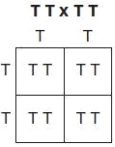
Each one of the boxes on the Punnett square represents what probability of an offspring's genotype?

a)

25%

b)

1%

c)

10%

d)

0%

66.

What is ratio of the offspring from the cross shown will be homozygous recessive for the trait of tallness? T = tall t = short

a)

0 in 4

b)

1 in 4

c)

2 in 4

d)

4 in 4

67.

Brown eyes are dominant over blue eyes. What is the probability that the offspring will have brown eyes in this cross?

a)

25%

b)

50%

c)

75%

d)

100%

68.

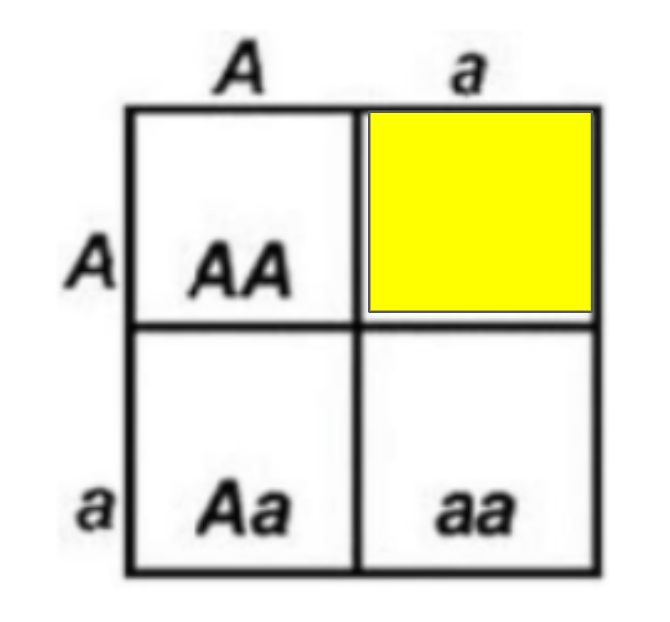
Fill in the Yellow Box

a)

AA

b)

Aa

c)

aa

69.

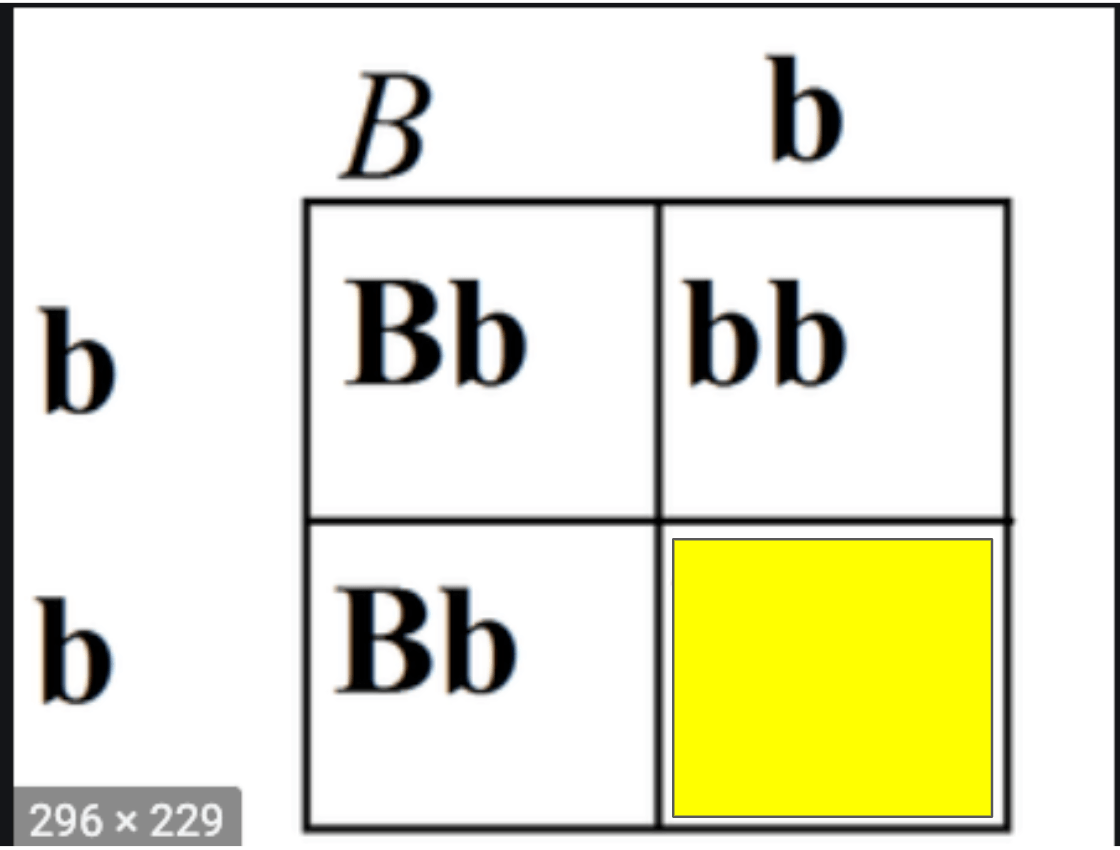
Fill in the Yellow Box

a)

Bb

b)

BB

c)

bb

70.

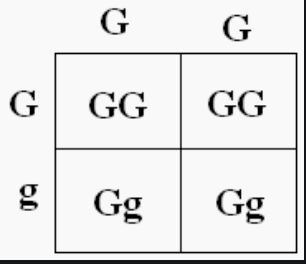
The punnett square is used to tell the color of a frogs skin. "G" means green skin and "g" means brown skin. What is the chance the baby frogs will have brown skin?

a)

0%

b)

25%

c)

50%

d)

100%

71.

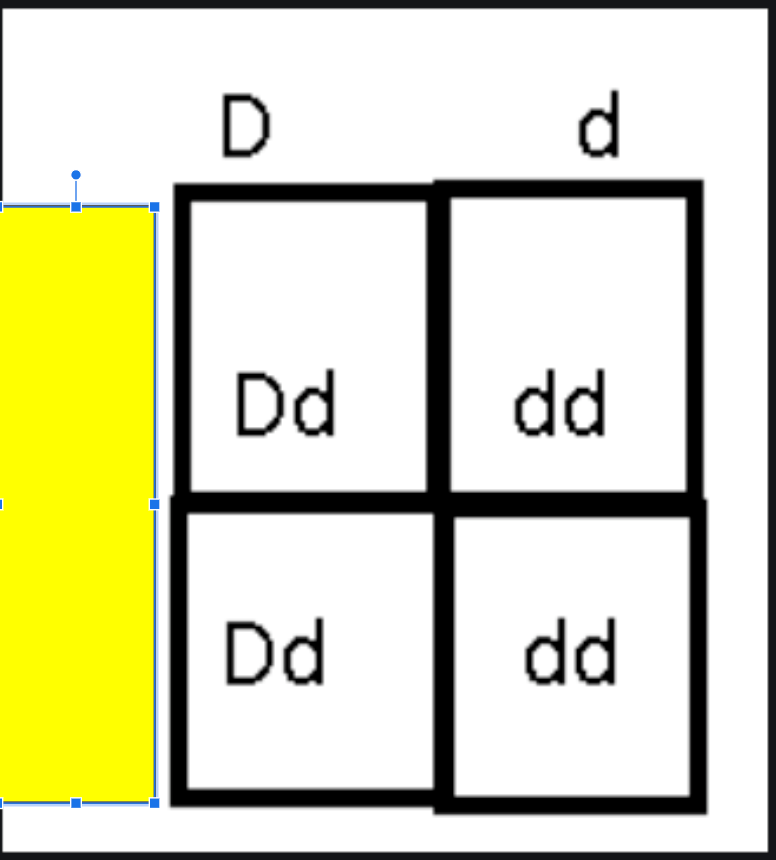
What is the mother's genotype?

a)

DD

b)

Dd

c)

dd

72.
A possible explanation to a problem that has not yet been tested. 
a)
data
b)
theory
c)
hypothesis
d)
fact
73.
What step does every scientific experiment begin with?
a)
hypothesis
b)
question/problem
c)
procedures
d)
conclusion
74.
The summary at the end of an experiment that explains the results. 
a)
conclusion
b)
procedures
c)
materials
d)
responding variable
75.

What is an observation?

a)

A scientific statement based on ideas

b)

Using your senses to notice what is going on around you

c)

To be unaware of your surroundings

d)

The question that you want an answer to.

76.
A series of steps used by scientists to solve a problem or answer a question. 
a)
scientific method
b)
recipe
c)
data collection
d)
metric system
77.
Testing a hypothesis often involves a(n):
a)
answer
b)
experiment
c)
problem
d)
safety check