
 Worksheets
Layers of the Atmosphere TEST
Total questions: 87
Worksheet time: 53mins

Kai is studying the carbon cycle for a science project. He looks at a diagram similar to the one above. Based on the information in the diagram, which statement correctly describes a step in the carbon cycle?
Photosynthesis adds carbon directly to the lithosphere.
Plant respiration adds carbon directly to the atmosphere.
Burning fossil fuels removes carbon directly from the biosphere.
Animal respiration removes carbon directly from the atmosphere.

Luna is studying the layers of Earth's atmosphere for her science project. She notices that in some layers, the temperature drops as you go higher up. Based on the graph, in which two layers does the temperature decrease as altitude increases?
Troposphere & Mesosphere
Stratosphere & Thermosphere
Troposphere & Thermosphere
Troposphere & Stratosphere
Arjun is studying the Earth's atmosphere using a graph that shows how temperature changes with altitude. He notices that in some layers, the temperature increases as you go higher. Based on the graph, in which two layers does the temperature increase as the altitude increases?
Troposphere & Mesosphere
Stratosphere & Thermosphere
Troposphere & Thermosphere
Troposphere & Stratosphere
Zoe is fascinated by space and wants to learn more about where the International Space Station orbits Earth. She discovers that many satellites actually orbit Earth within a certain layer of the atmosphere. She also learns that variations in the amount of energy coming from the Sun exert a powerful influence on both the height of the top of this layer and the temperature within it. The aurora, the Northern Lights and Southern Lights, occur here. Another name for this layer is the “heat” layer. Which layer is Zoe learning about?
Troposphere
Mesosphere
Stratosphere
Thermosphere
Exosphere
Abigail is reading about Earth's atmosphere for her science project. She learns that most meteors burn up in a certain layer. Unlike the stratosphere, temperatures in this layer grow colder as you rise. The coldest temperatures in Earth's atmosphere, about -90° C (-130° F), are found near the top of this layer. The air is far too thin to breathe; air pressure at the bottom of the layer is well below 1% of the pressure at sea level, and continues dropping as you go higher. Which layer is Abigail learning about?
Troposphere
Mesosphere
Stratosphere
Thermosphere
Exosphere
Emma is studying about Earth's atmosphere for her science project. She learns that the "air" is very, very, very thin in one particular layer, making it even more space-like than the thermosphere. In fact, the air is constantly - though very gradually - "leaking" out of Earth's atmosphere into outer space. There is no clear-cut upper boundary in this layer. High Earth Orbit satellites can be found here. Which layer is Emma learning about?
Troposphere
Mesosphere
Stratosphere
Thermosphere
Exosphere
Mia is curious about the layer of the atmosphere where humans live, and where nearly all weather occurs. She notices that most clouds appear here, and learns that 99% of the water vapor in the atmosphere is found in this layer. As Mia climbs a mountain, she observes that air pressure drops and temperatures get colder the higher she goes. Which layer is Mia exploring?
Exosphere
Thermosphere
Mesosphere
Stratosphere
Troposphere
While hiking up a mountain, Noah notices that the air feels thinner the higher he climbs. The density of our atmosphere _______________ with an increase in altitude.
increases
gets greater
decreases
gets heavier
Lily is hiking up a mountain. She notices that the atmospheric pressure _________________ with ___________________ altitude.
decreases with increased
decreases with decreased
increases with increased
Charlotte is learning about the air we breathe. She wonders what the atmosphere is composed of mainly. Can you help her find the answer?
Oxygen
Nitrogen
Argon
Carbon Dioxide
Grace is learning about the atmosphere for her science project. She wants to know which layer of the atmosphere is the most dense. Which layer should she choose?
Troposphere
Stratosphere
Mesosphere
Thermosphere
Exosphere
Aiden is planning a high-altitude balloon experiment and wants to know which layer of the atmosphere will be the coldest for his equipment. Which layer is the coldest?
Troposphere
Stratosphere
Mesosphere
Thermosphere
Exosphere
Zoe is planning a trip to see the Northern Lights and wants to know in which layer of the atmosphere she should expect to find them.
Troposphere
Stratosphere
Mesosphere
Thermosphere
Exosphere
William is curious about where most weather events, like rain and snow, take place in Earth's atmosphere. In which layer do these weather events mostly occur?
Troposphere
Stratosphere
Mesosphere
Thermosphere
Exosphere
Ava is learning about the different layers of Earth's atmosphere in her science class. Her teacher mentions a layer known as the “heat layer” because temperatures rise significantly there. Which layer is Ava's teacher referring to?
Troposphere
Stratosphere
Mesosphere
Thermosphere
Exosphere
Charlotte is learning about the Earth's atmosphere in her science class. She wants to know in which layer the Ozone layer is found.
Troposphere
Stratosphere
Mesosphere
Thermosphere
Exosphere
Jackson is reading about how the Earth is protected from space objects. He wonders which layer of the atmosphere protects the earth from meteoroids. Which layer is it?
Troposphere
Stratosphere
Mesosphere
Thermosphere
Exosphere

Grace is looking at a photo taken from space and notices a thin blue layer surrounding Earth. She wonders what this layer of gases is called. What is the layer of gases that surrounds Earth?
Atmosphere
Hydrosphere
Geosphere
Biosphere

Nora is learning about the air we breathe in her science class. Her teacher tells her that one particular gas makes up 21% of our atmosphere. Which gas is it?
Nitrogen
Oxygen
Carbon Dioxide
Methane

Rohan is learning about how Earth stays warm enough for people, plants, and animals to live. His teacher tells him about the Greenhouse Effect. How does the Greenhouse Effect protect life on Earth?
It maintains Earth's temperature
It blocks harmful rays from the sun
It gives us gravity
It traps pollution in the sky

Kai is learning about how Earth is protected from the sun's harmful rays. He wonders which sphere blocks these rays. Which sphere is responsible for this protection?
Thermosphere
Mesosphere
Stratosphere
Troposphere

Aria and her friends are playing outside and start wondering about the air they breathe. Aria asks, "What sphere do we live in?"
Thermosphere
Mesosphere
Stratosphere
Troposphere

Mia is climbing to the top of a mountain and notices it is harder to breathe. Why is this?
There is less oxygen
There is more oxygen
There is more carbon dioxide
There is less carbon dioxide

Ava is curious about how the atmosphere helps keep everyone safe on Earth. She asks her teacher, "How does the atmosphere protect life on Earth?" What could her teacher say?
It blocks harmful rays from the sun
It keeps our planet the right temperature
It provides oxygen to breathe
All of these protect life on Earth

Hannah is learning about how the Earth is protected from the sun's harmful rays. She wonders which layer of gases blocks radiation from the sun. Which layer is it?
Greenhouse Layer
Bozo Layer
Ozone Layer
Thermo Layer

David notices that factories in his city are releasing a lot of pollution into the air. He wonders how this pollution might effect Earth's temperature. What is the impact?
It traps more heat, warming the planet
It cools our planet
It does not effect our temperature

Benjamin is curious about what would happen if Earth suddenly lost its atmosphere. What would Earth be like without an atmosphere?
There would be no life
There would be no air
More radiation from the sun would harm the planet
All of these are true

Maya is working on a science project about Earth's atmosphere. She needs to identify the three gases present in the greatest concentration in our atmosphere. Which combination should she choose?
ozone, xenon, carbon dioxide
nitrogen, oxygen, carbon dioxide
nitrogen, oxygen, argon
argon, carbon dioxide, neon
While watching a documentary about space, Sophia learns about the different layers of Earth's atmosphere. She wonders, which is the uppermost layer?
thermosphere.
stratosphere.
mesosphere.
exosphere.
Benjamin is learning about the Earth's atmosphere in science class. He wonders why the thermosphere and exosphere are the warmest of the atmospheric layers. What is the reason?
because of the gases trapped in these layers
because they are closest to the Sun
because the underlying mesosphere keeps the warm air there
because the air pressure is too great

Scarlett is curious about where rain, snow, and clouds form in the atmosphere. Using the figure, in which layer would she find these weather phenomena?
troposphere
stratosphere
mesosphere
thermosphere
Ava notices droplets forming on the outside of her cold water bottle on a hot day. What is it called when water changes from gas to liquid?
evaporation
freezing
melting
condensation
Avery is curious about what powers most of the natural processes she observes on Earth's surface, like weather and plant growth. What is the major source of energy for the Earth's surface?
convection motion within the oceans
the collision of tectonic plates
Earth rotating on its axis
the Sun
Grace is hiking up a mountain. As she climbs higher, what happens to the air pressure?
It increases
It decreases
It stays the same

Maya is learning about the layers of the atmosphere in her science class. She wants to know more about the Troposphere. Which two statements describe the Troposphere?
Layer closest to earth
The hottest layer
Layer farthest from earth
Where weather occurs
Grace is reading about Earth's atmosphere for her science project. She wonders, what is the layer that is in space? This is the top layer?
(a)

Kai is studying how temperature changes as you go higher in the atmosphere. He notices that some layers are warmer at lower altitudes and get steadily colder as altitude increases. According to this graph, which two layers is Kai observing?
Troposphere and Mesosphere
Stratosphere and Thermosphere
Mesosphere and Thermosphere
Troposphere and Stratosphere
Henry is building a model to show the layers of Earth's atmosphere for his science project. He wants to stack the layers in the correct order from the ground up to space. Which of the following is the correct order of the atmosphere layers from Earth to space?
troposphere, stratosphere, mesosphere, thermosphere, exosphere
troposphere, mesosphere, thermosphere, exosphere, stratosphere
thermosphere, stratosphere, mesosphere, troposphere, exosphere
troposphere, stratosphere, mesosphere, exosphere, thermosphere
While studying for her science test, Mia reads that the lower part of the thermosphere is called the _________.
Exosphere
Ionosphere
Ozonosphere
Thermosphere
David is preparing a science project about the Earth's atmosphere. He wants to know what percentage of our atmosphere is made up of other gases such as argon, water vapor, and carbon dioxide. What percentage should he write in his report?
1%
21%
78%
90%
Charlotte is reading about Earth's atmosphere for her science project. She wants to know in which layer she will find the ozone layer. Where should she look?
stratosphere
thermosphere
exosphere
mesosphere
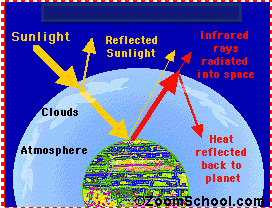
Priya is learning about how Earth's atmosphere helps keep the planet warm. She looks at this diagram in her science class. What does this diagram illustrate?
Ozone Layer
The Greenhouse Effect
Ultraviolet Radiation
Layers of the atmosphere
Priya is reading about the Earth's atmosphere and wonders which layer is considered space. Which layer is considered space?
thermosphere
troposphere
mesosphere
exosphere
Priya is curious about why the Earth's atmosphere doesn't just float away into space. What enables the atmosphere of Earth to stay in place?
gravity
air pressure
types of air molecules
clouds
Ava is learning about the environment in her science class. Her teacher asks her to explain how the ozone layer helps protect the Earth. What should Ava say?
Absorbs solar radiation, Protects Earth from UV Rays, and emits heat
Ozone in the lower atmosphere is a pollutant
While helping Scarlett with her science homework, Liam claims that the mesosphere is the layer of the atmosphere that contains the ozone layer. Is Liam correct?
True
False
Jackson is studying for his science test and reads that the layer of the atmosphere where weather occurs is the thermosphere. Is this statement correct?
True
False
While stargazing, Nora wonders if most meteoroids burn up in the mesosphere.
True
False
Isla is curious about where satellites orbit the Earth. In which layer of the atmosphere do we find satellites in space?
Exosphere
Troposphere
Mesosphere
Stratosphere
Abigail is studying for her science test and reads that the troposphere is made up of helium and hydrogen. True or False?
True
False
Which layer of the atmosphere contains the highest percentage of water vapor?
exosphere
mesosphere
troposphere
stratosphere
What is Global Warming?
Increasing temperature in Earth's atmosphere
Decreasing temperature in a city
Increasing rain rates in Earth
Decreasing temperature rates
Global warming is caused by a phenomenon known as the greenhouse effect.


Why are too many greenhouse gases bad for the environment?
They cause trees to die.
They release heat and will be the cause of the next ice age.
They trap heat in our atmosphere causing the planet to warm up.
They are fossil fuels which pollute our environment.
Which one is not a fossil source?
petrol
sun
coal
natural gas

A student draws a model to represent the precesses involved in the water cycle, as shown. To which process is the formation of clouds related?
Condensation
Evaporation
Freezing
Melting

If groundwater reaches earth's surface, how does it reenter the water cycle?
by transpiration
by evaporation
by accumulation
it can't
Gravity is not a factor in the water cycle
True
False
What is the water that is above the Earth's surface?
Surface Water
Runoffs
Groundwater
Water Table
What is it called when water flows across the Earth's surface into bodies of water?
Surface Water
Runoffs
Groundwater
Water Table
What is the correct order of the water cycle?
Evaporation, Condensation, Precipitation, Runoff
Runoff, Precipitation, Condensation, Evaporation
Evaporation, Precipitation, Runoff, Condensation
Condensation, Evaporation, Runoff, Precipitation

