wayground logo

Free Printable Worksheets

Font size

S
M
L
XL
Worksheets

Nuclear Chemistry

Total questions: 60

Worksheet time: 15hrs 0mins
Name
Class
Date
1.
Which process produces alpha particles?
a)
Alpha decay
b)
Beta decay
c)
Gamma decay
d)
Nuclear fusion
2.
What do these symbols represent?
a)
alpha particle
b)
beta particle
c)
neutron
d)
gamma ray
3.
What sort of shield will block gamma rays?
a)
skin
b)
paper
c)
aluminum
d)
thick lead
4.

How is the alpha particle written in a nuclear equation?

a)

42He

b)

24He

c)

0-1e

d)

00γ

5.
Solve this equation for alpha decay.
85209At = ___ + 24He
a)
83205Bi
b)
86209Rn
c)
81207Tl
d)
85208At
6.
Solve this equation for beta decay.
614C = ___ + -10e
a)
410Be
b)
714N
c)
210He
d)
613C
7.
Has the lowest penetrating power.  Can only penetrate 0.05 mm into the body and can be stopped by a piece of paper or clothing.
a)
Alpha
b)
Beta
c)
Gamma
8.
Uranium-238  decays into  Thorium-234  by emitting .........
a)
an alpha particle
b)
a beta particle
c)
gamma rays
d)
visible light
9.

13755Cs —› ____ + 0-1e

a)

17872Hf

b)

13753I

c)

14154Xe

d)

13756Ba

10.
Radioactive materials have unstable...
a)
electrons
b)
protons
c)
nuclei
d)
neutrons
11.

Finish this equation

20983Bi--> _______ + 20581Tl

a)

42He

b)

0-1e

c)

y

12.

finish the equation


18173Ta --> ____ + 18174W

a)

42He

b)

0-1e

c)

y

13.
Mass number of Selenium - 79
a)
34
b)
45
c)
78
d)
79
14.

What does 210 represent in Bismuth - 210?

a)

Atomic number

b)

Rate of decay

c)

Mass number

d)

Number of neutrons

15.
During beta decay, a nucleus .... 
a)
gives up two protons and two neutrons.
b)
  maintains the same number of protons and neutrons.
c)
  loses a proton and gains a neutron.
d)
gains a proton and loses a neutron. 
16.
When a nucleus undergoes nuclear decay by gamma rays, the atomic number of the element....
a)
remains the same
b)
  decreases by one.
c)
increases by one.
d)
increases by two.
17.
The type of radioactive particle that can be stopped by a sheet of paper is the ____.
a)
alpha particle
b)
beta particle
c)
gamma ray
d)
uranium
18.

Identify the type of nuclear decay shown here

21483Bi 0-1e + 21484Po

a)

alpha

b)

beta

c)

gamma

19.

finish the equation


22688Ra --> ____ + 22688Ra

a)

42He

b)

0-1e

c)

y

20.
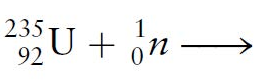
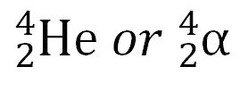
What particle completes this reaction?
a)
alpha particle
b)
beta particle
c)
gamma particle
d)
neutron
21.
What type of particle is being illustrated in following picture? 
a)
gamma ray
b)
alpha particle 
22.
What element makes up an alpha particle? 
a)
oxygen
b)
helium
c)

nitrogen

d)

lithium

23.
What makes up a beta particle? 
a)
electron
b)
proton
c)

neutron

d)

gamma radiation

24.
The process by which nuclei having low masses are united to form nuclei with larger masses is ____.  
a)
a chain reaction 
b)
fission
c)
a chemical reaction 
d)
fusion 
25.
What makes something radioactive?
a)
elements with an atomic number above 81
b)
an unstable nucleus
c)
contaminated sewage
d)
It decays over time
26.
The splitting of a nucleus into smaller nuclei is
a)
fusion
b)
fission
c)
half-life
d)
gamma radiation
27.

Which type of radioactive decay gives off energy only (no particles)?

a)

alpha

b)

beta

c)

gamma

28.
Gamma rays have a _____ charge
a)
0
b)
+1
c)
-1
d)
+2
29.
Alpha particles have a _____ charge.
a)
+2
b)
0
c)
+1
d)
-1
30.

Beta particles have a _____ charge.

a)

+2

b)

0

c)

+1

d)

-1

31.
The sun is powered by
a)
nuclear decay
b)
nuclear fission
c)
nuclear fusion
d)
combustion
32.

Which elements on the periodic table have the most unstable nuclei?

a)
metals
b)
non-metals
c)
low atomic number
d)
high atomic number
33.
If 10 mg of iodine 131 is given to a patient, how much is left after 24 days? The half-life of iodine-131 is 8 days.
a)
1.25mg
b)
1.25g
c)
10g
d)
10mg
34.

An isotope of cesium (cesium-137) has a half-life of 30 years. If 0.125 mg of cesium-137 remains after a period of 90 years, how much was present initially?

a)

0.5 mg

b)

2.0 mg

c)

0.750 mg

d)

1.0 mg

35.
After 4 half-lives, 1g of a sample of Krypton-85 remains unchanged.  What was the original mass of the sample?
a)
16g
b)
32g
c)
0.0625g
d)
4g
36.
Pd-100 has a half-life of 3.6 days. If one had 620,310,740 atoms at the start, how many atoms would be present after 21.6 days?
a)
9.7x10⁶ atoms remain
b)
97.0x10⁶ atoms remain
c)
0.97x10⁶ atoms remain
d)
9.7x10⁵ atoms remain
37.

If we start with 400 radioactive atoms, how many will remain radioactive after one half-life?

a)

25

b)

50

c)

100

d)

200

38.
The half-life of strontium-90 is 25 years. How much strontium-90 will remain after 100 years if the initial amount is 4.0 g?
a)
3.0g
b)
0.25mg
c)
0.3g
d)
0.25g
39.

What is the term for an ongoing series of nuclear reactions?

a)

fission

b)

chain reaction

c)

fusion

d)

nuclear

40.
When small nuclei combine to produce a nucleus of greater mass
a)
Fusion
b)
Fission
c)
Chain Reaction
41.
The splitting of a nucleus into smaller fragments accompanied by the release of neutrons and a large amount of energy
a)
Fusion
b)
Fission
c)
Chain Reaction
42.
When neutrons produced react with other fissionable atoms, continuing the fission.
a)
Fission
b)
Chain Reaction
c)
Fusion
43.
The splitting of a nucleus into smaller nuclei is
a)
fusion
b)
fission
c)
half-life
d)
gamma radiation
44.

If the particle that starts a nuclear reaction is also one of the products, the process is a...

a)

Neutron emission

b)

Chain reaction

c)

Nuclear fusion

d)

Alpha decay

45.

Which uses controlled nuclear chain reactions?

a)

Nuclear reactors

b)

Atomic bombs

c)

Fusion

d)

Creation of the Hulk

46.
Balance the following equation:
146C --> 0-1e + ________
a)
145B
b)
146C
c)
147N
d)
42He
47.
In fission neutron is often used to start the reaction and it is also a product of the reaction. This is called a ____
a)
neutron emission
b)
nuclear fusion
c)
domino effect
d)
chain reaction
48.
Why do we need neutron absorption in a nuclear reactor?
a)
it recycles the fuel
b)
it increases heat absorption
c)
it speeds up a reaction
d)

it controls the chain reaction

49.
Very high temperature and pressure is required for:
a)
Fission
b)
 Fusion
c)
Radioactive Decay
50.
Which of the following is true about nuclear fusion?
a)
It is easy to implement.
b)
It produces less energy than nuclear fission.
c)
It produces more energy than nuclear fission.
d)
It has the ability to occur easily in everyday life.
51.
Which type of radiation releases an electron?
a)
Alpha radiation
b)
Beta radiation
c)
gamma radiation
52.

A nuclear fission reaction occurs when a uranium-235 nucleus is bombarded with a _______.

a)

Neutron

b)

Proton

c)

Alpha particle

d)

Beta particle

53.

How many elements after atomic number 83 are radioactive?

a)

None

b)

All

c)

Most (bottom 2 rows)

d)

2

54.

Elements with atomic numbers greater than 92

a)

Half Life

b)

Transmutation

c)

Transuranium Element

d)

Quark

55.

The half-life of throium-232 is 1.4 x 10¹⁰ years. If there are 12.50 g of the sample left after 4.2 x 10¹⁰ years, how many grams were in the original sample?

a)

100.0 g

b)

50.0 g

c)

200.0 g

d)

37.5 g

56.

A sample of germanium-66, which has a half-life of 2.5 hours, is left for 12.5 hours. At the end of this time, only 1.0 g remain. What was the original amount of germanium-66?

a)

32 g

b)

5.0 g

c)

12.5 g

d)

16 g

57.

What is a pro of nuclear energy?

a)

More efficient than coal

b)

Produces nuclear waste

c)

Less Carbon emmited

d)

Lots of material available for reactions

58.

What is a con of nuclear energy?

a)

More efficient than coal

b)

Produces nuclear waste

c)

Less Carbon emmited

d)

Lots of material available for reactions

59.
What is the missing isotope that will balance the following nuclear equation?
94Be  +  11H →  _____  +  42He
a)
105B
b)
105Ne
c)
63Li
d)
63C
60.
a)
23692U
b)
23693U
c)
23492Np
d)
23493Np