Wayground logo

Free Printable Worksheets

Font size

S
M
L
XL
Worksheets

Unit 9 Test Review: Genetics

Total questions: 134

Worksheet time: 11hrs 10mins
Name
Class
Date
1.
What do we use pedigrees for?
a)
To look at families
b)
To make determinations about the offspring
c)
To track traits in families
d)
Nothing
2.

In a pedigree, which shape represents a male?

a)

circle

b)

square

3.

On a pedigree, this symbol represents a ----

a)

not affected male.

b)

not affected female.

c)

affected male.

d)

affected female.

4.

How many individuals are there in the 3rd generation?

a)

1

b)

2

c)

4

d)

6

5.

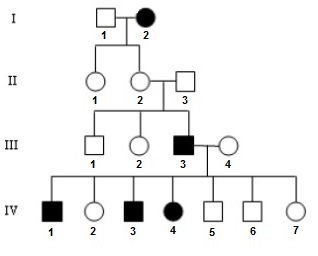
How are individuals III-2 and II-4 related?

a)

Brother and sister

b)

Dad and daughter

c)

Uncle and niece

d)

Grandfather and granddaughter

6.

What is the mode of inheritance shown here?

a)

Recessive because it "skips" a generation

b)

Dominant because it shows up in every generation

7.

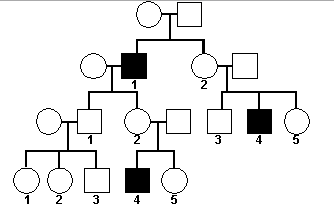
On this pedigree, the allele for curly hair is dominant. The couple labeled 2 both have curly hair, but have a daughter who does not have curly hair. Therefore, we can tell from the chart that for the couple labeled 2 -

a)

the male is heterozygous and the female is heterozygous.

b)

the male is homozygous recessive and the female is homozygous dominant.

8.
How many generations are shown in this pedigree?
a)
1
b)
2
c)
3
d)
4
9.
How many kids did the mother and father from the first generation have?
a)
2
b)
4
c)
5
d)
6
10.
Is this trait (the shaded individuals) dominant or recessive?
a)
dominant
b)
recessive
11.

If this pedigree shows a recessive disorder, what MUST the genotype of individual 4 be?

a)

HH

b)

Hh

c)

hh

12.
What does a filled in square represent?
a)
Not affected Female
b)
Not affected Male
c)
Affected Male
d)
Affected Female
13.
What does a horizontal line between a square and a circle mean?
a)
They are siblings
b)
They are cousins
c)
They are married ("together")
d)
They are the children
14.
What does a vertical line coming down from a square and circle that are connected by horizontal line indicate?
a)
They are cousins
b)
The children
c)
Aunts and Uncles
15.
In the second generation-how many people are carriers of the trait?
a)
2
b)
3
c)
5
d)
6
16.
Which individual in the first generation is a carrier?
a)
The male
b)
The female
c)
individual 1
d)
None of the above
17.
This pedigree represents the inheritance of hemophilia in this family. How many of the females have the hemophilia trait?
a)
8
b)
5
c)
2
d)
3
18.

Why do all the daughters in Generation II carry the colorblind gene?

a)

Because mom passed on the gene.

b)

Because dad passed on the X chromosome.

19.

The trait this pedigree traces is recessive because it skips a generation and individuals can be carriers. What is the most likely genotype for person III-3?

a)

GG

b)

Gg

c)

gg

20.

If this pedigree shows a recessive disorder, what MUST the genotype of individual II-3 be?

a)

HH

b)

Hh

c)

hh

21.

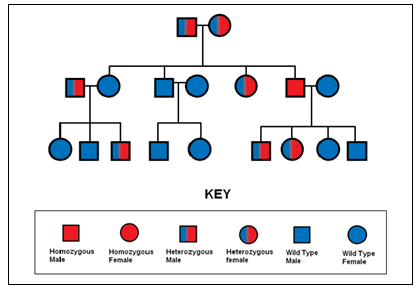
What do half colored symbols represent?

a)

The individual is a carrier (heterozygous).

b)

The individual has the phenotype

c)

The individual has both recessive alleles.

22.

This characteristic skips a generation. The trait in this pedigree must be

a)

Dominant

b)

Recessive

23.

This pedigree chart shows Freckles in this family. This characteristic is probably

a)

Dominant

b)

Recessive

24.

What type of heredity is shown in the pedigree?

a)

Sex-Linked Dominant

b)

Sex-Linked Recessive

c)

Autosomal Dominant

d)

Autosomal Recessive

25.
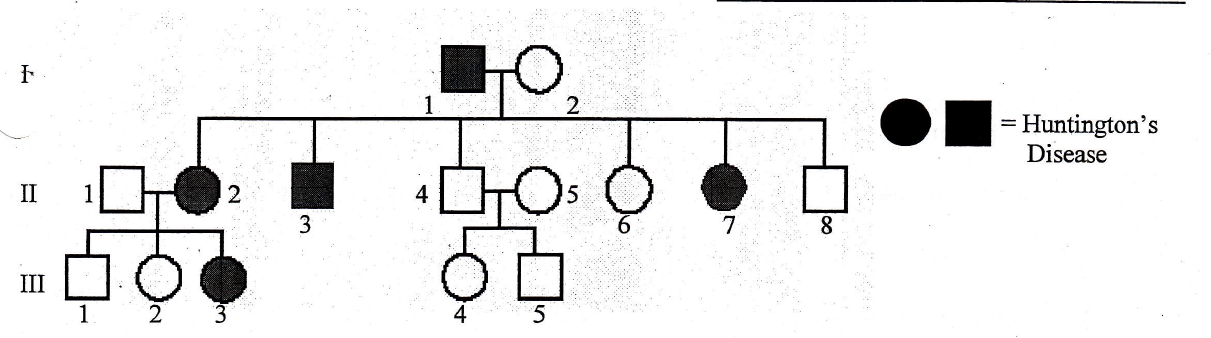
There are no carriers for Huntington's Disease- you either have it or you don't. Is Huntington's disease caused by a dominant or recessive trait?
a)
Dominant
b)
Recessive
26.

The pedigree is showing a _____________ trait.

a)

autosomal dominant

b)

autosomal recessive

c)

sex linked recessive

27.

Which of the following is a result of a nondisjunction?

a)

Klinefleter syndrome

b)

Sickle cell anemia

c)

Cystic fibrosis

d)

Hemophilia

28.

Which of the following best describes the cause of cystic fibrosis?

a)

a mutated blood clotting protein

b)

a mutated transport protein

c)

an extra 21st chromosome

d)

an extra 13th chromosome

29.

Which of the following is an autosomal recessive disorder?

a)

Huntington's disease

b)

sickle cell anemia

c)

colorblindness

d)

Hemophilia

30.

Which of the following is a autosomal dominant disorder?

a)

Huntington's

b)

Cystic fibrosis

c)

Hemophilia

d)

Sickle cell anemia

31.

Which of the following is a sex-linked disorder?

a)

Hemophilia

b)

Sickle cell anemia

c)

Cystic fibrosis

d)

Huntington's

32.

Which of the following is a chromosomal mutation?

a)

insertion

b)

frameshirt

c)

substitution

d)

nondisjunction

33.

Which of the following cause frameshift mutations?

a)

insertions and deletions

b)

translocations and nondisjunctions

c)

duplicaitons and deletions

d)

inversions and substitutions

34.

Which of the following is NOT a chromosomal disorder?

a)

Turner's syndrome

b)

Downs syndrome

c)

Klinefelter's syndrome

d)

Huntingdon's

35.

Which of the following is NOT caused by a gene mutation?

a)

Turner's syndrome

b)

Sickle cell anemia

c)

Cystic fibrosis

d)

Hemophilia

36.

Identify the substitution mutation that results in an abnormally shaped protein and that causes a reduced ability to bind and transport oxygen.

a)

Cystic fibrosis

b)

Sickle cell anemia

c)

Huntington's

d)

Hemophilia

37.
Which disease or disorder causes people to have abnormal hemoglobin?
a)
Cystic Fibrosis
b)
Albinism
c)
Sickle-cell Disease
d)
Down Syndrome
38.
Which disease or disorder is the result of having an extra chromosome?
a)
Cystic Fibrosis
b)
Down Syndrome
c)
Colorblindness
d)
Sickle-cell Disease
39.
What are the two ways that genetic disorders can be inherited?
a)
Through blood transfusions and meiosis.
b)
Mutations in DNA and changes in structure or number of chromosomes.
c)
Missing chromosomes or premature egg splitting.
d)
Unhealthy environments and heredity.
40.
What is the name of the protein that is not normal in people with sickle-cell disease?
a)
mucus
b)
clotting protein
c)
karyotype
d)
hemoglobin
41.
A doctor may use a _________ to examine the chromosomes in a cell.
a)
x-ray
b)
blood test
c)
karyotype
d)
hemoglobin
42.
Which genetic disorder or disease is a sex-linked trait and carried on the X chromosome?
a)
Cystic Fibrosis
b)
Sickle-cell Disease
c)
Hemophilia
d)
Down Syndrome
43.
Which disorder or disease has alleles that are co-dominant with each other?
a)
Cystic Fibrosis
b)
Sickle-cell Disease
c)
Down Syndrome
d)
Hemophilia
44.
What chromosome is affected by hemophilia?
a)
x
b)
y
c)
21
d)
13
45.
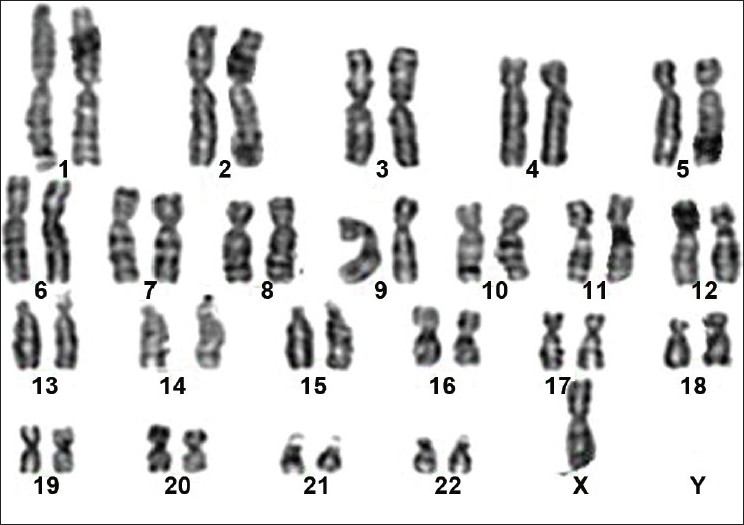
What is the gender of the individual whose karyotype is seen in the image?
a)
Male
b)
Female
46.
a)
This karyotype shows Trisomy 21
b)
This karyotype has no abnormality
c)
This karyotype is missing a sex chromosome (monosomy x)
d)
This karyotype is from a gamete
47.
Which sex chromosomes would indicate a typical human male?
a)
XX
b)
X
c)
XY
d)
XXY
48.
What is the chromosomal condition of the individual whose karyotype is seen in the image?
a)
Trisomy 21 (Down's Syndrome)
b)
Trisomy 13 (Patau Syndrome)
c)
Trisomy 18 (Edward's Syndrome)
d)
XXY Sex Chromosomes (Klinefelter's Syndrome)
49.
Which of the following is true of your sex chromosomes?
a)
I have two Y chromosomes.
b)
I have at least one X chromosomes.
c)
They aren't developed until I turn 13.
d)
They are afraid of one another.
50.
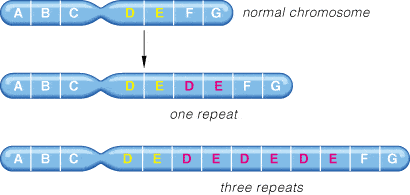
Identify the mutation in the picture.
a)
Inversion
b)
Duplication
c)
Deletion
d)
Translocation
51.
Identify the mutation in the picture.
a)
Deletion
b)
Inversion
c)
Duplication
d)
Translocation
52.
When can a mutation be passed on to offspring?
a)
only when the mutation is present during or occurs during mitosis
b)
only when the mutation is present during or occurs during meiosis
c)
when the mutation occurs during mitosis or meiosis
d)
when the mutation occurs in somatic cells
53.
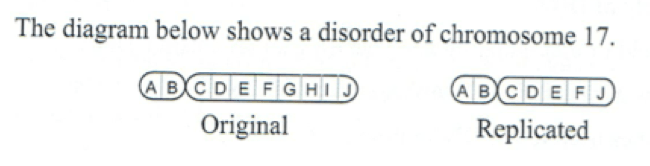
What type of chromosomal mutation has occurred?
a)
substitution
b)
insertion
c)
deletion
d)
nondisjunction
54.

Inversion

a)

When a segment of a chromosome breaks off.

b)

When a segment of a chromosome breaks off, flips, and reattaches.

c)

When a segment of a chromosome is copied or doubles.

d)

When a segment of a chromosome breaks and attaches to a non homologous chromosome.

e)

When entire chromosomes don't separate evenly during meiosis.

55.

Nondisjunction

a)

When a segment of a chromosome breaks off.

b)

When a segment of a chromosome breaks off, flips, and reattaches.

c)

When a segment of a chromosome is copied or doubles.

d)

When a segment of a chromosome breaks and attaches to a non homologous chromosome.

e)

When entire chromosomes don't separate evenly during meiosis.

56.
Trisomy 21 means you have what?
a)
Three copies of chromosome 21
b)
Twenty one copies of chromosome 3
c)
Three omies and 21 means
d)
Two copies of chromosome 21
57.
Which of the following is NOT a characteristic of Down Syndrome
a)
Flattened face
b)
Eyes slanting upward
c)
Unusual palm crease
d)
Less flexible
58.
What are chromosomes 1-22 called?
a)
Autosomes
b)
Sex Chromosomes
c)
Chromotids
d)
Xenosomes
59.

In genetics, ……………….. is a type of mutation in which a part of a chromosome contains certain amount of gene as well as DNA or a sequence of DNA is lost.

a)

Duplication

b)

Deletion

c)

Inversion

d)

Translocation

60.

……………..occurs when a segment of the chromosome is represented two or more time in the chromosome.

a)

Duplication

b)

Deletion

c)

Inversion

d)

Translocation

61.
An example of a mutation where a piece of chromosome breaks off and attaches to another chromosome is called ___.
a)
trisomy
b)
translocation
c)
inversion
d)
deletion
62.
What process occurs during meiosis that can result in chromosomal disorders?
a)
crossing over
b)
non-disjunction
c)
anaphase I
d)
prophase II
63.

Study the blood cells in the picture below. Describe the genotype for the individual with these types of cells.

a)

homozygous recessive

b)

heterozygous

c)

homozygous dominant

d)

codominant

64.

What is the effect of sickle-cell anemia?

a)

blocked respiratory pathways

b)

decreased neurological functions

c)

inefficient oxygen transportation

d)

susceptibility to contracting malaria

65.

A man carrying the allele for Huntington’s disease marries a woman who is homozygous recessive for the allele. What is the probability that their offspring will develop Huntington’s disease?

a)

25 percent

b)

50 percent

c)

75 percent

d)

100 percent

66.
Which disorder is characterized by the inability to break down a specific amino acid and can be treated by a special diet?
a)
Huntington's
b)
Tay Sachs
c)
Cystic fibrosis
d)
PKU
67.
Which genetic disorder is sex-linked?
a)
Huntington's
b)
cystic fibrosis
c)
red-green colorblindness
d)
sickle cell anemia
68.
Which disorder is characterized by degradation of the nervous system and usually results in death during infancy?
a)
Tay-Sachs
b)
Cystic fibrosis
c)
Huntington's
d)
PKU
69.
A red flowered plant (RR) breeds with a White flowered plant (WW). The gene for petal color in these plants expresses incomplete dominance.  What percentage of the offspring will have pink (RW) flowers?
a)
0%
b)
25%
c)
50%
d)
100%
70.
AB blood type is an example of what type of inheritance?
a)
complete dominance
b)
incomplete dominance
c)
codominance
d)
polygenic inheritance
71.
Homozygous is when...
a)
the alleles are the same
b)
the alleles are different
c)
the alleles are absent
d)
the alleles are present
72.
Heterozygous is when...
a)
the alleles are the same
b)
the alleles are different
c)
the alleles are absent
d)
the alleles are present
73.
Which of the following is a phenotype?
a)
Aa
b)
red hair
c)
heterozygous
d)
BB
74.
What you see, or the physical appearance.
a)
Genotype
b)
Phenotype
c)
Homozygous
d)
Heterozygous
75.
Aa, DD, bB, yy are all examples of
a)
genotypes
b)
phenotypes
76.
In mice, the homozygous mice are black and white. The heterozygous mice are gray. What pattern of inheritance is expressed in fur color in mice?
a)
complete dominance and recessiveness
b)
co-dominance
c)
incomplete dominance
d)
pleiotropy
77.
This is an example of ___________?
a)
Incomplete dominance
b)
Co-Dominance
78.
This is when a trait is controlled by more than one gene.
a)
Multiple alleles
b)
Polygenetic inheritance
c)
Codominance
d)
Incomplete Dominance 
79.
Blood types are an example of co dominance and
a)
incomplete dominance
b)
sex linked traits
c)
multiple alleles
d)
polygenics
80.
What type of inheritance is shown?
a)
complete
b)
incomplete
c)
codominance
d)
sex-linked
81.
What do you call the non-Mendelian inheritance pattern that states that neither trait is dominant and the traits appear to blend together?
a)
Codominance
b)
Incomplete dominance
c)
Polygenic traits
82.
If this image were real, it would represent what type of inheritance?
a)
incomplete dominance
b)
codominance
c)
polygenic inheritance
d)
compete dominance
83.

A single gene has 3 or more alternative forms. These are called

a)

heterozygotes

b)

multiple alleles

c)

epistatic

d)

polygenic

84.
A calico cat shows both the traits for orange fur and black fur. What kind of allele expression is this?
a)
Incomplete Dominance
b)
Co dominance
c)
Independent assortment
d)
Recessive inheritance
85.
The different forms of a gene are called
a)
traits
b)
pollinators
c)
alleles
d)
hybrids
86.
This type of inheritance pattern is a MIXTURE of both traits.
a)
incomplete dominance
b)
co-dominance
c)
complete dominance
d)
recessive pattern
87.
This type of inheritance pattern shows BOTH traits in possible offspring
a)
complete dominance
b)
incomplete dominance
c)
co-dominance
d)
dominant pattern
88.
I have 2 X chromosomes. What am I?
a)
Male
b)
Female
89.
I have 1 X chromosome and 1 Y chromosome. What am I?
a)
Male
b)
Female
90.
What goes in box 3
a)
Aabb
b)
AABB
c)
AAbb
d)
aaBb
91.

What goes in box 15

a)

aabb

b)

AABB

c)

aaBB

d)

AAbb

92.
What is the genotype for a pea plant heterozygous for round seeds (R), and homozygous recessive for green seeds (y)?
a)
Ry
b)
RRyy
c)
RrYy
d)
Rryy
93.
Using the dihybrid cross and key provided, what is the probability of the offspring being tall and white?
a)
9
b)
2
c)
3
d)
6
94.
In a dihybrid cross
a)
one trait is crossed.
b)
two traits are crossed.
c)
four boxes are needed for the punnett square.
d)
mom's alleles are dominant.
95.

Based off this punnett square, what fraction of the offspring will have wrinkled, yellow seeds?

a)

9/16

b)

3/16

c)

1/16

d)

16/16

96.

Based off this punnett square, what fraction of the offspring will have wrinkled, green seeds?

a)

9/16

b)

3/16

c)

1/16

d)

16/16

97.

What is the genotype for a pea plant homozygous for round seeds (R), and heterozygous for yellow seeds?

a)

RrYy

b)

RRyy

c)

RRYy

d)

rryy

98.
What gamete possibilities could come from this parent's genotype?
a)
AB, AB, aB, aB
b)
Ab, AB, Ab, ab
c)
Ab, Ab, Ab, Ab
d)
AB, aB, ab, aB
99.

Based off this punnett square, what fraction of the offspring will have wrinkled, yellow seeds?

a)

9/16

b)

3/16

c)

1/16

d)

16/16

100.

AA and Aa always show up as

a)

dominant

b)

recessive

101.
What goes in box 6
a)
AaBB
b)
AABB
c)
aaBB
d)
AAbb
102.
What is another way of saying "purebred"?
a)
homozygous
b)
dominant
c)
recessive
d)
heterozygous
103.
What genotype is missing from this Punnett Square?
a)
RrYy
b)
RRYY
c)
rryy
d)
RrYY
104.
What gamete possibilities could come from this parent's genotype?
a)
aB, ab, AB, Ab
b)
aB, Ab, AB, AB
c)
AB, aB, AB, Ab
d)
aB, ab, aB, ab
105.
What goes in box 2
a)
AABb
b)
AaBb
c)
aabb
d)
AaBB
106.

If your genotype is Bb, then you can only pass a B or b to your child but you can't pass both.

a)

Law of Dominance

b)

Law of Segregation

c)

Law of Independent Assortment

107.

There are more right-handed people in the world.

a)

Law of Dominance

b)

Law of Segregation

c)

law of Independent Assortment

108.

Which of Mendel's laws states that alleles are separated during meiosis?

a)

Law of Dominance

b)

Law of Segregation

c)

Law of Independent Assortment

109.

Which of Mendel's laws states that alleles are distributed to gametes independent of one another?

a)

Law of Dominance

b)

Law of Segregation

c)

Law of Independent Assortment

110.

If a dominant allele is present, the trait will always appear in the organism.

a)

Law of Segregation

b)

Law of Dominance

c)

Law of Independent Assortment

111.

Law of Independent Assortment

a)

every organism has two alleles which separate when gametes are produced

b)

alleles for traits are the same

c)

genes from different traits are inherited independently of one another

d)

the allele combination of an organism

112.

Law of Segregation

a)

every organism has two alleles which separate when gametes are produced

b)

alleles for traits are the same

c)

genes from different traits are inherited independently of one another

d)

the allele combination of an organism

113.

To discover whether an animal showing the dominant trait is homozygous or heterozygous, it must be crossed with an animal that is:

a)

homozygous dominant

b)

homozygous recessive

c)

heterozygous

d)

choices B & C

114.

In a test cross to determine whether a fruit fly is homozygous (WW) or heterozygous (Ww) for long wings, 7 long-winged flies & 1 short winged-fly are produced. Which is a valid conclusion?

a)

the unknown fruit fly is WW

b)

the unknown fruit fly is Ww

c)

the unknown fruit fly is ww

d)

more offspring are needed

115.
A heterozygous long-tusked elephant is crossed with a homozygous recessive short-tusked elephant. What is the probability of the offspring having short tusks?
a)
0%
b)
25%
c)
50%
d)
75%
116.
What is the probability of a purple-horned unicorn if a heterozygous pink-horned unicorn is crossed with a heterozygous pink-horned unicorn?
a)
0%
b)
25%
c)
50%
d)
75%
117.
Leonardo bet his friend Olivet that two heterozygous green-eyed sea monsters could not have a recessive blue-eyed baby sea monster. Olivet said they can have a blue-eyed sea monster.
Who wins the bet?
a)
Leonardo
b)
Olivet
c)
Both
d)
Neither
118.
Identify the homozygous dominant genotype:
a)
FF
b)
Ff
c)
ff
119.
A heterozygous long-tusked elephant is crossed with a homozygous recessive short-tusked elephant. What is the probability of the offspring having short tusks?
a)
0%
b)
25%
c)
50%
d)
75%
120.
In pea plants, the tall allele is dominant to the short allele. What key would demonstrate this?
a)
Tall = T
Short = S
b)
Tall = T
Short = t
c)
Tall = t
Short = T
d)
Tall = TT
Short = tt
121.

In a flowering plant species, red flower color (R) is dominant over white flower color (r). What is the genotype of any white-flowering plant resulting from this species?

a)

rr

b)

rR

c)

RR

d)

Rr

122.

Complex molecule that carries genetic information that defines an organism's traits. It is stored in the nucleus.

a)

Protein

b)

DNA

c)

RNA

d)

Glucose nucleic acid (GNA)

123.

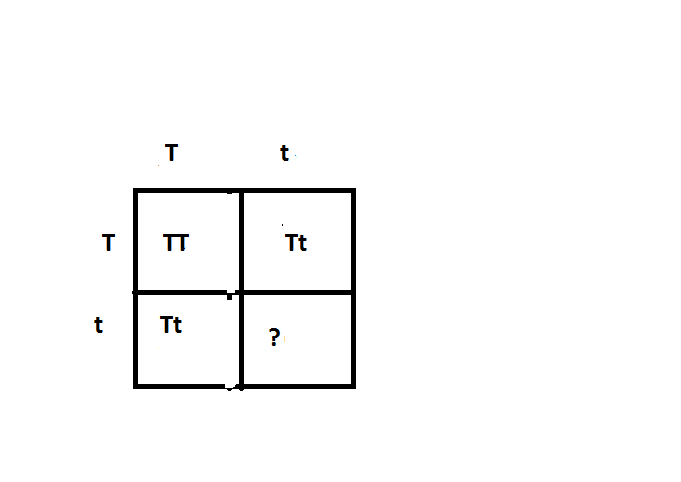
T - tall and t = short

In the punnett square below, what belongs in the missing square

a)

tt

b)

Tt

c)

Bb

d)

TT

124.
Which of the following genotypes is heterozygous?
a)
Bb
b)
BB
c)
bb
d)
B
125.
What you see, or the physical appearance.
a)
Genotype
b)
Phenotype
c)
Homozygous
d)
Heterozygous
126.
In a heterozygous genotype, the ___________ allele takes over in the phenotype.
a)
recessive
b)
dominant
c)
lower case letter
d)
both 
127.
Aa, DD, bB, yy are all examples of
a)
genotypes
b)
phenotypes
128.
Dominant alleles are represented by a:
a)
Male gene
b)
lowercase letter
c)
recessive trait
d)
capital letter
129.

B = brown eyes

b = blue eyes

One brother has genotype BB and the other brother has genotype Bb.

Which statement is true about these two brothers?

a)

They have same phenotype and genotype

b)

They have different phenotypes and genotypes

c)

They have same phenotype, but different genotypes

d)

They have different phenotypes, but the same genotype

130.

The genotype Aa is called . . .

a)

Homozygous recessive

b)

Hybrid

c)

Purebred

d)

Homozygous dominant

131.

Which of the following would be a phenotype?

a)

Aa

b)

red hair

c)

heterozygous

d)

DNA

132.

Which of the following genotypes is Purebred? Select 2 answers.

a)

aA

b)

Aa

c)

AA

d)

aa

133.

Which of the following genotypes is homozygous dominant?

a)

Yy

b)

yY

c)

yy

d)

YY

134.

Which of the following genotypes is homozygous recessive?

a)

Tt

b)

tt

c)

TT

d)

tT