wayground logo

Free Printable Worksheets

Font size

S
M
L
XL
Worksheets

Evolution Practice

Total questions: 70

Worksheet time: 27mins

Name
Class
Date
1.

An inherited trait that helps those organisms that have it to survive

a)

niche

b)

structure

c)

characteristic

d)

adaptation

2.

What is the advantage of having different shaped beaks?

a)

To look different from other species.

b)

To be able to eat the food readily available in the environment.

c)

To protect itself against predators.

d)

To protect itself against prey.

3.

A group of organisms that share similar characteristics and can reproduce among themselves to produce fertile offspring.

a)

Mutation

b)

Species

c)

Adaptation

d)

Variation

4.

This is the organisms with traits best suited to their environment are more likely to survive and reproduce.

a)

Variation

b)

Mutation

c)

Natural Selection

d)

Gradualism

5.

This is an inherited trait that makes an individual different from other members of its species.

a)

Variation

b)

Mutation

c)

Punctuated Equilibrium

d)

Embryology

6.

This is any variation that makes an organism better suited to its environment.

a)

Evolution

b)

Graduation

c)

Species

d)

Adaptation

7.
Which feature helps an animal hide from other animals?
a)
looking like a dangerous animal
b)
being the same color as the place it lives (camoflauge)
c)
having sharp claws or a strong shel
d)
having only a few young and caring for them
8.

How do adaptations help animals?

a)

To escape animals

b)

to hunt for food

c)

to survive in their habitats

d)

All of these are correct

9.
How do adaptations help animals?
a)
to hide from predators
b)
to hunt for food
c)
to survive in their habitats
d)
All of these are correct
10.
The source of all genetic material is...
a)
Protein
b)
cells
c)
DNA
d)
The brain
11.
A scientist puts 100 houseflies in a sealed container; then sprays an insecticide into the container.  Ninety-six of the flies die.  Four survive.  The scientist lets the survivors mate and produce offspring, then repeats the experiment with 100 offspring.  Fifty-six of them survive the spray.  This experimental result is evidence of – 
a)
adaptive radiation 
b)
speciation
c)
natural selection
d)
extinction
12.
Which statement does not accurately describe natural selection?
a)
Individual organisms change their genes to adapt to their environment
b)
The genetic composition of a population changes from one generation to the next
c)
More advantageous traits become more common in population
d)
Beneficial and useful traits are inheritable
13.
Survival of the Fittest and Evolution were proposed by what scientist?
a)
Steven Hawking
b)
Albert Einstein
c)
Charles Darwin
d)
Isaac Newton
14.
Natural selection results in change over time by acting on traits that are
a)
heritable
b)
new
c)
mutated 
d)
better than the best
15.
a)
analogous structures
b)
homologous structures
c)
vestigial structures
d)
none of the above
16.
What is the process of which humans breed organisms for certain traits?
a)
artificial selection
b)
descent without modification
c)
inheritance of acquired characteristics
d)
natural selection
17.
Vertebrate embryos pass through similar stages of development is evidence for
a)
use and disuse
b)
homologous structures
c)
common ancestry
d)
acquired characteristics
18.
Individuals that are well adapted to their environment will survive and produce
a)
better traits
b)
stronger genes
c)
more offspring
d)
fewer mutations
19.
All the individuals of a species that live in a particular area are called a 
a)
group
b)
population
c)
variation
d)
fossil
20.
The remnant of an organ that had a function in an early ancestor is known as a(n)
a)
vestigial structure
b)
analogous structure
c)
homologous structure
d)
fossil structure
21.
Which of the following is a term for a group of similar organisms that can reproduce fertile offspring?
a)
individual
b)
population
c)
species
d)
fossil
22.
If an organism has a vestigial structure, that structure likely once had a function in a(n)
a)
close relative
b)
early ancestor
c)
unrelated organism
d)
embryological stage
23.
Mutations are important because they bring about
a)
death of the organism in which they develop
b)
genetic variation needed for a population to evolve
c)
benefits for the individual, not for the population
d)
Hardey-Weinberg equilibrium within a population
24.
Inherited trait that helps an organism survive is a(n) __________.
a)
Fossil
b)
Adaptation
c)
Ancestor
d)
Natural selection
25.
Magda is a tall, 11 year old drummer. She has a scar on her right cheek. She is good at swimming. Which of her traits did Magda most likely inherit?
a)
height
b)
the scar
c)
ability to swim
d)
ability to play drums
26.
Structures with the same parts have different functions; suggests that organisms share a common ancestry
a)
vestigial structures
b)
homologous structures
c)
adaptive radiation
d)
fossil
27.
The diagram shows fossils in different rock layers. Which of these statements about the age of these fossils is most likely correct?
a)
Fossil A and C are the same age
b)
Fossil B is older than fossil C
c)
Fossils A is older than fossil B
d)
Fossil D is older than fossil C
28.
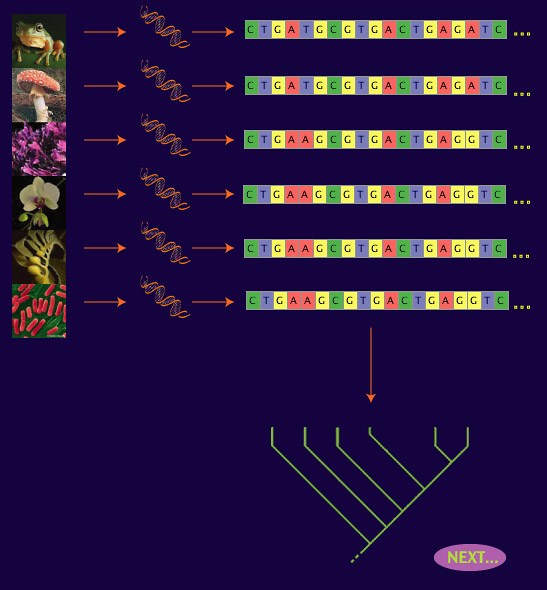
If species A and B have very similar genes and proteins, what is probably TRUE?
a)
species A and B share a relatively recent common ancestor
b)
species A evolved independently of species B for a long period
c)
species A is younger than species B
d)
species A is older than species B
29.
The ability of an organism to survive and reproduce in its specific environment 
a)
diversity.
b)
evolution
c)
adaptation
d)
 fitness
30.
Two organisms that are closely related would have
a)
very similar DNA sequence
b)
exactly the same DNA sequences
c)
no proteins in common
d)
completely different DNA sequence
31.
Comparing human hemoglobin of chimpanzees, horses, kangaroos, and chickens, reveal that humans have the fewest amino acid differences with 
a)
Kangaroos
b)
Horses
c)
chickens
d)
chimpanzees
32.
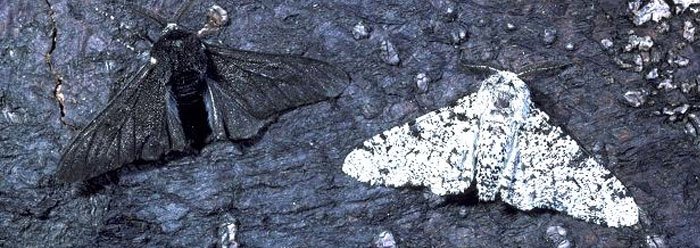
The trees these moths used to live on were white, but have been covered in soot from coal factories. Which moth will be more successful in this environment?
a)
Dark moth
b)
Light moth
c)
Both will be equally successful
d)
Neither will be successful
33.
Study of embryos of various organisms to show a common ancestor because of similarities in development
a)
natural selection
b)
embryology
c)
speciation
d)
evolution
34.

Whales are aquatic mammals that contain a pelvis (hip) bone. Even though it does not aid in its movement, the function must have been used by a common ancestor of the whale. Thus, the pelvis is referred to as a(n)

a)

vestigial structure

b)

analogous structure

c)

homologous structure

35.
A theory has significant evidence to support it.  True or False
a)
True
b)
False
36.
Genetic differences between organisms of the same species
a)
Variation
b)
Adaptation
c)
Behavior
d)
Environment
37.
An error in DNA copying that results in a new trait
a)
Homeostasis
b)
Mutation
c)
Natural Selection
d)
Selective Breeding
38.

________ structures are reduced in size or function due to lack of use.

a)

vestigial

b)

homologous

c)

cladistic

d)

phylogenic

39.
This mechanism of evolution occurs when populations migrate.
a)
Extinction
b)
Gene flow
c)
Genetic drift
d)
Natural Selection
40.

What type of evidence is shown in the picture above?

a)

Ancestral traits

b)

Embryonic Development

c)

Homologous Structures

d)

Vestigial Structures

41.
A few deer wander out of their native woods into a completely new park where no deer had ever been before. They go on to create an entirely new population.
a)
Genetic Drift
b)
Natural Selection
c)
Non-random mating
d)
Mutation
42.

The female birds of paradise tend to look for the most colorful, best dancing males to make babies together.

a)

Genetic Drift

b)

Non-random mating

c)

Gene flow

d)

Mutation

43.
What does the picture represent?
a)

Genetic Drift (Founder Effect)

b)
Mutations
c)

Genetic Drift (bottleneck effect)

d)
Gene Flow
44.
Since the 1800s humans have stopped burning coal, and the trees have returned to their original color. Which moth will be more successful in this environment?
a)
Dark moth
b)
Light moth
c)
Both will be equally successful
d)
Neither will be successful
45.

Structures are similar in function but not in structure

a)

Vestigial

b)

Homologous

c)

Analogous Structures

d)

Embryonic

46.

Charles Darwin observed that finches of different species on the Galápagos Islands have many similar physical characteristics, this supports the hypothesis that these finches

a)

are twins

b)

acquired traits through use and disuse.

c)

all eat the same type of food.

d)

descended from a common ancestor.

47.
These are natural differences within a species.
a)
Evolution
b)
Genetic variation
c)
Biological diversity
d)
Populations
48.

body parts in organisms that have the same functions, but have different structures

a)

analagous structures

b)

homologous structures

c)

vestigal structures

49.

Which of the following are selection pressures in nature?

a)

Selective breeding by humans

b)

Available food

c)

classification of organisms

d)

Competition for mates

e)

Hot, dry climate

50.

When does natural selection happen the fastest in nature?

a)

when there is a large change to the environment

b)

when the species are most closely related to eachother

c)

when there are little to no mutations happening

d)

when there is very little genetic diversity

51.

How would a warming climate affect the species in an ecosystem?

a)

individuals might die off but a species cannot disappear completely

b)

species would increase in number to offset the numbers killed by the heat

c)

species that have never been seen before would suddenly appear

d)

individuals best able to survive the heat would become more numerous

52.

Which of the following are adaptations for attracting mates in a population?

a)

the protective bony armor on an armadillo

b)

the colorful plumage on a male peacocks tail

c)

similar coloration of male and female red-tailed hawks

d)

larger body size and antlers in bull elk

53.

In a cooling environment, which species will have the best chance for survival?

a)

the one with the smartest individuals

b)

the one with the smallest body size

c)

the one with the most genetic variation

d)

the one with the largest population

54.

What is speciation?

a)

when a population reaches a balance and change is no longer occuring

b)

when populations move away from each other

c)

when species begin to pass on acquired traits and change their behavior

d)

when two species can no longer interbreed

55.

How have 340 breeds of dogs emerged from wolves?

a)

natural selection has allowed the toughest dogs to survive

b)

humans have selectively bred dogs for desired traits

c)

wolves have a diverse gene pool that contains many variations

d)

dogs have been scattered by humans to many new places

56.

Occasionally a mutation produces a bird with a new characteristic. What determines whether this bird will be the beginning of a new species?

a)

The bird must dominate the other birds and reduce their ability to reproduce

b)

The bird must be able to live in the usual environment for that fish

c)

The mutation must provide some type of advantage for the bird

d)

The mutation must make the bird very different from other fish

57.

If two organisms have a similar body structure, what would an analysis of their DNA reveal?

a)

their DNA is identical

b)

there are more differences than similarities

c)

there are many similarities

d)

they have the same number of chromosomes

58.

What is a scientific theory?

a)

An educated guess

b)

A known fact

c)

Absolute and unchangeable

d)

the best explanation for a set of data or observations

59.

Evolution is...

a)

changes over time in populations

b)

natural process that passes favorable traits

c)

historical timeline of fossils

d)

the process in which an animal dies out

60.

Natural selection is the process that passes down ____________________ traits.

a)

Same

b)

Old

c)

Useless

d)

Favorable

61.
Group of organisms capable of interbreeding and producing fertile offspring.
a)
species
b)
gene pool
c)
population
d)
homologous structure
62.
Which structures below are vestigial structures? 
a)
mouse arm & bat wing
b)
human arm & bat wing
c)
wisdom teeth & an appendix
d)
dog's nose & snake's tongue
63.
Which structures are homologous structures?
a)
human arm & cat arm
b)
dog's nose & snake's tongue
c)
wisdom teeth & an appendix
d)
dolphin fin & fish fin
64.
Different in structure but share common job or function:
a)
Vestigial structures
b)
Analogous structures
c)
Homologous structures 
65.
When more offspring are being produced, there is a competition of limited resources---this is known as:
a)
Struggle for Existence
b)
Survival of the Fittest
c)
Descent with Modification
d)
Adaptation
66.
A virus killed most of the seals in the North Sea (e.g. dropped the population from 8000 to 800).  In an effort to help preserve the species, scientists caught 20 of the remaining seals and used them to start a new population in the northwest Pacific Ocean.  Which of the following statements would accurately describe the new   population?  
a)
The new seal population is genetically less diverse than the original population 
b)
The new seal population is genetically more diverse than the original population
c)
There is equal genetic variety compared  to the original population 
d)
None of the answers
67.
If two organisms have similar traits of DNA they are probably
a)
share a common ancestor
b)
share a common environment
c)
share a common population
d)
speciation
68.
Which of the following is true of genetic bottlenecks?
a)
They reduce the fertility of the surviviors
b)
Occurs when there are major natural disasters that kill the majority of the population
c)
Result in increased genetic diversity
d)
Due to mutation rather than natural selection
69.

The picture is showing an example of...

a)

Natural Selection

b)

Genetic drift

c)

Mutations

d)

Homologous structures

70.

The animals in the picture do not live in the same population. They are found in different parts of the world, but are all still part of the camel family. What can be said about these animals?

a)

They belong to the same species

b)

It is difficult for them to find food to eat

c)

They have a very similar skeletal structure

d)

They descended from a common ancestor