wayground logo

Free Printable Worksheets

Font size

S
M
L
XL
Worksheets

exam 3

Total questions: 122

Worksheet time: 2hrs 10mins

Name
Class
Date
1.

In what process is mRNA synthesized?

a)

Transcription

b)

Translation

c)

DNA Replication

d)

Mitosis

2.

Where does TRANSCRIPTION occur?

a)

Nucleus

b)

Ribosome

c)

Cytoplasm

d)

Mitochondria

3.

Why must transcription occur where DNA can be found?

a)

because DNA can't leave

b)

because ribosomes are in the nucleus

c)

because DNA polymerase is found there

d)

because helicase unzips the DNA

4.

How many nucleotides equal 1 amino acid?

a)

1

b)

2

c)

3

d)

4

5.

TRANSCRIBE this DNA sequence: TACGTTACT

a)

AUGCAAUGA

b)

ATGCAATGA

c)

AUGGATUGA

d)

TACGTTACT

6.
Does the order of amino acids in a protein matter?
a)
YES!
b)
NO!
7.
Which of the following is the template for the production of RNA within a cell?
a)
DNA
b)
protein
c)
ATO
d)
carbohydrate
8.
Which of the following best describes how DNA and RNA are similar?
a)
they both contain A and T
b)
They both have a double helix
c)
They are both composed of 5 different nucleotides
d)
they both have C and G
9.
The DNA sequence ATCAGCGCTGGC is part of a gene. how many amino acids are coded for by this message?
a)
4
b)
8
c)
12
d)
20
10.
Choose the nucleotide sequence of the RNA strand that would be complementary to the following strand: 
GTAGTCA
a)
UATUAGA
b)
ACGACTG
c)
CAUCAGU
d)
CATCAGT
11.
The central dogma of biology states that information flows in one direction from 
a)
nuclei to RNA to cytoplasm
b)
ribosomes to proteins to DNA
c)
genes to nuclei to ribosomes
d)
DNA to RNA to proteins
12.
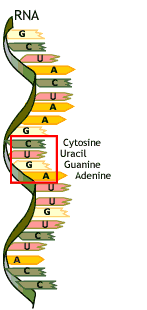
In RNA, Uracil pairs with ______. 
a)
cytosine
b)
adenine
c)
guanine
d)
thymine
13.
Which is the mRNA molecule that would be transcribed from this DNA template:
TGGCAAGTACGT
a)
ACCGTTCATGCA
b)
UGGCAAGUACGU
c)
UCCGUUCUUGCU
d)
ACCGUUCAUGCA
14.

True or False: RNA is double stranded.

a)

True

b)

False

15.

What is the process called when DNA is made into mRNA.

a)

translation

b)

transcription

c)

transcribe

d)

translate

16.

What type of RNA moves to the ribosome to start protein synthesis?

a)

tRNA

b)

mRNA

c)

rRNA

d)

nRNA

17.

What does tRNA stand for?

a)

transition RNA

b)

transcription RNA

c)

transfer RNA

d)

translation RNA

18.

Which macromolecule is made up of amino acids?

a)

carbohydrate

b)

lipid

c)

nucleic acid

d)

protein

19.

DNA and RNA are which type of macromolecule?

a)

carbohydrate

b)

lipid

c)

nucleic acid

d)

protein

20.

mRNA is read into amino acids during what process?

a)

transcription

b)

transfer

c)

translation

d)

transition

21.

What enzyme transcribes DNA into mRNA?

a)

DNA polymerase

b)

RNA polymerase

c)

helicase

d)

rRNA

22.

What makes up a codon?

a)

2 amino acids

b)

3 amino acids

c)

2 nucleotides

d)

3 nucleotides

23.

Where would you find the anti-codon?

a)

tRNA

b)

mRNA

c)

ribosome

d)

rRNA

24.

What do tRNA bring to the ribosome?

a)

glucose

b)

fatty acids

c)

nucleotides

d)

amino acids

25.
the base that pairs with Thymine in DNA
a)
adenine
b)
guanine
c)
helicase
d)
nucleotide
26.
nitrogen base that pairs with guanine
a)
adenine
b)
cytosine
c)
nucloetide
d)
deoxyribose
27.
the process of making a copy of DNA
a)
transcription
b)
double helix
c)
DNA replication
d)
replication fork
28.
The shape of DNA.
a)
double helix
b)
nucleotide
c)
DNA polymerase
d)
single stranded
29.
Which shows the correct complementary base pairing for DNA?
a)
C-A, T-G
b)
A-G, C-T
c)
C-G, U-A
d)
T-A, G-C
30.
What does DNA do?
a)
a.  It carries genetic codes from parents to offspring.
b)
a.  It carries oxygen from the lungs to the body.
c)
a.  It tells you who you are.
d)
a.  It defines the organism.
31.

What did Gregor Mendel study?

a)

Mold Spores

b)

Pea Plants

c)

Sun Flowers

d)

Rats

32.

What was the theory of genetics before Mendel did his experiments.

a)

All traits were random

b)

All traits skipped a generation

c)

All traits were decided by God

d)

All traits were a mixing of the the parents traits

33.

What was Mendel's first conclusion?

a)

Pea plants were inheriting a pair of genetic instructions from both parents.

b)

Pea plants were inheriting genetic instructions from their grandparents.

c)

Pea plants were inheriting genetic instructions only from their maternal parent.

d)

Pea plants were inheriting genetic instructions only from their paternal parent

34.

Mendel's Law of Segregation means?

a)

Every person has two alleles for each trait, they segregate from each other and the dominant is passed more often.

b)

Every person has two alleles for each trait, Where two traits are being passed, they do not effect each other.

c)

Every person has two alleles for each trait, they segregate from each other and are passed down at random.

d)

Every person has two alleles for each trait, they segregate from each other and the recessive is passed more often.

35.

What is Mendel's Law of Independent Assortment?

a)

If the recessive allele is passed for one trait, then it is more likely that the recessive allele will be passed for the other trait.

b)

The passing of allele of one trait does not affect the passing of allele of another trait.

c)

If the dominant allele is passed for one trait, then it is more likely that the dominant allele will be passed for the other trait.

d)

If the dominant allele is passed for one trait, then it is more likely that the recessive allele will be passed for the other trait.

36.

Which of the following is heterozygous?

a)

MM

b)

Mm

c)

mm

37.

Which of the following is homozygous dominant?

a)

RR

b)

Rr

c)

rr

38.

Which of the following is homozygous recessive?

a)

QQ

b)

Qq

c)

qq

39.

What term denotes the physical expression of a gene?

a)

genotype

b)

phenotype

c)

appearance

d)

homologous

40.

Which of these genotypes would most likely be used to represent the dominant for pea plant height?

a)

TT

b)

tt

c)

PP

d)

pp

41.

Which of the following would produce a recessive phenotype?

a)

hh

b)

Rr

c)

Ww

d)

BB

42.

Which of the these is homozygous?

a)

gg

b)

Yy

c)

Nn

d)

Ee

43.
T - tall and t = short
In the punnett square below, what belongs in the missing square
a)
tt
b)
Tt
c)
Bb
d)
TT
44.
Dominant alleles are represented by a:
a)
Male gene
b)
lowercase letter
c)
recessive trait
d)
capital letter
45.
A ________________________ is used to predict the possible genotype from certain parents
a)
Mendel Grid
b)
Genetic Tic Tac Toe
c)
Punnett Square
d)
Pedigree Plot
46.
Heredity is the passing of traits from _____________________ to _____________________
a)
predators to prey
b)
water to rain
c)
parents to offspring
d)
fungi to protists
47.
___________________________ is the field of science that studies of how traits are passed on, or inherited.
a)
dominant traits
b)
ratio
c)
phenotype
d)
genetics
48.
Which is a true statements about this picture?
a)
Brown is recessive
b)
Brown is dominant
c)
Blue is dominant
d)
Blue is codominant
49.
What is a gene?
a)
An entire chromosome that  codes for a trait
b)
a piece of clothing
c)
a piece of a DNA on chromosome that codes for a trait
d)
Chemical messengers in your brain that code for a trait
50.

If brown hair is represented by the allele "B" and blond hair is represented by the allele "b" then what must be the genotype of someone who has blond hair?

a)

BB

b)

bb

c)

Bb

d)

either BB or Bb

51.

What is a phenotype?

a)

the alleles in an organism

b)

the genetic code

c)

a fake gene

d)

the physical traits expressed

52.

If black fur is dominant and white fur is recessive, what are the possible offspring of two black mice bred together?

a)

all black

b)

all white

c)

half white and half black

d)

any of the above are possible, depending on the parents' genotypes

53.

How many alleles does a child get from each parent for a trait?

a)

1

b)

2

c)

3

d)

4

54.

Aa, DD, Bb, yy are all examples of ---

a)

genotypes.

b)

phenotypes.

55.
What do we use pedigrees for?
a)
To look at families
b)
To make determinations about the offspring
c)
To track traits in families
d)
Nothing
56.

In a pedigree, which shape represents a male?

a)

circle

b)

square

57.

Which gender has an X and a Y chromosome?

a)

male

b)

female

58.

On a pedigree, this symbol represents a ----

a)

not affected male.

b)

not affected female.

c)

affected male.

d)

affected female.

59.

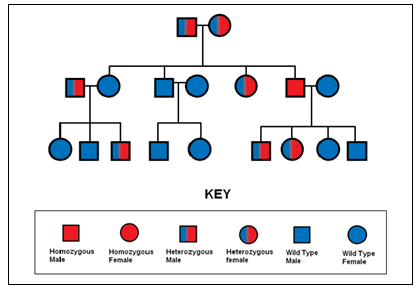
How many individuals are there in the 3rd generation?

a)

1

b)

2

c)

4

d)

6

60.

How are individuals III-2 and II-4 related?

a)

Brother and sister

b)

Dad and daughter

c)

Uncle and niece

d)

Grandfather and granddaughter

61.

What is the mode of inheritance shown here?

a)

Recessive because it "skips" a generation

b)

Dominant because it shows up in every generation

62.

On this pedigree, the allele for curly hair is dominant. The couple labeled 2 both have curly hair, but have a daughter who does not have curly hair. Therefore, we can tell from the chart that for the couple labeled 2 -

a)

the male is heterozygous and the female is heterozygous.

b)

the male is homozygous recessive and the female is homozygous dominant.

63.
How many generations are shown in this pedigree?
a)
1
b)
2
c)
3
d)
4
64.
How many kids did the mother and father from the first generation have?
a)
2
b)
4
c)
5
d)
6
65.
Is this trait (the shaded individuals) dominant or recessive?
a)
dominant
b)
recessive
66.

If this pedigree shows a recessive disorder, what MUST the genotype of individual 4 be?

a)

HH

b)

Hh

c)

hh

67.
What is it called when a sperm and egg meet?
a)
meiosis
b)
fertilization
c)
cell division
d)
mitosis
68.
Which process and type of resulting cells are represented?
a)
mitosis, gametes
b)
mitosis, body cells
c)
meiosis, gametes
d)
meiosis, body cells
69.
The chromosomes that pair up during meiosis, are called __________ chromosomes.  
a)
homozygous 
b)
asexual
c)
homologous
d)
genes
70.
A male shark has 40 chromosomes in each of its sex cells. How many would be present in its body cells?
a)
20
b)
40
c)
80
d)
160
71.
Which letter(s) in the diagram correspond to cells that are haploid? 
a)
A
b)
B
c)
C
d)
A and B
72.
What causes genetic variation in meiosis?
a)
chromosomes lining up
b)
crossing over of chromosomes
c)
separation of chromosomes
d)
chromosomes pulling apart
73.
What is one of the advantages, why is it better to reproduce sexually versus asexually?
a)
survival of the fittest
b)
overproduction
c)
genetic variation
d)
cloning
74.
A human zygote should have _____ chromosomes inside.
a)
46
b)
23
c)
92
d)
64
75.
Females have ____ and males have _____ chromosomes.
a)
XX, XY
b)
XY, XX
c)
XX, XX
d)
XY, XY
76.
A human being has a somatic cell that has 46 chromosomes.  What is the haploid number found in a gamete?
a)
23
b)
46
c)
69
d)
92
77.
Unlike mitosis, meiosis in male mammals results in the formation of
a)
one haploid gamete
b)
three diploid gametes
c)
four diploid gametes
d)
four haploid gametes
78.
Goes through P.M.A.T two rounds 
a)
Mitosis
b)
Meiosis
c)
Osmosis
d)
Transcription
79.
The process of crossing over occurs in what phase of meiosis?
a)
anaphase 1
b)
prophase 1
c)
prophase 2
d)
telophase 1
80.
Which of these cells would be produced through meiosis?
a)
skin cells
b)
liver cells
c)
brain cells
d)
sperm cells
81.
a)
Prophase
b)
Interphase
c)
Anaphase
d)
Telophase
82.
a)
Anaphase
b)
Cytokinesis
c)
Telophase
d)
Metaphase
83.
a)
Cytokinesis
b)
Interphase
c)
Anaphase
d)
Metaphase
84.
a)
Anaphase
b)
Cytonkinesis
c)
Interphase
d)
Prophase
85.
a)
Cytokinesis
b)
Anaphase
c)
Telophase
d)
Prophase
86.
Which is Metaphase?
a)
A
b)
E
c)
C
d)
F
87.
Chromosomes condense from long stands into rod like structures. 
a)
Prophase
b)
Interphase
88.
The phase in mitosis where chromosomes move away and are pulled apart by spindles to opposite sides of the cell.
a)
prophase
b)
anaphase
c)
metaphase
d)
telephase
89.
A chromatid is attached to a spindle fiber by the
a)
nucleolus
b)
deep furrow
c)
centromere
d)
centriole
90.
The process by which the nuclear material is divided equally between two new cells
a)
mitosis
b)
cancer
c)
spindle
d)
centromere
91.
the two halves of the doubled chromosome structure 
a)
centromeres
b)
sister chromatids
c)
spindle
d)
tissues
92.
Why would it be important to replicate DNA before a cell divides in mitosis or meiosis?
a)
In order for genetic information to be transferred into daughter cells.
b)
In order for the cell to be able to increase in size.
c)
In order for the DNA to be contained in the nucleus.
d)
In order for the cell to re-order the DNA sequencing in the new cells.
93.
In mitosis, the two resulting cells are
a)
different from the starting cell and identical to each other.
b)
different from the starting cell and different from each other.
c)
identical to the starting cell and different from each other.
d)
identical to the starting cell and identical to each other.
94.
What is the name of the structure labeled X?
a)
Centriole
b)
Centrosome
c)
Chromatid
d)
Chromosome 
95.
The time between cell divisions in the life cycle of the cell is called
a)
anaphase
b)
interphase
c)
prophase
d)
metaphase
96.
This picture shows which process?
a)
mitosis
b)
meiosis
c)
the cell cycle
97.
Fruit fly body cells have 8 chromosomes. After mitosis, you would expect a resulting fruit fly daughter cell to have -
a)
16 chromosomes.
b)
46 chromosomes.
c)
8 chromosomes.
d)
4 chromosomes.
98.

in the cell cycle, what is the next stage after TELOPHASE (most of the time)?

a)

Metaphase

b)

anaphase

c)

cytokinesis

d)

interphase

99.
Structure (b) is a ____.
a)
chromosome
b)
chromatid
c)
centromere
100.

Structure (c) is a ____. Hint: It is one half of the X shape.

a)

chromosome

b)

chromatid

c)

centromere

101.
The stages of mitosis in order
a)
Metaphase, Anaphase, Prophase, Telophase
b)
Prophase, Anaphase, Metaphase, Telophase
c)
Prophase, Metaphase, Anaphase, Telophase
d)
Anaphase, Prophase, Telophase, Metaphase
102.
Where does a cell contain its genetic material?
a)
nucleus
b)
nucleolus
c)
cytoskeleton
d)
chloroplasts
103.
What is the first phase of Mitosis?
a)
Prophase
b)
Metaphase
c)
Anaphase
d)
Telophase
104.
Which is telophase?
a)
A
b)
E
c)
B
d)
F
105.
The cell membrane pinches in, dividing the cytoplasm into 2 cells
a)
Metaphase
b)
Anaphase
c)
Telephase
d)
Cytokinesis
106.
When can a mutation be passed on to offspring?
a)
only when the mutation is present during or occurs during mitosis
b)
only when the mutation is present during or occurs during meiosis
c)
when the mutation occurs during mitosis or meiosis
d)
when the mutation occurs in somatic cells
107.
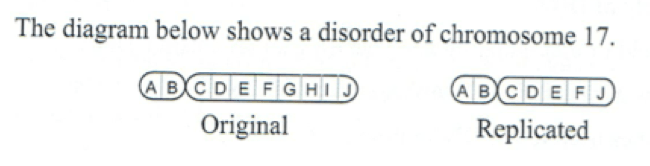
What type of chromosomal mutation has occurred?
a)
substitution
b)
insertion
c)
deletion
d)
nondisjunction
108.
What are chromosomes 1-22 called?
a)
Autosomes
b)
Sex Chromosomes
c)
Chromotids
d)
Xenosomes
109.
Which term refers to a picture of an individual’s chromosomes, used to detect genetic conditions? 
a)
synapsis
b)
tetrad
c)
centriole
d)
karyotype
110.

What type of gene mutation has occurred here?

T-G-A-C-C-A

T-G-A-C-C-A-A

a)

Substitution

b)

Deletion

c)

Insertion

111.

DNA molecule segment is : TTACGCAAG

The mutated DNA segment is TTCGCAAG. This is an example of ___ mutation.

a)

Substitution

b)

Deletion

c)

Insertion

112.

DNA molecule segment is : TTACGCAAG

The mutated DNA segment is TTACGCAAC. This is an example of ___ mutation.

a)

Substitution

b)

Insertion

c)

Inversion

113.

What are the three possible consequences to changes in DNA? [check all that applies]

a)

Improved trait

b)

removal of trait

c)

No change (neutral)

d)

Harmful trait

114.

What is a GMO?

a)

An organism that has had its DNA modified by humans

b)

An organism missing a chromosome

c)

Epigenetics

d)

A genetically identical organism

115.

Which of the following best describes a mutagen?

a)

Direct manipulation of an organism's genes using biotechnology.

b)

Any organism whose genetic material has been altered using genetic engineering techniques.

c)

An agent which can change the structure of DNA, causing a mutation.

116.

The three types of mutagens are:

a)

Radiation (physical)

b)

Chemical

c)

Infectious Agents (biological)

d)

Smoke

e)

GMOs

117.
What is the purpose of PCR?
a)
To produce millions of copies of DNA.
b)
To produce millions of copies of a specific region of DNA
c)
To add nucleotides to a DNA sequence
d)
To watch polymerase work.
118.
What does PCR stand for?
a)
Polymerase Chronic Reagent
b)
Principle Chorionic Reliability
c)
Polymerase Chain Reaction
d)
Probably Cannot React
119.
What is the function of a primer?
a)
To identify the particular region of DNA to be copied by PCR.
b)
To copy DNA.
c)
To create DNA nucleotides.
d)
To maintain the temperature of the PCR reaction.
120.
Why does PCR require a specific type of polymerase?
a)
Taq polymerase can withstand the range of temperatures in PCR without denaturing.
b)
Taq polymerase is the most inexpensive type of polymerase.
c)
Taq polymerase is the most common type of polymerase.
d)
A specific type of polymerase is unnecessary.
121.

What is the denaturation step?

a)

mutating RNA polymerase

b)

Cooling DNA to allow primers to form

c)

separating DNA helix in a cold environment

d)

separating DNA helix with using heat

122.

What is the Extension step?

a)

DNA polymerase adds nucleotides to the 5' end

b)

RNA polymerase adds nucleotides to the 5' end

c)

DNA polymerase adds nucleotides to the 3' end

d)

RNA polymerase adds nucleotides to the 3' end