wayground logo

Free Printable Worksheets

Font size

S
M
L
XL
Worksheets

Mitosis/Meiosis Exam Review

Total questions: 80

Worksheet time: 1hrs 4mins

Name
Class
Date
1.

A cat has a total of 40 chromosomes in its body cells. How many in its sex cells?

a)

38

b)

20

c)

76

d)

10

2.
The process of crossing over occurs in what meiotic phase?
a)
anaphase 1
b)
prophase 1
c)
prophase 2
d)
telophase 1
3.

Meiosis would occur in which of these cells?

a)

skin cells

b)

liver cells

c)

brain cells

d)

sperm cells

4.
The chromosomes that pair up during meiosis, are called __________ chromosomes.  
a)
homozygous 
b)
asexual
c)
homologous
d)
genes
5.

In humans, sperm cell have ___________ chromosomes and are ___________________, while skin cells have _____________ chromosomes are are diploid.

a)

23. haploid. 46 diploid

b)

46. haploid. 23. diploid

c)

23 diploid. 46 haploid

d)

46. diploid. 23. haploid.

6.
Crossing over helps promote ?
a)
male genotype
b)
genetic variation
c)
DNA replication
d)
mitosis
7.
You get one homologous chromosome from your ________ and one from your _______.  
a)
dad, mom
b)
brother, sister
c)
grandmother, grandfather
d)
dog, cat
8.
With mitosis you get ___, _________ cells, but with meiosis, you get ___, ____________.
a)
4 different, 2 identical
b)
4 identical, 2 different
c)
2 different, 4 identical
d)
2 identical, 4 different
9.
The purpose of meiosis is to form ________ cells.
a)
body
b)
sex
c)
somatic
d)
brain
10.

Fruit fly body cells have 8 chromosomes. After mitosis, you would expect a resulting fruit fly daughter cell to have ...

a)

16 chromosomes.

b)

46 chromosomes.

c)

8 chromosomes.

d)

4 chromosomes.

11.
Name the phase:
a)
Anaphase
b)
Telophase
c)
Metaphase
d)
Prophase
12.

which phases are in mitosis ?

a)

interphase

b)

prophase

c)

metaphase

d)

cytokinesis

e)

anaphase

13.
Mitosis is the process by which
a)
Cells get bigger
b)
Cells get smaller
c)
Body cells divide into two
d)
Cells die
14.
True or false: Living things grow when their cells get bigger.
a)
True
b)
False
15.
True or false: Living things grow when their cells divide.
a)
True
b)
False
16.
The original cell before it divides is called the
a)
Father cell
b)
Mother cell
c)
Parent cell
17.
The two cells that result after division are called the
a)
Sister cells
b)
Brother cells
c)
Son cells
d)
Daughter cells
18.
Chromosomes contain what?
a)
DNA
b)
RNA
c)
FBI
d)
GNC
19.
Chromosomes contain what?
a)
DNA
b)
RNA
c)
FBI
d)
GNC
20.
The middle part that holds the two chromatids together is called the
a)
Chromatin
b)
Centriole
c)
Centromere
d)
Nucleus
21.
One chromosome is made up of two
a)
Chromes
b)
Chromatids
c)
Centrioles
d)
Controls
22.
Humans have 46 chromosomes, which means we have _______ of chromosomes.
a)
46 pairs 
b)
23 pairs
c)
20 pairs
d)
56 pairs
23.
True or false: All body cells have the same number of chromosomes.
a)
True
b)
False
24.
A cell spends most of its life in what stage?
a)
Interphase
b)
Telophase
c)
Anaphase
d)
Metaphase
25.
True or false: All organs in your body are developed when cells multiply.
a)
True
b)
False
26.
The dark "spider" looking things on opposite sides of the cell are called "Spindle Fibers".  What is their job?
a)
Eating the chromosomes
b)
Pulling the chromosomes apart
c)
Putting the chromosomes together
27.
How many cells are created at the end of Mitosis?
a)
1
b)
2
c)
3
d)
4
28.
The cell cycle is ______________.
a)
the process of cells circling throughout the body
b)
the process of splitting the organelles
c)
a process where one cell gets energy
d)
the sequence of stages of growth and division that a cell undergoes
29.
A process where one cell forms two identical daughter cells is called...
a)
cell cycle
b)
cell division (mitosis)
c)
interphase
d)
cytokinesis
30.
During interphase the cell ___________.
a)
divides into two cells
b)
divides its nucleus
c)
replicates its DNA
d)
replicates the organelles within the cell
31.
What does DNA stand for?
a)
DeNatured Acid
b)
DomiNant Acid
c)
DeoxyriboNucleic Acid
d)
DiriboNucleic Acid
32.
Replication is when __________.
a)
the cell makes a copy of its DNA in nucleus 
b)
the cell forms 2 identical cells
c)
the cell produces 2 sets of organelles
d)
the cell continues to complete the same function
33.
What is the correct term for "the basic building block of all living organisms"?
a)
cell
b)
cell cycle
c)
cell plate
d)
centriole
34.
a)

Prophase

b)

Interphase

c)

Anaphase

d)

Telophase

35.
a)
Anaphase
b)
Cytokinesis
c)
Telophase
d)
Metaphase
36.
a)
Cytokinesis
b)
Interphase
c)
Anaphase
d)
Metaphase
37.
a)
Anaphase
b)
Cytonkinesis
c)
Interphase
d)
Prophase
38.
a)
Cytokinesis
b)
Anaphase
c)
Telophase
d)
Prophase
39.

Which is Metaphase?

a)

A

b)

E

c)

C

d)

F

40.
Why would it be important to replicate DNA before a cell divides in mitosis or meiosis?
a)
In order for genetic information to be transferred into daughter cells.
b)
In order for the cell to be able to increase in size.
c)
In order for the DNA to be contained in the nucleus.
d)
In order for the cell to re-order the DNA sequencing in the new cells.
41.
In mitosis, the two resulting cells are
a)
different from the starting cell and identical to each other.
b)
different from the starting cell and different from each other.
c)
identical to the starting cell and different from each other.
d)
identical to the starting cell and identical to each other.
42.
How many chromosomes do humans have?
a)
46
b)
21
c)
10
43.
The time between cell divisions in the life cycle of the cell is called
a)
anaphase
b)
interphase
c)
prophase
d)
metaphase
44.
The cells produced via meiosis are called:
a)
sex cells
b)
somatic cells
c)
body cells
d)
skin cells
45.
Unlike mitosis, meiosis in male mammals results in the formation of
a)
one haploid gamete
b)
three diploid gametes
c)
four diploid gametes
d)
four haploid gametes
46.
If a body cell in a butterfly contains 24 chromosomes, a butterfly egg would contain
a)
3
b)
6
c)
12
d)
24
47.
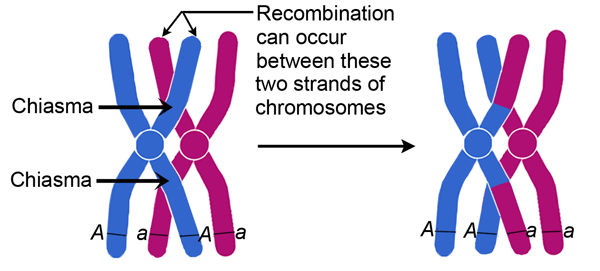
This image shows chromosomes during Prophase 1. Which of the following correctly describes the process shown?
a)
segregation of sister chromatids
b)
condensation and segregation of alleles
c)
mutationin which the DNA content of the gene is altered
d)
crossing - over in which alleles are exchanged
48.

Offspring are genetically different from parents

a)

Asexual reproduction

b)

Sexual reproduction

49.

There is only one parent.

a)

Asexual reproduction

b)

Sexual reproduction

50.

Most of the life of any cell is spent in a period of cell growth and development called ___.

a)

interphase

b)

metaphase

c)

prophase

d)

telophase

51.

Which of the following is NOT a disadvantage of sexual reproduction?

a)

longer

b)

genetic variation

c)

search for mate can expose to disease

d)

takes more energy to find a mate

52.
What do we call the whole process of eukaryotic cell reproduction?
a)
Binary Fission
b)
Mitosis
c)
Cytokinesis
d)
Cell Cycle
53.
What form is DNA is in during Interphase?
a)
Chromatin
b)
Replicated Chromosome
c)
Unreplicated Chromosome
d)
Chromatids
54.
What stage of the cell cycle is the cell in?
a)
Prophase
b)
Metaphase
c)
Anaphase
d)
Telophase
55.
What stage of the cell cycle is the cell in?
a)
Prophase
b)
Interphase
c)
Anaphase
d)
Telophase
56.
How is animal cell cytokinesis different than a plant cell's?
a)
Animal cells have a cleavage furrow
b)
Plant cells have a cleavage furrow
c)
Animal cells have a metaphase plate
d)
Animal cells must stay stuck together
57.

Undifferentiated cells that can become one or more specialized types of cell are called_________

a)

Stem Cells

b)

Somatic Cells

c)

Body Cells

d)

Zygotes

58.

Arrange the following levels of hierarchy from LARGEST to SMALLEST

a)

Organism, Organ, Tissue, Cell

b)

Cell, Tissue, Organ, Organism

c)

Organism, Cell, Tissue, Organ

d)

Tissue, Cell, Organ, Organism

59.

Two identical chromatids are called...

a)

Daughter Chromatids

b)

Sister Chromatids

c)

Brother Chromatids

d)

Twin Chromatids

60.

Doctors can test a patients type of cancer by... Check all that apply

a)

Taking a biopsy of the cancer

b)

Genetic engingerring

c)

Imagining studies

d)

Reproduction

61.

Which characteristic of suspected cancer tissue would be MOST helpful in making a cancer diagnosis?

a)

the size of the suspected cancer cells have variations in nuclear size and shape

b)

the cells stain a purple color

c)

the size of the sample is large and has many visible cells

d)

the cells with visible chromosomes are diploid

62.
An abnormal mass of cancer cells is called a 
a)
tumor
b)
cyst
c)
lesion
d)
polyp
63.
Cancer creates abnormal cells by disrupting
a)
the cell cycle
b)
red blood cell formation
c)
DNA replication
d)
ATP synthesis
64.
Something that increases the chance of developing a disease.
a)
morbidity
b)
palliative treatment
c)
lifetime risk
d)
risk factor
65.
Cancer is
a)
a premature stop in the cell cycle.
b)
uncontrolled mitosis.
c)
programmed cell death.
66.
Cancer creates abnormal cells by disrupting
a)
the cell cycle
b)
red blood cell formation
c)
DNA replication
d)
ATP synthesis
67.
What is cancer?
a)
The heart does not receive enough blood.
b)
Sudden disruption of blood flow to part of the brain.
c)
Blood filled weak spot.
d)
Uncontrolled growth and spread of abnormal cells.
68.

What is a mutation?

a)

A mistake in DNA which can lead to cancer

b)

A complete copy of DNA

c)

A change in DNA which doesn't cause an issue

d)

A mistake in your body that is caught and removed

69.
During the cell cycle, the resting phase is ...
a)
G0
b)
G1
c)
G2
d)
S
70.
The whole point of the cell cycle is the outcome which in body cells create
a)
2 cells
b)
2 identical cells
c)
4 cells
d)
4 identical cells
71.
Which of the following is not a way mutations occur in cellular DNA?
a)
UV radiation
b)
Genetics
c)
DNA repair proteins not working correctly
d)
Extreme cold
72.

What does DNA replication mean?

a)

DNA is made.

b)

DNA makes new cells.

c)

DNA copies itself.

d)

DNA starts the cell cycle.

73.

Cells of organism must replicate for ___?

a)

growth

b)

repair of damaged tissue

c)

replacement of dying cells.

d)

All of the above

74.
Which process and type of resulting cells are represented?
a)
mitosis, gametes
b)
mitosis, body cells
c)
meiosis, gametes
d)
meiosis, body cells
75.
Which of the following cell types is formed by meiosis?
a)
muscle cells
b)
skin cells
c)
sperm cells
d)
blood cells
76.
Which statement correctly describes meiosis?
a)
cells divide only once
b)
meiosis does not occur in reproductive cells
c)
the cells produced at the end of meiosis are genetically identical to the parent cell
d)
The cells produced at the end of meiosis contain half the number of chromosomes as the parent cell
77.
Which of the following best describes meiosis?
a)
It is carried out in all tissues theat require cell replacement
b)
It occurs only in cells in the reproductive structures of an organism
c)
It happens in all of the tissues except the brain and spinal cord
d)
It is the first stage of mitosis
78.
Which best describes the process shown?
a)
mutation in which the DNA content of the gene is ltered
b)
segregation of sister chromatids
c)
condensation and segregation of the alleles
d)
crossing-over which alleles are exchanged
79.
Which of the following represents chromosome # during fertilization?
a)
n+n=2n
b)
n=n
c)
2n=n+n
d)
2n=2n
80.
Which of the following best explains why the chromosome number is an even number in organisms?
a)
It is only by coincidence, many organisms have an odd number
b)
The diploid number is always even so that when mitosis occurs each cell gets the same number of chromosmes
c)
The diploid chromosome number represents pairs of chromosomes, one from ech parent, so that it is always an even number
d)
Chromosomes double very time the cell divides, so after the first division, the number is always even