Wayground logo

Free Printable Worksheets

Font size

S
M
L
XL
Worksheets

Bio. Heredity Unit Test

Total questions: 115

Worksheet time: 3hrs 55mins

Name
Class
Date
1.
What kind of cells are made in MEIOSIS?
a)
Haploid cells
b)
Diploid Cells
c)
Skin Cells
d)
Liver Cells
2.
Diploid Cells are represented by
a)
2n
b)
n
c)
4n
d)
1/2 n
3.
When homologous chromosomes match up, they form a structure call a ___________.
a)

tetrad

b)
triad
c)
diploid
d)

quad

4.
Which of the following best describes meiosis?
a)
It is carried out in all tissues theat require cell replacement
b)
It occurs only in cells in the reproductive structures of an organism
c)
It happens in all of the tissues except the brain and spinal cord
d)
It is the first stage of mitosis
5.
What phase is  shown in the picture?
a)
metaphase 2
b)
anaphase 2
c)
metaphase 1
d)
telophase 1
6.
Meiosis makes sperm and egg cells. In humans, sperm and egg cells each have _____ chromosomes. Therefore a fertilized human egg cell (sperm and egg cell combined) would create a cell with _____ chromosomes.
a)
23, 46
b)
46, 23
c)
2, 4
d)
50, 100
7.
The fertilized egg is termed a/an _____.
a)
gamete
b)
allele
c)
homolog
d)
zygote
8.

Is this karyotype for a male or female?

a)

MALE

b)

FEMALE

9.

What would you call the failure of one or more pairs of homologous chromosomes or sister chromatids to separate normally during meiosis resulting in gametes with wrong number of chromosomes?

a)

nondisjunction

b)

anaphase I

c)

nondiploidy

d)

karyotype

10.
Which sex chromosomes would indicate a typical human male?
a)
XX
b)
X
c)
XY
d)
XXY
11.
Which statement best describes the importance of sexual reproduction?
a)
sexual reproduction produces variation in offspring
b)
sexual reprosuction provides regeneration of body parts
c)
sexual reproduction occurs between individuals of the same species
d)
sexual reproduction produces offspring that are identical
12.
Which of the following cell types is formed by meiosis?
a)
skin cells
b)
sperm cells
c)
blood cells
d)
muscle cells
13.
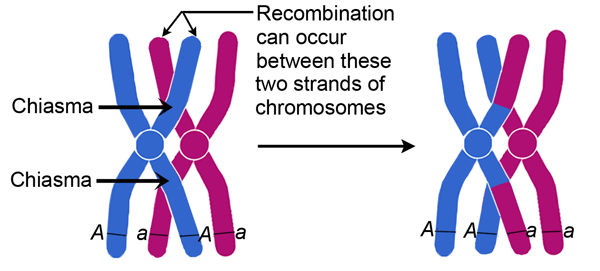
This image shows chromosomes during Prophase 1. Which of the following correctly describes the process shown?
a)
segregation of sister chromatids
b)
condensation and segregation of alleles
c)
mutationin which the DNA content of the gene is altered
d)
crossing - over in which alleles are exchanged
14.
Which of the following statements correctly describes meiosis?
a)
Meiosis does not occur in reproductive cells.
b)
The cells produced at the end are identical 
c)
the cells produced at the end contain half the # of chromosomes
d)
cells divide only once during meiosis
15.
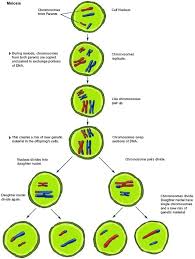
This diagram  shows which cellular process that occurs in organisms?
a)
endocytosis
b)
mitosis
c)
meiosis
d)
phagocytosis
16.
Which of the following sequences represents chromosome # during fertilization?
a)
2n-> n + n
b)
n + n -> 2n
c)
n -> n
d)
2n -> 2n
17.

If a somatic cell in a butterfly contains 12 chromosomes, a butterfly egg cell would contain___________.

a)
12 chromosomes
b)
6 chromosomes
c)
3 chromosomes
d)
24 chromosomes
18.
Which of the following normally results from meiosis in a human cell that contains 46 chromosomes?
a)
an egg cell with 46 chromosomes
b)
a liver cell with 23 chromosomes
c)

a egg cell with 23 chromosomes

d)
a blood cell with 46 chromosomes
19.
Based only on the sex chromosomes in a human egg and sperm cells at fertilization, the probability of producing a female is 
a)
25%
b)
50%
c)
75% 
d)
90%
20.
Meiosis is the key process in the production of_________.
a)
body cells
b)
RNA
c)
white blood cells
d)
gametes
21.
The end of meiosis results in  ____ to each other.
a)
2 cells that are identical
b)
4 cells that are identical
c)
2 cells that are not identical
d)
4 cells that are not identical
22.

In Anaphase I, the _________ are separated by the pulling of the spindle fibers to opposite poles of the cell.

a)

homologous pairs of chromosomes

b)

sister chromatids

c)

centromeres

d)

centrosomes

23.

In Metaphase II, _________ line up on equatorial plane.

a)

homologous pairs of chromosomes

b)

sister chromatids

c)

tetrads

d)

centrosomes

24.

Name this phase of Meiosis

a)

Anaphase II

b)

Anaphase I

c)

Metaphase I

d)

Metaphase II

25.

Name this phase of Meiosis:

a)

Telophase I

b)

Prophase II

c)

Telophase II

d)

Anaphase II

26.

Name this phase of Meiosis:

a)

Metaphase I

b)

Anaphase II

c)

Anaphase I

d)

Metaphase II

27.

Name this phase of Meiosis:

a)

Metaphase I

b)

Anaphase I

c)

Prophase II

d)

Telophase I

28.

The phase of Meiosis in which tetrads are formed:

a)

Prophase I

b)

Metaphase I

c)

Anaphase I

d)

Telophase I

29.

The phase of Meiosis in which homologous pairs line up along the equator:

a)

Anaphase I

b)

Metaphase I

c)

Anaphase II

d)

Metaphase II

30.

Which of the following describes mitosis?

a)

Cell division--creates new somatic cells

b)

Cell division--creates gametes

31.

Which of the following describes meiosis?

a)

Cell division--creates new somatic cells

b)

Cell division--creates gametes

32.

Which is a type of asexual reproduction?

a)

Mitosis

b)

Meiosis

33.

Which is a type of sexual reproduction?

a)

Mitosis

b)

Meiosis

34.

Which process produces 2 cells?

a)

Mitosis

b)

Meiosis

35.

Which process produces cells that are identical?

a)

Mitosis

b)

Meiosis

36.

Which process produces cells that are unique / different from each other?

a)

Mitosis

b)

Meiosis

37.

The physical expression of a genetic trait is called a (what it looks like)

a)

mutation

b)

genotype

c)

crossing over

d)

phenotype

38.

The following items are examples of __________.

Items: eye color, hair color, height

a)

homozygous alleles

b)

genotype

c)

heterozygous alleles

d)

phenotype

39.
having two of the same genes for the trait (sometimes called purebred).
a)
homozygous
b)
hetrozygous
c)
protein
d)
chromosome
40.
having two different genes for a trait (sometimes called hybrid).
a)
protein
b)
homozygous
c)
heterozygous
d)
genotype
41.
An allele whose trait only shows up when no dominant allele is present.
a)
hidden allele
b)
dominant allele
c)
recessive allele
d)
present allele
42.
Which of the following genotypes would be considered heterozygous?
a)
BB
b)
gg
c)
Ff
d)
TT
43.
Which of the following alleles is homozygous recessive?
a)
Tt
b)
tt
c)
TT
d)
T
44.
An allele whose trait always shows up in the organism when the allele is present.
a)
recessive allele
b)
dominant allele
c)
hidden allele
d)
present allele
45.
Who is the father of genetics? 
a)
Charles Darwin 
b)
Gregor Mendel
c)
Dimitri Mendeleev 
d)
Hans Krebs 
46.
B=brown eyes
b= blue eyes
What is true about these two brothers that have brown eyes:
One has genotype BB the other Bb.
a)
they have same phenotype and genotype
b)
they have different genotypes and phenotypes
c)
they have same phenotype but different genotypes
d)
they have same genotype but different phenotypes
47.

The passing of genetic traits from parent to offspring is known as

a)

heredity

b)

trait

c)

gene

d)

allele

48.
What are the possible genotypes for this cross?
a)
TT = 25% Tt= 50% tt=25%
b)
all tall
c)
TT= 75% tt = 25%
d)
Tt = 100%
49.

Huntigton's disease is a autosomal genetic disorder caused by a dominant lethal allele. The condition is a progressive breakdown of nerve cells that causes uncontrolled movement. The disorder can be found on the dominant H allele (which is rare... because usually disorders are recessive!). If the father is homozygous dominant for the trait and the mother does not have the trait, what is the phenotypic probability for their children?

a)

100% Hh

b)

50% Hh : 50% hh

c)

25% HH: 50% Hh: 25% hh

d)

50% Have Huntington's: 50% Does not have Huntington's

e)

100% Have Huntington's

50.

In labrador retrievers the allele for a black coat color (B) is dominant over the allele for a brown coat color (b). If a brown labrador retriever is crossed with a heterozygous black labrador retriever, which of the following genotypic ratios can be expected?

a)

0 BB: 2 Bb: 2 bb

b)

1 BB: 2 Bb: 1 bb

c)

2 BB: 0 Bb: 2 bb

d)

2 BB: 1 Bb: 0 bb

51.

Which of Mendel's Laws states that the two alleles for a trait must separate when gametes are formed(Meiosis)?

a)

Law of Dominance

b)

Law of Segregation

c)

law of Independent Assortment

52.
What goes in box 6
a)
AaBB
b)
AABB
c)
aaBB
d)
AAbb
53.
Cross Two Homozygous plants
(
RRYY x rryy)
R = round seeds, r  = wrinkled seeds Y = yellow seeds, y = green seeds
What percent will have Round and Yellow seeds? 
a)
0%
b)
25%
c)
50%
d)
100%
54.
A diagram used to predict an outcome of a cross or breeding experiment.
a)

Pedigree

b)
Punnet Square
c)

Karyotype

d)

Anagram

55.
In cacti, long arms (A) are dominant to short arms (a).  Suppose 2 heterozygous cacti are crossed.  What percentage of their offspring are expected to have short arms?
a)
0%
b)
25%
c)
75%
d)
100%
56.
If green is dominant over purple, then what is the genotype for this individual?
a)
Purple
b)
Green
c)
GG
d)
gg
57.
Mendel crossed what organism in his investigations?
a)
Peas
b)
Flies
c)
Pigs
d)
Humans
58.
In a ____________ cross, one pair of contrasting traits are being crossed.
a)
monohybrid
b)
dihybrid
c)
trihybrid
d)
quadhybrid
59.

A red flowered plant (RR) is crossed with a white flowered plant (WW). The gene for petal color in these plants expresses incomplete dominance.  What percentage of the offspring will have pink (RW) flowers?

a)
0%
b)
25%
c)
50%
d)
100%
60.
This is an example of ___________?
a)
Incomplete dominance
b)
Co-Dominance
61.

What type of inheritance do two alleles have if their traits blend together?

a)

Incomplete Dominance

b)

Co-Dominance

c)

Mendelian Inheritance (Complete Dominance)

d)

Homozygous Inheritance

62.
In chickens, feather color is codominant.  If a black chicken BB is mated with one that is black and white (BW) what are the chances of having a chicken that is black and white?
a)
50%
b)
0%
c)
25%
d)
100%
63.
In some carnations, flower color exhibits codominance.  Identify the correct genotypes for red, white, and speckled carnations.
a)
Red = RR, white = rr, speckled = Rr
b)
Red = RR, white = WW, speckled = rw
c)
Red = RR, white = ww, Speckled = Rw
d)
Red = RR, white = WW, speckled = RW
64.
In some carnations, flower color exhibits codominance. When crosses, Red (R) and white (W) flowers make speckled flowers (RW) that show both colors.
Complete a cross between 2 speckled flowers and find the genotype ratio.
a)
0 RR: 4 RW: 0 WW
b)
2 RR: 2 RW: 0 WW
c)
1 RR: 2 RW: 1 WW
d)
0 RR: 2 RW: 2 WW
65.
What blood type is the "universal donor" because it can be donated to anyone?
a)
A
b)
B
c)
AB
d)
O
66.
What type of blood can receive any type of blood?
a)
A
b)
B
c)
AB
d)
0
67.
Mike has type O blood. Mike can receive blood from someone who has Type A or Type B.
a)
True
b)
False
68.
Someone with type A blood can receive blood from someone who is type AB.
a)
True
b)
False
69.
Someone who has Type O blood has what for antibodies (clumping proteins)?
a)
No antibodies
b)
A antibodies
c)
B antibodies
d)
A and B antibodies
70.

Mrs. Canal is type A and Mr. Canal is type O. They have three children named Greg, Rosalind and Biff. Greg is type 0, Rosalind is type A and Biff is type AB...

What is Mrs. Canal's genotype? How do you know?

a)

IᴬIᴬ , because Rosalind is A

b)

Iᴮi because Biff is AB

c)

Iᴬi because Greg is type O

d)

ii because it is a universal donor

71.

Mrs. Canal is type A and Mr. Canal is type O. They have three children named Greg, Rosalind and Biff. Greg is type 0, Rosalind is type A and Biff is type AB...

Can BIFF be there son? Explain

a)

Yes because he has a portion of A in his blood like his mom

b)

Yes because his dad is type O and that is a universal donor

c)

No because his sister is type A blood

d)

No because neither parent has the B allele

72.

Two parents think their baby was switched at the hospital. The mother has blood type O, the father has blood type AB and the baby has blood type B.

Complete a punnett square and then answer the question. What is the mother's genotype? What is the father's genotype?

a)

Mom genotype is IᴬIᴬ, Dad genotype is IᴬIᴮ

b)

Mom genotype is ii, Dad genotype is IᴮIᴮ

c)

Mom genotype is ii Dad genotype is IᴬIᴮ

d)

Mom genotype is ii Dad genotype is ii

73.

Two parents think their baby was switched at the hospital. The mother has blood type O, the father has blood type AB and the baby has blood type B.

Complete a punnett square and then answer the question. Was the baby switched at birth? (Do they have a baby that is not theirs? )

a)

No, the baby is type B which is possible when Dad is AB

b)

No, the baby is theirs - it has type B just like the mom

c)

Yes - neither parent is type B so it must have been switched

74.
The sex of a child is determined by
a)
whether the father's sperm contains an x or y chromosome
b)
whether the mother's egg contains an x or y chromosome
c)
the age of the parents
75.
Males are more likely to suffer from a sex-linked disease or disorder because
a)
males are the weaker sex
b)
males have less DNA
c)
males have 1 X chromosome, so the disorder is more likely to be expressed
76.
When we say that a woman is a carrier for a genetic disease or disorder it means that
a)
she has 1 gene, but not the disorder
b)
she has 2 genes for the disorder
c)
she can pass the gene only to male children
d)
she can pass the gene only to female children
77.
If a gene is found only on the X chromosome and not the Y chromosome, it is said to be 
a)
sex-linked trait
b)
polygenic trait
c)
codominant trait
d)
incomplete dominance trait
78.

What is the difference between a monohybrid and a dihybrid cross?

a)

A monohybrid cross produces a single offspring, whereas a dihybrid cross produces two offspring

b)

A monohybrid cross involves a single parent, whereas a dihybrid cross involves two parents

c)

A monohybrid cross involves only one heterozygous parent whereas a dihybrid cross involves both heterozygous and homozygous parents

d)

A monohybrid cross predits the outcome of one trait whereas a dihybrid cross predicts the outcome of two traits

79.

H= normal blood clotting

h=hemophilia

A carrier female and a normal male

XHXh x XHY

What is the probability that any of their offspring will have hemophilia?

a)

4/4

b)

3/4

c)

2/4

d)

1/4

80.

Which chromosome contains more genes?

a)

The X chromosome

b)

The Y chromosome

c)

They are homologous, so they contain the same amount of genes.

81.

Males can be heterozygous for sex-linked traits.

a)

True

b)

False

82.

Colorblindness is a sex-linked recessive trait. A colorblind woman marries a male with normal color vision. What is the percent chance of them having a color blind son?

a)

0%

b)

25%

c)

50%

d)

75%

83.

Muscular dystrophy is a sex-linked recessive disorder. A man with muscular dystrophy marries a woman who doesn’t have this disease. Half of their daughters and half of their sons develop this disease. What is the genotype of the mother?

a)

XNXN

b)

XNXn

c)

Xn

d)

XN

84.

The different forms of a gene are called

a)

traits

b)

pollinators

c)

alleles

d)

hybrids

85.

What type of inheritance is determined by multiple genes and there can be a range of traits?

a)

Codominance

b)

Incomplete dominance

c)

Polygenic traits

86.

A single gene has 3 or more alleles. These are called

a)

multiple genes

b)

multiple alleles

c)

codominance

d)

polygenic traits

87.

AB blood type is an example of what type of inheritance? Both alleles show in the phenotype

a)

complete dominance

b)

incomplete dominance

c)

codominance

d)

polygenic inheritance

88.

Examples include skin color and height (the individual's phenotype exists somewhere along a spectrum)

a)

polygenic inheritance

b)

multiple alleles

c)

linked genes

d)

incomplete dominance

89.

Both traits expressed TOGETHER (not blended)

a)

Codominance

b)

Incomplete Dominance

c)

Mendelian trait

d)

Sex-linked

90.
For an XX female to express a recessive sex-linked trait, she must have....
a)
two recessive alleles
b)
a Y chromosome 
c)
one recessive allele
d)
two dominant alleles
91.
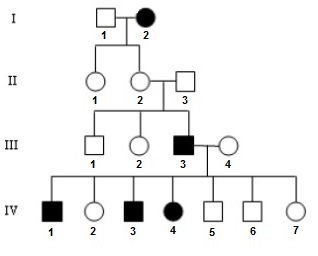
How many generations are shown in this pedigree?
a)
1
b)
2
c)
3
d)
4
92.
How many kids did the mother and father from the first generation have?
a)
2
b)
4
c)
5
d)
6
93.
This pedigree represents the inheritance of hemophilia in this family. How many of the females have the hemophilia trait?
a)
8
b)
5
c)
2
d)
3
94.
What do half colored symbols represent?
a)
The individual is a carrier (heterozygous).
b)
The individual expresses the trait.
c)
The individual has both recessive alleles.
d)
The individual has both dominant alleles.
95.
Is this trait (the shaded individuals) dominant or recessive?
a)

autosomal dominant

b)

autosomal recessive

c)

x-linked dominant

d)

x-linked recessive

96.
What is this?
a)
Pedigree
b)
Karyotype
c)
Venn diagram
d)
Punnett Square
97.
Give the genotype for person II-1, for this autosomal trait.
a)
GG
b)
Gg
c)
gg
d)
we cannot be 100% sure of the genotype
98.
If a trait SKIPS a generation, it is an indication that the trait is....
a)
dominant
b)
recessive
c)
incompletely dominant
d)
co-dominant
99.

A pedigree chart tracks ________ specific trait(s).

a)

one

b)

two

c)

three

d)

15

100.

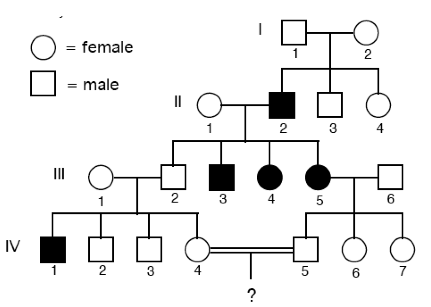
What is the genotype of individual IV – 2?

a)

Hh

b)

HY

c)

hh

d)

HH

101.

The pedigree above is an example of:

a)

autosomal dominant

b)

autosomal recessive

c)

x-linked dominant

d)

x-linked recessive

102.

What is the genotype of individual III-3?

a)

Rr

b)

rr

c)

RR

d)

AR

103.

In a recessive disorder, a person that has the trait, but does not show it, are known as

a)

afflicted.

b)

carriers.

c)

heterozygous

d)

both carriers or heterozygous

e)

both afflicted and heterozygous

104.

Individuals II 1 and II 2 have some children with dominant phenotypes and some with recessive phenotypes. Which cross represents the genotypes of individuals II 1 and II 2?

a)

TT x TT

b)

TT x Tt

c)

Tt x Tt

d)

Tt x tt

e)

tt x tt

105.
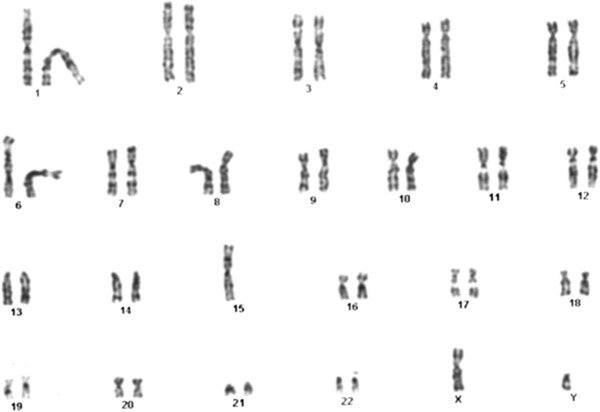
Is this Karyotype human?
a)
Yes
b)
No
c)
Impossible to Determine
106.
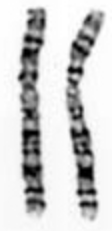
A pair of identical chromosomes shown in a karyotype, one inherited from mom, and one inherited from dad are called
a)
sister chromotids
b)
centromeres
c)
homologous chromosomes
d)
autosomes
107.

This person has Angel Mans syndrome. What is different about their chromosomes?

a)

Chromosome 1 is misshapen

b)

Chromosomes 21 is too small

c)

They are missing one of chromosome 15

d)

Chromosomes 7 and 8 look weird

108.
Chromosome pairs 1-22 are referred to as
a)
sex chromosomes
b)
sister chromatids
c)
a karyotype
d)

autosomes

109.
What makes this individual's karyotype not normal?
a)
An extra sex chromosome
b)
An extra autosome
c)
A missing sex chromosome
d)
A missing autosome
110.

Which Genetic syndrome can we observe in this karyotype?

a)

Turner

b)

Klinefelter's

c)

Down

d)

Edward's

111.

What syndrome can we observe in this karyotype?

a)

Turners Syndrome

b)

Klinefelter's Syndrome

c)

Downs Syndrome

d)

XXX syndrome

112.

Which of Mendel's Laws states that the alleles of two (or more) different genes get sorted into gametes independently of one another. In other words, the allele a gamete receives for one gene does not influence the allele received for another gene.

a)

Law of Dominance

b)

Law of Segregation

c)

law of Independent Assortment

113.

In which stage of MEIOSIS does crossing over occur? (The exchange of genetic material between chromosomes in a tetrad.)

a)

Anaphase I

b)

Metaphase I

c)

Prophase I

d)

Telophase I

114.
Heredity is the passing of traits from _____________________ to _____________________
a)
predators to prey
b)
water to rain
c)
parents to offspring
d)
fungi to protists
115.
If a child has red hair, they inherited a certain _______________ from their parents.
a)
ratio
b)
trait
c)
probability
d)
sex chromosome