
Font size
 Worksheets
Evolution Practice Test
Total questions: 101
Worksheet time: 6hrs 41mins
Ctenodiscus crispatus (Mud Starfish)
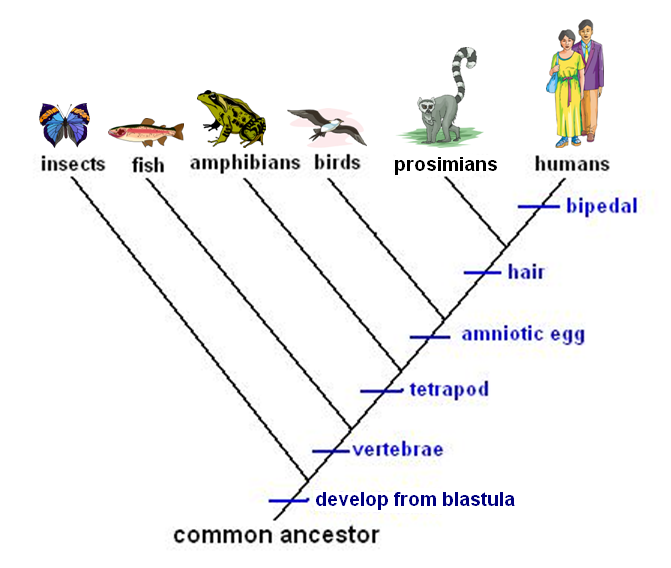

Which 2 organisms would be able to reproduce and produce fertile offspring?
2 organisms in the same class
2 organisms in the same family
2 organisms in the same genus
2 organisms in the same species

Who is the father of evolution?
Mendel
Newton
Darwin
Einstein
When the weather got drier and only large seeds were left, birds with small beaks died and large-beaked birds survived. Overall, the beak size increased in the bird population. This process is called:
genetics
mutations of individuals
evolution by natural selection
energy moving through a food chain
____________
is the process by which humans use animal breeding and plant breeding to selectively develop particular phenotypic traits by choosing which animal or plant will sexually reproduce and have offspring together.
Natural Selection
Artificial Selection
Lamarkism
Sexual Selection
What is an example of artificial selection?
Letting dogs choose their own mate
Letting plants pollinate on their own
Crossing a labrador and a poodle to create a labradoodle
1. Artificial selection has been a big factor in the evolution of:
Dogs
Panda bears
Snakes
Jellyfish


The picture shows a male and female polar bear. What type of selection occurred for them to have these adaptations?
Natural Selection
Sexual Selection - Female Choice
Sexual Selection - Male Competition
Random Selection
All of the genetic information found in a population.
population
genetic drift
evolution
gene pool
A mutation is defined as:
A change in the cell's structure
Anything that changes in an embryo
Any change in the physical features of a human
A change in the DNA sequence
Genetic drift is driven by chance, not Natural Selection.
true
false
How do fossils support evolution?
Individual species disappear and reappear in the fossil record over time.
Organisms in the fossil record are identical to living organisms.
The fossil record provides evidence that all organisms developed at the same time.
The fossil record provides evidence that organisms have changed over time.
A large hurricane reduces a population of wild foxes from 1,200 to only 20 individuals. What has occurred?
gene flow
bottleneck effect
natural selection
founder effect
Corals have evolved shapes that allow algae to more easily fit and live on them. Which type of evolution is this?
directional selection
disruptive selection
stabilizing selection
coevolution
Which of the following is NOT a cause of evolution?
gene flow
large population size
mutation
genetic drift

This diagram of forelimbs of various mammals and birds is an example of:
analogous structures
homologous structures
adaptive radiation
speciation
Which of the following is required for a population to diverge into two separate species?
The two populations must have evolved different physical appearances.
The two populations must have mutated at least 10 times.
The two populations must have become reproductively isolated.
The two populations must have evolved analogous structures.

The palmarus longus tendon, pictured here, no longer serves a purpose in humans, but provides evidence of our species descendance from tree-dwelling ancestors. The palmarus longus tendon is an example of:
a vestigial structure
a homologous structure
bipedalism
convergent evolution
The large-scale events of speciation are called...
macroevolution
simplification
adaptation
microevolution
Microevolution refers to the small changes in an organism while macroevolution refers to the cumulative changes in an organism that lead to speciation.
True
False
Microevolution or Macroevolution: Small changes in a species.
Microevolution
Macroevolution
Both
None of the above
SARS-CoV-2 is the virus causing COVID-19. There are now different variants to this virus, does this exhibit microevolution or macroevolution?
Macroevolution
Microevolution
Due to the differences in the food source of the Galapagos finches, they were able to develop adaptations that will allow them to effectively consume their food. This led to the development of different species of Galapagos finches. Does this show microevolution or macroevolution?
Macroevolution
Microevolution
Humans living near the equator have more melanin compared to humans living farther away from the equator. Does this exhibit microevolution or macroevolution?
Macroevolution
Microevolution

The three species pictured do not share a common ancestor, yet have evolved to have a similar anatomy and life style. This is an example of ?
Homologous Structures
Divergent Evolution
Vestigial Organs
Convergent Evolution

The three species pictured share a common ancestor and have adapted so that each lives in a different environment. This is an example of
Law of Superposition
Evolutionary Arms Race
Divergent Evolution
Convergent Evolution

What branch is dedicated to studying the organism in the image?
Biogeography
Embryology
Ornithology
Ichthyology

The yucca moth depends on the small soap weed for food, and the small soap weed is only pollinated by the yucca moth. This is an example of
Evolutionary Arms Race
Convergent Evolution
Coevolution
Adaptive Radiation

Penguin flipper and fish fin
Homologous
Vestigial
Analogous
None of the above

Whales have pelvic bones. What type of structure does this best represent?
Homologous structure
Analogous structure
Vestigial structure
None of the above
Which of the following are vestigial structures humans have? Select all that apply.
Appendix
Tailbone
Forearm bones
Goosebumps
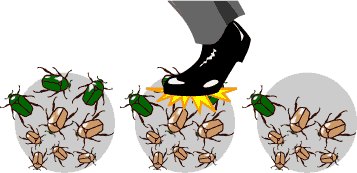
Someone steps on some bugs and randomly removes their alleles from the population. This is an example of
gene flow
genetic drift
speciation
allele frequency
If all 5 Hardy-Weinberg assumptions are true, a population is said to be in genetic equilibrium. This means
it is evolving
it is not evolving
When allele frequencies remain constant, a population is evolving.
True
False
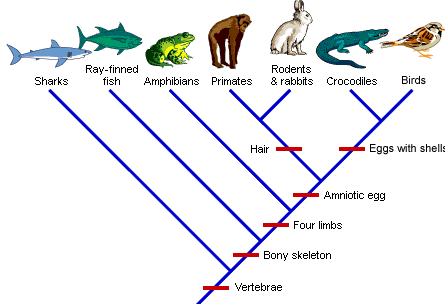
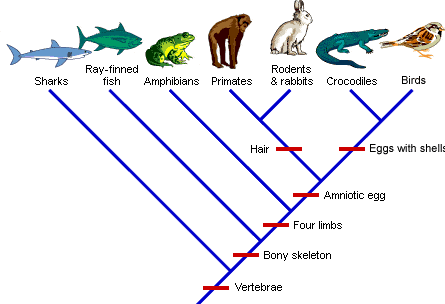


Phyletic Speciation
Adaptive Radiation
Convergent Evoltion
Divergent Evoltuion
Co-evolution

The three species pictured share a common ancestor and have adapted so that each lives in a different environment. This is an example of
Law of Superposition
Evolutionary Arms Race
Divergent Evolution
Convergent Evolution
Convergent evolution is when
Species share traits due to a common ancestor
Species have similar traits because of similar environment
Species have same traits due to different environments
Coevolution is the
Species looking similar due to a common ancestor
Species looking similar due to a common environment
evolution of two species that do not interact
evolution of one species in response to evolution in another species
If an animal evolves to be more camouflaged in an environment, and another animal evolves a better ability to sense movement. This would be
Divergent Evolution
Coevolution: predator Pray
Coevolution: mimicry
In order for Evolution to happen you need
Genetic Variation, Selective Pressure, and Inheritance
Mutations, predators, inheritance
Predators
Selection
What happens to new traits that HELP organisms survive over time?
Nothing
That trait becomes MORE COMMON in the population
That trait becomes LESS COMMON in a population
Equally common

Which traits were selected for in whale ancestors?
Traits that helped them walk on land
Traits that helped them move in water
Traits that helped them give birth

Two organisms that are closely related would have
Very similar DNA sequences
Very different DNA sequences
The same exact DNA sequences
No similarity in DNA

What most likely caused the finches on the Galapagos Islands to have beaks that were different from the finches on the mainland?
There were different types of predators on the islands.
The finches on the mainland could not fly high enough.
There was no water on the islands.
There were different food types on each island.

What type of evolution does this picture show?
convergent evolution
divergent evolution
extinction
coevolution
What is a Homologous Structure?
Features of different species that are similar in function but not in structure
Similar features in organisms that share a common ancestor, but the features serve completely different functions
Feature that a species inherited from an ancestor but is no longer used
What is an Analogous Structure?
Feature that a species inherited from an ancestor but is no longer used
Similar features in organisms that share a common ancestor, but the features serve completely different functions
Features of different species that are similar in function but not in structure
What is a Vestigial Structure?
Feature that a species inherited from an ancestor but is no longer used
Similar features in organisms that share a common ancestor, but the features serve completely different functions
Features of different species that are similar in function but not in structure
Which type of structure describes: bat wings and bird wings
analogous structure
homologous structure
Which type of structure describes: human arm, whale flipper, and bat wings
analogous structure
homologous structure
which type of structure is defined as different structures; similar functions
homologous structures
analogous structures
which type of structure is defined as same structure; different function (proof of a common ancestor)
homologous structures
analogous structures
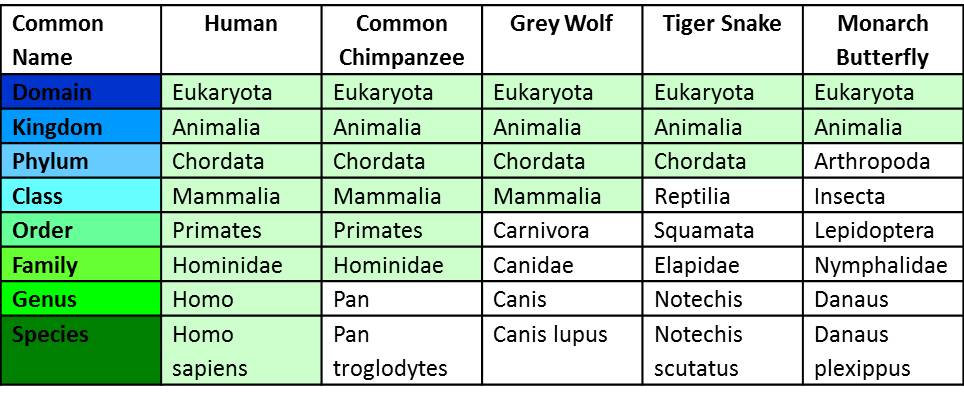

What is the scientific name of this wolf?
Eukarya lupus
eukarya Lupus
Canis lupus
canis Lupus
Lupus canus

Would these two organisms be able to mate and produce fertile young?
yes
no

These two organisms are part of the same class, Aves (birds). Out of the following choices, which other levels of classification would they also have in common? SELECT ALL THAT APPLY
genus
species
domain
phylum
order
Which of these organisms would be most closely related? CHOOSE TWO
Alligator mississippiensis
Elephas maximus
Felis domesticus
Felis bieti

Which would be an adaptation useful in a cold biome?
Being of a smaller size
Being active during the cooler times of day
Blubber/fat
Having dark fur
what is an adaptation?
a change in behavior or physical aspect of an organism in order to be better suited to survive in a particular environment.
a change that an organism quickly develps to survive
a unique characteristic that makes an organsism more dominant
a shift in an organisms behavior
Adapatations lead to...
Unique organisms
Evolution
Mutations
Stronger Organsisms

