
 Worksheets
8.1 & 8.2 Review
Total questions: 190
Worksheet time: 3hrs 45mins
Which are the reactants in the following reaction?
2Mg + O2 ---> 2MgO
Mg and O2
MgO
Mg and MgO
O and MgO
Rusting:
physical change
chemical change
Burning:
physical change
chemical change
Change in shape:
physical change
chemical change
Melting:
physical change
chemical change
Freezing:
physical change
chemical change
A change in state is caused by:
none are correct
adding or removing thermal energy
dissolving and mixing
cutting and shaping
When you add thermal energy:
particles speed up
particles slow down
particles disintegrate
particles are made
The process by which one or more substances change to produce one or more different substances
Chemical Process
Reactant
Chemical Reaction
The simplest unit of a chemical compound that can exist; formed when two or more atoms join together chemically
Atom
Compound
Molecule
A substance produced during a chemical reaction
Product
Reactant
Properties
Physical and chemical characteristics of matter used to describe or identify a substance
Chemical Reaction
Properties
Product
A substance that takes part in and undergoes change during a reaction
Product
Molecule
Reactant

How many of each type of atom are in the formula NH3?
1 nitrogen, 3 hydrogen
3 nitrogen, 3 hydrogen
1 neon, 3 hydrogen
1 nitrogen, 3 helium
How many molecules are represented in the formula 3CO2?
3 carbon, 2 oxygen
6 carbon dioxide
3 carbon dioxide
3 carbon, 6 oxygen
Law of conservation of mass means that the number of atoms of the products is more than the number of atoms in the reactants.
True
False
Which of the following is NOT part of the Law of Conservation of Matter?
Matter cannot be created or destroyed
Matter can be rearranged
Fire converts matter to heat
Matter can change phase; go from a solid to a liquid to a gas
What is the Law of Conservation of Matter?
Matter is created in a chemical reaction
Matter is created in a physical change
New chemicals formed from a chemical reaction have a larger overall mass than the original reactants
Matter cannot created or destroyed
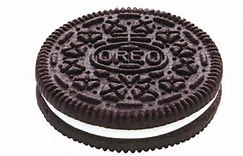
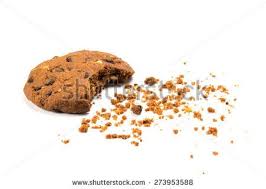
An oreo cookie has a mass of 20 grams. It gets crushed into crumbs for a recipe. What is the mass of the crumbs?
15 grams
25 grams
20 grams
How many of each type of atom are in the formula NH3?
1 nitrogen, 3 hydrogen
3 nitrogen, 3 hydrogen
1 neon, 3 hydrogen
1 nitrogen, 3 helium
How many molecules are represented in the formula 3CO2?
3 carbon, 2 oxygen
6 carbon dioxide
3 carbon dioxide
3 carbon, 6 oxygen
In a reaction A + B ----> C.
Reactant A has 5g and product C has 9g.
How many grams should reactant B have?
4g
5g
9g
14g
What will have more mass when a chemical change is complete: the reactants before the chemical reaction or the product after the reaction is complete?
They both will have the same mass
The product always has more mass than the reactant
The reactant will have more mass than the product
They both will lose mass after the reaction
How many atoms of aluminum are on each side of the following equation?
4Al + 3O2 --> 2Al2 O3
2
6
1
4
Matter is anything that ---
takes up space and has mass.
is in our universe.
is light, sound or ideas.
Which of the following is NOT part of the Law of Conservation of Matter?
Matter cannot be created or destroyed
Matter can be rearranged
Fire converts matter to heat
Matter can change phase; go from a solid to a liquid to a gas
The Law of Conservation of Matter states that the total amount of matter _____ after it undergoes change.
disappears
stays the same
weighs less
explodes
2H2 + O2 --> 2H2O
What is the right part of a chemical equation called?
2H2 + O2 --> 2H2O
Reactants
Products
Yields
Chemical Equation

When ice melts, the water has the same _________ as the
temperature
state of matter
shape
mass
Law of conservation of mass means that the number of atoms of the products is more than the number of atoms in the reactants.
True
False
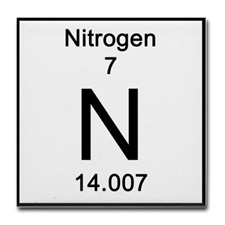
What is the number of protons that the element in this image contain?
14
7
15
18

What is the number of electrons that the element in this image contains?
14
7
15
18

If an atom was the size of our soccer field...
it's nucleus would be the size of a pencil eraser and the atoms would be a grain of sand.
it's electrons would be the size of a pencil eraser and the nucleus would be a grain of sand.
it's molecule would be the size of a pencil eraser and the electrons would be a grain of sand.
it's nucleus would be the size of a pencil eraser and the electrons would be a grain of sand.
What do we call a chemical substance made up of 2 or more different types atoms bonded together?
formula
atom
subscript
molecule
This number tells the number of atoms present.
This number tells how many molecules are in a chemical equation.
3H2O
How many H2O molecules are present?
1
3
2
6


Which subatomic particle identifies an element?
Proton
Neutron
Electron
Nucleus

How many electrons are in this element?
7
6
5
2

How many neutrons are in an atom of Phosphorus, P?
17
15
16
5
Protons + Neutrons =
the average atomic mass
mass number
number of electrons
APE MAN
An oreo cookie has a mass of 20 grams. It gets crushed into crumbs for a recipe. What is the mass of the crumbs?
15 grams
25 grams
20 grams
If reaction starts with 20g of reactants, it will produce ---
a total of 40g of product
a total of 10g of product
a total of 80 g of product
a total of 20g of product
In a reaction A + B ----> C.
Reactant A has 5g and product C has 9g.
How many grams does reactant B should have?
4g
5g
9g
14g
What will have more mass when a chemical change is complete: the reactants before the chemical reaction or the product after the reaction is complete?
They both will have the same mass
The product always has more mass than the reactant
The reactant will have more mass than the product
They both will lose mass after the reaction
Matter is anything that ---
takes up space and has mass.
is in our universe.
is light, sound or ideas.
The Law of Conservation of Matter states that the total amount of matter _____ after it undergoes change.
disappears
stays the same
weighs less
explodes

Why does the weight of the dry ice go down while it's sitting on the scale?
it's melting
it's disappearing
it's evaporating
none of these
Physical Properties are
Physical properties of matter
are properties that can be observed without changing the matter's identity
are properties that can be observed that change the matter into new matter with new properties
True or False. States of matter are solids, liquids, and gases
True
False
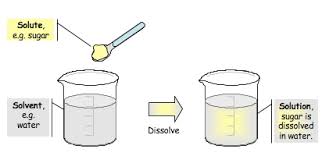
The ability of sugar to dissolve in water is called
malleability
Density
State
solubility

A property of matter that involves pounding a substance into thin sheets.
solubility
state
malleability
density
The amount of matter in an area
density
state
volume
mass

What is the least dense liquid in this container?
Honey
vegetable oil
lamp oil
water
Anything that has mass and takes up space
Matter
weight
volume
mass
True or False. Melting butter is a physical change. Is it still butter?
True
false
Most physical changes are easily reversible. Hint - Is it easy to melt and freeze ice?
True
False
True or false. Wood is malleable.
True
False

Which block has more density?
The one on the right
The one on the left
Chemical Properties are
Physical properties of matter
are properties that can be observed without changing the matter's identity
are properties that can be observed that change the matter into new matter with new properties
The temperature at which a solid changes to a liquid is...
melting point
boiling point
a phase change
solubility
The temperature at which a liquid changes to a gas is...
melting point
boiling point
a phase change
solubility
The ability to conduct electricity is...
malleability
thermal conductivity
electrical conductivity
flammability
The ability to conduct heat is...
reactivity
thermal conductivity
electrical conductivity
flammability
How easily something catches on fire is...
malleability
thermal conductivity
electrical conductivity
flammability
How easily a substance will react with another is...
reactivity
thermal conductivity
electrical conductivity
flammability
Which of the following are physical changes?
reactivity
malleability
solubility
flammability
thermal conductivity
Which of the following are chemical properties?
flammability
conductivity
reactivity
malleability
combustibility

In the _________ phase, molecules are in constant motion.
Solid
Liquid
Gas

In the _________ phase, molecules change position easily and slide past one another.
Solid
Liquid
Gas
When heat is added, a _________ evaporates into a gas and the molecules speed up.
Solid
Liquid
Gas
When heat is added, a _________ melts into a liquid and the molecules speed up.
Solid
Liquid
Gas
When heat is added, a _________ doesn't change state, it just becomes hotter and the molecules speed up
Solid
Liquid
Gas
When heat is taken away, a _________ condenses into a liquid and the molecules slow down.
Solid
Liquid
Gas
The _________ phase is the least dense.
Solid
Liquid
Gas

In the _________ phase, molecules only vibrate in place.
Solid
Liquid
Gas
When heat is taken away, a _________ doesn't change state, it just becomes cooler and molecules slow down.
Solid
Liquid
Gas
When heat is taken away, a _________ freezes into a solid and the molecules slow down.
Solid
Liquid
Gas

This phase change is when a solid turns into a liquid
Melting
Freezing
Evaporation
Condensation

This phase change is when a liquid is turned into a gas
Condensation
Evaporation
Freezing
Melting
This phase change is when a gas is turned into a liquid
Evaporation
Condensation
Freezing
Melting
This phase change is when a liquid is turned into a solid.
Evaporation
Condensation
Freezing
Melting
The density equation looks like a....
heart with the V(volume) on top and the M(mass) on bottom.
circle with an M(mass) on top and the V(volume) on bottom.
heart with the M(mass) on top and the V(volume) on bottom.
circle with an V(volume) on top and the M(mass) on bottom.
What is the density of a substance that has a mass of 3 and a volume of 15?
5 g/ml
0.6 g/ml
3 ml
15 g
What is the density of a substance that has a mass of 20 and a volume of 4?
5 g/ml
0.6 g/ml
20 ml
4 g
As a substance gains heat energy...
it's molecules speed up and spread apart, becoming less dense
it's molecules slow down and spread apart, becoming less dense
it's molecules slow down and spread apart, becoming more dense
it's molecules slow down and clump together, becoming more dense

What is #1 in the diagram?
wavelength
amplitude
crest
trough
What part of a wave is #2 on the diagram?
wavelength
amplitude
crest
trough
In the diagram, #3 is what?
wavelength
amplitude
crest
trough
Which part of a wave is #4?
wavelength
amplitude
crest
trough

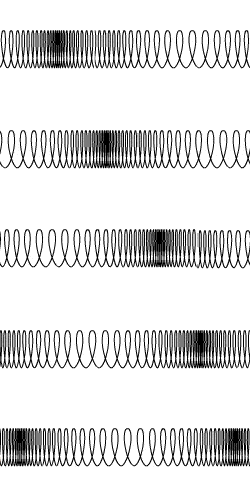
What kind of wave is pictured below?
compressional wave
transverse wave
sound wave
mechanical wave

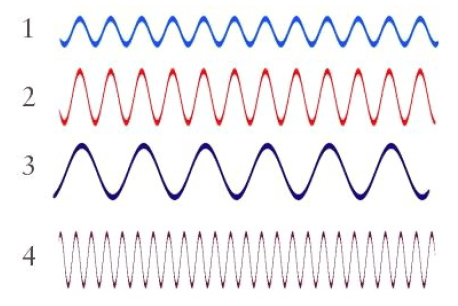

For a wave, the larger the amplitude, the _____ energy the wave carries.
more
less

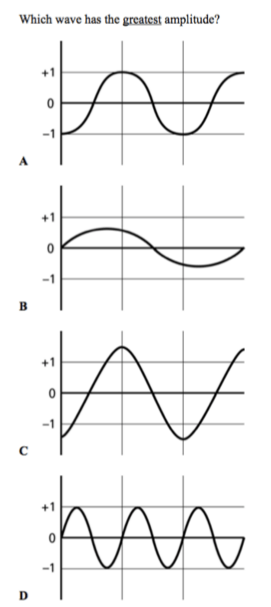
What wave has the loudest sound in the diagram?
A
B
C
D
If a wave has an amplitude of 3, its energy will be...
3 Joules
6 Joules
9 Joules
A wave medium is...
Anything that has matter, but NOT a vacuum
Anything that has matter OR a vacuum
Anything a wave travels through

absorption
diffraction
reflection
refraction
transmission

absorption
diffraction
reflection
refraction
transmission
When a wave passes from one medium to another, the ________ changes.
speed
frequency
wavelength
speed, frequency, and wavelength
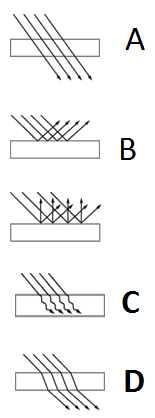


What is happening in this picture?
Reflection
Refraction
Diffraction

A boy has a cork on his fishing line in a lake. His brother throws a rock in the lake near where he is fishing, and the waves created from the rock splashing cause the boy's cork to bob up and down for over a minute. What is the medium for the waves in this scenario?
the cork
the water
the rock
the fishing line
travels through solids best because the molecules are closer together
sound
all waves
light
x-rays
ex. police car siren sounding lower pitch after the car passes

Law of reflection state that - The angle a wave hits a medium is .................. to the angle a wave bounces off the medium.
equal
double
half
If you see a green leaf on a tree, that means...
Green is the color being reflected off the leaf.
Green is the color being absorbed by the leaf.
All the colors are being reflected off the leaf.
All the colors are being absorbed by the leaf.
What two factors affect an object's kinetic energy?
area and volume
mass and weight
weight and height
mass and velocity

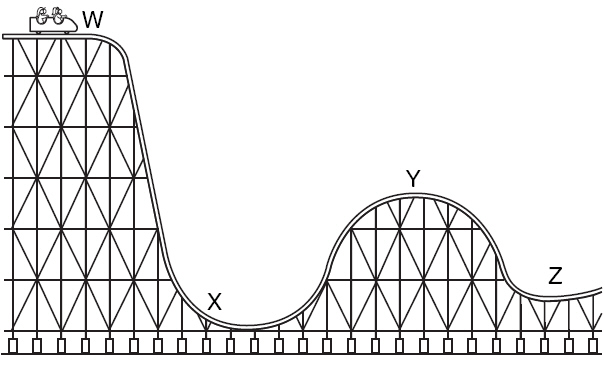
Where would this tossed baseball have the least amount of kinetic energy?
point W
point X
point y
point z
Where would this tossed baseball have the greatest amount of kinetic energy?
point W
point X
point y
point z
Which of these has kinetic energy?
a book sitting on a shelf
hat and gloves on a table
cars parked in a parking lot
a child kicking a soccer ball

The diagram shows a cart moving freely along a track. What happens to the energy of the cart as it moves from point A to point B on the diagram?
Potential energy is transformed to kinetic energy.
Kinetic energy is transformed to potential energy.
Both potential energy and kinetic energy stay the same.
Which diagram models the position of a soccer ball when it has the greatest amount of gravitational potential energy?
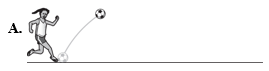
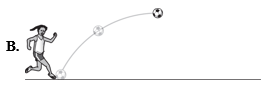
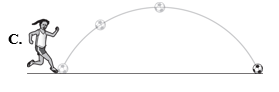
What forms of energy are involved in hammering a nail into wood? Select all that apply
Sound
Kinetic
Electrical
Nuclear
Which term describes the energy that is stored due to the height of an object above the ground?
kinetic energy
chemical energy
elastic potential energy
gravitational potential energy
Which of these has elastic potential energy?
a vase sitting on a shelf
a stretched rubber band
a child moving down a slide
sugars stored in the molecules of food
A hockey player uses her stick to hit a hockey puck. Which statement describes the overall energy transfer?
Energy is transferred from the stick to the puck.
Energy is transferred from the player to the puck.
Energy is transferred from the puck to the player.
Energy is transferred from the stick to the player.
Increasing an object's mass will increase its kinetic energy.
true
false
Increasing an object's speed will increase its kinetic energy.
false
true


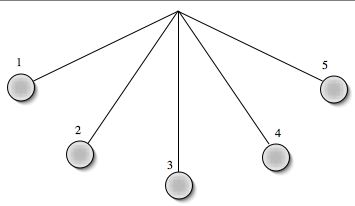

Increasing an object's height or distance increases its...
Kinetic Energy
Potential Energy
Transform Energy
Which increases an object's kinetic energy the most?
Increasing its mass
Increasing its speed
Increasing its height/distance
Decreasing its mass
Decreasing its speed

