wayground logo

Free Printable Worksheets

NEW

Font size

S
M
L
XL
Worksheets

FARLINATOR: EARTH AND SPACE HONORS

Total questions: 77

Worksheet time: 44mins

Name
Class
Date
1.

How many planets do we have in our solar system?

a)

9

b)

8

c)

7

d)

6

2.

The ______ is the center of our solar system.

a)

Sky

b)

Earth

c)

Sun

d)

Moon

3.

_______ are balls of gases made up of mainly hydrogen and helium.

a)

Moons

b)

Stars

c)

Planets

d)

Asteroids

4.

Areas of the photosphere that appear to be darker because they have a lower temperature.

a)

Sunspots

b)

Solar flare

c)

Corona

5.

A rocky mass up to several hundred kilometers wide that revolves around the sun.

a)

Asteroid

b)

Meteor

c)

Comet

d)

Moon

6.

An explosive eruption of waves and particles from the sun's surface into space.

a)

Sun

b)

Asteroids

c)

Solar flare

7.

What forms when a meteoroid hits Earth's atmosphere.

a)

Meteorite

b)

meteor

c)

comet

8.

A ribbon of glowing gases that leaps out of the chromosphere into the corona.

a)

Solar flare

b)

Prominence

c)

Sunspots

9.

A natural object that orbits a body bigger than itself.

a)

Planet

b)

Star

c)

Comet

d)

Moon

10.

The layer above the photosphere in the sun's atmosphere.

a)

Corona

b)

Photosphere

c)

chromosphere

11.

The innermost layer of the sun's atmosphere.

a)

Photosphere

b)

chromosphere

c)

Corona

12.

A large, round object that revolves around the sun but has not cleared the region around its orbit.

a)

Planet

b)

Dwarf Planet

c)

Moon

13.

A piece of a meteor that lands on Earth.

a)

Meteor

b)

Meteorite

c)

Asteroid

14.
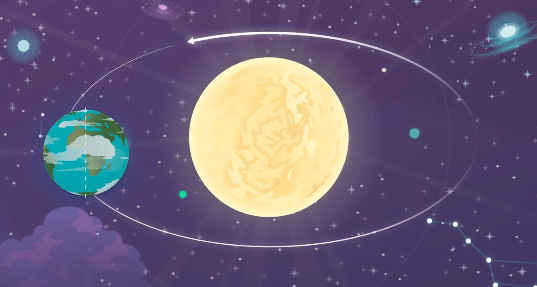
How long does it take for the Earth to make one full orbit around the Sun?
a)
one day
b)
one week
c)
one month
d)
one year
15.
The Earth is rotating on its axis, creating _____
a)
the 12 months
b)
the years
c)
the seasons
d)
day and night
16.
What looks to be the motion of the Sun in the sky is really caused by the motion of _____
a)
the Earth
b)
the stars
c)
the planets
d)
the Earth's axis
17.
The spinning movement of the Earth about its axis is called the Earth's _____
a)
revolution
b)
rotation
c)
precession
d)
orbit
18.
When the part of the world that you're living in is leaning towards the Sun, its _____
a)
winter
b)
spring
c)
summer
d)
fall
19.
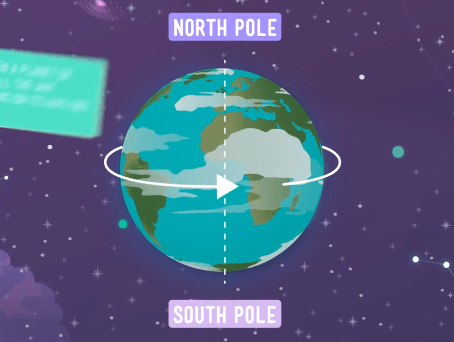
The invisible line that passes through the North Pole and the South Pole is called Earth's ____
a)
axis
b)
equator
c)
ecliptic
d)
prime meridian
20.

Which of the following correctly shows rotation?

a)
b)
c)
d)
21.

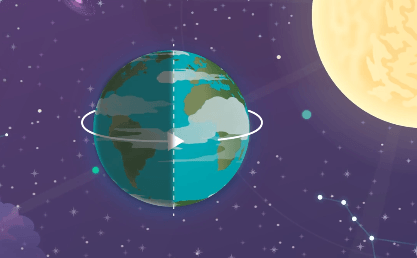
The illustration represents which of the following?

a)

Revolution of Earth

b)

Swimming Earth

c)

Bicycle wheel

d)

Roation of Earth

22.

How many days are in a calendar year?

a)

362.1

b)

356 1/5

c)

635

d)

365 1/4

23.

To complete one year’s time, the Earth makes one complete _____.

a)

Revolution around the Moon.

b)

Rotation around the Moon.

c)

Revolution around the Sun.

d)

Revolution around Mars.

24.

Which month has a day added because of a leap year?

a)

February

b)

January

c)

March

d)

April

25.

What season is being experienced in the Southern Hemisphere?

a)

Spring

b)

Fall

c)

Winter

d)

Summer

26.
When the Northern Hemisphere is tilting towards the sun, what season is the Southern Hemisphere?
a)
Winter
b)
Spring
c)
Fall
d)
Summer
27.
There is less daylight in the winter.
a)
True
b)
False
28.
The reasons we have seasons is because the Earth is _______
a)
pie
b)
tilted
c)
melting
d)
water
29.
What degree is the earth tilted?
a)
23
b)
25
c)
23.5
d)
25.5
30.
​Which​ ​motion​ ​of​ ​earth​ ​could​ ​be​ ​best​ ​demonstrated​ ​by​ ​Lebron​ ​James​ ​spinning​ ​a​ ​basketball​ ​on​ ​his​ ​finger?
a)
rotation
b)
revolution
c)
tilting
d)
leap year
31.
Because the earth spins on its axis, we experience:
a)
seasons
b)
weather
c)
day and night
d)
revolution
32.
How long does it take the moon to rotate on its axis?
a)
24 hours
b)
23 days
c)
365.25 days
d)
28 days
33.
A word used to describe a moon that is "getting larger"
a)
gibbous
b)
crescent
c)
waxing 
d)
waning
34.
As the moon revolves around the earth, we always see the same side of the moon.
a)
true
b)
false
35.
Seasons on Earth are caused by how close the earth is to the sun
a)
true
b)
false
36.
The dark side of the moon is the side of the moon that never sees the sunlight.
a)
true
b)
false
37.
A "day" and a "year" on the moon are the same length.
a)
true
b)
false
38.
The moon is waning for about 14 days.
a)
true
b)
false
39.
A moon that is more than a quarter, but less than full is called gibbous
a)
true
b)
false
40.
When the north pole faces away from the sun we experience summer.
a)
true
b)
false
41.
Which of the following has the biggest impact on the seasons?
a)
Earth's rotation
b)
Tilted axis
c)
Moon's gravitational pull
d)
Pressure systems
42.
What causes the day and night cycle on Earth?
a)
Rotation of the Sun
b)
Revolution of the Earth
c)
Gravitational pull from the moon
d)
Rotation of the Earth
43.
In which position would the Northern Hemisphere be experiencing spring?
a)
Position A
b)
Position B
c)
Position C
d)
Position D
44.
What phase is illustrated here?
a)
1st Quarter
b)
Waning gibbous
c)
Waxing crescent
d)
New moon
45.
Which of the following has the BIGGEST impact on the Earth's tides?
a)
The sun
b)
Earth's rotation
c)
Earth's revolution
d)
The moon
46.
How much time passes between a high tide and a low tide?
a)
6 hours
b)
12 hours
c)
24 hours
d)
2 days
47.

By how many degrees is the Earth tilted on its axis?

a)

90

b)

2.5

c)

23.5

d)

28

48.
Which of the following has the biggest impact on the seasons?
a)
Earth's rotation
b)
Tilted axis
c)
Moon's gravitational pull
d)
Pressure systems
49.
What causes the day and night cycle on Earth?
a)
Rotation of the Sun
b)
Revolution of the Earth
c)
Gravitational pull from the moon
d)
Rotation of the Earth
50.
In Which position would the Southern Hemisphere experience winter?
a)
Position A
b)
Position B
c)
Position C
d)
Position D
51.
In which position would the Northern Hemisphere be experiencing spring?
a)
Position A
b)
Position B
c)
Position C
d)
Position D
52.
How long does one lunar cycle take?
a)
1 week
b)
2 weeks
c)
4 weeks
d)
1 year
53.
What phase is illustrated here?
a)
1st Quarter
b)
Waning gibbous
c)
Waxing crescent
d)
New moon
54.
Which of the following has the BIGGEST impact on the Earth's tides?
a)
The sun
b)
Earth's rotation
c)
Earth's revolution
d)
The moon
55.
How many tides does a location experience each day?
a)
1
b)
2
c)
4
d)
8
56.
How much time passes between a high tide and a low tide?
a)
6 hours
b)
12 hours
c)
24 hours
d)
2 days
57.

By how many degrees is the Earth tilted on its axis?

a)

90

b)

2.5

c)

23.5

d)

28

58.

If there is a full moon today, what moon phase will be occur tomorrow?

a)

waning gibbous

b)

waxing gibbous

c)

new moon

d)

3rd quarter

59.

It is currently Spring in the northern hemisphere, what season is it currently in the southern hemisphere?

a)

winter

b)

spring

c)

summer

d)

fall

60.

Which term describes when the moon is less illuminated each night?

a)

waxing

b)

waning

c)

wandering

d)

whining

61.

If a 1st quarter moon were to occur tonight, what moon phase would occur in 2 weeks?

a)

waxing gibbous

b)

full moon

c)

waning crescent

d)

3rd quarter

62.

During which season do we experience the most hours of daylight because of the tilt of the Earth?

a)

Summer

b)

Fall

c)

Winter

d)

Spring

63.

It is currently Spring in the northern hemisphere, what season is it currently in the southern hemisphere?

a)

winter

b)

spring

c)

summer

d)

fall

64.
What is one condition that is necessary for a hurricane to form?
a)
Warm ocean water
b)
A strong cold front
c)
Cold ocean water
d)
A strong warm front
65.
**
a)
the mass of a the plates
b)
the weight of the plates
c)
unbalanced force
d)
gravitational force
66.
**
a)
Barnard’s Star is less bright than the sun, has a surface temperature below 3,800 K, and is red.
b)
Barnard’s Star is less bright than the sun, has a surface temperature above 3,800 K, and is red.
c)
Barnard’s Star is brighter than the sun, has a surface temperature below 5,300 K, and is yellow.
d)
Barnard’s Star is brighter than the sun, has a surface temperature above 5,300 K, and is yellow
67.
lines on a map that connect areas of the same elevation
a)
longitude lines
b)
latitude lines
c)
contour lines
d)
contour interval
68.
a slightly oval shaped galaxy
a)
elliptical
b)
milky way
c)
irregular
d)
spiral
69.
What moon phase is this picture?
a)
This is the waning crescent phase.
b)
This is the waxing gibbous phase.
c)
This is the waning gibbous phase.
d)
This is the new moon phase.
70.
Why is the light from distant galaxies red-shifted?
a)
They produce more red light than nearby galaxies
b)
They are moving away from us
c)
The longer wavelengths are filtered out more by dust
d)
They are moving toward us
71.
What is the highest tide?
a)
High Tide
b)
Low Tide
c)
Spring Tide
d)
Neap Tide
72.
Very hot stars are what color? 
a)
Blue
b)
Yellow
c)
Red
d)
Orange
73.
All stars begin as a __________?
a)
giant
b)
black hole
c)
white dwarf
d)
nebula
74.
A student stands at the point marked X on the topographic map below.
What height in meters must the student climb in order to reach the top of the hill?
a)
245 m
b)
253 m
c)
236 m
d)
260 m
75.
When the Northern Hemisphere of Earth is Leaning away from the Sun, What season is the Southern Hemisphere experiencing?
a)
Summer
b)
Winter
c)
Spring
d)
Fall
76.
What is this moon phase?
a)
This is the waxing crescent phase.
b)
This is the full moon phase.
c)
This is the waxing gibbous phase.
d)
This is the last quarter moon.
77.
What moon phase is this picture?
a)
This is the waning crescent phase.
b)
This is the waxing gibbous phase.
c)
This is the waning gibbous phase.
d)
This is the new moon phase.