wayground logo

Free Printable Worksheets

Font size

S
M
L
XL
Worksheets

CR Pretest

Total questions: 154

Worksheet time: 1hrs 27mins

Name
Class
Date
1.
The type of polysaccharide which serves as a strengthening tissue in the cell wall of plants is 
a)
cellulose
b)
glucose
c)
lactose
d)
fructose
2.
Glucose is a _____.
a)
carbohydrate
b)
lipid
c)
protein 
d)
nucleic acid
3.
Proteins are composed of what smaller building blocks?
a)
amino acids
b)
nucleic acids
c)
fatty acids
d)
nucleotides
4.
Which group of organic molecules serve as long-term energy storage and make the cell membrane is?
a)
proteins
b)
carbohydrates
c)
lipids
d)
nucleic acids
5.
The primary purpose the body uses monosaccharides for is?
a)
Building muscles
b)
Helping the Immune System
c)
Immediate Energy
d)
Generating Heat
6.
Building blocks of polymers.
a)
monomer
b)
polypeptide
c)
monosaccharide
d)
glycerol
7.
Attractions between water molecules are called
a)
Covalent bonds
b)
Ionic bonds
c)
Polar bonds
d)
Hydrogen bonds
8.
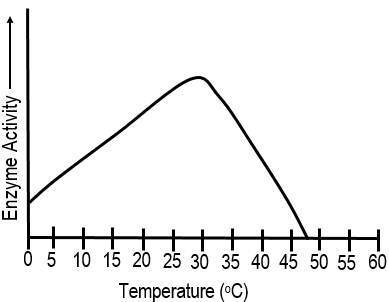
Based on the graph, what temperature does this enzyme work best? 
a)
15 C
b)
40 C
c)
30 C
9.
What happens when enzymes are heated to a high temperature?
a)
The enzymes die.
b)
The shapes of the enzyme are altered or denatured
c)
The enzymes' amino acid sequence changes.
d)
The enzymes remain the same
10.
Which of the following binds to the active site of an enzyme? 
a)
substrate
b)
product
c)
codon
d)
none of the above
11.
What happens when enzymes are heated to a high temperature?
a)
The enzymes die.
b)
The shapes of the enzyme are altered or denatured
c)
The enzymes' amino acid sequence changes.
d)
The enzymes remain the same
12.
Letter C...
a)
active site
b)
enzymes
c)
substrate
d)
products
13.
Enzymes are
a)
nucleic acids
b)
proteins
c)
lipids
d)
carbohydrates
14.
Enzymes are _________ that __________ chemical reactions.
a)
proteins, slow down
b)
proteins, speed up
c)
lipids, slow down
d)
lipids, speed up
15.
The property where water molecules are attracted to other water molecules.
a)
adhesion
b)
capillary action
c)
cohesion
d)
universal solvent
16.

In a covalent bond, atoms

a)

share electrons

b)

transfer electrons

c)

attract water molecules to each other

d)

do not bond

17.

Water is a _ molecule.

a)

nonpolar

b)

polar

18.
The property where water molecules are attracted to other water molecules.
a)
adhesion
b)
capillary action
c)
cohesion
d)
universal solvent
19.

Water _ heat when it evaporates.

a)

absorbs

b)

releases

20.

Which is the strongest acid?

a)

ph of 1

b)

ph of 4

c)

ph of 7

d)

ph of 9

21.

Which is the strongest acid?

a)

ph of 1

b)

ph of 4

c)

ph of 7

d)

ph of 9

22.

Which is the wrong polymer/monomer pair?

a)

nucleic acids : nucleotides

b)

lipids: monosaccharides

c)

carbohydrates: monosaccharides

d)

proteins : amino acids

23.

A compound is made of up

a)

Two or more atoms

b)

Two or more different elements

c)

Two molecules

d)

Water and Oxygen

24.

The work of scientists generally begins with

a)

analyzing results

b)

drawing conclusions

c)

asking questions

d)

testing a hypothesis

25.

A well-tested explanation that is backed by experimental results is a (an)

a)

theory

b)

controlled experiment

c)

inference

d)

hypothesis

26.

The control group in an experiment is the

a)

point at which observations are made.

b)

one that does not receive any experimental treatment.

c)

careful measuring and recording of data.

d)

point at which variables are made.

27.

If you measure how acidic or basic a liquid is, you will find the value of the _____.

a)

inference

b)

weight

c)

metabolism

d)

pH

28.

The ability of an organism to maintain stable internal conditions is

a)

homeostasis

b)

a response to growth

c)

reproduction

d)

metabolism

29.

Thinking that it is going to rain when you see dark clouds in the sky is a (an)

a)

variable

b)

theory

c)

inference

d)

observation

30.

Using energy to complete activities within the body (ex: digesting food) is called

a)

interdependence

b)

reproduction

c)

heredity

d)

metabolism

31.

Which of the following do you need to bring to science class every day?

a)

pen or pencil

b)

binder or notebook

c)

charged laptop

d)

all of these

32.

If you are absent, you should look at the _____ when you return to see what you missed.

a)

bulletin board

b)

ceiling

c)

assignment calendar

d)

clock

33.

Parents pass their traits onto their children through genes. Genes are instructions for making what?

a)

fats

b)

starches

c)

carbohydrates

d)

proteins

34.

Which characteristic is shared by all living things?

a)

ability to move in response to the environment

b)

use of tiny organs to control cell processes

c)

ability to store hereditary information

d)

use of respiration for energy release

35.

Which of the following lists shows the level of biological organization from smallest to largest?

a)

cells, organisms, tissues, populations

b)

populations, organs, tissues, cells

c)

cells, tissues, organs, organisms

d)

organs, cells, tissues, organelles

36.

Snakes move onto a warm rock in the sun to heat up. What characteristic of life does this describe?

a)

homeostasis

b)

reproduction

c)

heredity

d)

interdependence

37.

Science should be based on

a)

feelings

b)

observations

c)

opinions

d)

faith

38.

Which of the following is an example of an observation?

a)

My favorite food is French fries.

b)

The frog has brown stripes on its back.

c)

The insect was lonely so it flew away.

d)

Biology is the best class ever.

39.

What might be falling from the sky that could affect amphibians like frogs and salamanders?

a)

sunlight

b)

acid rain

c)

birds

d)

airplanes

40.

The everyday meaning of the word "theory" is the same as the scientific meaning.

a)

True

b)

False

41.

_____ make it easier to understand things that might be hard to observe directly.

a)

Theories

b)

Heredity

c)

Models

d)

Observations

42.

Which organizational level includes all of the other levels?

a)

ecosystem

b)

cell

c)

biosphere

d)

organism

43.

An inference is

a)

the same as an observation

b)

a way to avoid bias

c)

a statement involving numbers

d)

a logical interpretation of an observation

44.
Which organelle is found only in plant cells?
a)
nucleus
b)
mitochondria
mitochondria
c)
chloroplast
d)
cell membrane
45.
Which organelle directs all cell activities, using the DNA stored inside of it?
a)
lysosomes
b)
ribosomes
c)
nucleus
d)
mitochondria
46.
Which of the following is directly involved in the transportation of materials inside the cells?
a)
endoplasmic reticulum
b)
lysosome
c)
vacuole
d)
mitochondria
47.
I am a protein packaging and shipping machine! Who am I?
a)
vacuole
b)
ribosome
c)
mitochondrion
d)
golgi apparatus
48.
You might think of me as the trash collector, but recycler is maybe more accurate. What am I?
a)
mitochondria
b)
lysosome
c)
vacuole
d)
ribosome
49.
What is the name of the genetic material that is inside the nucleus?
a)
ER
b)
SER
c)
DNA
d)
ATP
50.
Which part of the cell is often called the "brain" of the cell?
a)
endoplasmic reticulum
b)
golgi apparatus
c)
nucleus
d)
mitochondria
51.
What is found in both plant and animal cells but is much larger in plant cells?
a)
nucleus
b)
chloroplast
c)
mitochondria
d)
vacuole
52.
Where are proteins made?
a)
ribosomes
b)
chromosomes
c)
golgi apparatus
d)
mitochondria
53.
This organelle takes sunlight and turns it into energy for plant cells.
a)
lysosome
b)
chloroplast
c)
mitochondria
d)
nucleus
54.
I am the outer most layer of an animal cell.
a)
cell wall
b)
nucleus
c)
cell membrane
d)
cell skin
55.
What are tiny organelles that convert glucose to ATP?
a)
ribosomes
b)
vesicles
c)
cytoskeletons
d)
mitochondria
56.
A rigid layer that lies outside the cell's membrane is...
a)
cytoskeleton
b)
cilia
c)
cell wall
d)
cytoplasm
57.
What organelle is called the powerhouse of the cell?
a)
endoplasmic reticulum
b)
nucleus
c)
golgi apparatus
d)
mitochondria
58.
What organelle uses enzymes to help with digestion?
a)
lysosomes
b)
ribosomes
c)
endoplasmic reticulum
d)
vacuoles
59.
What is the gel like substance called inside cells?
a)
cytoskeleton
b)
cytoplasm
c)
smooth ER
d)
cilia
60.
Which organelle is the main producer of ATP?
a)
mitochondria
b)
endoplasmic reticulum
c)
ribosomes
d)
lysosomes
61.
Which organism can circular DNA called plasmids be found?
a)
Eukaryotes
b)
Prokaryotes
62.
Which cell type are found in bacteria?
a)
Prokaryotes
b)
Eukaryotes
63.
Which cell type is larger?
a)
Prokaryotes
b)
Eukaryotes
64.

In passive transport, the concentration gradient goes from..

a)

Low to low

b)

High to low

c)

Low to high

d)

High to high

65.
The cellular process in which materials are moved across a membrane from an area of low concentration to an area of high concentration is called
a)
Osmosis
b)
Simple Diffusion
c)
Active Transport
d)
Passive Transport 
66.
Describe the movement of molecules in the illustration.
a)
Molecules are moving from a lower concentration to a higher concentration. 
b)
Molecules are moving from a lower concentration to a higher concentration. 
c)
Molecules are moving from a higher concentration to a lower concentration and then from a lower to higher concentration.
d)
Molecules are moving from a lower concentration to a higher concentration and then from a higher concentration to a lower concentration. 
67.
How is diffusion different from this process?
a)
 Diffusion takes place due to osmotic pressure. 
b)
Diffusion requires cellular energy for the transfer of molecules.
c)
Diffusion requires protein channels as a passage-way for particles
d)
Diffusion transfers particles from an area of high to low concentration. 
68.
Osmosis is the diffusion of __________.
a)
water
b)
glucose
c)
air
d)
passive transport
69.
Passive transport requires no
a)
concentration gradients
b)
osmosis
c)
motion
d)
energy
70.
This cell organelle helps organisms maintain homeostasis by controlling what substances may enter or leave cells.
a)
vacuole
b)
nucleus
c)
cell membrane
d)
cell wall
71.
Large molecules, such as glucose, can easily pass through the cell membrane without any help...
a)
True- they pass right through
b)
False- they need a protein channel 
72.
When particles move out of a cell through facilitated diffusion, the cell ____________.
a)
Gains energy
b)
Uses energy
c)
Releases energy
d)
Does not use energy
73.
Which type of Passive Transport is being represented in this picture?
a)
Passive Diffusion
b)
Simple Diffusion
c)
Active Diffusion
d)
Facilitated Diffusion
74.
Large molecules are released by cell by 
a)
Endocytosis
b)
Exocytosis
c)
Passive transport
d)
Phagocytosis
75.
Bacteria are engulfed by
a)
Pinocytosis
b)
Receptor mediated endocytosis
c)
Exocytosis
d)
Phagocytosis
76.
Hydrophobic region of the cell membrane?
a)
E
b)
B
c)
C
d)
77.
Hydrophilic portion of cell membrane?
a)
A
b)
C
c)
D
d)
78.
What forms the channels and pumps in the phospholipid bilayer?
a)
Carbohydrates
b)
Proteins
c)
Hydrophilic heads 
d)
Lipids
79.
Which statement best describes the cell membrane?
a)
The protective outer layer that controls what enters and leaves the cell.
b)
Stores information on DNA molecules / Directs and controls the activities of the cell.
c)
A folded membrane that moves materials around inside cells / Also acts as the site of manufacturing materials needed by the cell.
d)
The smallest organelle with a huge job / Makes proteins, which are the building blocks of the body.
80.
What are the products of photosynthesis?
a)
water and carbon dioxide
b)
oxygen and glucose
c)
oxygen and carbon dioxide
d)
oxygen and water
81.
Which gas is removed from the atmosphere during photosynthesis?
a)
hydrogen
b)
oxygen
c)
nitrogen
d)
carbon dioxide
82.
Which statement about photosynthesis is correct?
a)
Plants get the energy they need for photosynthesis from water.
b)
Plants get the energy they need for photosynthesis from soil.
c)
Plants get the energy they need for photosynthesis from sunlight.
d)
Plants do not require energy to perform photosynthesis.
83.
The main source of energy for all life comes from ____.
a)
the Earth
b)
the moon
c)
the sun
d)
the food we eat/make
84.
Green plants reflect ________ light.
a)
Red
b)
Green
c)
All
d)
Red and Violet
85.
What characteristic sets heterotrophs apart from autotrophs?
a)
Heterotrophs can be classified only as mammals.
b)
Heterotrophs use energy from the sun to make their own food.
c)
Heterotrophs obtain food from consuming other living or once-living things.
d)
Heterotrophs obtain food through the process of photosynthesis.
86.
What is the organelle that contains the chlorophyll used in photosynthesis ?
a)
mitochondria
b)
ribosome
c)
chloroplast
d)
nucleus
87.
What is the "waste" gas (product) produced during photosynthesis?
a)
oxygen
b)
nitrogen
c)
helium
d)
hydrogen
88.
What is the end product of photosynthesis ?
a)
carbon dioxide
b)
water
c)
glucose
d)
methane
89.
An autotroph is an organism that can ?
a)
make its own food.
b)
grow its own food
c)
kill and eat other organisms.
d)
play ball with you. 
90.
The raw ingredients (reactants) of photosynthesis are sunlight along with ?
a)
CO2 and H20
b)
CO2 AND C6H12O6
c)
oxygen and water
d)
oxygen and CO2
91.

Under anaerobic conditions yeast release

a)

oxygen

b)

carbon monoxide

c)

lactic acid

d)

ethyl alcohol

92.

The term aerobic means

a)

wine-making

b)

with carbon dioxide

c)

without carbon dioxide

d)

with oxygen

e)

without oxygen

93.

Respiration ____ and cellular respiration ____.

a)

produces ATP, is gas exchange

b)

is gas exchange, produces ATP

c)

produces glucose, produces glucose

d)

uses glucose, produces glucose

94.

Humans use calories they obtain from ____ as their energy source.

a)

food

b)

water

c)

sunlight

d)

minerals

95.

During cellular respiration, NADH

a)

is converted by NAD+ by enzyme called dehydrogenase

b)

is converted directly to ATP

c)

is reduced from NAD+

d)

is involved in an exergonic reaction when it gives up electrons to other molecules

96.

Oxidation is the ____ and reduction is the _____.

a)

gain of electrons...loss of electrons

b)

loss of electrons.... gain of electrons

c)

loss of oxygen...gain of oxygen

d)

gain of oxygen...loss of oxygen

97.

The functioning of an electron transport chain can be analogized with

a)

a slinky going downstairs

b)

going over a waterfall

c)

climbing a flight of stairs one step at a time

d)

jumping from the top to the bottom of a flight of stairs

98.

which of the following is the result of glycolysis?

a)

reduction of FAD to FADH2

b)

production of carbon dioxide

c)

conversion of glucose to 2 three carbon compounds

d)

conversion of NADH to NAD+

99.

Glycolysis

a)

does not occur in plant cells

b)

does not occur in animal cells

c)

does not occur in bacterial cells

d)

takes place in virtually all cells

100.

The end products of the KREBS cycle include all of the following except

a)

carbon dioxide

b)

pyruvic acid

c)

ATP

d)

NADH

101.
It is the process of dividing the DNA of a cell into two new nuclei.
a)
mitosis
b)
meiosis
c)
cytokinesis
d)
cell division
102.

It is otherwise known as "Resting stage" because the cell is not dividing.

a)

Interphase

b)

prophase

c)

metaphase

d)

anaphase

103.

in the cell cycle, what is the next stage after TELOPHASE (most of the time)?

a)

Metaphase

b)

anaphase

c)

cytokinesis

d)

interphase

104.

In what stage do the chromosomes line up along the equator of the cell?

a)

interphase

b)

prophase

c)

metaphase

d)

anaphae

105.
Structure (b) is a ____.
a)
chromosome
b)
chromatid
c)
centromere
106.

Structure (c) is a ____. Hint: It is one half of the X shape.

a)

chromosome

b)

chromatid

c)

centromere

107.

Name the phase:

Hint: Chromosomes are moving apart.

a)

Anaphase

b)

Telophase

c)

Metaphase

d)

Prophase

108.
Name the phase:
a)
Prophase
b)
Metaphase
c)
Anaphase
d)
Telophase
109.
Name the phase:
a)
Prophase
b)
Metaphase
c)
Anaphase
d)
Telophase
110.
Name the phase:
a)
Prophase
b)
Metaphase
c)
Anaphase
d)
Telophase
111.
Name the phase:
a)
Prophase
b)
Metaphase
c)
Anaphase
d)
Telophase
112.
The stages of mitosis in order
a)
Metaphase, Anaphase, Prophase, Telophase
b)
Prophase, Anaphase, Metaphase, Telophase
c)
Prophase, Metaphase, Anaphase, Telophase
d)
Anaphase, Prophase, Telophase, Metaphase
113.
The phase in mitosis where chromosomes are pulled apart by spindles to opposite sides of the cell.
a)
prophase
b)
anaphase
c)
metaphase
d)
interphase
114.
Which is Metaphase?
a)
A
b)
B
c)
C
d)
D
115.
Who were the first guys to build a model of a DNA molecule?
a)
Larry, Moe, and Curley Joe
b)
Watson and Crick
c)
Watson and Holmes
d)
Superman and Batman
116.
The building block of nucleic acids are nucleotides.  Nucleotides are composed of a sugar, a phosphate group, and a _________________ base.
a)
oxygen
b)
hydrogen
c)
nitrogen
d)
carbon
117.

The backbone of a DNA molecule is made from a 5 carbon ______________ and a _______________ group.

a)

lipid, carbon

b)

sugar, phosphate

c)

nitrogen, oxygen

d)

nitrogen, sulfur

118.
What are the four nitrogen bases?
a)
adenine, thymine, guanine, cytosine
b)
adenine, lysine, prolene, guanine
c)
arganine, cytosine, lysine, purine
d)
lysine, cytosine, lucine, guanine
119.
The shape of the DNA molecule is a double __________________?
a)
"S"
b)
helix
c)
rope
d)
curve
120.
The sugar in DNA is ?
a)
sucrose
b)
glucose
c)
deoxyribose
d)
fructose
121.
When DNA makes a copy of itself, the new strands are identical or different?
a)
identical
b)
different
122.
What kind of information does DNA carry?
a)
genetic
b)
nuclear
c)
cell structure
d)
it doesn't carry any info
123.

DNA makes a copy of itself in a process called ________________________________?

a)

translation

b)

replication

c)

transcription

d)

division

124.
What are the building blocks for DNA?
a)
carbohydrates
b)
nucleotides
c)
lipids
d)
proteins
125.

In what process is mRNA synthesized?

a)

Transcription

b)

Translation

c)

DNA Replication

d)

Mitosis

126.

Where does TRANSCRIPTION occur?

a)

Nucleus

b)

Ribosome

c)

Cytoplasm

d)

Mitochondria

127.

Where does TRANSCRIPTION occur?

a)

Nucleus

b)

Ribosome

c)

Cytoplasm

d)

Mitochondria

128.

Where does TRANSCRIPTION occur?

a)

Nucleus

b)

Ribosome

c)

Cytoplasm

d)

Mitochondria

129.

Why must transcription occur where DNA can be found?

a)

because DNA can't leave

b)

because ribosomes are in the nucleus

c)

because DNA polymerase is found there

d)

because helicase unzips the DNA

130.

How many codons equals 1 amino acid?

a)

1

b)

2

c)

3

d)

4

131.

How many nucleotides equal 1 amino acid?

a)

1

b)

2

c)

3

d)

4

132.

TRANSCRIBE this DNA sequence: TACGTTACT

a)

AUGCAAUGA

b)

ATGCAATGA

c)

AUGGATUGA

d)

TACGTTACT

133.

Which of the following are differences in the structure between RNA and DNA

a)

DNA uses deoxyribose sugar, RNA uses sugar ribose

b)

DNA pairs Adenine with Uracil, RNA pairs Adenine with Thymine

c)

DNA is a double helix, RNA is a single helix

d)

DNA pairs Adenine with Thymine, RNA pairs Adenine with Uracil

134.

Which organelle is the location where protein is made?

a)

Ribosome

b)

Nucleus

c)

Cytoplasm

d)

Nucleotide

135.
The process to go from DNA to mRNA is _______
a)
translation
b)
transcription
c)
replication
136.
The process to go from mRNA to a protein is called ____
a)
transcription
b)
rRNA
c)
replication
d)
translation
137.
The process to go from mRNA to a protein is called ____
a)
transcription
b)
rRNA
c)
replication
d)
translation
138.
The cells produced via meiosis are called:
a)
sex cells
b)
somatic cells
c)
body cells
d)
skin cells
139.
A human usually has xx amount of chromosomes.
a)
6
b)
22
c)
4
d)
46
140.
What is it called when a sperm and egg meet?
a)
meiosis
b)
fertilization
c)
cell division
d)
mitosis
141.
Meiosis makes sperm and egg cells. In humans, sperm and egg cells each have _____ chromosomes. Therefore a fertilized human egg cell (sperm and egg cell combined) would create a cell with _____ chromosomes.
a)
23, 46
b)
46, 23
c)
2, 4
d)
50, 100
142.
Unlike mitosis, meiosis in male mammals results in the formation of
a)
one haploid gamete
b)
three diploid gametes
c)
four diploid gametes
d)
four haploid gametes
143.
What kind of cells are made in MEIOSIS?
a)
Haploid Gametes
b)
Diploid Somatic Cells
c)
Skin Cells
d)
Liver Cells
144.
Goes through P.M.A.T two rounds 
a)
Mitosis
b)
Meiosis
c)
Osmosis
d)
Transcription
145.
If a somatic cell in a butterfly contains 24 chromosomes, a butterfly egg would contain
a)
3
b)
6
c)
12
d)
24
146.
The process of crossing over occurs in what phase of meiosis?
a)
anaphase 1
b)
prophase 1
c)
prophase 2
d)
telophase 1
147.
Which of these cells would be produced through meiosis?
a)
skin cells
b)
liver cells
c)
brain cells
d)
sperm cells
148.
The chromosomes that pair up during meiosis, are called __________ chromosomes.  
a)
homozygous 
b)
asexual
c)
homologous
d)
genes
149.
Crossing over helps promote 
a)
male genotype
b)
genetic variation
c)
DNA replication
d)
mitosis
150.
A male shark has 40 chromosomes in each of its sex cells. How many would be present in its body cells?
a)
20
b)
40
c)
80
d)
160
151.
What is another reason we need meiosis?
a)
So the offspring has genes from both parents
b)
So the offspring has genes from one parent
c)
So the offspring has genes from neither parents
d)
So the offspring makes its own genes
152.
The inherited combination of alleles is called the ______
a)
genotype
b)
phenotype
c)
chromosome
d)
DNA
153.
An organism's inherited appearance is called _______.
a)
genotype
b)
phenotype
c)
chromosome
d)
DNA
154.
Different forms of a single gene are called a(n) _________.
a)
gene
b)
chromosome
c)
allele
d)
genotype