
 Worksheets
Reproduction in humans
Total questions: 113
Worksheet time: 57mins
What is the scientific name for a sex cell?
Gromets
Embryo
Gamete
Stem cell
What is the name of the male gamete in humans?
Sperm
Ovum
Testis
Pollen
What is the name of the female gamete in humans?
Sperm
Zygote
Ovary
Ovum
what is/are the function(s) of testes?
produce sperms
produce testosterone
produce progesterone
keep a lower body temperature

Where in the body does fertilisation occur in humans?
Epididymis
Uterus
Oviduct
Vagina
The prostrate gland secretes.....................
nutrients only
nutrients and hormones only
nutrients and enzymes only
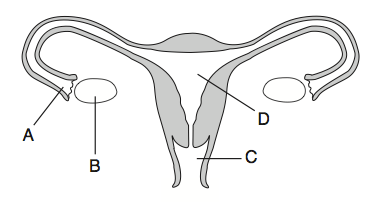
The function of part B is to _______.
produce eggs
produce sperms
allow fertilisation to take place
release the sperm
The correct path travel by the sperm out of the human body is?
testes -> sperm duct -> urethra
testes -> spermatic cord -> urethra
testes -> spermatic cord -> ureter
testes -> sperm duct -> ureter

The human male reproductive parts consist of _____________ and ___________.
anther and penis
testes and penis
sperm and testes
sperm and penis

Which is true for sexual reproduction?
It involves a male and female parts to reproduce.
It does not involve any male or female parts to reproduce.
It takes one mate to reproduce.
The ovaries in the human female reproductive system produced ______________.
egg
ovules
sperm
pollen grain

Fertilisation is when a sperm fuses with an egg.
True
False
A fertilised egg in the female human body attaches itself to the wall of the female's vagina.
True
False

A developing baby in a female's womb obtain its nutrients through the _________________________.
fallopian tube
pollen tube
umbilical cord
During reproduction, what are passed down from parents to their young?
Behaviours
Blood
Characteristics
Thumbprint
Both the young of humans and plants inherit their characteristics from their parents.
True
False
Sperms are produced by:
liver
testes
scrotum
uterus
Choose all the possible features of sexual reproduction
it involves two or more than two parents
it leads to variety in progeny
it occurs in bacteria
it involves production of gametes
Foetus is connected to the uterus by the structure called:
Umbilical cord
Placenta
Amniotic Cord
Zygotic cord
The lower part of uterus is known as :
Vagina
Fallopian tube
Accessory space
Cervix
Release of an egg from the ovary is known as :
Fragmentation
Ovarization
Ovulation
Fertilization

Identify the process.
Fertilization
Mensuration
Menstruation
Sexualization
Select the correct statement regarding the male reproductive system.
Penis is the reproductive organ
Oestrogen is the male reproductive hormone
Oviduct carries sperms
A sperm reaches the oviduct for fertilization
A stage in woman's life when menstrual period stops permanently is called:
menstruation
menarche
menopause
none of the above
Sperm mixed with fluid secreted by accessory gland is :
seminal vesicle
spermination
semen
simin
The ovaries in the human female reproductive system produced ______________.
egg
ovules
sperm
pollen grain
A _______________ is any sex cell. (egg or sperm)
zygote
gamete
chromosome
gene

female sex cell
zygote
egg
sperm
meiosis

male sex cell
egg
zygote
sperm
diploid cell
Which cells can swim?
egg cell
sperm cell
Controls the passage of materials inside and outside of the cell.
cell membrane
nucleus
cytoplasm
gametes are
haploid
diploid
the zygote is
haploid
diploid
the part of sperm cells that allows them to move
nucleus
flagella
cytoplasm
acrosome
the part of sperm cells that contains enzymes to digest the jelly coating of the egg
nucleus
flagella
cytoplasm
acrosome
egg cells do NOT have
cytoplasm
nucleus
jelly coat
acrosome
why does the jelly coat of the egg change after fertilisation
to prevent any more sperm from entering
to provide the embryo with oxygen
to protect the embryo
to allow other sperm to enter
What is the scientific name for a sex cell?
Gromets
Embryo
Gamete
Stem cell
What is the scientific name for a sex cell?
Gromets
Embryo
Gamete
Stem cell
What is the name of the male gamete in humans?
Sperm
Ovum
Testis
Pollen
What is the name of the female gamete in humans?
Sperm
Zygote
Ovary
Ovum
what is/are the function(s) of testes?
produce sperms
produce testosterone
produce progesterone
keep a lower body temperature
Where in the body does fertilisation occur in humans?
Epididymis
Uterus
Oviduct
Vagina
The prostrate gland secretes.....................
nutrients only
nutrients and hormones only
nutrients and enzymes only
The function of part B is to _______.
produce eggs
produce sperms
allow fertilisation to take place
release the sperm
Therer are .......... chromosomes inside each gametes of a human and ......... chromosomes inside the zygote of a human.
23; 23
23; 46
46; 23
46; 46
The correct path travel by the sperm out of the human body is?
testes -> sperm duct -> urethra
testes -> spermatic cord -> urethra
testes -> spermatic cord -> ureter
testes -> sperm duct -> ureter
Length of menstrual cycle can be affected by
Stress
Malnutrition
Illness
Exercise

What is asexual reproduction?
No reproduction.
Reproduction with TWO parents.
Reproduction with only ONE parent.
Any reproduction.

What is sexual reproduction?
Any type of reproduction.
Reproduction with TWO parents.
Reproduction with ONE parent.
No reproduction.

Which type of reproduction creates offspring with MORE genetic variation?
Sexual Reproduction
Asexual Reproduction

Which type of reproduction results in offspring that are CLONES of their parents?
Sexual Reproduction
Asexual Reproduction

What is heredity?
The passing of traits from parent(s) to offspring.
The passing of genes in plants.
The passing of genes from offspring to parents.
A scary movie.

What is a gene?
A type of pants.
The offspring of an organism.
What an organism looks like.
A unit carrying the specific recipe for an organism's traits.

What is an example of a genotype? (Pick 2)
My eye color.
My DNA.
My genes.
My height.

What is an example of phenotype? (Pick 2)
My eye color.
My genes
My DNA
My nose.
What are some organisms that can reproduce asexually? (Pick 3)
Humans
Spider Plants
Yeast Cells
Sea Stars
What are some organisms that can reproduce sexually? (Pick 2)
Humans
Yeast Cells
Cats
Spider Plants
What are some benefits of asexual reproduction? List at least two and explain why.
What is one drawback of asexual reproduction?
What is one benefit of sexual reproduction? What is one drawback of sexual reproduction?

What is a dominate allele?
The better version of an allele.
The stronger allele.
Version of a gene that will usually show up in the phenotype.
Version of a gene that will NOT usually show up in the phenotype.

What is a recessive allele?
The bad version of an allele.
The weaker version of an allele.
Version of a gene that will usually show up in the phenotype.
Version of a gene that will usually be hidden.

What does heterozygous mean?
Having different genes.
Having different alleles for one gene.
Having the same allele for one gene.

What does homozygous mean?
Having the same allele for a gene.
Having different alleles for a gene.
Having the same genes.
True or False: Having the dominant alleles is ALWAYS BETTER than having a recessive allele.
True
False
Which is true for sexual reproduction?
It involves a male and female parts to reproduce.
It does not involve any male or female parts to reproduce.
It takes one mate to reproduce.
The human male reproductive parts consist of _____________ and ___________.
anther and penis
testes and penis
sperm and testes
sperm and penis

The female reproductive parts consists of __________________________________________.
ovaries and ovules.
ovaries and womb.
ovaries, womb and vagina.
ovaries, stigma and style.
The ovaries in the human female reproductive system produced ______________.
egg
ovules
sperm
pollen grain
The testes in male reproductive system produce _________________.
ovules
sperm
pollen grain
testes
Fertilisation is when a sperm fuses with an egg.
True
False
A fertilised egg in the female human body attaches itself to the wall of the female's vagina.
True
False
A developing baby in a female's womb obtain its nutrients through the _________________________.
fallopian tube
pollen tube
umbilical cord
During reproduction, what are passed down from parents to their young?
Behaviours
Blood
Characteristics
Thumbprint

What are some observable characteristics that are passed on to young from parent?
Single or double eyelids, colour of hair and shape of nose.
Single or double eyelids, blood type, and tumbprint.
How similar is sexual reproduction in flowering plants and in humans?
It involves the fusion of pollen grain and sperm.
It involves the fusion of ovaries and ovules.
It involves the fusion of male and female reproductive cells.
It does not involve any fusion of male and female reproductive cells.
When flowering plants or humans reproduce, they pass on characteristics from one generation to another. This ensures that each kind continues to exist.
True
False
Both the young of humans and plants inherit their characteristics from their parents.
True
False

Sperms are produced by:
liver
testes
scrotum
uterus
Choose all the possible features of sexual reproduction
it involves two or more than two parents
it leads to variety in progeny
it occurs in bacteria
it involves production of gametes
Foetus is connected to the uterus by the structure called:
Umbilical cord
Placenta
Amniotic Cord
Zygotic cord
The lower part of uterus is known as :
Vagina
Fallopian tube
Accessory space
Cervix
Release of an egg from the ovary is known as :
Fragmentation
Ovarization
Ovulation
Fertilization
Male peacocks have colourful feathers while the peahen is dull coloured. What is is called?
sexual dimorphism
parthenogenesis
external morphism
differential dimorphism
Identify the process.
Fertilization
Mensuration
Menstruation
Sexualization
Select the correct statement regarding the male reproductive system.
Penis is the reproductive organ
Oestrogen is the male reproductive hormone
Oviduct carries sperms
A sperm reaches the oviduct for fertilization
A stage in woman's life when menstrual period stops permanently is called:
menstruation
menarche
menopause
none of the above
Sperm mixed with fluid secreted by accessory gland is :
seminal vesicle
spermination
semen
simin
The female reproductive parts consists of __________________________________________.
ovaries and ovules.
ovaries and womb.
ovaries, womb and vagina.
ovaries, stigma and style.
The ovaries in the human female reproductive system produced ______________.
egg
ovules
sperm
pollen grain
A developing baby in a female's womb obtain its nutrients through the _________________________.
fallopian tube
pollen tube
umbilical cord
During reproduction, what are passed down from parents to their young?
Behaviours
Blood
Characteristics
Thumbprint
What are some observable characteristics that are passed on to young from parent?
Single or double eyelids, colour of hair and shape of nose.
Single or double eyelids, blood type, and tumbprint.
How similar is sexual reproduction in flowering plants and in humans?
It involves the fusion of pollen grain and sperm.
It involves the fusion of ovaries and ovules.
It involves the fusion of male and female reproductive cells.
It does not involve any fusion of male and female reproductive cells.
In which of the following structures of the female human reproductive system is the developed egg developing during gestation?
Ovary
Womb
Vagina
Fallopian tube
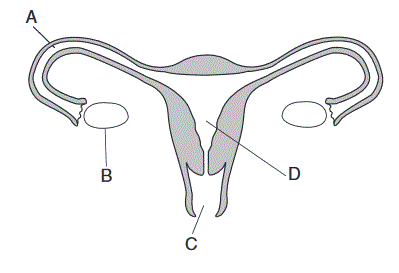
The diagram below represents structures found in the female reproductive system. If the areas labeled A were completely blocked on both sides, the most likely result would be that
egg production would stop
sperm production would stop
fertilization would not occur
an embryo would develop
What is the female reproductive organs that produce eggs?
Ovary
Testes
Womb
Penis
What is the male reproductive organs that produce sperms?
Penis
Fallopian tube
Testes
Ovary

Mr. Robinson's hairline is straight, and Mrs. Robinson has a widow's peak. Which sentence best explains why their son has a straight hairline?
He brushes his hair the same way his father brushes his hair.
He cuts his hair the same way his mother cuts her hair.
He inherited his hairline from his father.
He inherited his hairline from his parents.
Characteristics which are unable to be passed down
eye color
length of hair
shape of ears
type of chin
Which statement is false about the similarity of the human and plant reproduction system?
Both involve the passing on of characteristics from parents to young
Both will need to disperse their young far away
Both involve the fusion of the male and female reproductive cell
Both involve the production of male and female reproductive cells from the male and female respectively
Which of the following correctly describes sexual reproduction in humans?
Fertilisation of the egg takes place inside the male's body.
Many eggs are fertilised by one sperm.
The fertilised egg develops in the stomach.
Fertilisation occurs when a sperm and an egg fuse.
The word 'inherited' means _______________.
reproduced
fertilised
passed on
gave birth

Where does fertilization occur?
The womb
The fallopian tube
The ovary
The vaginal
Which of the following statements is true?
If one of the testes is damaged, reproductive cells cannot be produced as the reproductive parts must work in pairs
The ovary releases a large number of eggs to increase the chance of an egg getting fertilized
The testes produce a large number of sperms since birth
If one of the ovaries is damaged, eggs can still be released by the remaining ovary

