
Font size
 Worksheets
Newton's Laws of Motion
Total questions: 65
Worksheet time: 2hrs 10mins
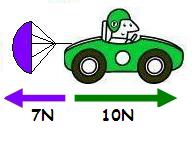
What is the net force?
Calcula la fuerza neta del objeto en la imagen que se muestra.
3 N
3 N, right
17 N, right
3 N, left


A force can cause an object to
accelerate
slow down
remain in place
all of the above


Force is equivalent to which measurement...
distance (m)
weight (lbs)
mass (g)
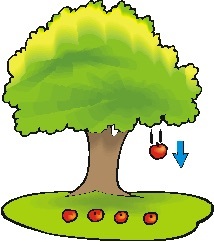
Mass of an object can be defined by...
the size of the object
gravitational pull of the object
the amount of matter in the object
The greater the mass of an object, the greater the amount of ______ is needed to make it accelerate.
Force
Matter
Acceleration
Velocity
In the equation f=ma, what does the "m" stand for
acceleration
matter
mass
force
According to Newtons Third Law of Motion, every action has an equal and opposite _________.
gravity
force
mass
reaction
In the equation f=ma, "F" stands for _______.
force
mass
velocity
acceleration
What is velocity?
It is only the acceleration of an object
It is the speed AND direction of an object.
Only the direction of an object
None of the above
What is a PUSH or a PULL of an object?
Motion
Friction
Force
Gravity

What causes a ball rolling across a rug to slow to a stop?
The rug doesn't have enough force to hold the ball.
Friction resists the ball's forward motion.
The rug doesn't have enough momentum to keep the ball moving.
The ball isn't moving fast enough.
Who developed the 3 laws of motion?
Bill Nye
Charles Darwin
Albert Einstein
Sir Isaac Newton
The resistance of any physical object to any change in its state of motion or rest.
force
gravity
inertia
The resistance when a surface of an object moves over another surface is known as what?
gravity
force
friction
acceleration
acceleration increases
nothing happens
it becomes more massive
acceleration decreases
If an object has a small mass, it wouldn't need as strong of a force to accelerate it. Which law does this describe?
Newton's 1st Law
Newton's 2nd Law
Newton's 3rd Law
Newton's 4th Law
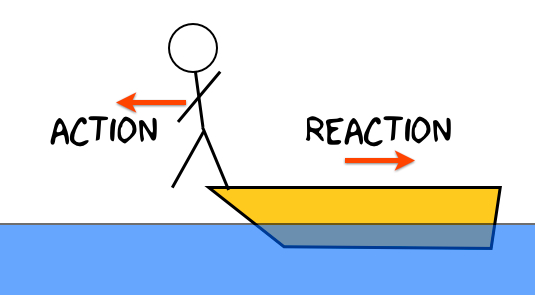
For falling objects, the acceleration constant due to gravity is...
9.8 m/s2
13.0 m/s2
2.0 m/s2
Law of Inertia
Newton's 1st Law
Law of Acceleration
Newton's 2nd Law
Law of Action/Reaction
Newton's 3rd Law
static
Friction at Rest
sliding
Friction between objects sliding pass each other
rolling
Friction from use of wheels, ball bearing, etc...
fluid
Friction from liquids or gases
sliding
Friction between the wheels and the road slows your bike to a stop.
Factors that affect the amount of friction between against an object are
mass
surface texture
inertia
distance
The measure of the gravitational force pulling on a mass is
mass
weight
magnetism
g or kg
unit for mass
N
unit for force
m/s2
unit for acceleration
directly proportional
as one amount increases, another amount increases at the same rate
indirectly proportional
when the value of one quantity increases with respect to a decrease in another or vice-versa
directly proportional
The greater the force that is applied, the greater the acceleration
indirectly proportional
If the same force is applied to an object with a large mass, it will have a lesser acceleration
Force arrows are used to represent the ____________ and direction of the forces.
length
magnitude
distance
inertia

Newton's 1st law

Newton's 2nd law

Newton's 3rd law

Newton's 1st law

Newton's 3rd law
Which accurately describes acceleration?
speeding up/slowing down only
slowing down to change direction only
speeding up, slowing down, & changing direction
The gravitational pull between objects increases as objects move farther away from each other.
True
False
The factors that affect gravitational pull on an object are MASS and DISTANCE.
True
False
A baseball bat hits a baseball with a force of 100 Newtons. What is the force and its direction exerted by the ball on the bat?
100 Newtons, same direction
100 Newtons, opposite direction
200 Newtons, opposite direction
200 Newtons, same direction
Friction and air resistance are forces that:
can make an object slow down or stop
pulls an object toward the center of Earth
changes an object's position
can't be described

(Use a=F/m) Jenny applies a 60 N force to a 20 Kg cart, what is the acceleration of the cart if friction can be neglected?
1200 m/s/s
0.33 m/s/s
20 m/s/s
3 m/s/s
If an object is at rest, then there are no forces acting upon the object.
True
False
(Using Fnet=ma), What net force is required to accelerate a car at a rate of 2 m/s2 if the car has a mass of 3,000 kg?
6,000 N
1,500 N
3,002 N
2,998 N
(Use Fnet=ma), A 10 kg bowling ball would require how much unbalanced force to accelerate down an alleyway at a rate of 3 m/s2?
30 N
13 N
3.3 N
0.3 N
(Use m=F/a). What is the mass of a falling rock if its weight is 147 N? (Acceleration due to gravity = 9.8 m/s2)
15 kg
1,440.6 kg
156.8 kg
137.2 kg
(Use m=F/a). What is the mass of a truck if an unbalanced force of 14,000 N acting on it gives the truck an acceleration of 5 m/s2?
2,800 kg
0.0004 kg
70,000 kg
13,995 kg
(Use m=F/a). What is the acceleration of a softball when it hits a catcher's mitt if the softball has a mass of 0.5 kg and the catcher's mitt exerts a force of 25 N to slow the ball down?
0.5 kg
50 kg
25.5 kg
12.5 kg
(Use a=F/m). Your parents' car has a mass of 2,000 kg. If an unbalanced force of 5,000 N acts on the car, at what rate will the car accelerate?
2.5 m/s2
0.4 m/s2
10,000,000 m/s2
3,000 m/s2

(Use Fnet=ma). Use the diagram to determine the net force, assume the object is accelerating at a rate of 2 m/s2 and determine the mass of the object.
2 kg
4 kg
6 kg
8 kg

(Use Fnet=ma). Use the diagram to determine the net force, assume the object is accelerating at a rate of 3 m/s2, and determine the object's mass?
3 kg
5 kg
60 kg
75 kg

For the scenario, decide if the example is Newton's 1st, 2nd, or 3rd law.
1
2
3

For the scenario, decide if the example is Newton's 1st, 2nd, or 3rd law.
1
2
3

For the scenario, decide if the example is Newton's 1st, 2nd, or 3rd law.
1
2
3

For the scenario, decide if the example is Newton's 1st, 2nd, or 3rd law.
1
2
3

Analyze the image. Decide if what is depicted is true or false.
True
False
Inertia is Latin for which term?
balanced
movement
laziness

Who published the masterpiece Philosophiae Naturalis Principia Mathematica in 1687?
Sir Isaac Hayes
Albert Einstein
Sir Isaac Newton
Bill Nye
What has more inertia:
freight train at rest
freight train moving at 50 km/hr
If a 300-N action force is exerted to the right, the reaction force will be
300 N Right
600 N Right
300 N Left
600 N Left

