
 Worksheets
S2 U11-12 UT9 Review
Total questions: 65
Worksheet time: 1hrs 2mins
Light travels... (select 2 answers)
Around corners
In straight lines
Faster in glass than in air
Faster than sound

The picture shows 4 sound waves on an oscilloscope. Which has the highest pitch?
A
B
C
D
The picture shows 4 sound waves on an oscilloscope. What can you say about A?
It is a very low pitched sound
It is a very high pitched sound
It is a very quiet sound
It is a very loud sound
The picture shows 4 sound waves on an oscilloscope. Which 2 have the smallest amplitude?
A
B
C
D
Which statement is true of sound waves. Select 2 answers.
They are made by objects vibrating
They are detected because they make our ear drum vibrate
They are transverse waves
They travel faster in air than in water.
What is the height of a wave called?
Peak
Wavelength
Amplitude
Frequency
Sound waves are caused by the (a) of particles
The separation of white light after passage through a prism...
spectrum
dispersion
filter
refraction

A
B
Human can hear Ultrasound?
YES
NO
Select the correct answer: Ultrasound are...
sounds that only dolphins can produce
sounds that have a frequency above 20 000Hz
sounds that only superheroes can hear
sounds that are below 20 000Hz
From the words below, which one is linked with the Pitch of the sound
Amplitude
Loudness
Frequency
speed
Frequency is measured in
m/s
m
Hz
Decibel
(Hint: Think about our sound song.)
A straight line that shows the path of light
prism
shadow
ray
incident ray

Sound does not travel in space because
Distance is too far away.
There is no matter in space.
It is too dark.
Space has planets.
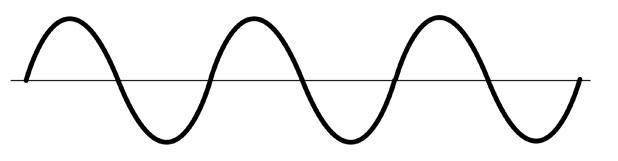
Why do we see lightning before we hear the thunder?
Lightning is an illusion.
Light travels faster than sound
Sound travels faster than light.
What happens to our hearing if we listen to loud noises all the time?
we appreciate music better
we get a ringing in our ears
we start to experience hearing loss
The volume of a sound is measured in units called ________
decibels
hertz
frequency
amplitude
Matter that carries sound waves is called a _________
particle
object
medium
matter

Which device measures sound waves?
Oscilloscope
Stethoscope
Antenna
Microscope
What is Pitch?
How loud or soft a sound is.
Muscle that holds vocal cords.
Movement back and forth.
How high or low a sound is.
Which of the following sound wave produces the highest pitch of sound?


What is changed in the second picture?
Someone is talking louder in picture 2
Someone is talking softer in picture 2
Someone is talking lower pitch in picture 2
Someone is talking higher pitch in picture 2

Which of these provides the best explanation for why the pencil appears broken?
The pencil absorbs the light rays that hit it.
Water reflects light rays away from the pencil.
Light rays are bent by the water in the glass.
The surface of the water reflects the light rays.
Caleb is sitting near the window on a sunny day. When he closes the curtain, the room becomes darker. What property of the curtain allows it to make the room darker?
The curtain absorbs light.
The curtain is brightly colored.
The curtain folds easily.
The curtain is rectangular shape.
Which of the following is the best example of an object absorbing light?
A black sweater in the sun.
A clean window in the sun.
A curved mirror in the sun.
A long shadow in the sun.

Which object refracted the laser beam?
Silver locket
Picture frame
Glass marble
Notebook
What is the best description of a transparent material?
no light passes through the material
some light passes through the material
all light passes through the material
What is the best description of an opaque material?
no light passes through the material
some light passes through the material
all light passes through the material
When this occurs, light rays pass from one transparent medium to another transparent medium.
Absorbtion
Transmission
Relfection
Refraction
When a light ray strikes a smooth, flat surface, what is the relationship between the angle of incidence and the angle of reflection?
They are equal.
The angle of incidence is twice that of the angle of reflection.
The angle of reflection is twice that of the angle of incidence.
They combine to add up to 180o.

In this diagram, which is the angle of incidence?
Angle A
Angle B
Angle C
Angle D
Objects that generate their own light are called:
luminous objects.
illuminated objects.
non-luminous objects.
reflective objects.
When an object moves closer to a light source, its shadow...
Gets smaller
Gets bigger
Changes shape
Stays the same size
Choose the three primary colors of light.
Pink
Red
Blue
Green
Which color has the longest wavelength and shortest frequency?
Red
Yellow
Blue
Violet
Which of these statements is true?
Light travels in straight lines
Light is stopped when it meets a solid object
Light does not travel in straight lines
Light will only travel for about 2000 km before it stops
Which phrase best completes the following sentence? We can read a book because:
it is luminous
a light shines on it
light is reflected by the book and enters our eyes
light from our eyes shines on the book
Which statement is true?
Sound travels faster than light
Light does not travel. It is either on or off
Light travels faster than sound
Light and sound travel at the same speed
Which of these statements is true?
Light bounces evenly off rough surfaces
Light bounces evenly off smooth surfaces such as mirrors
Light bounces off mirrors in all directions
Light does not bounce off mirrors

How big will the angle of reflection be?
20°
40°
30°
60°
Refraction is what happens when light:
hits an opaque object
bounces off a mirror
is scattered unevenly by a rough surface
changes direction as it goes from one substance into another
FROM EAR TO BRAIN: What's next?
sound waves travel down the ear canal --> ___________
vibrations push on the eardrum
small bones tap on the cochlea
eardrum pushes on the 3 small bones
vibrations travel through the liquid and reach the nerves at the back of the cochlea
A red filter:
absorbs red light
lets through all colours of light
only lets red light through
changes all the colours into red light
Blue objects look blue because:
they reflect all colours
they refract all colours
they absorb blue light
they reflect blue light
Danny is wearing white shorts and a red shirt. Which statement is most likely to be true?
In blue light, his shorts look blue and his shirt looks black
In blue light, his shorts look blue and his shirt looks red
In red light, his shorts look red and his shirt looks black
In green light, his shorts look red and his shirt looks yellow


What part is #1?
Pinna
Ear Canal
Ear Drum
Oval Window
What part is #2?
Pinna
Ear Canal
Ear Drum
Oval Window
What part is #3?
Pinna
Ear Canal
Ear Drum
Oval Window
What part is #7?
Semicircular Canals
Eustachian Tube
Cochlea
Oval Window
The auditory nerve sends signals to the ....
cochlea
ear drum
brain
FROM EAR TO BRAIN: What's next?
vibrations push on the eardrums --> ___________
sound waves travel down the ear canal
small bones tap on the cochlea
eardrum pushes on the 3 small bones
vibrations travel through the liquid and reach the nerves at the back of the cochlea
FROM EAR TO BRAIN: What's next?
eardrum pushes on the 3 small bones --> ___________
sound waves travel down the ear canal
small bones tap on the cochlea
vibrations travel down the ear canal
vibrations travel through the liquid and reach the nerves at the back of the cochlea

