wayground logo

Free Printable Worksheets

Font size

S
M
L
XL
Worksheets

Nervous/endocrine/homeostasis quizizz

Total questions: 98

Worksheet time: 2hrs 32mins

Name
Class
Date
1.

Endocrine glands secrete _

a)

Hormones

b)

Neurotransmitters

c)

A wide range of chemical substances

2.

What is the endocrine system?

a)

A system of vessels that circulates blood around the body.

b)

A group of bones and tissue that provides support and structure for the body.

c)

A group of glands that work together with the nervous system to coordinate all body functions

d)

A group of organs that is responsible for eliminating wastes.

3.

What is the main function of the endocrine system?

a)

It creates chemicals, or hormones, that are sent around the body to maintain homeostasis.

b)

It creates electrical messages that are sent around the body to maintain homeostasis.

c)

It maintains the correct level of oxygen in the body to maintain homeostasis.

d)

It releases waste from the body to maintain homeostasis.

4.

The "master gland" is known as the __________________.

a)

thyroid gland.

b)

adrenal gland.

c)

pancreas.

d)

pituitary gland.

5.
The gland that stimulates body metabolism
a)
Thyroid
b)
testes
c)
ovary
d)
adrenal
6.

The adrenal glands release adrenaline to help the body regulate _________________.

a)

diseases

b)

body temperature.

c)

stress.

d)

hormones.

7.

Which of the following are chemicals that travel in the blood and cause changes in different parts of the body?

a)

Hormones

b)

Glands

c)

Parathyroid

d)

Adrenal Gland

8.

The response to stress is called

a)

Stay or Stray Response

b)

Fight or Stay Response

c)

Flee or Stray Response

d)

Fight or Flight Response

9.

Which term refers to the body's use of energy for energy and growth?

a)

Excretion

b)

Metabolism

c)

Digestion

d)

Respiration

10.

Hormone regulation operates under which type of feedback mechanism?

a)

positive feedback

b)

negative feedback

c)

zero feedback

d)

Hormones are not regulated

11.

Feedback loops are important because they allow organisms and the environment to

a)

change based on new inputs

b)

fall apart

c)

change based on new outputs

d)

maintain balance

12.
If the environment gets cold, we will often shiver in order to:
a)
keep body temperature the same as the external temperature
b)
decrease body temperature
c)
increase body temperature
d)
regulate blood pressure
13.
If you have diabetes, you most likely have a problem with this hormone.
a)
ADH
b)
Glucagon
c)
Insulin
d)
PTH
14.

Produces the hormone insulin and glucagon, which controls the level of glucose in the blood.

a)

Thyroid Gland

b)

Pancreas

c)

Thymus Gland

d)

Pituitary Gland

15.

These release testosterone, which controls changes in a male's body and regulates sperm production.

a)

Ovaries

b)

Target Cells

c)

Parathyroids

d)

Testes

16.
Are chemicals that travel in the blood and cause changes in different parts of the body
a)
Hormones
b)
Glands
c)
Parathyroid 
d)
Adrenal Gland 
17.
Where are the adrenal glands located?
a)
One on each side of the larynx
b)
On top of the kidneys
c)
Behind the orbital bone
d)
The inner ear
18.
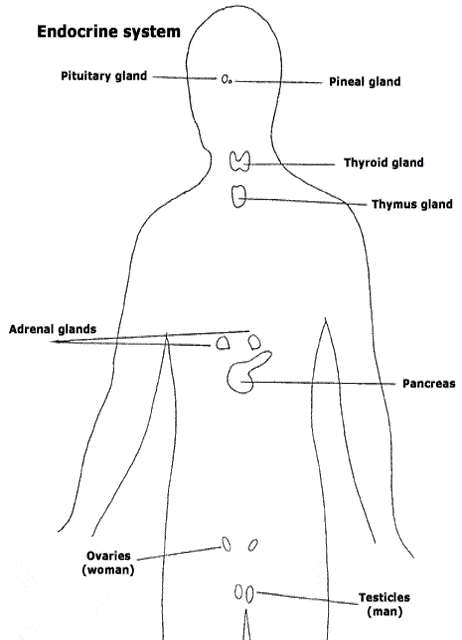
What is gland #3?
a)
Adrenal Gland
b)
Pancreas
c)
Ovaries
d)
Testes
19.

Letter J is pointing to

a)

Ovaries

b)

Pineal Gland

c)

Adrenal

d)

Testes

20.
Letter I is pointing to
a)
Testes
b)
Oviducts
c)
Ovaries
d)
Adrenals
21.

The gland labeled 4 in the diagram is?

a)

the thymus gland

b)

the thyroid gland

c)

the parathyroid glands

d)

the adrenal glands

22.

Prolactin is a hormone that..

a)

Initiates milk production

b)

Creates growth hormones

c)

Helps with sexual reproduction

d)

Helps keep metabolism in check

23.

Which of the following is NOT a complication involved with the pituitary gland?

a)

Water diabetes

b)

Prolactinoma

c)

Acromegaly

d)

Hypothyroidism

24.

Hyperthyroidism is associated with too much or too little hormones?

a)

Too much

b)

Too little

25.

Hypothyroidism is associated with too much or too little hormones?

a)

Too much

b)

Too little

26.

Which of the following is NOT an exocrine gland?

a)

Sweat Glands

b)

Salivary Glands

c)

Mammary Glands

d)

Adrenal Gland

27.

Hormones that send messages through our endocrine system have a ______________ lasting response

a)

Short

b)

Long

c)

Medium lasting

d)

Fast

28.

In the endocrine system, hormones send messages _____________

a)

Slowly

b)

Fast

c)

At a medium speed

d)

At a speed that depends on which gland the messages are coming from

29.

The endocrine system is a collection of _____________ which produce ______________ into the __________________

a)

Organs, nerve impulses, capillaries

b)

Neurons, hormones, brain

c)

Glands, hormones, bloodsteam

d)

Glands, nerve impulses, bloodstream

30.

Organs working together to maintain a stable internal environment through stability and balance is called

a)

Diabetes

b)

Heart disease

c)

Vasopressin

d)

Homeostasis

31.

Which gland is located at the base of the brain

a)

Hypothalamus

b)

Thalamus

c)

Pituitary gland

d)

Cerebrum

32.

The nervous system and the endocrine system are similar due to the fact that they both

a)

Use electricity to send messages very quickly

b)

Produce a fast and short response

c)

Send messages around your body

d)

Send messages slowly using chemicals

33.
What transports substances around the body?
a)
Blood
b)
Sweat
c)
Tears
d)
Urine
34.
What is involuntary contractions of voluntary muscles to warm up?
a)
Shivering
b)
Sweating
c)
Vasodilation
d)
Vasoconstriction
35.
What is the evaporation of a liquid to cool the body?
a)
Shivering
b)
Sweating
c)
Vasodilation
d)
Vasoconstriction
36.
Which of the following is an example of positive feedback to indirectly maintain homeostasis?
a)
the chemical reactions involved in blood clotting
b)
your blood vessels dilate and you begin to sweat in response to elevated body temperature
c)
your blood vessels constrict and you begin to shiver in response to low body temperature
d)
your coach compliments you on your performance in practice
37.
Homeostasis
a)
allows for a wildly fluctuating internal environment
b)
is impossible in vertebrates
c)
is the maintenance of a relatively stable internal environment and often incorporates a form of feedback regulation
d)
is the maintenance of a relatively stable external environment and often incorporates a form of feedback regulation
38.
Homeostasis in the human body is often maintained by a: 
a)
neutral feedback loop 
b)
solar feedback loop
c)
positive feedback loop
d)
negative feedback loop
39.
Positive feedback is when the change caused by the stimulus is
a)
decreased
b)
non existant
c)
increased
d)
changes constantly
40.
When you get cut, your skin cells release hormones that signal platelets to come and stop the bleeding. Platelets then release more hormones that signal even more platelets to help stop bleeding. The hormone signals continue until the cut is closed.
a)
Positive Feedback Response
b)
Negative Feedback Loop 
41.
When you are cold, you shiver and your blood vessels contract, which warms you up. When you are hot, you sweat and your blood vessels expand, which cools you down.  
a)
Positive Feedback Response
b)
Negative Feedback Loop 
42.

Sweating is an example of:

a)

Saying a nasty word.

b)

What a Ghost does in a Steam Room

c)

Positive Feedback Loop

d)

Negative Feedback Loop

43.
Which diagram represents an organ?
a)
#1
b)
#2
c)
#3
d)
#4
44.
Which is the largest structure?
a)
Cells
b)
Tissue
c)
Organ
d)
Organism
45.

Which body system controls the body to maintain homeostasis?

a)

excretory

b)

nervous

c)

circulatory

d)

skeletal

46.

How are viruses different than bacteria, fungi, and parasites?

a)

Viruses are not living

b)

Viruses reproduce quickly

c)

Viruses can infect the cells of a variety of organisms

47.

How are viruses, fungi, bacteria, and parasites similar?

a)

they all carry out sexual reproduction

b)

they are all living

c)

they are all made up of cells

d)

they all contain genetic material

48.

What is the large object in the middle a picture of?

a)

bacteria

b)

fungi

c)

virus

d)

parasite

49.

What is an example of a positive feedback mechanism?

a)
b)
50.
The two types of feedback systems that help organisms maintain homeostasis are:
a)
positive and negative 
b)
receptor and effector
c)
static and dynamic
d)
minor and major
51.
Maintaining body temperature is an example of a:
a)
negative feedback loop
b)
positive feedback loop
52.
The term for maintaining internal temperature is: 
a)
Thermoregulation
b)
Thermometer
c)
Homeothermal
d)
Homeostasis
53.
Rapid growth during puberty causes your body to release more and more growth hormones. As you grow, more and more growth hormones are released until puberty is reached, and then the hormones stop.
a)
Positive Feedback Response
b)
Negative Feedback Loop 
54.
If the calcium in your blood decreases below homeostasis levels, a gland in the brain will sense the decrease and send a chemical message to your bones. Your bones will release calcium into the blood, bringing blood calcium levels back up.
a)
Positive Feedback Response
b)
Negative Feedback Loop 
55.
When glucose levels in the blood rise, your brain sends a signal to your pancreas. The pancreas releases insulin, which opens channels in cell membranes to allow glucose to enter the cell, lowering blood sugar levels. 
a)
Positive Feedback Response
b)
Negative Feedback Loop 
56.
Homeostasis
a)
allows for a wildly fluctuating internal environment
b)
is impossible in vertebrates
c)
is the maintenance of a relatively stable internal environment and often incorporates a form of feedback regulation
d)
is the maintenance of a relatively stable external environment and often incorporates a form of feedback regulation
57.
When you get cut, your skin cells release hormones that signal platelets to come and stop the bleeding. Platelets then release more hormones that signal even more platelets to help stop bleeding. The hormone signals continue until the cut is closed.
a)
Positive Feedback Response
b)
Negative Feedback Loop 
58.
Which system sends electrical messages that helps control the body's responses to internal and external changes?
a)
nervous
b)
endocrine
c)
reproductive
d)
integumentary
59.

What hormone is produced in the pancreas that lowers blood sugar?

a)

Insulin

b)

Glucagon

c)

Ketones

d)

Glucose

60.
which of the factors not affecting the internal environment?
a)
Temperature
b)
Respiration
c)
pH value
d)
Osmotic pressure
61.
which of the organ will balance the glucose level in the body?
a)
Stomach
b)
Small intensine
c)
Deodenum
d)
Pancrease
62.
what is the function of integumentary system to control body temperature high?
a)
arterioles in the epidermis dilate so that more blood flow to the skin
b)
produce hormones to reduce the metabolic rate
c)
sweat glands in the skin produce more sweat and hair erector mucles relax to let the hair lie down
d)
detect the temperature and send to nerve impulses to the brain
63.

The group of organisms that use the process of homeostasis includes

a)

mammals, only

b)

animals, only

c)

plants and animals

d)

all living things

64.
The tendency of an organism to maintain a balanced state in order to stay healthy.
a)
Stimuli
b)
Response
c)
Tropism
d)
Homestasis
65.
a body system that controls growth and homeostasis by secreting hormones from glands.
a)
skeletal system
b)
nervous system
c)
endocrine sytem
d)
integumentary system
66.
Negative Feedback Loops:
a)
amplify processes
b)
prevent small changes from getting larger
c)
are initiated during childbirth
d)
are found only in plants
67.
Name the levels of organization in the human body in order from smallest to largest:
a)
Tissue, organ, organ system
b)
Organ system, tissue, organs, cells
c)
Cells, tissue, organs, organ system
d)
Cells , organs, tissue, organ system
68.

What does the nervous system do?

a)

Pumps blood from your heart to your body

b)

Carries messages back and forth between your brand and the rest of your body

c)

Breaks up food

d)

Secrete hormones.

69.

What are the 3 mains parts of the Nervous System

a)

Brain, heart, blood vessels

b)

Blood Vessels, spinal cord, blood

c)

Brain, Spinal Cord, Neurons

d)

Heart, blood vessels, and blood

70.

What is considered the command center of the nervous system?

a)

Neurons

b)

Heart

c)

Spinal Cord

d)

Brain

71.

What are the senses that the nervous system receives messages from? (mark all that apply)

a)

Vision

b)

Hearing

c)

Smell

d)

Taste

e)

Touch

72.

What kind of cells make up the nervous system?

a)

Plasma

b)

Neurons

c)

Blood Vessels

d)

Spinal Cord

73.

What makes up the Central Nervous System?

a)

Blood and Heart

b)

Spinal Cord

c)

Nerves

d)

Brain and Spinal Cord

74.

List all that the brain controls. (mark all that apply)

a)

Thoughts

b)

Speech

c)

Memory

d)

Muscles Movement

e)

None of the above

75.

What does the cerebrum control?

a)

Memory, language, and thoughts.

b)

Heartbeat, swallowing, and blinking.

c)

Coughing and sneezing

d)

Standing, running, waving, and speaking.

76.

What does the cerebellum control?

a)

involuntary muscle movement

b)

voluntary muscle movement

c)

thoughts, speech, memory

d)

none of the above.

77.

The spinal cord is.....

a)

The command center of the nervous system

b)

The body's message and control center

c)

A long bundle of neurons that sends messages to and from the brain and all parts of the body.

d)

All of the above.

78.

What is the Peripheral Nervous System consist of?

a)

The brain

b)

The spinal Cord

c)

The nerves that connect the CNS to all parts of the body.

d)

All of the above.

79.

And injury to the spinal cord can lead to paralysis.

a)

True

b)

False

80.

What is paralysis?

a)

Loss of feeling or unable to move some body parts

b)

Able to jump around

c)

Able to run

d)

None of the above.

81.

How can you keep the nervous system healthy?

a)

Make healthful food choices

b)

Drink plenty of water

c)

Get plenty of sleep

d)

All of the above

82.

What is this? It coordinates muscle movements.

a)

Cerebrum

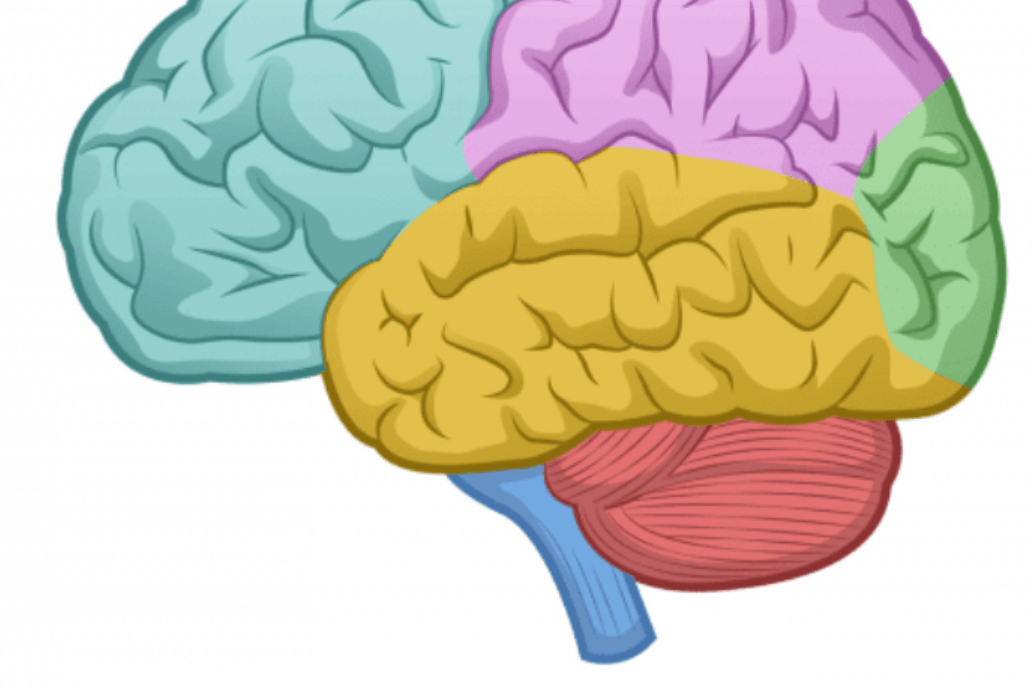
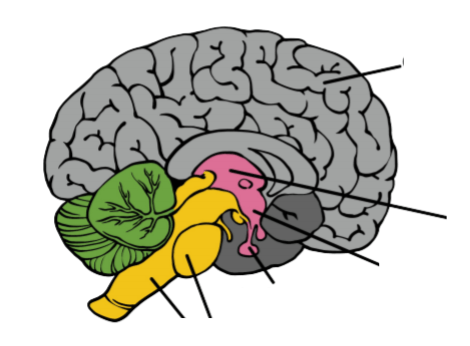
b)

Cerebellum

c)

Brain Stem

d)

Diencephalon

83.

What structure is bright blue and located at bottom of the brain and controls the information sent between brain and rest of the body?

a)

Cerebrum

b)

Cerebellum

c)

Brain Stem

84.

What structure is grey in this picture. It controls conscious thought and memory?

a)

Cerebrum

b)

Cerebellum

c)

Brain Stem

85.

What is the gap between two neurons called?

a)

Impulse

b)

Synapse

c)

CNS

d)

Inter neuron

86.

Select the VOLUNTARY action.

a)
b)
c)
d)
87.

Select the INVOLUNTARY action.

a)
b)
c)
d)
88.
The long, fiber like part of a neuron which the cell sends information to receiving neurons
a)
axon 
b)
dendrite
c)
axon terminal
d)
gene
89.
This insulating material forms a layer, around the axon of a neuron.  It enables electrical signals to travel down the axon at higher speeds.
a)
neuron
b)
myelin sheath
c)
dendrite
d)
neurotransmitter
90.
E
a)
Synapse
b)
Cell Body
c)
Axon 
d)
Dendrite
91.

The part of the PNS that controls involuntary actions

a)

autonomic nervous system

b)

somatic nervous system

c)

organic nervous system

d)

reflexive nervous system

92.
A chemical produced by neurons that carries messages to other neurons
a)
myelin sheath
b)
neurotransmitter
c)
axon
d)
axon terminal
93.
The tiny gap between neurons where nerve impulses are sent from one neuron to another.  It is where communication occurs between an axon and dendrite
a)
synapse
b)
axon terminal
c)
impulse
d)
myelin
94.
This part of the neuron stores then releases neurotransmitters into the synapse.
a)
Axon 
b)
Dendrite
c)
Myelin Sheath
d)
Axon Terminal
95.
The neurotransmitter enters the post-synaptic cell to cause depolarization.
a)
True
b)
False
96.
Heartbeat would be accomplished by which branch of the nervous system?
a)
Sensory
b)
Autonomic
c)
Motor
d)
Pineal
97.
This nervous system branch causes increases in heart rate and breathing.
a)
Sympathetic
b)
Parasympathetic
c)
Motor
d)
Sensory
98.
Sensory stimuli that generate reflexes generally are processed by the brain before signals are sent to effectors.
a)
True
b)
False