
 Worksheets
interia quiz
Total questions: 129
Worksheet time: 2hrs 41mins
Newton's First Law States........
Objects at rest tend to stay at rest unless acted on by an outside force.
Objects accelerate often and it is difficult to know when or how they will accelerate.
Objects in motion tend to stay in motion unless acted on by an outside force.
Both A & C
What is inertia?
An object that is accelerating
Gravitational force
An objects tendency to stay at rest or in motion
An unbalanced force
Inertia depends on __________.
Weight
none of these
Mass
Acceleration
What formula is used to calculate force?
Acceleration = Force x Mass
Force = Mass x Acceleration
Work = Force x Distance
Mass = Force + Acceleration
A force of 40 N acts upon a 2 kg block. Calculate the acceleration of the object.
20 m/s2
20 m/s
80 m/s2
80 m/s
Newton's third law states.......
For each action there is a larger reaction associated with it.
None of these choices
For each action there is an equal and opposite reaction.
For each action there is a smaller reaction associated with it.
The tendency of an object to just keep doing what it is doing.
Laziness
F=MA
No Clue
Inertia

Newton's 3rd Law

Newton's 3rd Law

True or False? Mass changes depending on what planet you are on.
True
False
A 10 kg bowling ball would require what force to accelerate it down an alleyway at a rate of 3 m/s2?
The tendency of a moving object to keep moving is (a) .
What is the acceleration of a softball if it has a mass of 0.50 kg and hits the catcher's glove with a force of 25 N?
A cart continues with constant velocity. What would have to be done in order to have the cart continue with constant acceleration?
Push the cart harder before release.
Push the cart longer before release.
Push the cart continuously.
Change the mass of the cart.
When you climb up a rope, the first thing you do is pull down on the rope. How to you manage to go up the rope by doing that?
this slows your initial velocity, which is already upward
you are pulling the ceiling down
you don't go up, you are too heavy
the rope actually pulls you up
Consider two identical blocks. Block A is resting on a flat surface. Block B is resting on an incline. For which case is the normal force greater?
Case A
Case B
both the same
When the force is doubled on an object, how does the acceleration change?
doubled
half
acceleration becomes zero
acceleration doesn't change
According to Newton's first law, an object at rest remains at rest as long as no ___ ______ acts on it.
(a)
The weight of an object is equal to its mass times the acceleration due to (a) .
Which object has the greater inertia?
5 kg rock
7 kg of groceries
6 kg of feathers
8 kg bowling ball
True or False. Only moving objects have inertia.
True
False
What is the weight of a girl with a mass of 30 kg on Earth?
What is NOT a force that controls the motion of everyday objects?
gravity
acceleration
friction
applied force
A force is a vector because it has both a magnitude and (a) .
What is the term used to describe the push or a pull on an object?
density
volume
force
mass
Newton's second law states that the acceleration of an object equals the net force acting on the object divided by the object’s (a) .
Mass is a measure of how much ________ an object has.
force
matter
weight
mass
Weight is a measure of how stronly an objects mass is attracted to _________ (Ms. P does not agree with this phrase and had to clarify)
mass
gravity
force
acceleration
If you have an object with a mass that is accelerating, and accelerating means a change in velocity that is equal to the amount of ________ applied to the object.
mass
weight
matter
force
Newton's Second Law of Motion can be summed up by the formula:
f=ma
m=fa
forces= mass * acid
mass=acceleration x force
Newton's Third Law of Motion is sometimes called the ________________ law.
action / reaction
action / jackson
inertia
f=ma
Each action or force has an _______ and ________ reaction.
balanced and unbalanced
equal and opposite
force and motion
inertia and acceleration
An object at rest will remain at rest, an object in motion will remain in motion, unless acted on by an unbalanced force.
Newton's 1st Law
Newton's 2nd Law
Newton's 3rd Law
The greater the mass the greater amount of force is needed to accelerate the object.
Newton's 1st Law
Newton's 2nd Law
Newton's 3rd Law
For every action there is an equal and opposite reaction.
Newton's 1st Law
Newton's 2nd Law
Newton's 3rd Law
What unit of measurement is used for mass in physics?
Liter
Kilograms
Meters
Newtons
What statement is true?
Mass never changes. Weight does.
Weight never changes. Mass does.
Both mass and weight change because they are affected by gravity.
Neither mass nor weight change. They are always the same.
What do you use to measure the mass of an object?


What is the name of this tool?
spring balance
Balance scale
measuring cylinder
thermometer
6) Which measurement would be different if you were on the Moon versus on Earth?
Mass
Weight
Find the weight of a 20g object
~200N
~20g
~0.2N
~0.02kg
What statement is true?
Mass never changes. Weight does.
Weight never changes. Mass does.
Both mass and weight change because they are affected by gravity.
Neither mass nor weight change. They are always the same.
Which method of determining mass involves measuring how much an object resists acceleration?
Inertial mass
Atomic mass
Gravitational mass
Newton mass
None of the Above
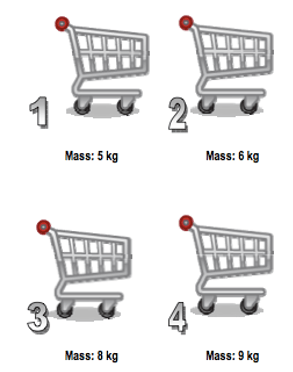


A ____________ is a push or a pull on an object.
friction
force
magnet
gravity
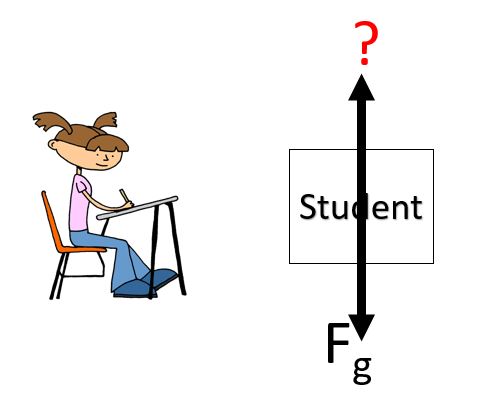
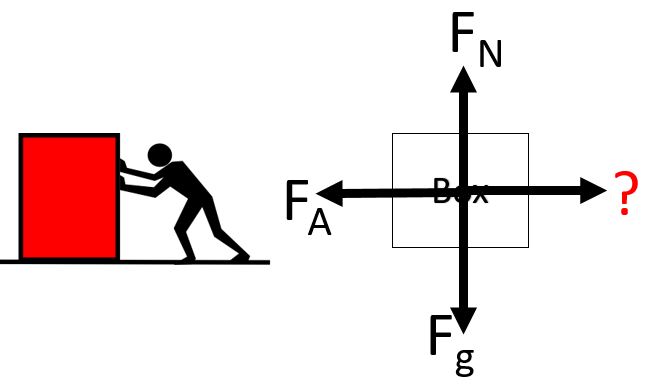
Whenever an object is moving, there is always this force opposing the motion:
inertia
momentum
friction
applied force
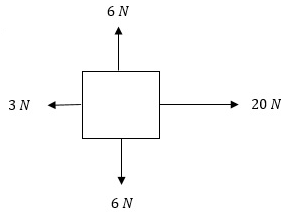
What is the NET FORCE of this diagram?
17 N, right
17 N, left
23 N, right
12 N, up
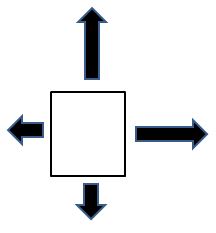
This object would be moving (pick all that are correct):
up
down
left
right

What forces are on a leopard laying on a log?
Fg & Fapp
Fb & Fg
Fg & FN
Ff & FN
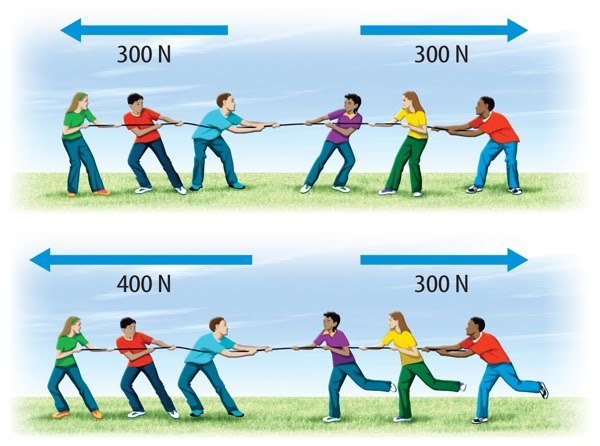
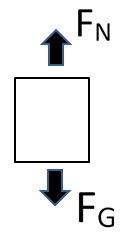
Which of the following is true about this free-body diagram?
the forces are are balanced
the object is free-falling
the object is moving upward
the forces are unbalanced
The unit for force is N. What is N?
Net Force
Newton
Net Weight
What can you conclude about an object moving at a constant speed?
No forces are acting on it.
The forces acting on it are balanced.
The forces acting on it are unbalanced.
Which is always true about forces?
An object at rest has no forces acting on it.
Unbalanced forces cause changes in speed or direction.
The net force on a moving object can never be zero.

5 N Left
25 N Right
30 N Left
55 N Right

How would you find the net force acting on this object?
Subtract the forces, 8N
Add the forces, 12 N
To move a mass you need a
reaction
rest
force
inertia
In a tug of war game, the net force is 50 N to the left. The winning team pulled with a force of 200 N to the left. How much force did the losing team pull with?
50 N Right
100 N Right
150 N Right
Which two factors affect the force of gravity?
volume and density
size and shape
mass and distance
Which option would make the best reference point?
A train passing by
A person walking to you
A moving car
A stop sign
Why does a crumpled piece of paper hit ground before a flat sheet of paper?
The crumpled paper is more massive.
There is more air resistance against the flat paper.
The acceleration of gravity is greater on the crumpled paper.
What is Velocity ?
The distance an object travels per unit of time
Speed in a given direction
Force that opposes motion
Force that pulls objects towards each other.

What is the Net Force acting on the box in this picture?
10 N to the Left
10 N to the Right
60 N to the Left
60 N to the Right
What scientist from history created the Laws that describe force and motion?
Thomas Edison
Albert Einstein
Isaac Newton
Stephen Hawking
A van is moving at a constant velocity of 10 m/s. Which of the following statements accurately describes the truck?
The truck has no forces
The truck has one force
The truck has unbalanced forces
The truck is in equilibrium (balanced forces)
A 50 kg truck and a 10 kg car collide and experience equal forces. What is true about the acceleration for each vehicle?
They both have zero acceleration.
They have the same acceleration.
The car will have a larger acceleration because it has a smaller mass.
The truck will have a larger acceleration because it has a larger mass.
Mr. Bryan rolls a ball across the floor with a constant speed. What is true about the rolling ball?
No forces are applied to the ball
There is a net force applied to the ball
The net force on the ball is zero
There is only one force applied to the ball

Which vector represents the weight of an object on the inclined plane?
Vector A
Vector B
Vector C
Vector D
Which vector represents the net force of an object on the inclined plane?
Vector A
Vector B
Vector C
Vector D
Which vector represents the normal force of an object on the inclined plane?
Vector A
Vector B
Vector C
Vector D
A 0.5 kg baseball is struck with a net force of 80 N from a baseball bat. What is the acceleration of the ball while it is in contact with the bat?
.02 N
160 N
400 N
3 N
A disco ball is hanging from the ceiling. If it has a weight of 20 N, What is the tension force in the cord supporting the light?
What is tension?
2 N
0 N
20 N
A man is trying to push a couch across the carpet. He applies a force of 60 N to the right and the carpet provides a frictional force of 20 N. What will be the resulting net force?
40 N Right
40 N Left
80 N Right
80 N Left

What can be said about the movement of the following object?
The object is moving at a constant place
The object is accelerating to the right
The object is accelerating to the left
The object has a net force of 0 N
Which is true when a bug hits the windshield of a car?
The force of the windshield hitting the bug is much greater than the force of the bug hitting the windshield.
The force of the windshield hitting the bug is much less than the force of the bug hitting the windshield.
The forces of the windshield hitting the bug and the bug hitting the windshield are equal.
I was on my phone or sleeping and do not remember anything.
Your car slams into a tree, you did not wear your seatbelt and fly straight out of the windshield (WEAR YOUR SEATBELT). Which one of Newton's Laws explains why this is happening?
1st Law of Inertia
2nd Law of Acceleration
3rd Law of Action-Reaction
I did not pay attention to the Google Quiz last Friday
Which of these has more inertia: an .02 kg ball or a 10 kg box?
The box because it has more mass
The ball because it has less mass
Both have the same inertia
Cannot be determined
You punch the wall and the wall then "punches you" with equal and opposite force. Which Newton's Law describes your broken hand?
1st Law
2nd Law
3rd Law
A book weighs 10 N on Earth. Which of the following statements is TRUE concerning the same book on the moon where g = 1.67 m/s2 ?
The book would weigh less on the moon
The book would have less mass on the moon
The book would have more mass on the moon
The book would weigh more on the moon
When a student runs and kicks a ball, they have applied an ___________ force to move the ball.
Balanced
Magnetic
Spring
Unbalanced
Which law of motion says that you must push or pull objects harder if they have more mass?
1st
2nd
3rd
4th
What law is best described by inertia?
1st
2nd
3rd
law of conservation of mass

Which of the following is an example of balancing forces?
A Book resting on the table.
A pencil is knocked off the desk.
What is the formula for mass and weight?
w = m/g
w = m - g
w = mg
w = m + g
What do you use to measure mass?
Newton Meter
Spring Balance
Weighing Scale
Beam Balance
What do you use to measure weight?
Spring Balance
Measuring Tape
Beam Balance
Ruler
Which statement is true?
Inertia is dependent on the shape of the object.
Inertia is dependent on the mass of the object.
Inertia is dependent on the size of the object.
Inertia is dependent on the colour of the object.
Which statement is true?
The larger the mass, the smaller the inertia.
The inertia is the same for all objects.
The larger the mass, the larger the inertia.
There is no such thing as inertia.
A 50kg cart will accelerate at 4 m/s2 when pushed with a force of 200N. This relationship demonstrates which of Newton's Laws of Motion?
Newton's 1st Law of Motion
Newton's 2nd Law of Motion
Newton's 3rd Law of Motion
Newton's 4th Law of Motion

Which of Newton's laws does this image most closely demonstrate?
Newton's 1st Law of Motion
Newton's 2nd Law of Motion
Newton's 3rd Law of Motion
Newton's 4th Law of Motion
Which statement below is FALSE?
When all forces are balanced, the object displays motion.
When all forces are balanced, the net force is zero.
When all forces are balanced, the object is not in motion.
When all forces are balanced, all forces acting on the object cancel out.
Which statement below is TRUE?
Friction always opposes the motion of an object.
Static friction occurs between moving objects.
Kinetic friction occurs between stationary objects.
Static friction is always less than kinetic friction.

According to Newton's 2nd law of motion, what two things determine how much a soccer ball will accelerate when kicked horizontally along the ground?
The mass of the soccer ball and gravity.
The mass of the soccer ball and the force applied to it.
The force of gravity and the size of the kicker's foot.
The size of the kicker's foot and the mass of the soccer ball.
The ______________ is the sum of all forces acting on an object.
Balanced force
Unbalanced force
Net Force
Summary Force
What is the acceleration of a 50 kg object pushed with a force of 500 Newtons?
0.10 m/s2
10 m/s2
25,000 m/s2
100 m/s2
How much force is needed to accelerate a 75 kg skier at an acceleration of 2 m/s2
150 N
37.5 N
735 N
Not enough information to determine
Tom lives on earth where the acceleration due to gravity is 9.8 m/s2. Tom has a mass of 85 kg. He rides to Mars, where the gravity is 3.7 m/s2. What is Tom's weight on Mars?
85 kg
187 lbs
314.5 N
833 N

What would be the net force and direction of movement (if any) for the diagram above?
Net force = 180 N
No movement
Net force = 0 N
No movement
Net force = 180 N
Movement downward due to gravity
Net force = 140 N
Movement to the right

What is the net force and direction of movement (if any) for the object shown in the diagram above?
Net force = 36 N;
movement north at 6 N
Net force = 36 N;
no movement
Net force = 6 N;
movement North at 6 N
Net force = -6 N;
movement South at -6 N
When calculating the Force of an object you must include a direction.
TRUE
FALSE


Mass NEVER changes no matter the location of the object.
true
false
The unit named after Issac Newton (N) is equivalent to which units?
kg m/s
kg m/s^2
m/s^2
kg m/s

A cat's motion is described by this image. What is the magnitude of the net force it experiences?
490N
701N
346.6N
205.8N
An object is sliding across a table at a constant velocity of 20m/s. What is the ΣF it experiences?
9.8N
0N
2.04N
196N
A pitcher throws a baseball to the right at 50m/s. It acts as a projectile, moving while falling down due to gravity. What is the ΣF it experiences in the horizontal direction?
9.8N
0N
5.1N
490

What type of force is this man using to push his grocery cart?
Normal Force
Gravity
Air Resistance
Applied Force
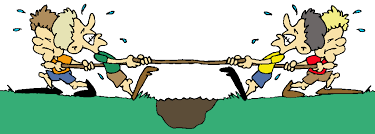
A ____________ is a push or a pull on an object.
friction
force
magnet
gravity

Forces that have a net force of zero Newtons
Balanced force
Unbalanced force
You are standing in a staionary elevator. The elevator begins moving upward. The normal force on your body has:
increased
decreased
stayed the same

