wayground logo

Free Printable Worksheets

Font size

S
M
L
XL
Worksheets

REVIEW ~ 7H Midterm

Total questions: 86

Worksheet time: 2hrs 44mins

Name
Class
Date
1.

UP and DOWN columns on the periodic table are

a)

groups

b)

periods

2.

SIDE TO SIDE rows on the periodic table are

a)

groups

b)

periods

3.

Which elements have properties in common?

a)

elements in a group

b)

elements in a period

4.

The group number tells you the number of

a)

protons

b)

valence electrons

c)

energy levels

5.

The period number tells you the number of

a)

protons

b)

energy levels

c)

valence electrons

6.

Which two elements have properties in common?

a)

Nitrogen and Phosphorous

b)

Oxygen and Nitrogen

c)

Sulfur and Nitrogen

7.

How many protons does Lithium have?

a)

3

b)

4

c)

7

8.

How many electrons does Lithium have?

a)

3

b)

4

c)

7

9.

How many neutrons does Lithium have?

a)

3

b)

4

c)

7

10.

These elements are in a:

a)

group

b)

period

11.

Do these elements have properties in common?

a)

yes

b)

no

12.

These elements are in a:

a)

group

b)

period

13.

Do these elements have properties in common?

a)

yes

b)

no

14.

Which elements are stable?

a)

Group 1

b)

Group 8

c)

Group 18

15.

Which elements have 1 valence electron?

a)

period 1

b)

group 1

c)

group 4

16.

which elements have 4 valence electrons?

a)

group 3

b)

group 4

c)

group 14

17.
What is this tool to get volume?
a)
triple beam balance
b)
ruler
c)
thermometer
d)
graduate cylinder
18.
What is this tool to get mass?
a)
triple beam balance
b)
ruler
c)
thermometer
d)
graduate cylinder
19.
True or False:  The density of a specific type of material never changes.  
a)
True
b)
False
20.
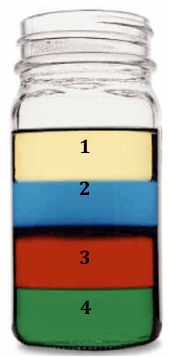
Put the liquids in order from most dense to least dense?
a)
4, 3, 2, 1
b)
1, 2, 3, 4
c)
3, 4, 2, 1, 
d)
4, 3, 1, 2
21.
Why does ice float?
a)
Liquid water is less dense than solid water.
b)
Solid water is less dense than liquid water.
c)
Gaseous water is less dense than solid water.
d)
Liquid water is less dense than gaseous water.
22.
What do we know about the density of lamp oil, rubbing alcohol, and vegetable oil?  
a)
The density is greater than 1.0 g/mL
b)
The density is less than 1.0 g/mL
c)
The density is equal to 1.0 g/mL
d)
The density can not be determined
23.
If an object has a density of .6 g/cm^3 and you put it into water, will it sink or float?  
a)
sink
b)
float
24.
If an object has a density of 3.6 g/cm^3 and you put it into water, will it sink or float?  
a)
sink
b)
float
25.
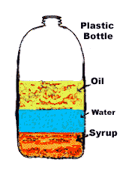
Which liquid is the least dense?
a)
oil
b)
water
c)
syrup 
d)
plastic bottle
26.
Jack has a rock. The rock has a mass of 14 g and a volume of 2 cm3. What is the density of the rock?
a)
7 mL
b)
7 g/cm3
c)
28 g/cm3
d)
1/7 g/cm3
27.
What is the formula for density?
a)
density = mass x volume
b)
density = mass / volume
c)
density = mass + volume
d)
density = mass - volume
28.
Frank has an eraser. It has a mass of 4 g, and a volume of 2 cm3. What is its density?
a)
8 g/cm3
b)
2 g/cm3
c)
1/2 g/cm3
d)
24 g/cm3
29.
Frank has a liquid. It has a mass of 6 g and a volume of 9 mL. What is its density?
a)
3 g/mL
b)
.66 g/mL
c)
1.33 g/mL
d)
54 g/mL
30.
Calculate the density of the cube.
a)
2 g/cm3
b)
4 g/cm3
c)
6 g/cm3
d)
8 g/cm3
31.
Calculate the density of the cube.
a)
.33 g/cm3
b)
.4 g/cm3
c)
.6 g/cm3
d)
.5 g/cm3
32.
Which substance is the MOST dense?  ** Use the key
a)
A
b)
B
c)
C
d)
Cannot be determined by the data provided.
33.
Valence electrons are: 
a)
Electrons farthest away from the nucleus
b)
Electrons closest to the nucleus
c)
Electrons that just come and go - they don't stay with the atom
34.
Ions are: 
a)
atoms with a positive or negative charge
b)
atoms with no charge
c)
atoms with ONLY a positive charge
d)
atoms with ONLY a negative charge
35.
When an atom loses a valence electron, it becomes a(n) _____________ ion.
a)
positive
b)
negative
c)
neutral
d)
polyatomic
36.
Negative ions form when atoms _________ valence electrons.
a)
lose
b)
gain
c)
share
37.
all matter is made of what 
a)
energy 
b)
atoms 
c)
electrons 
d)
compounds 
38.
The positive particles of an atom are 
a)
electrons 
b)
positrons 
c)
neutrons 
d)
protons 
39.
the central region of an atom where its neutrons and protons are is its 
a)
nucleus 
b)
electron cloud
c)
core 
d)
center 
40.
an atom with atomic number 6 would have how many protons 
a)
6
b)
12
c)
3
d)
cannot be determined 
41.
Particles in an atom that are neutral and have no charge are 
a)
negatrons 
b)
electrons 
c)
neutrons 
d)
protons 
42.
True or False? Neutrons have a negative charge
a)
True
b)
False
43.
A series of steps used by scientists to solve a problem or answer a question. 
a)
scientific method
b)
recipe
c)
data collection
d)
metric system
44.
This variable in an experiment is the one being changed by the scientist. 
a)
dependent variable
b)
independent variable
c)
data
d)
control group
45.
Dependent variable means
a)
the scientist controls what to test
b)
educated guess
c)
ask a question
d)
what is being measured
46.
If you increase the amount of spinach you eat, then you will increase the iron in your blood. 
What's the dependent variable?
a)
increase the amount of iron in your blood
b)
spinach you eat
47.
If I ride my bike to school instead of walking, then I will get to school faster. What is the dependent variable?
a)
True
b)
How fast you get to school
c)
Riding a bike or walking
d)
False
48.
If I study for my scientific method test, then I will have a better test score. What is the dependent variable?
a)
Scientific Method
b)
Studying
c)
Independent variable
d)
Test score
49.
What is a factor that changes because of what the experimenter does?
a)
Dependent Variable
b)
Independent Variable
c)
Control Group
d)
Hypothesis
50.
Who stipulated that electrons orbit the nucleus at fixed energies and distances?
a)
Albert Einstein
b)
Max Planck
c)
Ernest Rutherford
d)
Niels Bohr
51.
These elements are ductile
a)
Metals
b)
Nonmetals
c)
Metalloids
52.
An element has an atomic number of 76.  The number of protons and electrons in a neutral atom of the element are
a)
152 p+, 76 e-
b)
76 p+, 0 e-
c)
38 p+, 38 e-
d)
76 p+, 76 e-
53.
An atom has 5 protons, 7 neutrons and 5 electrons. What is the mass number of the atom?
a)
5
b)
7
c)
2
d)
12
54.
An atoms overall charge is 
a)
positive 
b)
depends on its mood 
c)
neutral 
d)
negative 
55.
How many of these substances are elements?
a)
2
b)
3
c)
4
d)
5
56.
How are elements and compounds different?
a)
A compound is a combination of two or more types of matter, an element is one type.
b)
Compounds are represented by chemical symbols of one letter, elements by two.
c)
There are an infinite number of elements, but a limited number of compounds.
d)
Elements are always larger units of matter, and compounds are smaller.
57.

What percentage of rubidium-87 atoms will be left after four half lives?

a)

25.0%

b)

12.5%

c)

6.25%

d)

3.125%

58.

What is an isotope?

a)

one of several forms of the same atoms; same number of protons but have different number of neutrons

b)

a particle that has no charge and is located in the nucleus of an atom.

c)

energy in the form of waves or particles that is emitted from an object and travels through space or air

59.

If one has 12 kg of Polonium and it undergoes two half-lives, how much do you have left?

a)

12 kg

b)

3 kg

c)

6 kg

60.
a)
40 mL
b)
38 mL
c)
36 mL
d)
34 mL
61.
a)
265.7 g
b)
165.6 g
c)
266.7 g
d)
266.6 g
62.
a)
241 g
b)
143 g
c)
144 g
d)
142 g
63.

What is the length of the object in centimeters?

a)

3.4 cm

b)

4.3 cm

c)

3.5 cm

d)

1 1/4 inches

64.

According to the graph, what is the volume of a 10 gram sample of this mineral?

a)

4 cubic cm

b)

2.5 cubic cm

c)

4.0 cubic cm

d)

6.0 cubic cm

65.

According to the graph, What is the density of this mineral?

a)

5.0 g/cm3

b)

0.5 g/cm3

c)

2.5 g/cm3

d)

2.5 g

66.

The half-life of strontium-90 is 25 years. How much strontium-90 was originally present if 0.25 g is present in a sample after 100 years?

a)

4.0 g

b)

2.0 g

c)

0.13 g

d)

0.25 g

67.

The half-life of Cobalt-60 is 5.26 years. If 50 grams are left after 15.8 years, how many grams were in the original sample?

a)

100 g

b)

400 g

c)

200 g

d)

50 g

68.
According to this graph, what is the melting point temperature of this substance?   (in degrees)
a)
40
b)
70
c)
100
d)
140
69.
According to this graph, what is the boiling point temperature of this substance?   (in degrees)
a)
40
b)
70
c)
100
d)
140
70.

According to this graph, what is the total time it takes for the substance to completely boil once it has reached its boiling point?

a)

5 minutes

b)

9 minutes

c)

13 minutes

d)

18 minutes

71.

The electrons in the outermost shell (main energy level) of an atom; these are the electrons involved in forming bonds

a)

alkali metals (group 1)

b)

Halogens (Group 17)

c)

atomic number

d)

valence electrons

72.
The Modern Periodic Table of Elements is arranged by
a)
atomic mass
b)
atomic number
c)
valence electrons
d)
number of isotopes
73.

What is a substance that is made of only one atom?

a)

element

b)

solution

c)

compound

74.

Carbon and oxygen combine chemically to form carbon dioxide. Carbon dioxide is

a)

an ion

b)

a nucleus

c)

a compound

d)

an atom

75.
When a fluorine atom gains an electron, it becomes a(n)
a)
positive ion
b)
negative ion
c)
isotope
d)
atom
76.
Rutherford’s research involved
a)
Vacuum Tubes
b)
Gold Foil
c)
Electron Shells
d)
None of the above
77.
Elements with eight valence electron are unreactive
a)
True
b)
False
78.

How many valence (outer) electrons does an Oxygen atom have?

a)

2

b)

6

c)

8

d)

16

79.

Which Bohr model represents Neon?

a)
b)
c)
d)
80.
How many electrons should Nitrogen have around its Lewis dot model?
a)
1
b)
3
c)
4
d)
5
81.

This is a correct dot diagram for carbon (C)

a)

true

b)

false

82.

This is a correct dot diagram for neon (Ne)

a)

true

b)

false

83.

Is this the correct Lewis Dot Diagram for Boron?

a)

Yes

b)

No

84.

Which of the following shows a correct Lewis dot structure?

a)
b)
c)
d)
85.

Choose one of the conclusions that Ernest Rutherford made based on the experimental results of his Gold-Foil experiment

a)

He concluded that the atom is indivisible

b)

He concluded that the atom is mostly empty space

c)

He concluded that the atom has neutrons

d)

He concluded that the atom is tightly packed with subatomic particles all mixed together

86.

Choose one of the conclusions that Ernest Rutherford made about the mass of the atom, based on the experimental results of his Gold-Foil experiment

a)

He concluded that almost all mass of the atom is distributed evenly among subatomic particles

b)

He concluded that almost all mass of the atom is distributed among electrons

c)

He concluded that almost all mass of the atom is concentrated in a small region, in a center of an atom, that has a positive charge

d)

He concluded that almost all mass of the atom is concentrated in a small region, in a center of an atom, that has a negative charge