
 Worksheets
Solar System 2 TM
Total questions: 129
Worksheet time: 2hrs 43mins



Which of the following are characteristics of the Sun?
Made up of gas
light and thermal energy
Star
All of the above

What is the name of the star closest to Earth
Sun
White Dwarf
Demios
Phobos
Out of the Earth, Sun, and Moon, the Sun has the most gravity of the three.
True
False
The Sun is made of gas.
True
False
Stars are made of mostly which two gases?
Hydrogen and Helium
Hydrogen and Oxygen
Hydrogen and Nitrogen
Hydrogen and Carbon
The surfaces of the Earth, Moon, and Sun are described as having different physical characteristics. How is the Sun different from the Earth and Moon?
The Sun has no gravity
The Sun is a solid
The Sun does not produce its own heat
The Sun is capable of producing its own light
We know that Earth consists of different layers. The Sun also has layers, but unlike Earth, the Sun is entirely –
Solid
Gas
Melted rock
Liquid
The Sun and Earth are both constantly changing. Students researched and collected information to compare the Earth’s and Sun’s physical characteristics by observing detailed photographs of each on the Internet. Which of the following is a physical characteristic of the Sun but NOT of Earth?
Sunspots
Layers
Atmosphere
Spherical shape
Which of the following are characteristics of the Sun?
Made up of gas
light and thermal energy
Star
All of the above
What are the 4 inner planets in order?
Mercury, Earth, Mars, Venus
Mercury, Venus, Earth, Mars
Mars, Earth, Venus, Mercury
Earth, Mars, Mercury, Venus
What are the 4 outer planets in order?
Saturn, Jupiter, Neptune, Uranus
Uranus, Neptune, Saturn, Jupiter
Jupiter, Saturn, Uranus, Neptune
Neptune, Uranus, Jupiter, Saturn
What are the 4 "GAS GIANTS"?
Mars, Earth, Mercury, Neptune
Earth, Venus, Mars, Neptune
Earth, Saturn, Uranus, Mars
Jupiter, Saturn, Uranus, Neptune

What are the 4 smaller rocky terrestrial planets?
Jupiter, Saturn, Mars, Earth
Mercury, Venus, Earth, Mars
Earth, Saturn, Uranus, Neptune
Jupiter, Saturn, Uranus, Neptune
Which inner planet has frozen water at its poles and is known as the red planet?
Mercury
Venus
Earth
Mars
Which outer planet has distinctive rings?
Mercury
Venus
Saturn
Jupiter
Which is the largest planet with a large red spot that is actually a storm?
Mercury
Earth
Neptune
Jupiter
Which planet is known as an ice giant and rotates on its side?
Saturn
Uranus
Earth
Jupiter
Which planet is made up of 78% Nitrogen and contains life?
Earth
Mars
Saturn
Neptune
Which planet is known as an ice giant and is also the furthest from the sun?
Mercury
Neptune
Jupiter
Venus
Which planet has a thick atmosphere that makes it the HOTTEST planet?
Venus
Earth
Mars
Mercury
Which planet is the smallest, the closest to the sun, and has NO atmosphere?
Venus
Neptune
Mercury
Earth
Which is the correct order of planets from the sun?
Mercury Venus Earth Mars Jupiter Neptune Uranus Saturn
Neptune Uranus Saturn Jupiter Mars Earth Venus Mercury
Mercury Venus Earth Mars Jupiter Saturn Uranus Neptune
Mars Venus Earth Mercury Jupiter Saturn Uranus Neptune
The ___ of a planet determines its day.
ellipse
revolution
orbit
rotation
The ___ of a planet determines its year.
rotation
ellipse
revolution
axis
All inner planets have the following in common except:
signs of volcanic activity
layers of core, mantle, crust
ice on their surfaces
solid, rocky surface
Besides Venus, which inner planet has more than 90% carbon dioxide in its atmosphere?
Mercury
Venus
Earth
Mars
Which inner planet has a day about the same length as Mars?
Mercury
Venus
Earth
Mars
Which inner planet has the tallest mountain in the solar system?
Mercury
Venus
Earth
Mars
Which inner planet has clouds of acid (sulfuric acid)?
Mercury
Venus
Earth
Mars
Besides Venus, which inner planet has no moons?
Mercury
Venus
Earth
Mars
Which inner planet has a day that is longer than its year? Its day is 244 Earth days; its year is 225 Earth days?
Mercury
Venus
Earth
Mars
Which inner planet has one moon?
Mercury
Venus
Earth
Mars
Which inner planet rotates the opposite direction of the other inner planets?
Mercury
Venus
Earth
Mars
Which inner planet has the shortest year?
Mercury
Venus
Earth
Mars
Which inner planet has the longest year?
Mercury
Venus
Earth
Mars
Besides Earth, which inner planet has a greenhouse effect which causes it to be the hottest planet?
Mercury
Venus
Earth
Mars
Which inner planet has red soil with a high content of iron oxide?
Mercury
Venus
Earth
Mars
Which outer planet is the largest in the solar system?
Jupiter
Saturn
Uranus
Neptune
Which outer planet has a density less than water's density and would float in water?
Jupiter
Saturn
Uranus
Neptune
Which outer planet rotates on its axis from top to bottom as if it is a rolling ball?
Jupiter
Saturn
Uranus
Neptune
Which outer planet has the longest year, about 165 Earth years?
Jupiter
Saturn
Uranus
Neptune
Which outer planet has the shortest year, about 12 Earth years?
Jupiter
Saturn
Uranus
Neptune
Which outer planet has the most complex and largest system of rings?
Jupiter
Saturn
Uranus
Neptune
Which outer planet has the shortest day, rotating around its axis in less than 10 hours?
Jupiter
Saturn
Uranus
Neptune
Which outer planet has a dark blue spot that resembles Earth's hurricanes?
Jupiter
Saturn
Uranus
Neptune
Besides Neptune, which outer planet has methane in its atmosphere which causes both planets to be blue?
Jupiter
Saturn
Uranus
Neptune
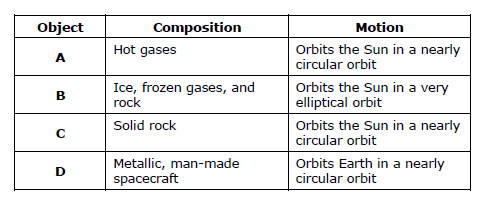
Which of the following are characteristics of a dwarf planet?
Has not cleared the neighborhood around its orbit and is not a moon.
Orbits the Sun
Rotates on an axis
Has enough mass to have a nearly round shape
Moons are studied in relation to the planet or celestial object they (a) .
A natural satellite is another name for which celestial object?
Asteroid
Comet
Moon
Star
True or False: All of the planets in our solar system have at least one moon.
True
False
Between which two planets can the asteroid belt be found?
Mars
Saturn
Neptune
Jupiter
Uranus
Movement of asteroids is based on their revolution around the ___________
Sun
Moon
Asteroid Belt
Planets
About how many million miles thick is the asteroid belt?
106
92
75
27
What is the area of our Solar System beyond the orbit of Neptune, believed to contain many comets, asteroids, and other small celestial bodies including dwarf planets made mostly of ice called?
Asteroid Belt
Milky Way Galaxy
Kuiper Belt
Pluto's Belt
Which celestial object has a main body or head made up of ice, methane, ammonia and/or dust as well as a characteristic tail that emerges as it gets closer to the Sun during its orbit?
Asteroid
Comet
Meteor
Meteoroid
What is the area beyond the Kuiper Belt, in which you can find icy, comet-like bodies called?
Asteroid Belt
Milky Way
Darkness
Oort Cloud
Which celestial object is a small rocky or metallic outer space that is much smaller than an asteroid ranging in size from small grains to one-meter-wide.
Comet
Meteor
Meteoroid
Meteorite
Which celestial objects are chunks of rock that burn up as they enter a planet’s atmosphere?
Asteroid
Comet
Meteor
Meteoroid
Which celestial object would a shooting star be classified as?
Comet
Meteor
Asteroid
Meteorite
What does a meteor become after it strikes the surface of a planet or moon?
Meteoroid
Meteorite
Meteorade
Meteoride
The sun gets its energy from nuclear fusion in its core.
True
False
Meteors are bits of asteroids that are floating aimlessly around in space.
True
False
Meteoroids usually come from comets or asteroids.
True
False
The sun is considered a super-giant star.
True
False
A star's apparent brightness is its brightness as seen from Earth.
True
False
Scientists believe that the moon has been hit by numerous meteoroids because they can see that it has many
maria
rocks
valleys
craters
In a geocentric system,
all of the planets revolve around the sun.
the sun revolves around the Earth.
Earth is the center of the universe.
the sun appears to move backward among the planets.
A streak of light made by a chunk of rock or dust entering Earth's atmosphere is called a(n)
asteroid
meteor
meteoroid
meteorite
The four terrestrial planets all have
hot temperatures
rocky surfaces
deep atmosphere
large size
The __________ is located between the orbits of Mars and Jupiter.
Oort Cloud
Asteroid belt
Kuiper belt
Milky Way Galaxy
A(n) ____________ is a loose collection of ice, dust, and small rocky particles that typically have a long, narrow orbit.
asteroid
planet
meteoroid
comet
Short term comets typically originate from where?
Oort Cloud
Asteroid belt
Kuiper belt
Milky Way galaxy
Long term comets typically originate from where?
Oort Cloud
Asteroid belt
Kuiper belt
Milky Way galaxy
What characteristic does a star's color typically indicate?
temperature
size
distance
brightness
Which characteristic does NOT describe the outer planets?
multiple moons and ring system
slow rotation
thick atmosphere
gaseous composition
Which element is the most abundant in the universe?
Carbon
Helium
Oxygen
Hydrogen
Mark all of the characteristics that apply to the inner planets
Gas Giants
Rocky Planets
Smaller
Larger
Most comets have ______ tails. One is made of ______ and the other is made of _______.
1
2
gas
dust
oil
The inner core of a comet is called the ____________.
nucleus
coma
head
tail
Which of the choices below describes why scientists study comets, asteroids, and meteors?
They contain evidence of the early composition and formation of the solar system.
They want to be able to design more effective military weaponry.
They believe that life exists elsewhere in the universe.
They have found radio waves transmitted from planets outside of our solar system and want to communicate with their originators.

