
Font size
 Worksheets
4th Six Weeks Review
Total questions: 118
Worksheet time: 1hrs 20mins
The gray squirrel, Eastern fox squirrel, and red squirrel are all different species of squirrels. Why is having a scientific name for each species of an organism important?
To prevent existing named organisms from having their names changed as they become extinct
To keep the classification system from being altered as new organisms are discovered
To allow organisms to be placed in many classification levels at the same time
To standardize the naming and organization of organisms to avoid confusion

Organisms are classified today using the Linnaean system, and the following table shows the taxonomic classification of two marine organisms living along the Pacific Coast.
Taxonomic classification is important to marine biologists because it provides a way to -
prove that marine evolution occurs
discover and name every marine organism on Earth
designate Latin as the universal language of marine biology
identify marine organisms and find evolutionary relationships between them
Scientists around the world use a standardized taxonomic system. Why would scientists want to use a taxonomic system that is standardized?
In order to avoid confusion with the identification of organisms
Because Linnaeus established the system
So that Latin names can be applied for a practical purpose.
In order to place organisms in different groups
The Linnaean taxonomic system classifies organisms into divisions called taxa. If two organisms belong to the same taxonomic group, they are related. Similarity at which of these levels indicates the closest relationship?
Kingdom
Class
Order
Genus

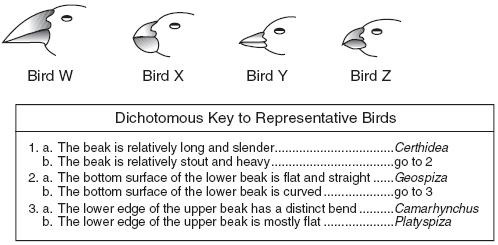
A dichotomous key for identifying fish is shown.
Based on this key, which two fish have eyes located on either side of their head and are not spotted?
Glassy sweeper and squirrelfish
Glasseye snapper and spotted eagle ray
Spotted goatfish and bandtail puffer
Peacock flounder and glassy sweeper
Many tree frog populations are threatened due to habitat loss. In an effort to promote conservation, tree frogs may be bred in captivity. A zoo acquired male and female tree frogs from two different populations. In the zoo, the tree frogs were able to successfully mate within their own population, but breeding attempts between the two populations were unsuccessful.
Based on this information, which statement correctly describes the relationship between the two populations of tree frogs.
They are in the same species but different kingdoms.
They are in the same class but different phyla.
They are in the same family but different orders.
They are in the same genus but different species.

A student used a microscope to study four members of the phylum Ciliophora. Members of this phylum move when propelled by hundreds of tiny cilia.
Although these organisms belong to the same phylum, they are classified as different -
families
species
kingdoms
orders

Simple leaves have a single leaf on a petiole, or stem, while compound leaves have more than one leaflet on a petiole. This unknown leaf can be identified using the dichotomous key.
Which tree does the unknown leaf come from?
Ungnadia speciosa
Sophora secundiflora
Salix nigra
Quercus laceyi
A team of students encounters an unknown organism in a field while conducting a biodiversity study. Some students think the organism is a plant, while others think it is a fungus.
Which question should the students investigate to classify the organism correctly?
Is there a cell wall around the cells of the organism?
Does the organism perform photosynthesis?
Is there nervous tissue present in the organism?
Does the organism reproduce sexually?
Which list correctly identifies characteristics that protists share with animals?


Five general characteristics of organisms in kingdoms Plantae or Fungi are listed in the box.
Which table correctly lists the characteristics of the organisms in the two kingdoms?


A student wants to use the Venn diagram below to show the characteristics of two kingdoms of organisms. The characteristics that the two kingdoms share will be listed in the shaded area where the circles intersect.
Which of these is a characteristic that the student should list in the shaded part of the diagram?
Heterotrophic
Mobile
Unicellular
Eukaryotic

A student produces a labeled drawing of a virus for a presentation. The student states that a capsid has a function similar to the nuclear membrane found in animal cells.
Which of these describes the similar functions of capsids and nuclear membranes?
Both transport proteins throughout the structures.
Both provide energy for activities in the structures.
Both protect genetic information for the structures.
Both code for the proteins needed for the reproduction of the structures.
In 1898 Friedrich Loeffler and Paul Frosch found evidence that the cause of the highly contagious hoof-and-mouth disease in livestock was a microscope infectious particle. It was discovered that this particle requires a host cell to reproduce.
Which pathogen is most likely responsible for causing hoof-and-mouth disease in livestock?
a bacterium, because it is contagious
a fungus, because it infects livestock
a protist, because it is microscopic
a virus, because it requires a host cell to reproduce
Which of these describes a difference between viruses and cells?
Cells contain protein, and viruses contain only carbohydrates.
Viruses have flagella, and cells have only cilia.
Cells are living organisms that can get and use energy. Viruses are non-living and can not get or use energy without a hot
Viruses have membranes, cytoplasm and ribosomes, cell have capsids and spikes.
The human immunodeficiency virus (HIV) often infects and destroys CD4 T-cells. These CD4 T-cells are one of many kinds of white blood cells that are an important part of the immune system, which protect the body.
The most common danger related to the destruction of CD4 T cells is -
an increase in the risk of high blood pressure
an increase in the threat of diseases caused by microorganisms and viruses
a decrease in the flow of blood to vital organs
a decrease in the amount of oxygen being transported to issues.

The picture shows a 3D model of a virus called a bacteriophage. Bacteriophages can infect bacteria such as E.coli.
In what way are the bacteriophage and E.coli alike?
they contain antibodies
they reproduce by mitosis
they have identical genomes
they lack membrane-bound organelles
Gibberellins are hormones produced in the root tips of plants. The plant uses these hormones to stimulate the growth of shoots.
How are gibberellins able to affect other parts of the plant?
Gibberellins are absorbed through the stomata and attach to chloroplasts.
Gibberellins are transported through vascular tissues to other parts of the plant.
Gibberellins become concentrated within the tissues of the plant during mitosis.
Gibberellins become modified once they infect healthy cells and are later released to infect other cells.

A chart of some plant systems and functions is shown.
Which system interactions are dependent on the plant's ability to respond to the direction of light?
Option 1
Option 2
Option 3
Option 4

Plant roots have extensions called root hairs. These root hairs. These root hairs are important in the homeostasis
of the plant.
Which statement best explains the importance of the root hair to the stems and leaves of the plant?
Root hairs convert minerals into glucose for immediate use by cells.
Root hairs decrease the need for osmosis and diffusion in vascular tissue.
Root hairs prevent water loss in leaves through transportation and gas exchange.
Root hairs increase the surface area of the roots for nutrient and water absorption.

A corn plant produces both male and female flowers. The male flower forms the tassel and the female flower forms the ear of corn. The silk that emerge from the ear are the stigma of the female flower. Each silk leads to an ovule that can become a corn seed.
Which of these must happen for corn seeds to develop on the ear?
More tassels that silks need to be present on the same plant.
Pollen grains must fall from tassels and land on the silks of the ear.
Pollen must be transported from the tassel to the silk through the phloem.
The tassels must come into direct contact with the silks of the ear.
Fruits grown in hot climates are usually less sweet than those grown in cooler temperatures. The high temperatures increase the rate of respiration in the plants, thus reducing the sugar content in some fruits.
Why does increased respiration in the leaves and stems reduce the sugar content in the fruits of a plant?
Chloroplasts move from the fruits to the leaves and stems to provide energy for respiration.
The flow of nutrients shifts from the phloem to the xylem, moving nutrients away from the fruits.
Sugars are moved from the fruits to the roots for storage.
Sugars produced in the leaves are used as an energy source instead of being stored in fruits.
In which type of plant does water/food move through xylem and phloem?
seed plants
vascular plants
non-vascular
both vascular and non-vascular
What material makes up plant cell wall
Chitin
Peptidoglycan
Protein coat
Cellulose
Select ALL plants that reproduce by using spores.
Gymnosperms
Angiosperms
Pteridophyte
Bryophyte
Select ALL plants that reproduce by using seeds.
Gymnosperms
Angiosperms
Bryophyte
Pteridophyte

This is a ...
Nonvascular plant
Vascular plant

This is a(n) ...
Angiosperm
Gymnosperm
Bryophyte
Pteridophyte

This is a(n) ...
Angiosperm
Gymnosperm
Pteridophyte
Bryophyte

This is a(n) ...
Angiosperm
Gymnosperm
Bryophyte
Pteridophyte


Which of these are functions of spongy mesophyll. Choose all the correct answers.
Allows gases to circulate freely:
Allows CO2 to pass to palisade cells for photosynthesis
Allows O2 produced to pass out of leaf into air
Covering layer of plant organs
Palisade mesophyll is...
Long, vertically arranged cells which are tightly packed
Full of chloroplasts
1-5 cells thick
Full of air spaces
Pollen grains are produced by ?
the anther
the stigma
the flowers
the leaves

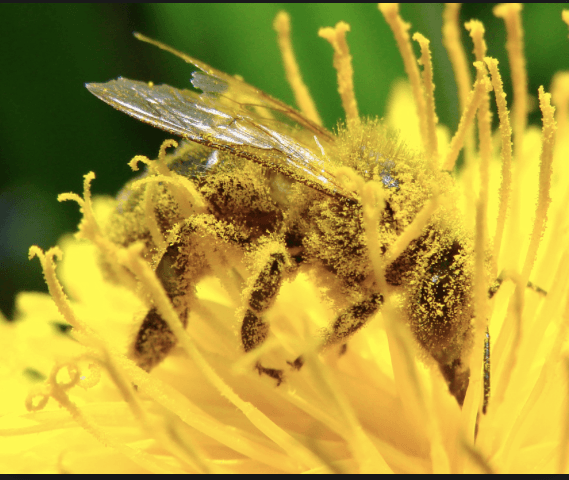

What is tropism?
A plant's response to a stimulus
A plant reproducing
An animal's response to a stimulus
A prokaryote's response to a stimulus
What is gravitropism/geotropism?
The movement of a plant in response to gravity
The movement of a plant in response to earthquakes
The movement of bacteria in response to changes in temperature
The movement of plants towards water
What is hydrotropism?
The movement of plants towards water
The movement of plants away from water
The rate of growth of a plant in response to temperature changes in water
A plant's response to gravity and touch
What is thigmotropism?
The movement of plants in response to touch
The movement of plants toward the sun
A prokaryote's movement inside the bloodstream
The movement of plants in response to gravity
What is phototropism?
The movement of plants towards light
The movement of plants away from light
The movement of plants in response to infrared light
The movement of plants towards water


What is the difference between a prokaryotic cell and a eukaryotic cell?
Prokaryotes do not have a nucleus or organelles, but a eukaryotic cell does
Eukaryotic cells do not have a nucleus or organelles, but prokaryotes do
What is binomial nomenclature?
system of 3 names
system of 2 names
the names of the kingdoms
the levels of classification
What is the genus name here:
Canis lupus
Canis
lupus
Biologist group living things based on ____.
Habitat
Size
Colors
Shared Characteristics
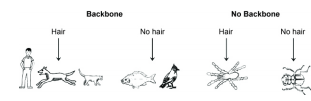
According to the classification key above, which pair of animals could be classified as mammals?
humans and dogs
birds and fish
birds and fish
cats and birds
Scientists use eight major classification levels to group and name organisms. Which level is the broadest (most general) classification level listed below?
kingdom
domain
family
class


What would the scientific name of this organism be?
Kingdom: Animalia
Phylum: Chordata
Class: Mammalia
Order: Carnivora
Family:Canidae
Genus: Canis
species: mesomelas
Mammalia carnivora
Canidae mesomelas
Canis mesomelas
Animalia chordata
Name them:
The most inclusive in the order of classification is?
Type of organism that produces its own food
Viruses are considered
living things
non-living things
partially living things
A virus's genetic material is surrounded by
a protein capsid
DNA
a tail fiber
nothing
Which cycle of a virus is most destructive to the host?
lytic cycle
lysogenic cycle

This image represents part of the
lytic cycle
lysogenic cycle
Viruses attach only to a particular host because of the presence of
DNA
magnetic attraction
surface receptors
other viruses
A virus in the lysogenic state can be forced into the lytic cycle by
exposure to UV light
exposure to certain chemicals
a change in temperature or pH
all of these
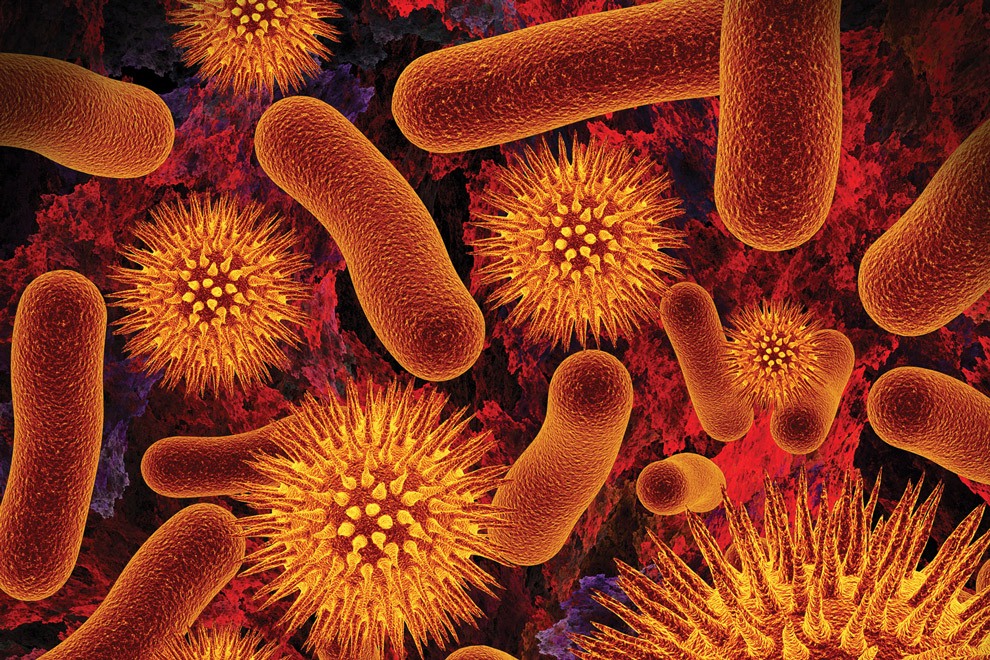
How do bacteria reproduce?
Sexual Reproduction
Division
Binary Fission
Pollination
Bacteria are treated with
Antibiotics
Vaccines
Asprin
Chemotherapy
The singular term for bacteria is...
Bacterial
Bacterias
Bacteria
Bacterium
What are pathogens?
Eukaryotic cells that turned in to bacteria
Disease causing agents
Microorganisms that help clean up oil spills
Beneficial bacterial cells
A ________________________ requires oxygen to live.
Obligate Aerobe
Obligate Anaerobe
Facultative Anaerobe

Archaebacteria have cell walls made out of Peptidoglycan
True
False
Which of the following is NOT a type of archeabacteria?
Methanogen
Halobacteria
Heterotroph


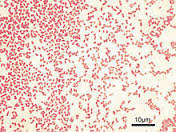
Bacteria can obtain their nutrition by
photosynthesis.
chemosynthesis.
heterotrophy.
all of the above


