
Font size
 Worksheets
Day 3 Review: Digital Worksheet
Total questions: 77
Worksheet time: 1hrs 2mins
In RNA, adenine is complementary to (a) .
Why does DNA stay in the nucleus?
To protect it from becoming damaged.
It is lazy.
It is grounded.
It cannot move.

What makes up the SIDES of a DNA ladder?
nitrogen bases
sugars & phosphates
genes & chromosomes
RNA

What makes up the rungs (steps) of a DNA ladder?
sugars & phosphates
nitrogen bases
sugars
genes & chromosomes

Which part of the DNA molecule holds the information that determines our traits?
deoxyribose sugar
hydrogen bonds
nitrogenous bases
phosphate ions

According to the image on the left, what TWO parts of the double helix model compose the backbone?
Nitrogen bases
Phosphate
Hydrogen
Deoxyribose sugar
ATP

Original DNA= ATT-CGA-AGC-GCC
What is the complementary DNA?
(a)

Match the DNA to the correct mRNA base
DNA Adenine pairs with (a)
DNA Thymine pairs with (b)
DNA Cytosine pairs with (c)
DNA Guanine pairs with (d)

OG DNA = ACA-AGA-TGC
use the OG DNA to make the RNA
(a)

DNA= shape (a) , bases (b) , found (c)
RNA= shape (d) , bases (e)
DNA = (a) Nucleic Acid = (b) Sugar
RNA = (c) Nucleic Acid = (d) Sugar
Where can you find mRNA?
(2 correct answers)
Nucleus
Ribosome (in the cytoplasm)
Vacuole
Cell Membrane
I contain the instructions for making just one protein.
DNA
RNA
Both
I contain the instructions for making thousands of different proteins.
DNA
RNA
Both

Spot the difference between DNA and RNA according to the image provided.
DNA is made of nucleotides, while RNA is not
DNA is made of a sequence while RNA is not
DNA is double-stranded while RNA is single stranded
There is no difference between them

A nucleotide from DNA and RNA are shown in the image, what is the difference between them regarding the sugars involved?
DNA and RNA have the same sugar
DNA has a ribose sugar while RNA has a deoxyribose sugar
DNA and RNA have no sugar
DNA has a deoxyribose sugar while RNA has a ribose sugar
A nucleotide from DNA and RNA are shown in the image, what is the difference between them regarding the bases?
DNA and RNA have the same bases
DNA has ATCG while RNA has AUCG
DNA and RNA have no bases
DNA has AUCG while RNA has ATCG
Which of the following has a correct base pair?
A-T
A-A
G-T
C-A
The term used to describe the copying of DNA (making DNA from DNA) is (a) and the term used to describe the creation of RNA (making RNA from DNA) is (b) .
Select all of the following that are TRUE about hydrogen bonds.
Hydrogen bonds hold together the two sides of the DNA ladder.
Hydrogen bonds are the strongest kind of bond.
Hydrogen bonds need to be able to break to do replication and transcription.
Hydrogen bonds form between nitrogen base pairs.
Which of the following characteristics is NOT seen in both DNA and RNA?
A single strand
Adenine
Cytosine
A double helix
Which of the following statements is correct about the differences between DNA and RNA?
RNA contains the same bases as DNA, except uracil is present instead of guanine
DNA is not present in prokaryotes, while RNA is
DNA is present as a single-stranded molecule while RNA is double-stranded
The sugar molecule in RNA has one more hydroxyl group than the sugar molecule in DNA
Which of the following statements is false?
DNA uses thymine, while RNA uses uracil
DNA and RNA utilize different sugars in their sugar-phosphate backbones
DNA is typically double-stranded, while RNA is typically single-stranded
DNA is a polymer, while RNA is a not
Which of the following is not a true characteristic of an RNA molecule?
It contains deoxyribose sugar
It can be single stranded
It can be double stranded
It contains deoxyribose sugar
Which of the following choices is an element common to both DNA and RNA molecules?
Both are often single-stranded
They can both be found in the nucleus
There is deoxyribose sugar in both of their sugar-phosphate backbones
Both contain the nucleotide uracil
Which of the following are properties of RNA?
Deoxyribose, uracil, and a globular structure
Deoxyribose, ribose, and uracil
Ribose, uracil, and a linear structure
Deoxyribose, thymine, and a linear structure
In DNA adenine (A) bonds to thymine (T) and guanine (G) bonds to cytosine (C). What is the bonding scheme in RNA?
A-C and G-U
A-U and C-G
A-T and C-G
None of these
Which of the following choices displays complementary DNA strands?
3’-ATTGC-5’
5’-ATTGC-3’
3’-AUUGC-5’
5’-UAACG-3’
3'-ATTGC-5’
5’-TAACG-3’
Which of the following could be a segment of DNA?
5'-CTCGTG-3'
3'-GATCTC-5'
5'-AGATAG-3'
3'-GATCTC-5'
5'-CTCGTG-3'
3'-AATGTA-5'
5'-CTAGAG-3'
3'-GATCTC-5'
Which of the following describes the components of a nucleotide?
ATP, a pentose sugar, and a nitrogenous base
A phosphate group, a pentose sugar, and an amino acid
A phosphate group, a hexose sugar, and a nitrogenous base
A phosphate group, a pentose sugar, and a nitrogenous base
Which Phase does the cell spend 90% of its life in?
M Phase
Interphase
Cytokinesis
Telophase
Which phase is known as the rest phase, when cells are not growing or preparing to divide?
G1
S
G0
G2
Which phase does DNA replicate?
Mitosis
S Phase
G2
Anaphase
What occurs in mitosis?
The cell is growing
The cell is divided
Nucleus is divided
Which phase do the chromosome pull apart?
Prophase
Metaphase
Anaphase
Telophase
Which phase does the DNA condense?
Prophase
Anaphase
Metaphase
Telophase
What occurs in Cytokinesis?
DNA replicates
The cell grows
The cell divides
The nucleus divides
What does the cell cycle allow an organism to do?
Grow, Develop, and Repair
Grow, Mutate, and Evolve
Evolve. Develop, and Grow
Develop, Repair and Evolve
G1
S
G2
Mitosis
Cytokinesis
If the DNA sequence of a gene is TAC CCC GGA GAG, what mRNA sequence will be produced in transcription?
UAC CCC GGA GAG
AUG GGG CCU CUC
ATG GGG GGT GTG
AUG GGG CCU CUG
AUG CCG GCA CGG
If the DNA sequence of a gene is GAC CAA TAT GTA, what mRNA sequence will be produced in transcription?
(a)
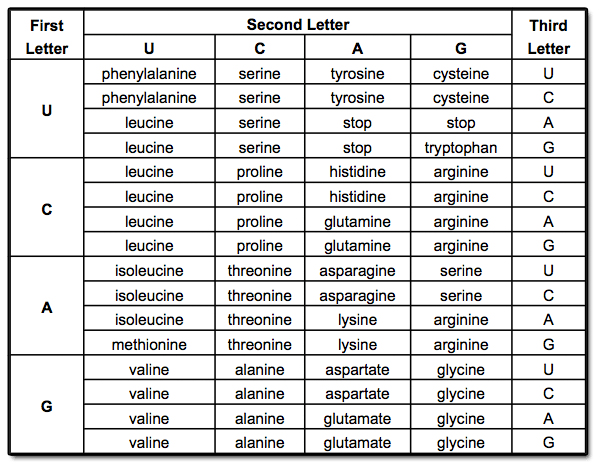
What amino acid would be added to the protein being formed during translation if the mRNA codon reads "AUG?"
Phenylalanine
Tyrosine
Leucine
Methionine

What amino acid (abbreviation) would be added to the protein being formed during translation if the mRNA codon reads "CCU?"
(a)

What is the correct amino acid sequence for the mRNA code AUG GCA AAC CGU ? (List the abbreviations with a dash between each one like this: pro-pro-met-leu)
(a)

What is the correct amino acid sequence if the DNA code of the gene is TAC GTA CAC?
*You will have to figure out the mRNA codons before figuring out the amino acid sequence
*Use the three letter abbreviations with a dash between each one (and no spaces)
(a)

The end of mitosis results in ____ to each other.
2 cells that are identical
4 cells that are identical
2 cells that are not identical
4 cells that are not identical
Reorder the phases of mitosis
Prophase
Metaphase
Anaphase
Telophase
Reorder the phases of meiosis
Prophase I
Metaphase I
Anaphase I
Telophase I
Prophase II


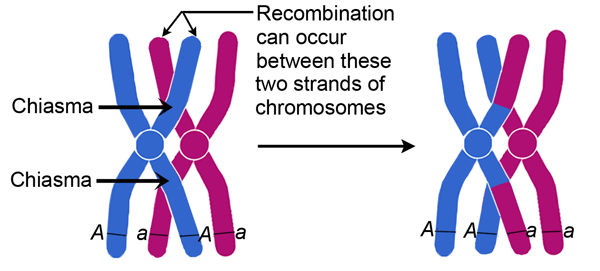
segregation of sister chromatids
condensation and segregation of alleles
mutationin which the DNA content of the gene is altered
crossing - over in which genes are exchanged
A chromosome is composed of two identical sister
centromeres
chromatids
autosomes
somatic cells
A pair of homologous chromosomes (a tetrad) is composed of (a) matching chromosomes, and (b) sister chromatids.
In which type of cell division does crossing over occur?
mitosis
meiosis
During meiosis, if an organism has 10 chromosomes, how many will the new daughter cells have?
10
8
5
2
During mitosis, if an organism has 10 chromosomes, how many will the new daughter cells have?
10
8
5
2
In mitosis the (a) daughter cells that are created are (b) . In meiosis the (c) daughter cells that are created are (d)
Which event is an important factor in increasing variety among sexually reproducing organisms?
crossing over
gene linkage
testcross
mitosis
In which phase of meiosis does the chromosome number change from diploid to haploid?
prophase I
anaphase I
prophase II
anaphase II
Select the image that represents meiosis:



