
 Worksheets
TEST: Ch 17 Plate Tectonics
Total questions: 86
Worksheet time: 1hrs 7mins
What is the name of the scientist that first hypothesized that the continents all fit together and were once a single land mass. (a)
The idea that all the continents slowly move over Earth's Surface became known as (a)
The name of the "super-continent" where all of the present continents were joined as one large continent. (a)
Any trace of an ancient organism that is preserved in rock is called (a)
What two specific continents fit together most noticeably? (a)
What specific technology did Wegener use in his study? (a)
Early mapmakers thought continents might have moved based on their observations of (a)
Pangaea was an ancient supercontinent made up of
South America, India, Australia, and South Africa
The United States, Greenland, and Europe
Antarctica, India, and South America
all of Earth's continents
To support his hypothesis of continental drift, Alfred Wegener did NOT use (a)
Fossil evidence that supported Wegener's idea of continental drift included (a)
Fossils of aquatic reptiles found in freshwater rocks suggested to Wegener that these reptiles
swam the great distances between continents
probably did not cross the oceans
ate Glossopteris
once lived in Earth's oceans
Based on observations of fossils of Glossopteris, Wegener concluded that
magnetic reversals had occurred in Earth's past
continental rocks containing these fossils had once been joined
Earth's continents were never joined
Glossopteris grew only in the tropics
Coal beds in Antarctica indicated to Wegener that this continent was (a)
Based on the glacial deposits he observed, Wegener argued that
glaciers form near the equator
Earth's axis of rotation had changed the past
landmass drifted away from the South Pole
Glossopteris could not survive hot weather
Most scientists at the time rejected Wegener's hypothesis of continental drift because he
had collected little evidence to support his hypothesis
would not state his hypothesis publicly
insisted that Earth's axis of rotation had changed
couldn't explain how or why the continents moved
The formation of new areas of oceanic crust, which occurs through the upwelling of magma at the Mid-Ocean Ridge. (a)
Match the following
Paleomagnetism
the study of magnetic minerals in rock
Plate Tectonics
theory of how lithospheric plates move and change shape
Sea-Floor Spreading
process by which new ocean floor forms as magma rises and solidifies at the Mid-Ocean Ridge
Trench
long, narrow, steep depression that forms on the sea floor as a result of subduction
Magma
liquid rock produced under the Earth's surface
_______ are mountain chains on the ocean floor.
Sea-floor ridges
Mid-ocean ridges
Tectonic plates
Photosynthesis
Mid-ocean ridges are the sites of intense _________ activity.
emotional
volcanic
earthquake
mathematical
At a mid-ocean ridge, melted rock rises through cracks in the _________.
ceiling
river
inner core
sea floor
As the melted rock cools and hardens,
it forms new ________.
volcanoes
hope
core
crust
___________ is the hypothesis that states that the continents once formed a single landmass, broke up, and drifted to their present locations.
Continental drift
Sea-floor spreading
Plate tectonics
Mid-ocean range

In the 1960s, scientists studying the ocean floor discovered _____________.
that the ocean floor had magnetic patterns
the Titanic
that the ocean floor had magical properties
that the ocean floor was as smooth as a desert
Throughout Earth's history, the north and the south magnetic poles have switched places many times.
true
false
Magnetic reversal is the process by which ________________.
the Earth's north and south magnetic poles periodically change places
the continents once formed a single landmass, broke up, and drifted to their present locations
new oceanic lithosphere (sea floor) forms as magma rises to Earth’s surface and solidifies at a mid-ocean ridge
During times of normal polarity, such as today, a compass needle points toward the North Pole.
true
false
Oceanic crust near the mid-ocean ridge is younger than oceanic crust farther away from the ridge.
true
false
What technology did scientists use in the mid-1900s to map the mid-ocean ridge?
satellites
deep-sea diving
submarines
sonar
In sea-floor spreading, molten material rises from the mantle and erupts
along the edges of all the continents
along mid-ocean ridges
in deep-ocean trenches
at the north and south poles
Old oceanic crust is more dense than new oceanic crust because it is _______________.
hot
moving toward a deep-ocean trench
cool
closer to the mid-ocean ridge
Mid-ocean ridges are ____________________.
found in all of Earth's oceans
found only in the Pacific Ocean
located mostly along coastlines
long deep-ocean trenches
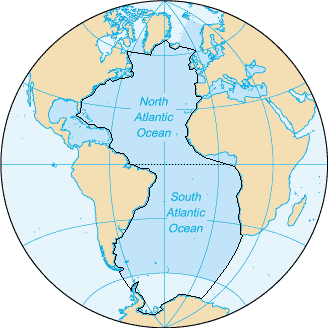
Seafloor spreading occurs because ____.
new material is being added to the asthenosphere
earthquakes break apart the ocean floor
sediments accumulate at the area of spreading
molten material beneath Earth's crust rises to the surface
A vast, underwater mountain chain is called a(n) _________.
ocean ridge
oceanic crust
deep-sea trench
ocean floor sediment
The process that creates new ocean crust by the upwelling of magma at ocean ridges is
Divergent boundary
Seafloor spreading
Subduction
Ocean trench
The study of the history of Earth's magnetic field is called
Magnetism
Magnetometer
Magnetic reversal
Paleomagnetism
What device measures magnetism?
Paleomagnetism
Magnetometer
Magnetic reversal
Isochron
Generally, what is the age of oceanic crust?
the same age as the continental crust
younger than the continental crust
older than the continental crust
science has never determined its age
What happens when the flow in the outer core changes, and Earth's magnetic field changes direction?
magnetic symmetry
paleomagnetism
core reversal
magnetic reversal
A magnetic field that has the same orientation as Earth's present field has _______________ polarity.
good
normal
abnormal
retrograde
A magnetic field that is opposite to the present field has ______________ polarity.
normal
reversed
retrograde
backward
What device can detect small changes in magnetic fields?
magnetometer
spectrograph
seismometer
An imaginary line on a map that shows points that have the same age is called a(n)
isotope
isometric
isochron
equator
As new oceanic crust forms, the older crust moves...
upward towards the surface
closer to the ridges
away from the ridges

What type of plate boundary is this? (a)

What type of plate boundary is this? (a)

What type of plate boundary is this?
Transform
Convergent
Divergent

What type of plate boundary is this? (a)

What type of plate boundary is this? (a)

What is happening in the picture?
layers of the Earth are changing positions
the inner and outer core are solid
convection currents are causing the tectonic plates to move
the mantle is growing
Two plates scrape and slide past each other at (a)
New crust forms along a(n)
subduction zone
divergent boundary
convergent boundary
transform boundary
A (a) plate is a large slab of crust and upper mantle that moves over the earth's surface.
The point where one plate slides beneath another is known as the ______________.
lithosphere
Pangaea
subduction zone
tectonic
Wegener
What is a plate boundary?
when two plates come together
the second layer of earth
ocean component
continental drift
What are the types of plate boundaries?
divergent, converge, transform
divergent, oceanic, transform
oceanic, continental, divergent
transform, oceanic, converge
What is a convergent boundary?
two plates that converge
two plates that drift apart
two plates that collide and push against each other
two plates that slide past each other
What type of crustal features form at a convergent boundary?
salt flats
folded mountains
earthquakes
lakes
What is a divergent boundary?
two plates that drift apart
two plates that slide past each other
two plates that collide
a fault
What type of crustal features form at a divergent boundary?
a trench
an ocean whole
an earthquake
a rift or a ridge
What is a transform boundary?
two plates colliding
two plates sliding past each other
two plates drifting apart
tectonic plates
What type of crustal features form at a transform boundary? (a)
What makes the plate tectonics move?
hot magma
the ocean floor
convection currents
heat waves
Convergent boundary lies within what layer of Earth?
crust
inner core
mantle
outer core
Which of the following boundary always moves away from each other?
close boundary
convergent boundary
divergent boundary
transformative boundary
Which of the following is a common product of the movement of the transform plate boundary?
hills
earthquakes
oceanic floor
seamount
What does heat do when convection currents are moving?
Sinks
Rises
Stays in place
Colder, more dense magma near the crust...
OPTIONS: sinks, rises, or remains the same
(a)
Hotter, less dense magma near the core...
rises.
sinks.
The plates of the crust move because...
volcanoes erupt violently.
of the weight of the oceans.
of convection currents in the mantle.
of the moon's gravity.
Convection currents occur due to...
rotation of earth
differences in temperature and density
electrons moving
gravitational pull
Which of the following is one reason Earth's tectonic plates to move?
energy from the Sun
magnetic Pole Reversal
convection currents in the mantle
faults in Mountain Ranges
Convection cycles move in the mantle. How does this affect the crust?
crust has no motion
crust moves in random directions
crust moves in same direction convection cycle moves

Which of the following best describes this diagram?
The oceanic crust is subducting under the continental crust because it is denser
The trench is froming a lake of water along the edge of the lithosphere.
Mountains are forming because 2 contiential crust are converging
The ocean water will put out the fire caused by the volcano.

The Ring of Fire is located around the Pacific Plate. How did this land feature form?
dinosaurs moved the plates to this location.
mountains formed along the ring because of uplifting.
movement along the edges caused earthquakes and volcanoes.
ice formed during the ice age and left rocks behind in this pattern,

Which of the following is the correct difference between the oceaninc and the continetal crust?
The ocean crust is thicker and less dense
The continential crust it thicker and more dense
The oceanic crust is thiner but is more dense.
The contiential crust is thinner and less dense.
What is the source of heat in a mantle convection current?
the sun
the crust
the core
the moon
In a convection current , hot materials move
any direction
downward
sideward
upward

