
 Worksheets
6th Grade Science Recap 2022-2023
Total questions: 132
Worksheet time: 1hrs 21mins


Which creature breathes through gills?
Fish
Cetacean
Which creature has flippers
Fish
Cetaceans
Which creature reproduces by laying eggs
Fish
Cetacean
If a fin is located on top, or the back, of the creature, what is the correct name of location?
Ventral
Dorsal
Which cetacean has baleen, or is a filter feeder?
Odontocete
Mysticete
Tail that is attached horizontally is known as:
Fluke
Tail fin
If a creature that produces their own heat is known as:
Ectothermic
Endothermic
Which data is numerical data?
Qualitative
Quantitative
What type of rock is formed from slow cooling magma UNDER the earth's surface?
Extrusive Igneous
Intrusive Igneous
Metamorphic
Sediment
Identify the series of geologic processes that can transform sediment into shale (sedimentary rock), shale into slate (metamorphic), and slate into magma
Cooling; Melting; Heat and Pressure
Compacting and cementing; heat and pressure; melting
Melting; heat and pressure; cooling
Weathering and erosion; compacting and cementing; cooling
Which characteristic is found only in sedimentary rocks?
Fossils
Crystals
Gas Bubbles
Glassy Surface

The Mount Rushmore National Monument is carved from the granite (formed from magma underground) of South Dakota's Black Hills. What type of rock is granite?
Igneous
Metamorphic
Sedimentary
None of the above

The seated sculpture of President Lincoln inside the Lincoln Memorial was carved out of white Georgia marble (formed from Earth's pressure and heat). What type of is marble?
Igneous
Metamorphic
Sedimentary
None of the above
Which characteristic is common to EXTRUSIVE igneous rocks?
Crystals
Fossils
Glassy surface
Ribbonlike layers
Identify the series of geologic processes that can transform magma into granite (igneous rock), granite into sand (sediment), and sand into sandstone (sedimentary rock).
Cooling; weathering and erosion; compacting and cementing
Melting; heat and pressure; cooling
Weathering and erosion; compacting and cementing;
Weathering and erosion; compacting and cementing; heat and pressure


Which type of rock is made from magma cooling inside Earth?
EXTRUSIVE igneous
INTRUSIVE igneous
metamorphic
sedimentary
Which type of rock is made from lava cooling on the surface of Earth?
EXTRUSIVE Igneous
Metamorphic
Sedimentary
INTRUSIVE Igneous


Which planet is closest to Earth in size?
Mercury
Uranus
Venus
Mars

Which is NOT a rocky planet?
Earth
Neptune
Mercury
Mars

Which is NOT true about Mercury?
it has no moons
it has no atmosphere
it is 1/2 the size of Earth
it is closest to the sun

Hamea, Makemake, Ceres, and Eris are all
dwarf planets
meteoroids
asteroids
comets

Which is the smallest celestial body in our Solar System?
meteoroid
planet
dwarf planet
asteroid

Which is the largest celestial body in our Solar System?
Jupiter
Sun
Saturn
Mars

Which celestial body turns on its side?
Neptune
Mars
Jupiter
Uranus

The asteroid belt is found between
The Sun and Mercury
Neptune and Uranus
Venus and Earth
Mars and Jupiter

What gas causes Uranus and Neptune to look blue?
carbon dioxide
methane
sulfuric acid
nitrogen

Which planet is 4x bigger than Earth?
Mars
Neptune
Saturn
Jupiter

What is true about Jupiter, Saturn, Uranus, and Neptune?
they all have many moons
they all have a solid surface
they all are smaller than Earth
they all have liquid water on the surface

How does Mars size compare to Earth?
it's 2x bigger
it's 3x bigger
it's 1/2 the size
it's 1/3 the size

How many moons does Mars have?
0
1
2
3

How many moons does Mercury have?
0
1
2
3

About how much of Earth's atmosphere is oxygen?
20%
40%
60%
80%

Which is true about Mercury, Venus, Earth, and Mars
they all have an atmosphere
they all have many moons
they all have rings made of rocks and ice
they all have a rocky surface

What is the hottest planet?
Mercury
Venus
Mars
Jupiter

Which planet is closest to Neptune in size?
Earth
Venus
Uranus
Mars

What are comets made of?
sulfuric acid
ice
helium and hydrogen
carbon dioxide

What gases make the Sun so hot and bright?
carbon dioxide & sulfuric acid
nitrogen & oxygen
helium & hydrogen
methane & helium
What keeps the planets in orbit around the sun?
gravity
friction
density
distance
A brick and a pencil are dropped at the same time from the same height. Which one would hit the ground first?
brick
pencil
both would hit at the same time
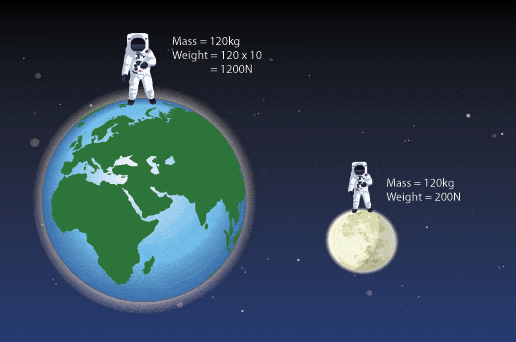
What two things determine the gravity of an object?
mass & weight
mass & distance
density & mass
volume & distance
When will the forces of gravity between two objects be the GREATEST?
when the masses of both objects are small and the objects are far apart
when the masses of both objects are large and the objects are close together
when the masses of both objects are small and the objects are close together
when the masses of both objects are large and the objects are far apart
When will the gravity between two objects be the LEAST?
when the masses of both objects is small and the objects are close together
when the masses of both objects is small and the objects are far apart
when the masses of both objects is large and the objects are close together
when the masses of both objects is large and the objects are far apart
When you drop a hammer and a feather, why does the feather fall slower?
air resistance causes the feather to slow down
gravity pulls harder on the hammer than the feather
gravity pulls harder on the feather than the hammer
air resistance causes the hammer to fall slower
Which statement about gravity is true?
gravity causes objects to pull towards one another
gravity causes objects to push away from each other
gravity only takes place between planets
the moon doesn't have any gravity


What is another name for Newton’s 1st law?
Law of Inertia
Law of Acceleration
Law of Action/Reaction



According to the picture, how would the gravitational potential energy of the car change if its weight was doubled?
The gravitational potential energy would be doubled
The gravitational potential energy would stay the same
The gravitational potential energy would be cut in half
The gravitational potential energy would be increased by 750

This is an example of what type of energy?
Kinetic
Potential
Electric
Thermal
A resource that we can use more than once is called a _____ resource.
Renewable
Nonrenewable
Reusable
Recyclable
Which of the following is NOT a natural resource
iPads
Trees
Wind
Fossil fuels
True or False: It is possible to make more nonrenewable resources in our lifetime.
True
False
What is deforestation?
Cutting down trees in a forest.
Planting new trees on empty land.
Using trees to produce oxygen.
Looking for new types of medicine in a forest.
Which of the following is a renewable resource?
Solar power
Wood from trees
Oil used for gasoline
Coal that powers a factory
Where are fossil fuels found?
In the Earth
In the forest
In animals
In the atmosphere
Fossil fuels are produced over _____ of years.
Hundreds of millions of years
Thousands of years
hundreds of years
every year
What do we need to use solar power for our electricity?
Solar panels
Sun panels
Solar engines
A sun motor
Why are trees considered natural resources?
People use them to make paper, lumber, fuel, and other products.
They provide shade.
They are a source of firewood
They can grow back after they are cut down.
True or False: Glass is a natural resource.
False
True
Which of these is the most sensible way to conserve natural resources?
Walk or ride your bike when you can, instead of driving in the car.
Stop using all electricity.
Never ride in the car.
Don't use any products made from trees.
How does recycling conserve resources?
It allows us to reuse things instead of making new ones.
It means there will be less garbage trucks driving around.
We can recycle everything, even food!
There will be no more trash at the dump.

Which of the following forms of biodiversity describes all of the different livable spaces in an ecosystem?
Species
Habitat
Genetic
None of the Above

Which of the following forms of biodiversity describes all of the different types of biotic factors in an ecosystem?
Species
Habitat
Genetic
None of the Above
Which of the following forms of biodiversity describes the differences between individuals within the same species?
Species
Habitat
Genetic
None of the Above
Which of the following forms of biodiversity describes the variety of resources within an ecosystem?
Species
Habitat
Genetic
None of the Above

Which do you think has a higher species diversity biodiversity, a food chain or a food web?
Food Chain
Food Web

What has a higher biodiversity: a rain forest or a desert?
Rain forest
Desert
They have a similar biodiversity
What has a higher biodiversity: a rain forest or a temperate forest?
Rain forest
Temperate Forest
They have a similar biodiversity

What has a higher biodiversity: a temperate forest or a frozen tundra?
Frozen Tundra
Temperate Forest
They have a similar biodiversity

In general, as you move from the equator to the poles, what happens to biodiversity>
Increases
Decreases
Remains the same

Why is biodiversity in an ecosystem so important?
Because it can help humans where to determine good places to develop farm land.
Because places that have a healthy biodiversity are unaffected by major disturbances.
Because having a high biodiversity allows ecosystems to withstand major changes.
Because having a high biodiversity allows for fewer opportunities of competition for similar resources.

What is another term for traits that a species helps them survive major changes in an ecosystem?
Resiliency
Adaptation
Disturbances
None of the above

What happened to the biodiversity in Yellowstone national forest with the addition of wolves to that temperate forest ecosystem?
Increased
Decreased
Stayed the same

What is happening to the biodiversity of the aquatic ecosystem as a result of the Great Barrier Reef dying?
Increased
Decreased
Stayed the same
Which of the following terms describes an ecosystems ability to survive or rebound from a major change?
Distubance
Resiliency
Adaptations
Biodiversity
Which of the following terms describes any major changes that may occur to an ecosystem?
Distubance
Resiliency
Adaptations
Biodiversity
Which factor is most likely to cause the number of rabbits living in an area to increase?
less water
fewer predators
lack of shelter
limited food
All of the different organisms interacting in a pond make up
a community
a population
the habitat
an organism

This diagram provides information on the diversity, in number of species, for four major groups of animals over time. What is the only group that experienced an increase of diversity between 413 million years ago and 265 million years ago?
Mollusks
Echinoderms
Arthropods
Chordates

