wayground logo

Free Printable Worksheets

Font size

S
M
L
XL
Worksheets

Astronomy Final Exam Review

Total questions: 125

Worksheet time: 1hrs 4mins

Name
Class
Date
1.

The name of the Galaxy that contains our solar system is...

a)

Milky Way

b)

Snickers

c)

3 Musketeers

d)

Mars Bars

2.

What is a solar wind?

a)

The surface of the sun

b)

Darker, cooler areas of the sun

c)

Outer layer of the sun

d)

Constant flow of tiny, fast, electrically charged particles

3.
The energy from the sun is created by a process called:
a)
nuclear fission
b)
nuclear fusion
c)
nuclear reaction
d)
nuclear core
4.
Energy is created in the core when two _____________ atoms join together to form a ______________ atom.
a)
helium, hydrogen
b)
carbon, hydrogen
c)
nitrogen, helium
d)
hydrogen, helium
5.

What layer can be seen here only during a total solar eclipse that also means "crown"?

a)

chromosphere

b)

corona

c)

photosphere

d)

core

6.

When explosions erupt into space from the sun releasing gas and energy we call this:

a)

solar winds

b)

coronal outburst

c)

solar flares

d)

auroras

7.
What type of galaxy is the Milky Way?
a)
Spiral galaxy
b)
Elliptical galaxy
c)
Nebula
d)
Globular cluster
8.
Where does nuclear fusion occur?
a)
Space
b)
Radiation Zone
c)
Photosphere
d)
The Core
9.

These can disrupt electronics on Earth.

a)

Sunspots

b)

Solar flares

c)

Prominences

d)

Tik Tok Videos

10.
What is the name for this giant loop of energy leaping from the solar surface? 
a)
aurora
b)
prominence
c)
solar flare
d)
sunspot
11.

The size of our sun compared to other stars is like...

a)

Dwarf

b)

Small to Meduim

c)

Giant

d)

Super giant

12.

Which of the following lists some of the layers of the Sun in order from the center of the Sun outward?

a)

radiation zone, convection zone, chromosphere, core, photosphere, corona

b)

radiation zone, convection zone, core, photosphere, chromosphere, corona

c)

core, radiation zone, convection zone, photosphere, corona, chromosphere

d)

core, radiation zone, convection zone, photosphere, chromosphere, corona

13.

Identify part 1. It is the center of the sun where nuclear fusion takes place.

a)

corona

b)

photosphere

c)

core

d)

radiation zone

14.

Identify part 4. This is the layer of the sun's atmosphere closest to the sun that produces the light.

a)

photosphere

b)

convection zone

c)

core

d)

radiation zone

15.

How many years are in a sunspot cycle

a)

4.5 million

b)

29

c)

11

d)

19

16.
At which stage is our sun at currently?
a)
Red Giant
b)
Nebula
c)
Main Sequence
d)
Dead Star
17.

How might a high mass star's life cycle end?

a)

white dwarf

b)

neutron star

c)

planetary nebula

d)

red giant

18.

A low mass star life cycle will end as ___.

a)

a supernova

b)

a white dwarf

c)

a neutron star

d)

a black hole

19.

Where are the hottest stars on this Hertzsprung Russell Diagram?

a)

Left side

b)

Right side

c)

Middle

d)

They are all the same temperature

20.

Which of these stars is hottest and brightest?

a)

Spica

b)

Vega

c)

Polux

d)

Centauri B

21.

Which star would you call a red giant?

a)

Polaris

b)

Sirius

c)

Betelgeuse

d)

DX Cancri

22.

The category is very stable contains the most stars (including our sun) is...

a)

Main Sequence

b)

Supergiants

c)

Giants

d)

Dwarfs

23.

Look at the H-R diagram. Which star is

sort of hot, dim (not too much light)?

a)

Red Giant

b)

Blue Supergiant

c)

Main Sequence

d)

White Dwarf

24.

What is believed to be at the center of most galaxies that has a strong enough gravitational pull to hold all of the stars in place?

a)

barred spiral

b)

black hole

c)

nebula

d)

spiral

25.

Stars can take different paths towards its death due to having different _____________

a)

temperature

b)

mass

c)

brightness

d)

color

26.

After a supergiant, a high mass star explodes and forms a

a)

supernova

b)

red giant

c)

black hole

d)

planetary nebula

27.

A high mass star can end as this stage, which is so dense and gravity is so strong that not even light can escape!

a)

black dwarf

b)

white dwarf

c)

supernova

d)

black hole

28.

A star is born as soon as ________________ begins to happen.

a)

nuclear fusion

b)

a black hole forms

c)

supernova explodes

d)

nuclear fission

29.

According to the Big Bang Theory, why is the light from distant galaxies red-shifted? And what is happening to the temperature of the universe?

a)

They are moving away from us; Universe is heating up

b)

They are moving away from us; Universe is cooling down

c)

They are moving toward us; Universe is heating up

d)

They are moving toward us; Universe is cooling down
30.
A hurricane would show an interaction between the Hydrosphere and
a)
Atmosphere
b)
Biosphere
c)
Geosphere
d)
All are correct
31.
All are examples of negative feedback loops EXCEPT:
a)
Predator/Prey Relationships
b)
Sweating when hot
c)
Shivering when cold
d)
Burning of fossil fuels
32.
Erosion of a coastline would be an example of what type of feedback loop?
a)
Positive Feedback
b)
Negative Feedback
c)
Equal Feedback
d)
None of the above
33.
Coral reefs dying would mostly impact which of Earth's spheres?
a)
atmosphere & biosphere
b)
geosphere & atmosphere
c)
hydrosphere & biosphere
d)
all are correct
34.
Animals, including humans, have to consume their food to get energy. This is done through a process called __________.
a)
cellular respiration
b)
denitrification
c)
nitrification
d)
photosynthesis
35.
The total amount of greenhouse gases released by a person, a family, a building, an organization, or a company each year is
a)
it's carbon cycle
b)
it's carbon footprint
c)
it's amount of pollution
d)
it's CFC level
36.
All are factors that affect climate EXCEPT
a)
Latitude
b)
Plate Tectonics
c)
Temperature
d)
Biodiversity
37.
Farming and agriculture contributes to the addition of ___________ & ___________ in the water.
a)
carbon dioxide & oxygen
b)
ozone & carbon dioxide
c)
phosphorus & nitrogen
d)
transpiration & evaporation
38.
Nitrogen fixation can be accomplished naturally either by lightning strike or by _____________.
a)
bacteria
b)
burning of fossil fuels
c)
photosynthesis
d)
cellular respiration
39.
Deforestation is causing increased erosion, so trees were planted and the erosion decreased. This would be an example of
a)
positive feedback loop
b)
negative feedback loop
c)
photosynthesis
d)
cellular respiration
40.
The Earth's temperature is rising due to increased carbon dioxide levels in the atmosphere, which causes more ice to melt in the Arctic. This would be an example of
a)
positive feedback loop
b)
negative feedback loop
c)
photosynthesis
d)
cellular respiration
41.
Producers (plants) make their own food through the process of
a)
Nitrogen-fixing bacteria
b)
cellular respiration
c)
photosynthesis
d)
phosphate cycle
42.
What process is shown by the following formula? Oxygen+Sugar---> Carbon Dioxide+Water+Energy
a)
Photosynthesis
b)
Cellular Respiration
c)
Phosphorus Cycle
d)
Carbon Cycle
43.
Photosynthesis and _________________ can be considered the chemical reverse of each other.
a)
Nitrogen-fixing Bacteria
b)
Cellular Respiration
c)
Photosynthesis
d)
Phosphate Cycle
44.
The Gulf of Mexico Dead Zone is caused by
a)
agricultural runoff of phosphorus and nitrogen.
b)
cellular respiration of organisms.
c)
overfishing of marine life in the Gulf of Mexico.
d)
forest fires caused by the increase amounts of oxygen in the atmosphere.
45.
One solution to reduce the Gulf of Mexico Dead Zone is to
a)
use fewer fertilizers
b)
increase runoff from farmland
c)
allow animal waste to enter waterways
d)
all of the above
46.
All are possible NATURAL causes of climate change EXCEPT
a)
volcanic eruptions
b)
changes in solar outputs (sunspot activity)
c)
deforestation
d)
Earth's position in space
47.
Which of the following is a HUMAN cause of climate change
a)
burning of fossil fuels
b)
plastic industry
c)
cattle farms
d)
all are human causes of climate change
48.
All are evidence of climate change EXCEPT
a)
global average temperature increasing
b)
carbon dioxide levels decreasing
c)
shrinking of ice sheets
d)
higher pH level causing ocean acidification
49.
Why does the equator experience about the same temperatures year round?
a)
The sun's rays strike the equator at about the same angle all year.
b)
Cities near the equator have no prevailing winds.
c)
Cities near the equator have no mountains to affect the climate.
d)
None of the above.
50.
As elevation increases,
a)
temperature increases.
b)
temperature decreases.
c)
humidity increases.
d)
humidity decreases.
51.
Closeness to large bodies of water has little impact on climates.
a)
True
b)
False
52.
One way to combat (fight) climate change would be to
a)
drive more cars
b)
eat more beef
c)
cut down trees
d)
invest in renewable energy alternatives
53.
When water leaves a plant, this is called:
a)
transpiration
b)
evaporation
c)
condensation
d)
none of the above
54.
When carbon dioxide levels increase...
a)
temperature increases
b)
temperature decreases
c)
temperature stays the same
d)
none of the above
55.
The Milankovitch cycles take what characteristic(s) of earth as a possible contributor(s) to climate change?
a)
Earth's orbital shape (eccentricity)
b)
Earth's tilt
c)
Earth's spin axis direction (precession)
d)
All of the Above
56.
Earth's axis is currently tilted at ______ degrees.
a)
22.1
b)
23.5
c)
24.6
57.
True or False: The more tilted the earth's axis is, the less extreme seasons are (milder winters, cooler summers).
a)
True
b)
False
58.
Which of the following gases are considered greenhouse gases?
a)
Methane
b)
Carbon Dioxide
c)
Ozone
d)
All of the above
59.
What is the greenhouse effect?
a)
Process by which plants turn sunlight into chemical energy.
b)
Process by which ozone is depleted in the atmosphere.
c)
Phenomenon where gases allow sunlight to enter Earth's atmosphere but make it difficult for heat to escape.
d)
None of the above
60.
Earth's rotation takes about
a)
24 hours
b)
6 months
c)
1 month
d)
1 year
61.
Day and night are caused by
a)
Earth's rotation on its axis
b)
the tilt of earth on its axis
c)
eclipses
d)
tidal forces from the moon
62.
One complete revolution of Earth around the sun takes about
a)
24 hours
b)
6 months
c)
1 month
d)
1 year
63.
Earth has seasons because
a)
the distance between Earth and the sun changes
b)
the temperature of the sun changes
c)
the axis is tilted as it moves around the sun
d)
the moon's pulls on Earth's oceans.
64.
When the north end of Earth's axis is tilted toward the sun, North America will experience
a)
more direct rays and longer days
b)
more indirect rays and longer days
c)
more indirect rays and shorter days
d)
none of the above
65.
The phase of the moon you see depends on
a)
how much of the moon's surface is lit by the sun.
b)
how much of the sunlit side of the moon faces the Earth.
c)
whether or not an eclipse is occurring.
d)
how much energy the sun is giving off.
66.
For a solar eclipse to occur,
a)
the moon must be directly between Earth and the sun.
b)
the sun must be directly between Earth and the moon.
c)
the moon must be directly behind the Earth.
d)
the Earth must be between the sun and moon.
67.
During what phase of the moon can a lunar eclipse occur?
a)
waxing gibbous
b)
new moon
c)
3rd quarter
d)
full moon
68.
When are tides highest?
a)
during the moon's third quarter phase
b)
when the moon is at right angles to the sun.
c)
when the sun, Earth and the moon are nearly in a line.
d)
during waxing gibbous phase of the moon.
69.
Scientists think the moon was formed when
a)
meteoroids collected and solidified within the pull of Earth's gravity.
b)
gases from Earth escaped from the atmosphere and condensed in space.
c)
a large object struck Earth, and ejected material from the collision combined.
d)
an asteroid passing by got caught in the Earth's gravity.
70.
In the Southern Hemisphere, the summer solstice occurs when the sun is
a)
at the equator
b)
farthest north
c)
closest to Earth
d)
farthest south
71.
An equinox occurs when
a)
neither end of Earth's axis is tilted toward or away from the sun.
b)
the north end of Earth's axis is tilted away from the sun.
c)
the north end of Earth's axis is tilted toward the sun.
d)
the Earth is closest in its orbit to the sun.
72.
Because the moon rotates once for every revolution around Earth,
a)
the far side of the moon is visible only during the full moon phase.
b)
a different side of the moon faces Earth each day.
c)
we have two high tides and two low tides every 24 hours.
d)
you never see the far side of the moon from Earth.
73.
The two factors that combine to keep Earth and the moon in their orbits are
a)
orbital speed and mass.
b)
mass and inertia
c)
gravity and inertia
d)
weight and distance
74.
The tendency of a moving object to continue moving in a straight line or a stationary object to remain in place is called
a)
mass.
b)
gravity.
c)
weight.
d)
inertia.
75.
The strength of the force of gravity depends on
a)
the weight of the objects and their speeds.
b)
the masses of the objects and their weights.
c)
the masses of the objects and the distance between them.
d)
the inertia of the objects and the distance between them.
76.
During a total lunar eclipse the moon is in Earth's
a)
orbit.
b)
umbra.
c)
penumbra.
d)
none of the above.
77.
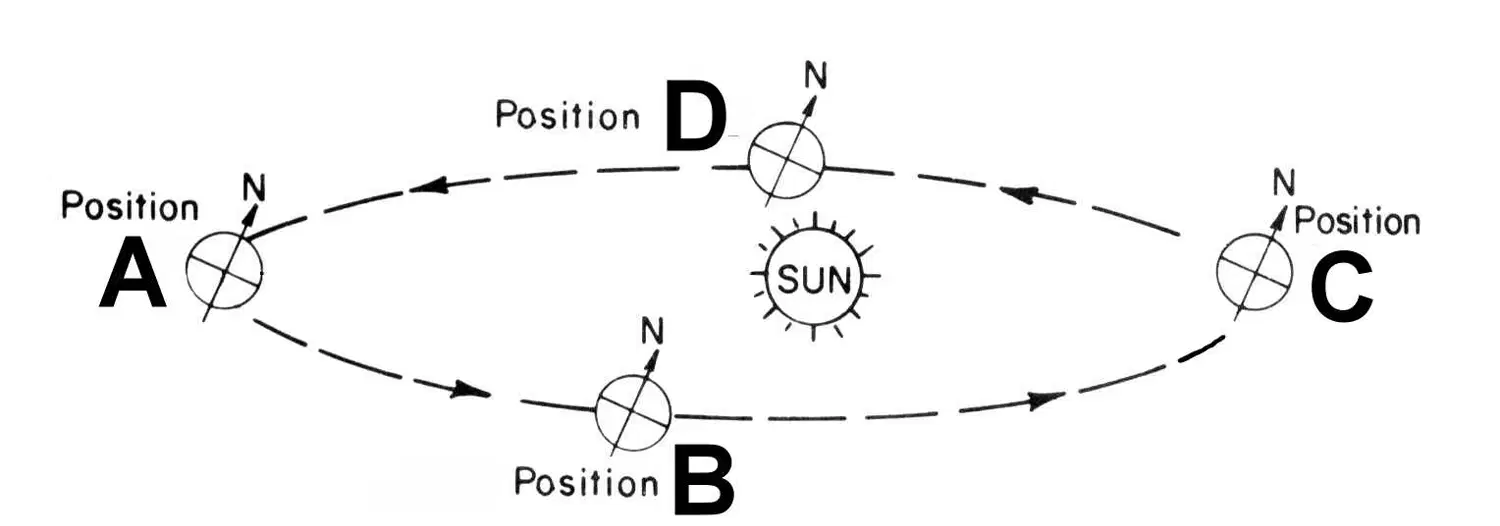
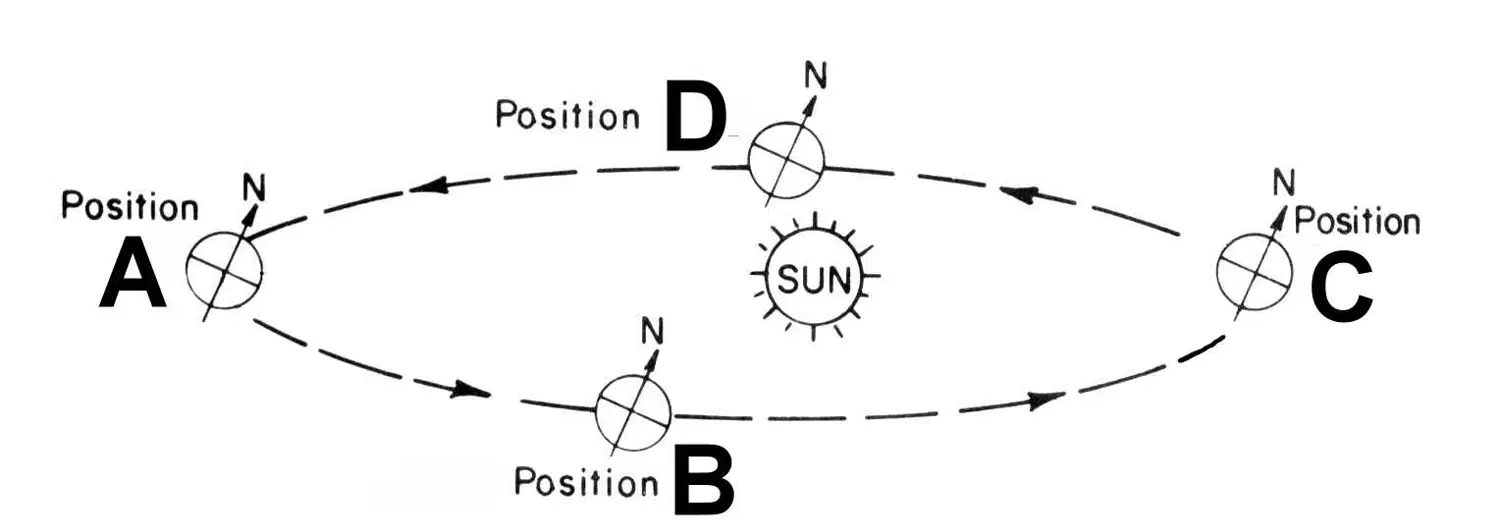
What special day of the year is depicted at position C in the Northern Hemisphere according to the diagram below?
a)
Vernal Equinox
b)
Summer Solstice
c)
Winter Solstice
d)
Autumnal Equinox
78.
What season is it in the Southern Hemisphere at position A according to the diagram below?
a)
Spring
b)
Summer
c)
Winter
d)
Fall
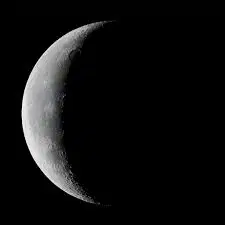
79.
What moon phase is depicted below?
a)
waning crescent
b)
waxing crescent
c)
waning gibbous
d)
waxing gibbous
80.
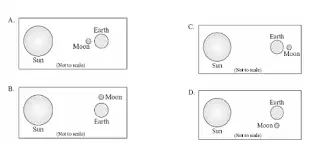
Which diagrams depict a spring tide?
a)
A and C
b)
B and C
c)
C and D
d)
C and B
81.
A neap tide occurs at what two moon phases?
a)
Full Moon and New Moon
b)
Waxing Crescent and Waning Crescent
c)
1st Quarter and Third Quarter
d)
Waning Gibbous and Waxing Gibbous
82.
How long does it take the moon to complete a cycle of phases?
a)
6 months
b)
24 hours
c)
365.25 days
d)
29.5 days
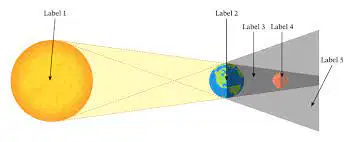
83.
What kind of eclipse is depicted in the diagram below?
a)
Partial Solar
b)
Partial Lunar
c)
Total Solar
d)
Total Lunar
84.
Looking at the electromagnetic spectrum, which waves have the highest energy?
a)
Gamma Rays
b)
Radio
c)
Infrared
d)
Microwaves
e)
Ultraviolet
85.
Looking at the electromagnetic spectrum, which waves have the lowest energy?
a)
Radio
b)
Infrared
c)
Microwaves
d)
Ultraviolet
e)
Gamma Rays
86.
Which correctly orders the items from the SMALLEST to LARGEST?
a)
Universe, Galaxy, Star Cluster, Star
b)
Star, Star Cluster, Universe, Galaxy
c)
Star, Star Cluster, Galaxy, Universe
87.
A light-year is
a)
365 days
b)
the distance light travels in a year
c)
the amount of light the sun produces in a year
88.
Parallax is used to determine a star's
a)
distance from Earth
b)
temperature
c)
brightness
89.
Characteristics used to classify stars include
a)
size, distance, and brightness
b)
color, brightness, and distance
c)
size, brightness, and temperature
90.
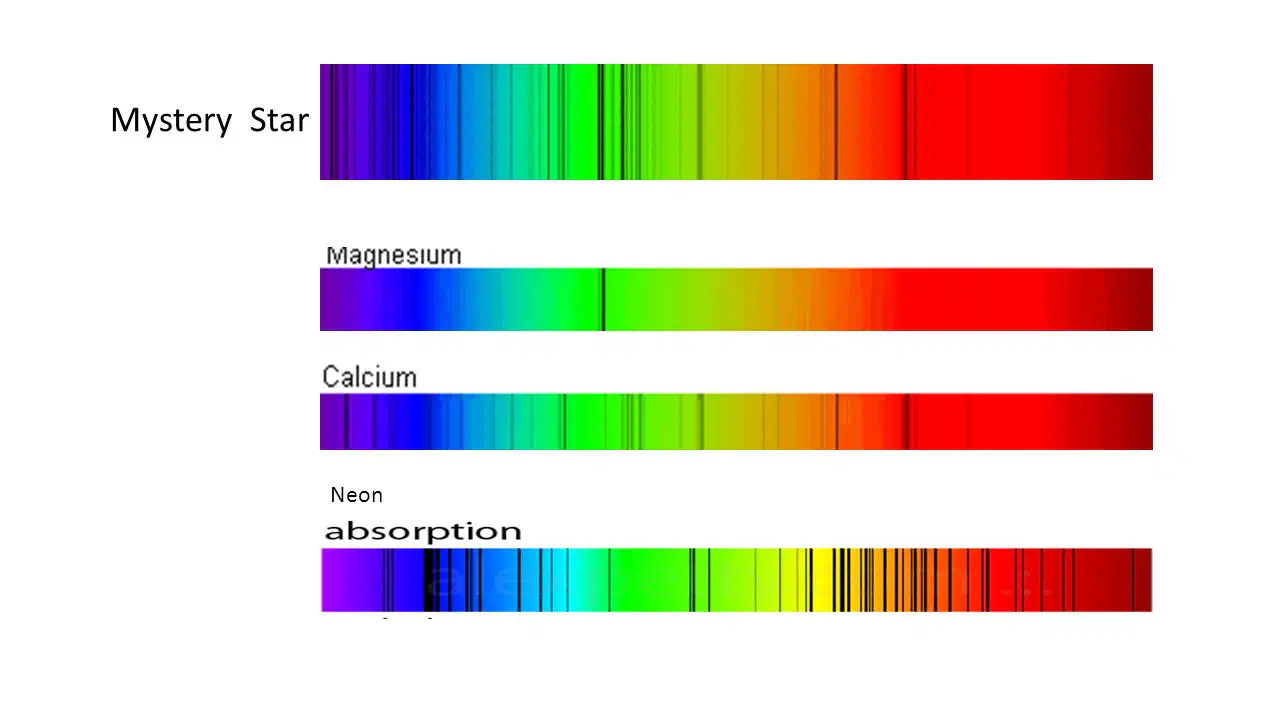
What characteristic about the star can a scientist determine by analyzing it's spectral pattern (fingerprint)
a)
Color
b)
Brightness
c)
Composition
91.
A stars brightness as if it were a standard distance from Earth is its
a)
apparent brightness
b)
absolute brightness
92.
A device that breaks light into colors and produces an image is a(n)
a)
spectrograph
b)
visible light scale
c)
seismogram
93.
Our sun will spend 90% of it's life as a
a)
Main Sequence Star
b)
Red Giant
c)
White Dwarf
94.
True/False: The brightness of a star as seen from Earth is its APPARENT brightness.
a)
True
b)
False
95.
True/False: Parallax can only be used to measure the distance of nearby stars.
a)
True
b)
False
96.
True/False: Stars with less mass will last LONGER than stars with more mass.
a)
True
b)
False
97.
Hubble's Law states
a)
that the closer to Earth a galaxy is the faster it moves towards Earth
b)
that the further away from Earth a galaxy is the faster it moves away from Earth
c)
that the closer to Earth a galaxy is the slower it moves away from Earth
98.
This image is showing...
a)
remnant heat left over after the big bang
b)
microwave background radiation
c)
all of the above
99.
Below are the spectrums of various stars, which spectrum represents a star moving AWAY from us?
a)
spectrum at rest
b)
redshifted spectrum
c)
blueshifted spectrum
100.
Below are the spectrums of various stars, which spectrum represents a star moving TOWARD us?
a)
spectrum at rest
b)
redshifted spectrum
c)
blueshifted spectrum
101.
What happens to the wavelength of a star that is blueshifted?
a)
it elongates
b)
it shortens
c)
it stays the same
102.
Which explanation best describes why a star shows a red-shift?
a)
Because the star is moving toward us, and the wavelength of light is shortened to the red end of the spectrum
b)
Because the star is moving away from us, and the wavelength of light is elongated to the red end of the spectrum
c)
Because the star is static/not moving, and the wavelength of light is elongated to the red end of the spectrum
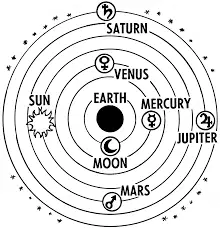
103.
What model is the image showing?
a)
Heliocentric Model
b)
Geocentric Model
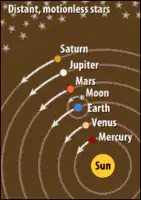
104.
What model is this image showing?
a)
Heliocentric Model
b)
Geocentric Model
105.
All planets travel in a(n) __________.
a)
circle
b)
different plane
c)
sphere
d)
ellipse
106.
T/F: Johannes Kepler studied under Tycho Brahe. After Brahe's death, Kepler used Brahe's data.
a)
True
b)
False
107.
Which planets did the Ancient Greeks know about?
a)
Venus, Mars, Neptune
b)
Earth, Mars, Jupiter, Saturn, Uranus
c)
Mercury, Venus, Earth, and Mars
d)
Mercury, Venus, Earth, Mars, Jupiter, and Saturn
108.
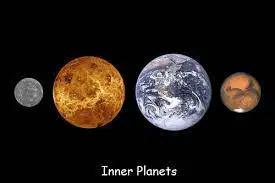
The 4 inner planets are also known as _____________.
a)
water planets
b)
rocky planets
c)
terrestrial planets
d)
gas giants
109.
Which of the following is a characteristic of Mercury?
a)
Has no atmosphere
b)
Called the red planet
c)
Has a smooth crust
d)
Rotates opposite direction
110.
What two inner planets are considered twins or sister planets?
a)
Mercury and Mars
b)
Venus and Earth
c)
Mars and Earth
d)
Venus and Mercury
111.
What is a characteristic of Earth?
a)
70% covered in water
b)
Atmosphere is heavy and thick
c)
Atmosphere is mostly carbon dioxide
d)
Has a density less than water
112.
What is a characteristic of Mars?
a)
Has a rocky surface
b)
Called the "red planet"
c)
Atmosphere mostly carbon dioxide
d)
All of the above
113.
What is the correct order of the outer planets (starting with the closest to the sun)?
a)
Jupiter, Saturn, Neptune, and Uranus
b)
Neptune, Uranus, Saturn, and Jupiter
c)
Jupiter, Saturn, Uranus, Neptune
d)
Saturn, Jupiter, Uranus, Neptune
114.
The last 4 planets in our solar system are known as _____________.
a)
water planets
b)
rocky planets
c)
terrestrial planets
d)
gas giants
115.
What is a characteristic of Jupiter?
a)
Has a red spot
b)
Has a dark spot
c)
Rotates on side
d)
Has a moon named Triton
116.
What is a characteristic of Saturn?
a)
Discovered using mathematics
b)
Less dense than water
c)
Similar to Neptune in size
d)
Largest in our solar system
117.
What is a characteristic of Neptune
a)
Has rings
b)
Known as the blue planet
c)
Has a dark spot
d)
All are characteristics
118.
Which planet was discovered using mathematics?
a)
Saturn
b)
Jupiter
c)
Uranus
d)
Neptune
119.
Which of the 3 characteristics did Pluto NOT meet?
a)
Must be round
b)
Must clear it's orbital path (neighborhood)
c)
Must orbit the sun
120.
When a meteoroid enters Earth's atmosphere, friction causes it to burn up and produce a streak of light called a(n) ____________.
a)
meteor
b)
asteroid
c)
comet
d)
meteoroid
e)
asteroid belt
121.
A chunk of ice and dust whose orbit is usually a long, narrow ellipse is a(n) ____________.
a)
comet
b)
asteroid
c)
meteoroid
d)
asteroid belt
e)
kuiper belt
122.
If a meteoroid hits Earth's surface, it is called a(n) _________.
a)
meteorite
b)
asteroid
c)
comet
d)
meteoroid
e)
asteroid belt
123.
The region of the solar system between the orbits of Mars and Jupiter is known as the ___________.
a)
asteroid belt
b)
asteroid
c)
comet
d)
meteoroid
e)
kuiper belt
124.
A spherical region of comets is the _________.
a)
oort cloud
b)
asteroid
c)
comet
d)
meteoroid
e)
asteroid belt
125.
A doughnut-shaped region of comets that begins near Neptune's orbit and is where Pluto lives is the ____________.
a)
kuiper belt
b)
asteroid
c)
comet
d)
meteoroid
e)
asteroid belt