
 Worksheets
Biochem: Oxidative Phosphorylation
Total questions: 97
Worksheet time: 50mins
Where does oxidative phosphorylation occur?
smooth ER
mitochondria
nucleus
ribosome
Oxidative phosphorylation is the third and final pathway of converting carbs to energy (ATP)
True
False
Electrons from the metabolism of carbs are transferred to
reduced coenzymes (NADH and FADH2)
not this
how many compartments are in the mitochondria?
1
2
3
4
Cells with higher energy need will have more mitochondria.
True
False
Relatively porous membrane that allows passage of metabolites and movement of phosphate, CAC components, ADP and ATP
inner membrane
outer membrane
similar environment to cytosol with higher proton concentration (lower pH)
inner membrane
outer membrane
intermembrane space
matrix
impermeable to ions and polar molecules and location of ETC and ATP synthase.
inner membrane
outer membrane
Cristae increase the surface area of the
inner mitochondrial membrane
outer mitochondrial membrane
location of the CAC and beta oxidaiton and amino acid metabolism with LOW proton concentration (high pH)
matrix
intermembrane space
which has a low pH?
intermembrane space
mitochondrial matrix
which has a higher pH?
intermembrane space
mitochondrial matrix
Makes up cellular respiration
anaerobic respiration
CAC
oxidative phosphorylation
glycolysis
Respiration is a ____ generating process
ADP
AMP
ATP
What is the final electron acceptor of cellular respiration?
iron
calcium
oxygen
carbon
In cellular respiration, NADH and FADH2 are oxidized (lose their H)
true
false
The ETC is made up of how many enzymes?
1
2
3
4
The ETC uses energy released from ___ to pump H+ to the intermembrane space.
protons
electrons
Oxidative phosphorylation depends on ....
protons
electron transfer
the presence of CO2
NADH and FADH2 reduce O2 to ____
bicarb
water
HCl
Reduction of O2 to water is highly ____.
endergonic
exergonic
Which is the stronger reducing agent?
NADH
FADH2
If something has a NEGATIVE reduction potential that means....
It is ready to accept e-
it is ready to donate e-
If something has a POSITIVE reduction potential that means...
it is ready to donate e-
it is ready to accept e-
What is the final e- acceptor in the ETC?
Mg
NADH
FADH2
O2
Electrons flow from NADH to O2 through ___ large protein complexes in the IMM.
2
4
3
The ETC complex facilitates rapid transfer of substrate while preventing intermediates from forming.
True
False
FADH2 electrons feed in ____ NADH because it has lower reduction potential.
before
after
What serves as a prosthetic group for each protein in the ETC?
Mg
Ca
Fe
H
The ETC is a series of
coupled redox reactions
not this
As we move through the complexes of the ETC, reduction potential becomes more ____
negative
positive
Electrons from NADH produced in glycolysis are donated to the ETC.
True
False
In eukaryotic cells, NADH from glycolysis in the cytosol can directly enter the ETC through complex I.
True
False
NAD+ pools are kept segregated from the mitochondria and cannot cross the membrane.
True
False
What are the two shuttles that feed 2 e-s from cytosolic NADH into the m matrix?
malate-aspartate shuttle (liver)
glycerol-3-phosphate (muscle)
Which shuttle is found in the liver and used to transport cytosolic NADH electrons?
Malate-aspartate shuttle
glycerol-3-phosphate
Which shuttle is found in the muscle and used to transport cytosolic NADH electrons?
malate-aspartate shuttle
glycerol-3-phosphate
How many electrons can the malatate-aspartate shuttle and glycerol-3-phosphate shuttle transport to the mitochondria?
1
2
3
4
The redox reactions in the ETC are reversible.
True
False
Which ETC complex is also part of the citric acid cycle?
Complex I
Complex II
Complex III
Complex IV
What serves as an electron carrier for complex I and II?
cytochrome C
coenzyme Q
Which complex in the ETC is the largest?
complex I
complex II
complex III
complex IV
How many electrons from complex I are transferred from NADH to coenzyme Q?
1
2
3
4
Coenzyme Q is
lipophillic
hydrophillic
Where does coenzyme Q reside?
in the matrix
in the IMS
in the membrane
How many H's does complex I transfer from the matrix to the IMS?
1
2
3
4
Electrons from NADH --> FMN (flavin mononucleotide) --> Fe-S --> coenzyme Q
True
False
Coenzyme Q from complex I gets reduced to
QH
QH2
QH3
Coenzyme Q travels from complex I to complex II.
True
False
How many H+s get transported to the IMS from the matrix through Complex I?
1
2
3
4
What is the name of complex II in the ETC?
succinate dehydrogenase
not this
Complex II: succinate transfers 2 e-s to FAD --> FADH2 --> Fe-S --> Coenzyme Q
True
False
Complex II is
free in the matrix
located in the IMM
A protein with heme that can accept electrons.
coenzyme Q
cytochrome C
How many electrons can each cytochrome C transfer?
1
2
3
4
How many cytochromes does complex III contain?
1
2
3
4
What transfers e-s from complex III to complex IV?
coenzyme Q
cytochrome C
How many protons are translocated to the IMS by complex II?
4
2
Which complexes pump 4 H+s to the IMS?
complex I
complex II
complex III
complex IV
Which complexes pump 2 H+s to the IMS?
complex I
complex II
complex III
complex IV
Cytochrome C transfers 1 e- at a time while coenzyme Q transfers 2 e-s at a time.
True
False
Complex IV accepts e-s ___ at a time.
1
2
3
For every 2 e-s that are transferred to complex IV, how many H+s are pumped to the IMS?
2
4
How many hydrogens are pumped per NADH?
6
10
How many ATP per NADH?
1.5
2.5
How many H+ are pumped from one FADH2?
10
6
how many ATP are made from one FADH2?
2.5
1.5
Which shuttle delivers electrons from NADH in the cytosol to the Mito matrix using FAD?
malate-aspartate shuttle
Glycerol-3-phosphate shuttle
What enzyme found in the mitochondria oxidizes glycerol-3-phosphate to dihydroxyacetone phosphate?
mitochondrial glycerol-3-P dehydrogenase
not this
Where are protons pumped?
from matrix to the IMS
from the IMS to the matrix
Which complex is ATP synthase?
complex IV
complex V
How many subunits make up ATP synthase?
1
2
3
4
What are the 2 subunits of ATP synthase?
F0
F1
How many protons are pumped per ATP generated?
1
2
3
4
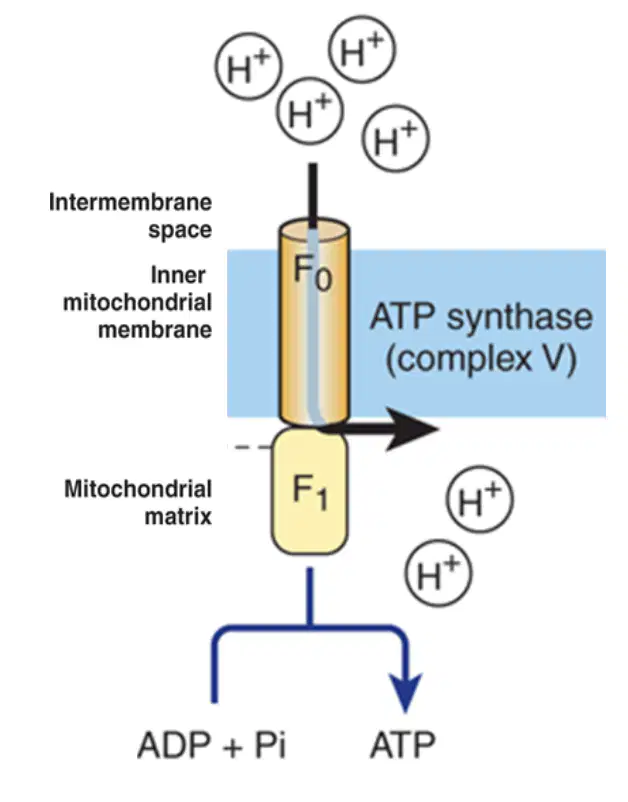
The F0 part of ATP synthase is longer and embedded in the membrane. the F1 part is in the mitochondrial matrix.
okay
not this
Adenine nucleotide translocase
translocates one Pi and one H+ into the matrix
exports one ATP for every ADP imported
Phosphate translocase
translocates one Pi and one H+ into the matrix
exports one ATP for every ADP imported
With the adenine nucleotide translocase, one ATP moves from the matrix to the intermembrane space and one ADP moves from the intermembrane space to the matrix.
True
False
Which is an antiporter?
adenine nucleotide translocase
phosphate translocase
Which one is a symporter?
adenine nucleotide translocase
phosphate translocase
translocation of a fourth H= per ATP is required to facilitate cotransport of substrates into and produces out of the mitochondria
True
False
Making ATP is very thermodynamically unfavorable.
True
False
How is the unfavorable thermodynamics of making ATP overcome?
proton gradient
e- gradient
Which has high levels of increased expression of uncoupling protein 1 (UCP1)?
white adipose tissue
brown adipose tissue
In brown adipose tissue, protons move through UCP1 and NOT through ATP synthase complex which decreases ATP and generated heat instead.
True
False
What are ETC inhibitors?
rotenone
hydrogen cyanide
CO
Antimycin A
Oligomycin
How many ATP from glycolysis?
2
not this
How many NADH from glycolysis?
2
not this
High NADH levels will inhibit
gluconeogenesis
CAC
High ATP levels inhibit
glycolysis
CAC
Inhibiting oxidative phosphorylation leads to ____ of NADH
decrease
accumulation
Coenzyme Q is naturally leaky
T
F
single electron transfers from leaky Q results in free radicals
True
False
converts O2 to H2O2
superoxide dismutase
not this
NADPH from PPP reduces glutathione with can
eliminate toxic oxygen radicals
not this
superoxide dismutase converts O2 to H2O2 which is then converted to water
True
False
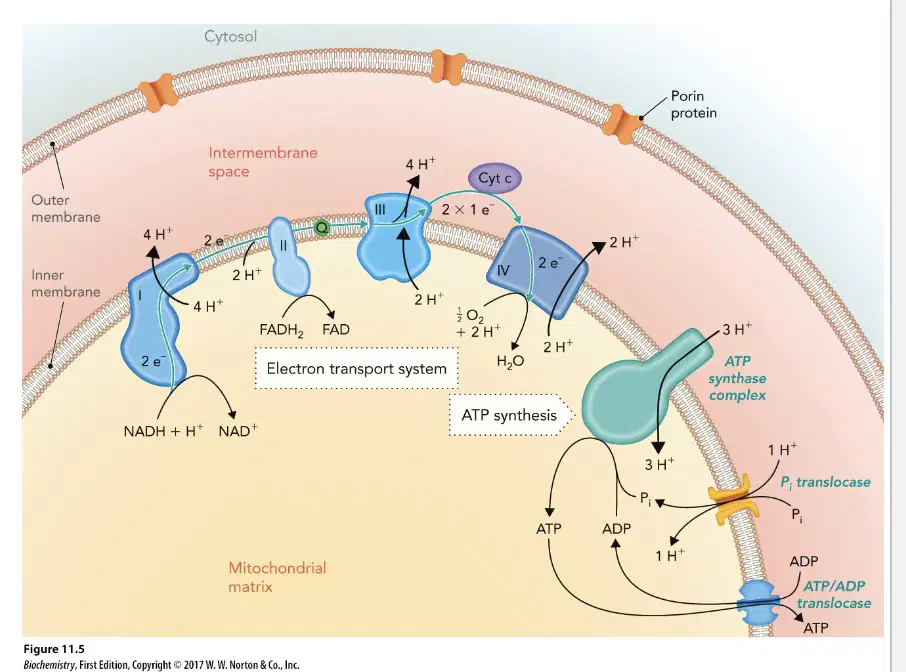
understand this image
okay
no

