
 Worksheets
Chemistry II Unit 4 Review
Total questions: 95
Worksheet time: 3hrs 17mins
Smaller clumps allow for a _________ surface area to be exposed for the reaction.
the surface area of the reactants are smaller.
For a reaction 2A + B --> 2C, with the rate equation:
Rate = k [A]2 [B]
The order with respect to A is 1 and the order overall is 1
The order with respect to A is 2 and the order overall is 2
The order with respect to A is 2 and the order overall is 3
The order with respect to B is 2 and the order overall is 3
The order with respect to B is 2 and the order overall is 2

Given the following information.
Rate = k[NH4+][NO2-]
Rate = k[NH4+]2[NO2-]2
Rate = k[NH4+]2[NO2-]
Rate = k[NH4+][NO2-]2
none of the above


true
false
What is collision theory?
Molecules must collide in the correct orientation with enough energy to bond.
Molecules need enough energy to collide and react.
Atoms constantly collide and react.
The minimum energy needed for atoms to react


Temperature is a measure of the average _____________ energy of the particles of a substance.
potential
kinetic
gravitational
heat

Which letter represents particles in solid form?
A
B
C
D
E
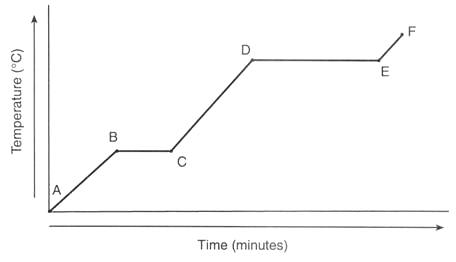
Between which points is the temperature of the substance remaining constant? (Diagram F)
A-B only.
A-B, C-D, E-F
B-C only.
B-C, D-E
True or false: melting and freezing occur at the same temperature
True
False
I don't know

A substance's heating curve is shown in the graph. What is its boiling point? (Diagram B)
100 C
60 C
80 C
20 C
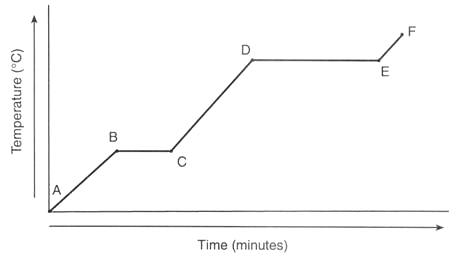
Moving left to right across the diagram, are the particles moving faster or slower as time goes on? (Diagram F)
Faster
Slower

Which letter represents where vaporization is occurring?
A
B
C
D
E

If a substance is freezing, what is happening to it?
It is changing from a liquid to a solid
It is losing thermal energy to its surroundings
the particles of the substance are making bonds
all of the above
If a substance is melting, what is happening to it?
It is changing from a solid to a liquid
It is gaining thermal energy from its surroundings
the particles of the substance are breaking bonds
all of the above
Boiling and evaporation are forms of vaporization
True
False

What is happening at letter D?
Evaporation of a liquid
Condensation of a gas
Boiling of a liquid
The answer depends on if there is thermal energy being added or removed

What letter on the diagram represents the substance only in the gas phase?
A
B
C
D
What letter on the diagram represents a substance only in the liquid?
A
B
C
D
What letter on the diagram represents a substance only in the solid phase?
A
B
C
D
What letter on the diagram represents the triple point?
A
B
C
D
What is the melting point of this substance at 1 ATM of pressure?
40
60
100
110
What is the melting point of this substance at 1 ATM of pressure?
40
60
100
110
What is the boiling point of this substance at 1 ATM of pressure?
40
60
100
110
What would the state of this substance be at 0.5 ATM of pressure at a 100 degrees Celsius?
Solid
Liquid
Gas
Michigan
What would the state of this substance be at 1 ATM of pressure at a 80 degrees Celsius?
Solid
Liquid
Gas
Michigan
The average atmospheric pressure in Michigan is close to 1 ATM. What state of matter would this substance be in if it was a nice summer day with a temperature of 80 o F (27 o C)?
Solid
Liquid
Gas
Michigan

What happens along the AC line?
Melting/Freezing
Boiling/Condensing
Boiling/melting
freezing/condensing
What happens along the BC line?
Melting/Freezing
Boiling/Condensing
Boiling/melting
freezing/condensing

The critical point is found at point.....
A
B
C
D
Intermolecular forces are responsible for which of the following properties?
State of matter
Color
Odor
Conductivity
Which of the following is correct for CH4?
Ionic bond, IMF's
Ionic bond, No IMF's
Covalent bond, IMF's
Covalent bond, No IMF's
How many moles of hydrogen are needed to react with 2 moles of nitrogen?
How many grams of potassium chloride (KCl) can be produced from 356 g of potassium bromide (KBr)?
How many moles of carbon dioxide are produced from the combustion of 110 g of CH4?
4 Al + 3 O2 –> 2 Al2O3 How much aluminum would be needed to completely react with 45 grams of O2?
1.05 moles
3.75 moles
0.875 grams
1.875 moles
Mg + 2HCl --> MgCl2 + H2
In the experiment above, 7.62 g of Fe are allowed to react with 8.67 g of S.
How much FeS is formed?
How many liters of carbon dioxide are produced from 10L of carbon monoxide?
24 grams of CH4 was added to the above reaction. Calculate the theoretical yield of CO2.
When reacting Na with Cl2, we calculated that the theoretical yield should be 13 grams. Our actual yield was 12.5 grams. What is the percent yield?
90.4%
104%
96.15%
1.04%
2Fe2O3 + C → Fe + 3CO2
You add 28 grams of carbon. You find the actual yield to be 181.2 grams of CO2. What is the percent yield of CO2? (Hint: calculate theoretical yield of CO2 first)
58.83%
308%
6435%
15.5
Actual yield = 62g
Calculate the percent yield.

Balance this equation.
_CF4 + _Br2 -- _CBr4 + _F2
2,1,2,1
1,2,2,1
1,2,1,2
2,2,2,2

When balancing equations, the rule is that you can only add, change, and remove ____________
Coefficients
Mass
Subscripts
Elements

Which of the following reactions involves the ions of two compounds exchanging places to form two new compounds?
Synthesis
Double replacement
Combustion
Single Displacement

The Law of Conservation of Mass states that the total mass of the reactants should be
More than the mass of the products
Equal to the mass of the products
Ignored during the reaction
Less than the mass of the products
2HI --> H2 + I2
AgNO3 + NaCl → AgCl + NaNO3
Zn + 2HCl --> ZnCl2 + H2
Predict the products for the this reaction:
Mg + CuCl2 -->
MgCl2 + Cu
MgCl + Cu
MgCu + Cl2
CuMg + Cl2
Predict the products for the this reaction:
AgNO3 + KCl -->
AgCl + KNO3
AgK + ClNO3
AgNO3 + KCl
KAg + NO3Cl
What is the right ratio of chemicals for the balanced chemical equation?
__CO + __Fe2O3--> __Fe + __CO2

Name this molecule:
methane
ethane
propane
butane

What is the correct name for the alkyne shown?
butyne
1-butyne
2-butyne
1-methyl-1-propyne
What is the functional group of alcohols?
–NH2
–COOH
–CHO
–OH
–NO2


Name the compound.
copper sulfate
copper (I) sulfate
copper (II) sulfate
copper monosulfate
Nitrate
Sulfate
SO32–
HSO4–
SO42–
CH3COO–
What molecular geometry would PH3 have?
Trigonal Pyramidal
Trigonal Bipyramidal
Bent
Linear

This carbon atom went through ....
sp hybridization
sp2 hybridization
sp3 hybridization
dsp3 hybridization
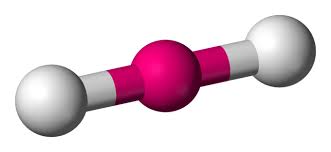
What is the hybridization of a linear molecule?
sp
sp2
sp3
sp3d
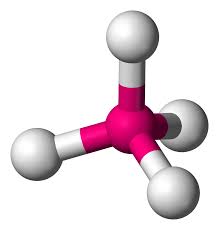
What is the hybridization of this molecule shown above
sp
sp2
sp3
sp4
Match the following to the correct type of bonding.
HF
Acid
Na2SO4
Ionic
SF6
Molecular Covalent
Diamonds
Network Covalent
Fe3N2
Transition Metal Ionic

