
Font size
 Worksheets
EARTH LIFE SCIENCE REVIEW
Total questions: 129
Worksheet time: 2hrs 34mins
Clouds of dust and gas and other star clusters
(a)
What is the nebulae made of?
(a)
What is the galaxy a group of?
(a)
What is the correct timeline of the big bang theory?
singularity era (planck era) - inflationary era - formation of the universe - formation of basic elements - radiation era - matter domination - birth of stars and galaxies
inflationary era - singularity era (planck era) - formation of basic elements - formation of the universe - matter domination - radiation era - birth of stars and galaxies
singularity era (planck era) - formation of the universe - inflationary era - formation of basic elements - radiation era - birth of stars and galaxies - matter domination
inflationary era - formation of the universe - singularity era (planck era) - formation of basic elements - matter domination - birth of stars and galaxies - radiation era
Pairs of hydrogen nuclei form helium nuclei, the process is called
(a)
What is the shift when the distance between galaxies is increasing with time
(a)
According to Edwin Hubble, the distance between galaxies is...
(a)
is speculated to be the remnant energy left over from the
formation of the universe
(a)
Sun center of the solar system
Geocentric Model
Heliocentric Model
What is the theory that states that the universe is unchanging?
(a)
What theory provides a solution to unresolved problems of the BBT
(a)
What theory provides a solution to unresolved problems of the BBT
(a)
According to the Inflation theory, what does flatness state?
(a)
According to the Inflation theory, what does monopole state?
(a)
According to the inflation theory, what does the horizon state?
space in opposite direction are so far apart they could never have contact with each other
space in similar direction are so far apart they could never have contact with each other
Sun, moon, and other known planets orbit earth
Geocentric Model
Heliocentric Model
Who discovered the Vortex Theory
(a)
What does the vortex theory state?
Solar system formed by great cloud or nebula
The sun's collision with a giant comet resulted to the creation of the planets.
Solar system was formed into bodies with nearly circular orbits because of the whirlpool-like motion the pre-solar system. The orbits of the planets are the primary whirlpool and the satellites are the secondary whirlpool.
The solar system developed out of an interstellar cloud of dust and gas, called a nebula.
What does the collision theory state?
Solar system formed by great cloud or nebula
The sun's collision with a giant comet resulted to the creation of the planets.
Solar system was formed into bodies with nearly circular orbits because of the whirlpool-like motion the pre-solar system. The orbits of the planets are the primary whirlpool and the satellites are the secondary whirlpool.
The solar system developed out of an interstellar cloud of dust and gas, called a nebula.
What does the nebular theory state?
Solar system formed by great cloud or nebula
The sun's collision with a giant comet resulted to the creation of the planets.
Solar system was formed into bodies with nearly circular orbits because of the whirlpool-like motion the pre-solar system. The orbits of the planets are the primary whirlpool and the satellites are the secondary whirlpool.
The solar system developed out of an interstellar cloud of dust and gas, called a nebula.
Where does the sun's energy come from?
(a)
What color are the hottest stars?
red
green
blue
orange
is the religious belief that nature, and aspects such as the universe
(a)
The theory that the universe originated in a huge explosion that released all matter and energy. (Alexander Friedmen ang Georges Lemaitre 1920)
(a)
A Doppler shift in which spectral features are shifted to shorter wavelengths, observed when an object is moving toward the observer.
(a)
a doppler shift toward the red end of the spectrum, occurs because the light waves are "stretched", which shows that earth and the source are moving away from each other.
(a)
The theory that the universe will eventually collapse back in on itself when it is done expanding as a result of the Big Bang. The outward flight of the galaxies will slow down and eventually stop.
(a)
The theory that states that the universe would continue to expand, but its density would decrease
(a)
High temperature gas ball collapse then heat up and them become disk shape
FLATTENING
COLLAPSE
SPINNING
ACCRETION
Disk spins faster and faster and temperature decreased
FLATTENING
SPINNING
COLLAPSE
CONDENSATION
Disk become sphere due to rotation, because of fast rotation, some of the fog escape
COLLAPSE
CONDENSATION
ACCRETION
FLATTENING
Some fog formed the core of the largest mass in the middle, while small part formed around cooling process.
CONDENSATION
ACCRETION
SPINNING
COLLAPSE
Cores of smaller mass turns into planets, while most remain in a high temperature flare.
SPINNING
FLATTENING
ACCRETION
COLLAPSE
• Is a yellow dwarf star
• Brings warmth
• Center of the Solar System
• Giant ball of glowing gases
• Makes lots of energy
• “Solar winds are destructive”
SUN
VENUS
EARTH
MARS
• Has rings that are made up of frozen gas, ice, and rock
• Second Largest Planet
• Made mostly of hydrogen and helium
SATURN
URANUS
JUPITER
NEPTUNE
• Largest Planet
• Giant ball of swirling gas
• Has between 80 and 95 moons
• Has two very thin rings
• Has a large red spot, which is a giant storm
URANUS
JUPITER
SUN
VENUS
• Closest to the Sun
• Rocky crust with craters
• Cold on half of the planet
• Hot on half facing the sun
• Gray in color
• Smallest planet
VENUS
EARTH
MARS
MERCURY
• Second planet from the sun
• Nicknames “the evening star”
• Poisonous fog
• The HOTTEST planet
• Orange in color
VENUS
MERCURY
JUPITER
NEPTUNE
• Third planet from the sun
• Only planet with large amounts of liquid water
• Only planet with living things???
MARS
VENUS
EARTH
NEPTUNE
• The RED Planet
• Has 2 moons
• Volcanoes and Canyons
• Rocks and Sand
JUPITER
MARS
URANUS
MERCURY
• Looks like it is on its side
• 90 degree angle
• Very cold and windy
• Has some rings
• Blue-green in color
URANUS
NEPTUNE
EARTH
MARS
• Most distant major planet
• Two dark spots
• Blue in color
• First planet located through mathematical calculations
JUPITER
SATURN
JUPITER
NEPTUNE
• Used to be considered a planet
• One of Neptune’s moons
• Gray in color
(a)
“cleared the neighborhood”
(a)
are rocky airless remnants left over from the early formation of our solar system about 4.6 billion years ago
comets
meteoroid
asteroid
meteorite
Icy body that releases gases as it orbits the Sun
comet
asteroid
meteorite
meteoroid
Rocky or metallic fragment of an asteroid, comet, or planet.
comet
asteroid
meteorite
meteoroid
Rocky or metallic fragment of an asteroid, comet, or planet.
comet
asteroid
meteorite
meteoroid
Cosmographical boundary of the solar system
(a)
a source of comets
(a)
Determine the exact age of the artifact or a site
(a)
Determine the which object is older
(a)
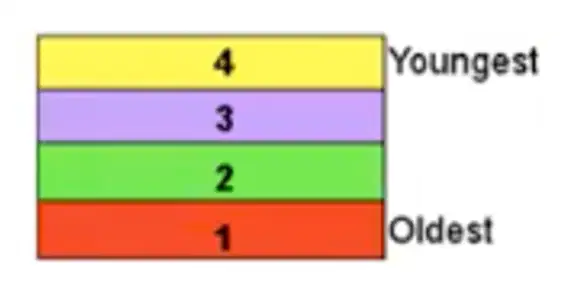
Rock layers in the bottom are older than those on top of them.
(a)
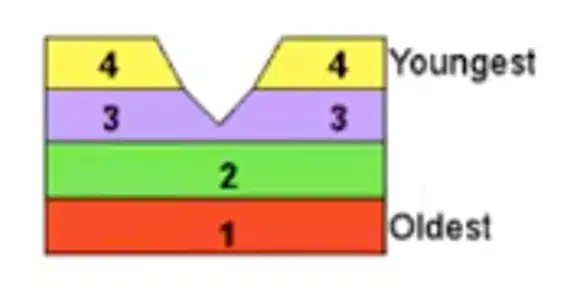
Rock layers are extended laterally and continuously.
lateral continuity
superposition
inclusion
original horizontality
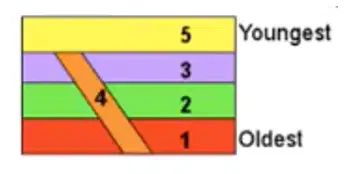
Rock layers that are cut across are older than the cut itself
superposition
inclusion
original horizontality
cross-cutting relationship
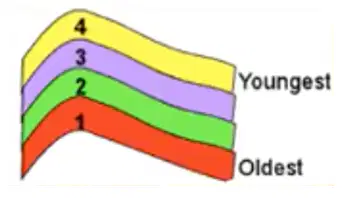
Rock layers form in a horizontal position
original horizontality
superposition
lateral continuity
inclusion
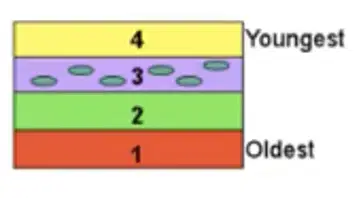
Any inclusion in rock layers are older than the rock that contains it
superposition
original continuity
inclusion
cross-cutting relationship
Form when minerals replace the structure of an organism
(a)
They are formed due to the burial of plants or plant parts in sediment
(a)
Are three dimensional and preserve the surface contours of the organism. A mold preserves a negative imprint of the surface, while a cast preserves the external form of the organism
(a)
Preservation of original skeletons and soft body parts
(a)
When did the Earth meet the moon?
hadean eon
archean eon
mesozoic eon
proterozoic eon
paleozoic eon
When did the magnetic field form?
hadean eon
archean eon
mesozoic eon
proterozoic eon
paleozoic eon
When did the first eukaryotes appear?
hadean eon
archean eon
mesozoic eon
proterozoic eon
paleozoic eon
When did the first oceans appear?
hadean eon
archean eon
mesozoic eon
proterozoic eon
paleozoic eon
When was tectonic activity first present?
hadean eon
archean eon
mesozoic eon
proterozoic eon
paleozoic eon
When did the first prokaryotic bacteria appear?
archean eon
hadean eon
proterozoic eon
paleozoic eon
When was the great oxygenation event?
archean eon
hadean eon
proterozoic eon
paleozoic eon
When was the oxygen crisis?
archean eon
hadean eon
proterozoic eon
paleozoic eon
When was the cambrian explosion?
archean eon
hadean eon
proterozoic eon
paleozoic eon
When was age of the fishes and amphibians?
archean eon
hadean eon
proterozoic eon
paleozoic eon
When was age of reptiles and dinosaurs?
archean eon
hadean eon
mesozoic eon
paleozoic eon
When did the Permian-Triassic Extinction occur?
archean eon
hadean eon
mesozoic eon
paleozoic eon
When did the dinosaurs go extinct?
archean eon
cenozoic eon
mesozoic eon
paleozoic eon
When was the stone age?
archean eon
cenozoic eon
mesozoic eon
paleozoic eon
used photosynthesis and released oxygen
(a)
Biggest extinction the planet has ever seen
Triassic-Jurassic Extinction
Cretaceous-Paleogene Extinction
Holocene Extinction
Permian-Triassic Extinction
Greek term which means air
(a)
Protects from sun’s UV radiation
(a)
order of layers in the atmosphere
mesosphere - thermosphere - stratosphere - troposphere - exosphere
troposphere - stratosphere - mesosphere - thermosphere - exosphere
stratosphere - mesosphere - exosphere - troposphere - thermosphere
● Contains Convection Currents created by the sun’s heat which cause most of our weather
● Lowest layer
troposphere
stratosphere
exosphere
mesosphere
● Second layer
● Contains the ozone layer
● Temperature increases with height because the ozone absorbs UV
radiation from the sun
troposphere
stratosphere
exosphere
mesosphere
● Mysterious layer - cannot be reached by the highest research
balloons nor is it accessible to the lowest orbiting satellites
● Protects earth from meteoroids - most meteors vaporize
troposphere
stratosphere
exosphere
mesosphere
● Mysterious layer - cannot be reached by the highest research
balloons nor is it accessible to the lowest orbiting satellites
● Protects earth from meteoroids - most meteors vaporize
troposphere
stratosphere
exosphere
mesosphere
● Aurora
● Absorption of very short-wave, high-energy solar radiation by oxygen
and nitrogen
thermosphere
stratosphere
exosphere
mesosphere
● Outermost layer
● Air is extremely thin
● Satellites have little friction with air
● Atoms and molecules are so far apart that this layer no longer
behaves like gas
thermosphere
stratosphere
exosphere
mesosphere
● Oxygen absorbs energy from sun’s UV rays then split to form single oxygen atoms
● These oxygen atoms combined with remaining oxygen molecule then form ozone molecules
(a)
first significant step wherein industrialized countries did and committed to reduce emissions of greenhouse gases
(a)
proven to be innovative and successful, first treaty to achieve universal replication by all countries in the world
(a)
Liquid component of the earth (including glacial water)
(a)
Water that exists underground in saturated zones beneath the land surface
(a)
● Natural hazards related to water
● Phenomenon of atmospheric, hydrological or oceanographic nature
that may cause loss of life, injury or other health impacts, property damage, loss of livelihoods and services, social and economic disruption, or environmental damage.
(a)
Large storm system having circular or spiral system of violent winds and heavy rain, typically hundreds of kilometers of miles in diameter
(a)
● Geographical locations/regions where the atmospheric pressure is lower than that of surrounding locations
● Wind – inward and upward
● Forms under areas of wind divergence that occur in upper levels oftroposphere
● Longer on water, bigger it gets
(a)
● abnormal increase of water level when a storm is near the coastal lines
(a)
● Solid state of the earth
● Structure, composition, minerals and processes of earth
● Layers of the earth
(a)
● Solid state of the earth
● Structure, composition, minerals and processes of earth
● Layers of the earth
(a)
process by which plants lose water out of their leaves
(a)
the largest freshwater lake by surface area
(a)
cold wind usually coming from China and Siberia (Nov. - Feb.)
Northeast Monsoon (Amihan)
Southwest Monsoon (Habagat)
wind from Australia that flows in a southwest direction going towards the equator (May - Oct.)
Northeast Monsoon (Amihan)
Southwest Monsoon (Habagat)
Is an inertial force (also called a fictitious force) that acts on objects that are in motion relative to a rotating reference frame
(a)
the solid Earth that includes the continental and ocean crust, as well as the various layers of Earth's interior
(a)
most abundant elements in the earth's crust
(a)
What is the difference between continental and oceanic crust
continental is thicker but less dense while oceanic is thinner but denser
continental is thinner but denser while oceanic is thicker but less dense
- Lithosphere and asthenosphere
(a)
rocky part of the earth in the crust and solid upper mantle
(a)
causes plate tectonic movement
(a)
center of the earth
(a)
What is the core believed to be composed of?
(a)
Site of violent convection which creates and sustains Earth's magnetic field
(a)
between crust and upper mantle
Mohorovic discontinuity
Repetti discontinuity
Gutenberg discontinuity
Lehmann discontinuity
between upper mantle and lower mantle
Mohorovic discontinuity
Repetti discontinuity
Gutenberg discontinuity
Lehmann discontinuity
between lower mantle and outer core
Mohorovic discontinuity
Repetti discontinuity
Gutenberg discontinuity
Lehmann discontinuity
between the outer and inner core
Mohorovic discontinuity
Repetti discontinuity
Gutenberg discontinuity
Lehmann discontinuity
Rocks formed by years and years of sediment compacting together and becoming hard
(a)
Rocks formed by volcanoes
metamorphic
Igneous rocks
sedimentary
Rocks formed by great heat and pressure
metamorphic
Igneous rocks
sedimentary
Naturally occurring inorganic solid materials with definite chemical composition and ordered atomic arrangement
(a)
What are the physical properties of minerals
(a)
- Most obvious property of a mineral
- Least diagnostic
hardness
streak
color
cleavage
- Color of mineral in its powdered form
hardness
streak
color
cleavage
- Most obvious property of a mineral
- Least diagnostic
hardness
streak
color
cleavage
- Measurement of strength of the chemical bonds
- Mohs scale
hardness
streak
color
cleavage
- Consistently breaks along planes
- Break smoothly along specific internal planes
hardness
streak
color
cleavage
- Breaks along random, irregular surfaces
- Breaking in a random pattern with no smooth planar surfaces
fracture
crystal habit
crystalline structure
luster
- Minerals have definite chemical composition.
- It forms a definite structure that has a specific crystal form.
fracture
crystal habit
crystalline structure
luster
- Outward appearance of the specific crystal form.
- Ideal shape of crystal faces
fracture
crystal habit
crystalline structure
luster
- Appearance of a mineral when light is reflected from its surface
fracture
crystal habit
crystalline structure
luster

