Worksheets
PMA 1 Review
Total questions: 91
Worksheet time: 3hrs 54mins
What type of microscope requires light passing through a specimen?
TEM
Light
SEM
NBA
Instead of light, a TEM and SEM utilize ____________ to create an image
a colored pencil
neutrons
protons
electrons
True or False? SEM images look 3D and are colorful.
True
False
True or False: An electron microscope gives a higher resolution than a light microscope.
True
False
Only in certain conditions
Select the best answer to the question: Explain why a scientist might choose to use an electron microscope rather than a light microscope.
The light microscope won't show as much and it doesn't make the picture as bigger as the electron microscope.
Electron microscope is better for a scientist to choose than a light microscope it uses electrons and not light.
An electron microscope gives a greater magnification and better resolution than a light microscope.
Scientists might need to choose the electron microscope because it is cheaper and easier than the light microscope.
What does TEM stand for?
transmission electron microscope
translation electron microscope
telepathic electron microscope
tori eats mangos
What does SEM stand for?
scanning electron microscope
sandwich electron microscope
soft electron microscope
Sara eats margarine
The microscopes we use are called
compound microscopes
dissecting microscopes
stereo microscopes
electron microscopes


What is one disadvantage of using an electron microscope
The specimen cannot be alive when viewed
The specimen cannot be viewed with as great a magnification as with a light microscope
One cannot view thin sections, only the surface of objects
It has less resolving power compared to a compound light microscope
What is the difference between transmission electron microscopes and scanning electron microscopes
TEM is used for thin sections while SEM is for surface photography
SEM does not require heavy metal staining while TEM does.
One can use a slide prepared for a compound light microscope directly in TEM, but not in SEM.
SEM generally has higher magnification than TEM
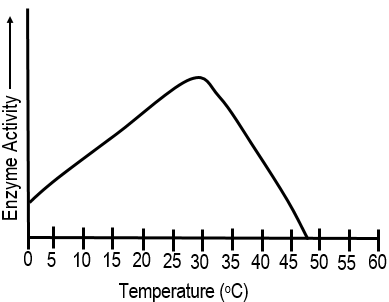
What ph do enzymes work best at?
1-3
4-5
6-8
9-14
What happens to the enzyme if it is outside of its ph range?
the enzyme will lose its shape and become denatured
the enzyme will work better
the enzyme will become bigger
the enzyme will stop working entirely
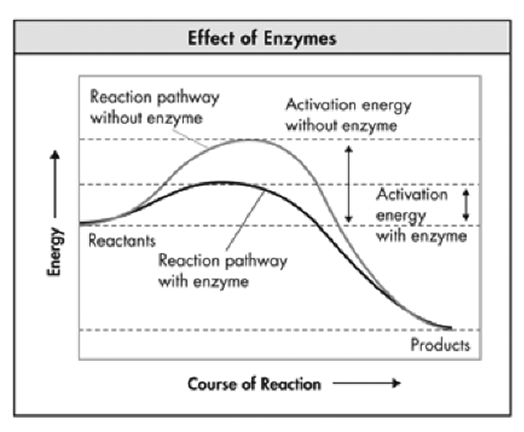
Enzymes work by __________________ the activation energy of a reaction.
raising
lowering
fixing
breaking
Enzymes are substances that ______________ chemical reactions.
slow down
don't affect
speed up
don't like
Which factor does NOT affect the rate of enzyme catalyzed reactions?
Temperature
Surface area
Color
pH
Concentration
What kind of molecule is water?
Ionic
Polar Covalent
Nonpolar Covalent
Metallic
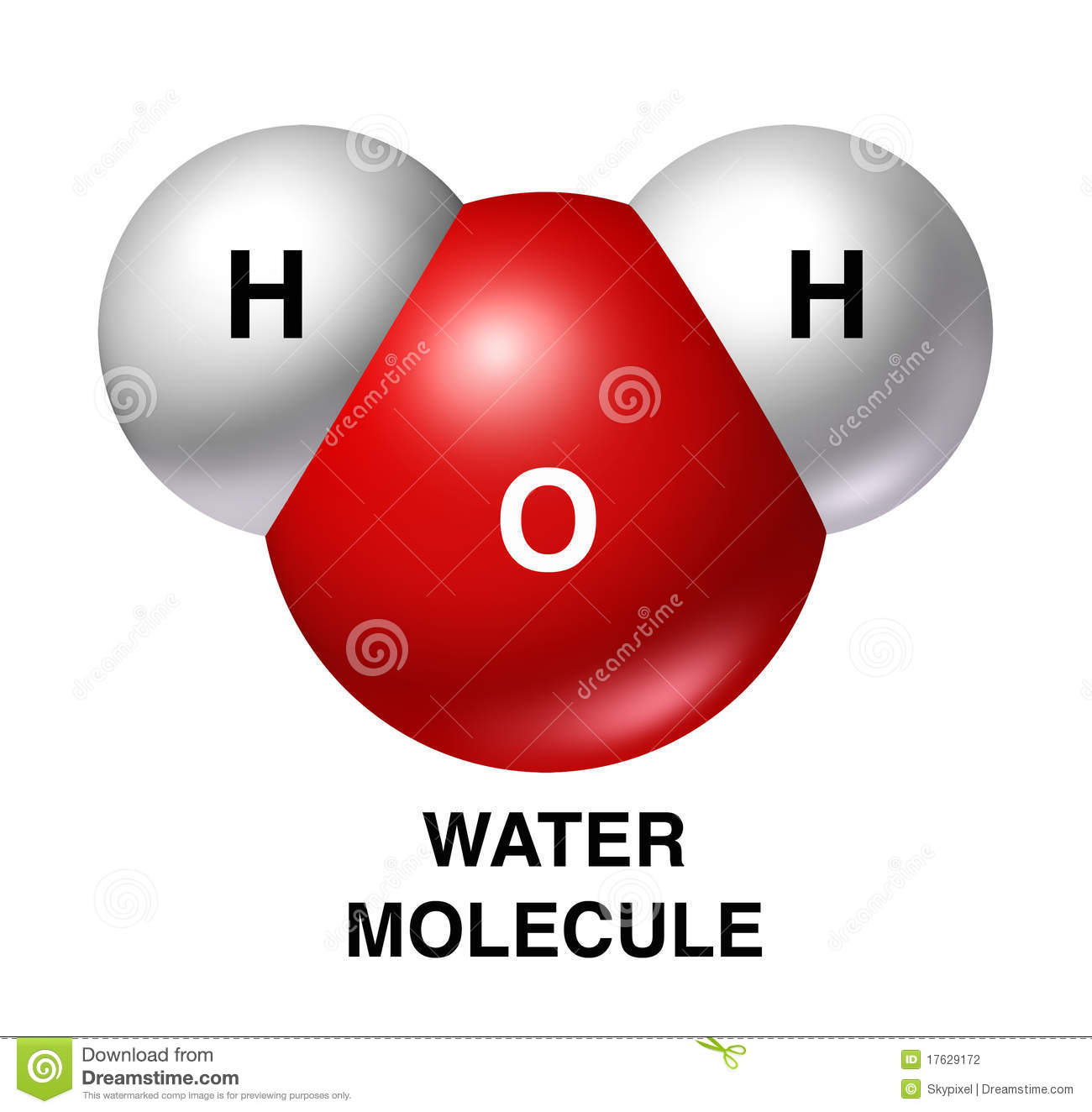
Which part of a water molecule has a Positive Charge?
The Hydrogen
The Oxygen
The Top
The Bottom
What is the correct chemical formula for water?
H2O
HO2
H2O2
2H1O
Which of the following is an example of COHESION?
water sticking to water
water sticking to glass
oil sticking to plastic
hydrogen sticking to oxygen
Which of the following is the CORRECT list of water's properties?
Read Carefully!
adhesion, cohesion, high specific heat, universal solvent
adhesion, cohesion, low specific heat, universal solvent
adhesion, no cohesion, low specific heat, universal solute
no adhesion, cohesion, high specific heat, universal solute

You body sweats to help prevent you from overheating. How does water regulate temperature?
it lets heat pass through it
it absorbs a lot of heat, then decreases in temperature
it absorbs a lot of heat, but only increases a little in temperature
heat is afraid of water and avoids it
Water is polar. What does that mean?
it is a molecule with opposite charges on opposite ends
it is a molecule with no charge
it is a molecule with identical charges on opposite ends
it is a molecule with too many protons
Water sticks well to many materials. What term relates to this property of water?
cohesion
adhesion
density
surface tension
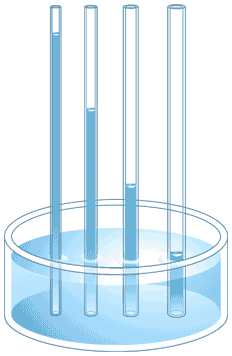
What is the term for water's ability to defy gravity and climb up a tube?
Capillary Action
Specific Heat
Universal Solvent
Magic
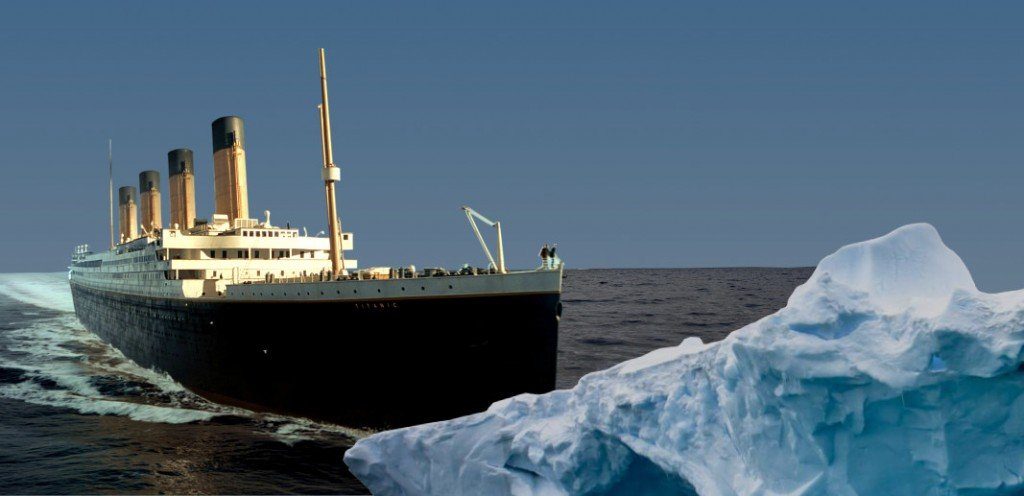
Why does ice float?
water expands when it freezes, making ice less dense than water
water compacts when it freezes, making ice more dense than water
hydrogen bonds in water push the ice to the surface
ice is afraid of water, and avoids it

What are the bonds called between a slightly positive hydrogen in a polar molecule and a negatively charged atom?
Hydrogen Bonds
Water Bonds
Covalent Bonds
Bail Bonds

A water strider can skate along the top of a pond because:
covalent bonds result in water cohesion (surface tension)
hydrogen bonds result in water cohesion (surface tension)
water striders have adapted to take advantage of water cohesion
water striders are afraid of water and avoid it
What cycle is Transpiration a part of?
Life Cycle
Water Cycle
Carbon Cycle
Phosphorus Cycle
What is absorbed by the plant by it's roots, and transpiration takes place as the water exits the ________?
Leaves
Stem
Branch
Roots
Which is true?
99% of water taken by the plant evaporates through transpiration
9% of water taken by the plant evaporates through transpiration
Evaporation through transpiration accounts only for 1% of all the water the plant takes in
Evaporation through transpiration is minuscule


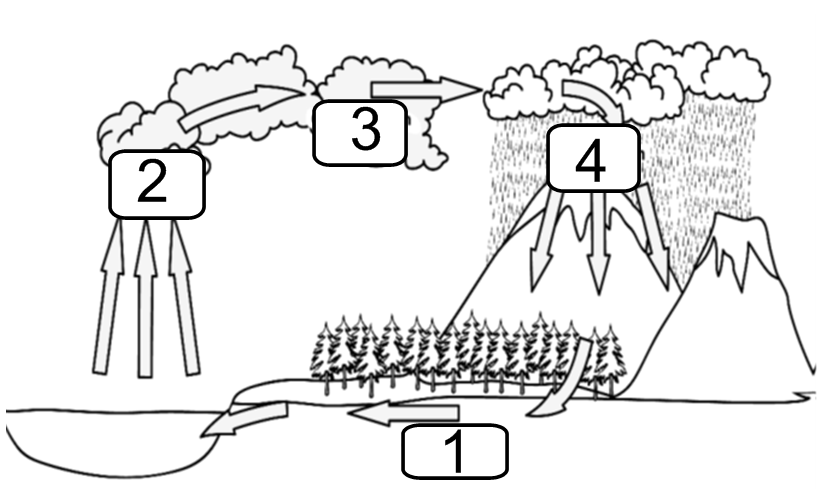

What is another name for the water cycle?
Perspiration Cycle
Carbon Cycle
Hydrologic Cycle
Life Cycle
When a solid turns into a gas without ever being a liquid
Evaporation
Precipitation
Sublimation
Condensation
Water that is not absorbed into the soil or evaporated into the atmosphere
Infiltration
Runoff
Water Storage
Watershed
The process where water soaks into soil or porous rock
Infiltration
Runoff
Water Storage
Watershed
Biodiversity, aka biological diversity, usually refers to
the number of people on Earth
the variety of species on Earth
the number of animal species in a specific area
the number of plant species in a specific area
a species that is not native to a particular region
endemic
exotic
endangered
extinct
Why is biodiversity important to ecosystems?
It helps populations adapt to ecological changes.
It increases at each level of the food chain.
The lionfish is a venomous fish found primarily in the Red Sea and the Indian Ocean. In the 1990s, lionfish were accidentally released into the Atlantic Ocean, where they found abundant resources and favorable environmental conditions. Which of the following scenarios is most likely to result in the lionfish having a major impact on the communities into which they were introduced?
With no natural predators, the lionfish population will become very large.
Some native species of invertebrates will develop a resistance to lionfish venom.
What is an example of a human disturbance?
Deforestation
Drought
Tsunami
Changing Seasons
What is the bottom layer of the an energy pyramid?
producer
tertiary consumer
Secondary consumer
primary consumer
What does an energy pyramid show?
Energy flow in a community
Longest lifespans
The stronger animal the higher it is on the pyramid
What would happen if the primary consumers died out?
the producers would grow and the secondary and tertiary consumers would die
producers would die out
consumers would grow
decomposers are producers.
true
false
A cheetah can be a primary, secondary, tertiary consumers.
yes
No


Birds eat insects off the skin of cows. If the relationship is a type of mutualism, then the organisms that will benefit are
only the cattle
neither the birds or the cattle
both the birds and the cattle
only the birds

*Remember Humans are on the top of all food chains because we do not get hunted.

What is a decomposer?


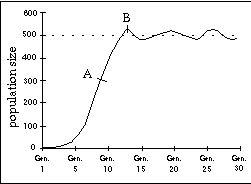
In the graph to the right, what is the population of deer at the carrying capacity of the environment?
3
7
70
40

What will happen if all of the frogs in a population die?
The frogs' predators will decrease and the frogs' prey will increase
The frogs' predators will increase and the frogs' prey will decrease
We better all pray because there isn't anymore frogs.

What does the yellow line represent?
exponential growth
logistic growth
carrying capacity
none of the above
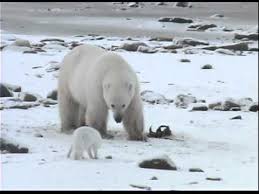
Two arctic fox are fighting with a polar bear for a sea lion carcass. One fox distracts the bear while the other eats. What type of limiting factor is the polar bear?
Predator-Prey Relationships
Competition
Herbivory Effect
Weather

A group of elephants gets stuck in mud at the edge of the river from a recent mud slide. A lion waits for an elephant to get tired before it attacks. What is the limiting factor to the elephant population?
Predator-Prey Relationships
Natural Disaster
Herbivory Effect
Competition

A duck population normally begin migrating south right after the last rain of the late summer season. Suddenly, they’re migrating much earlier. The climate has been changing far too often which is altering the effects of their magnetite.
Predator-Prey Relationships
Weather
Herbivory Effect
Competition

The wolf goes extinct, and the deer population has no predator to worry about. They graze the land. Because there is no more food. Some of the deer begin to bite at each other, while others die of starvation. What is the limiting factor to the deep population?
Competition
Overcrowding
Predator-Prey Relationships
Herbivory Effect