wayground logo

Free Printable Worksheets

Font size

S
M
L
XL
Worksheets

Ch 1 - An Introduction to Anatomy

Total questions: 124

Worksheet time: 1hrs 3mins

Name
Class
Date
1.
the branch of biology concerned with the study of the structure of organisms and their parts.
a)
anatomy
b)
cellular organization
c)
physiology
d)
anatomical imaging
2.
subdivides the body into discrete organ systems that work together towards a common goal or function (looks at anatomy based on systems)
a)
systemic anatomy
b)
anatomy
c)
regional anatomy
d)
surface anatomy
3.
the study of anatomy based on regions or divisions of the body and emphasizing the relations between various structures (muscles, nerves, and arteries etc.) in that region.
a)
regional anatomy
b)
systemic anatomy
c)
anatomy
d)
anatomical imaging
4.
the study of external anatomical features without dissection (usually is determined by a manual manipulation)
a)
surface anatomy
b)
regional anatomy
c)
systemic anatomy
d)
anatomy
5.
allows medical workforce to inspect the internal parts of the body with exceptional accuracy without the injury and danger of exploratory surgery. They use things such as X-rays, CTs, and MRIs.
a)
anatomical imaging
b)
surface anatomy
c)
regional anatomy
d)
systemic anatomy
6.
human body’s functions to work together to maintain a stable internal environment .
a)
physiology
b)
cellular organization
c)
cells
d)
tissues
7.
the basic building blocks of all living things.
a)
cells
b)
physiology
c)
cellular organization
d)
organelles
8.
groups of cells or fluids that work together to perform a specific job in the body.
a)
tissues
b)
cells
c)
physiology
d)
organelles
9.
any of a number of organized or specialized structures within a living cell
a)
organelles
b)
tissues
c)
cells
d)
physiology
10.
a collection of tissues that structurally form a functional unit specialized to perform a particular function, such as lungs, heart, liver, stomach, etc
a)
organs
b)
organelles
c)
tissues
d)
cells
11.
the components that make up a cell and how they are organized within it
a)
cellular organization
b)
organs
c)
organelles
d)
tissues
12.
the chemical reaction inside our bodies that turns food into usable energy
a)
metabolism
b)
response to stimuli
c)
organs
d)
organelles
13.
a response that annuls the cause that triggered the stimuli in the first place. For example in a cold environment our blood vessels constrict, while in a hot environment blood vessels dilate.
a)
response to stimuli
b)
metabolism
c)
cellular organization
d)
organs
14.
the irreversible increase of an organism's size or mass over a given period
a)
growth
b)
response to stimuli
c)
metabolism
d)
development
15.
structural changes of an individual from fertilization to adulthood
a)
development
b)
differentiation
c)
response to stimuli
d)
metabolism
16.
the process of unspecialized cells turning into specialized cells with distinct functions
a)
differentiation
b)
development
c)
growth
d)
response to stimuli
17.
results in the production of offspring that share characteristics of each parent
a)
reproduction
b)
differentiation
c)
development
d)
growth
18.
the largest organ of the body that forms a physical barrier between the external environment and the internal environment that it serves to protect and maintain.
a)
Integumentary system
b)
Muscular system
c)
Lymphatic system
d)
Skeletal system
19.
the internal framework of the human body. It consists of two parts made up of bones and connective tissues like tendons, cartilage and ligaments.
a)
Skeletal system
b)
Integumentary system
c)
Muscular system
d)
Respiratory system
20.
composed of specialized cells called muscle fibers. Their predominant function is contractility. The muscular system is attached to bones, organs and blood vessels and is responsible for movement.
a)
Muscular system
b)
Skeletal system
c)
Integumentary system
d)
Digestive system
21.
the network of vessels through which lymph drains from the tissues into the blood- keeps body fluid levels balanced and defends the body against infections
a)
Lymphatic system
b)
Muscular system
c)
Skeletal system
d)
Integumentary system
22.
is the network of organs and tissues which help you breathe. It includes your airways, lungs, and blood vessels.
a)
Respiratory system
b)
Lymphatic system
c)
Muscular system
d)
Skeletal system
23.
is made up of the digestive tract and other organs that are used to break down and absorb food.
a)
Digestive system
b)
Respiratory system
c)
Lymphatic system
d)
Muscular system
24.
a-
a)
not,without
b)
to grow
c)
viewing of
d)
heat, temperature
25.
-ation
a)
condition, process
b)
not,without
c)
to grow
d)
viewing of
26.
-cyte
a)
cell
b)
condition, process
c)
not,without
d)
heat, temperature
27.
-dynia, -algia, alge
a)
pain
b)
cell
c)
condition, process
d)
not,without
28.
hydro-
a)
water
b)
pain
c)
cell
d)
condition, process
29.
-itis
a)
inflammation
b)
water
c)
pain
d)
cell
30.
-ism
a)
condition
b)
inflammation
c)
water
d)
pain
31.
macro-
a)
large
b)
condition
c)
inflammation
d)
water
32.
meta-
a)
beyond
b)
large
c)
condition
d)
inflammation
33.
micro-
a)
small,tiny
b)
beyond
c)
large
d)
condition
34.
-ology
a)
the study of
b)
small,tiny
c)
beyond
d)
large
35.
-osis
a)
abnormal condition
b)
the study of
c)
small,tiny
d)
beyond
36.
phys-
a)
to grow
b)
abnormal condition
c)
the study of
d)
small,tiny
37.
-scopy
a)
viewing of
b)
to grow
c)
abnormal condition
d)
the study of
38.
therm-
a)
heat, temperature
b)
viewing of
c)
to grow
d)
abnormal condition
39.

"Posterior" or "Dorsal" means

a)

the front side of an organ or body

b)

the back side of an organ or body

c)

uppermost, above or toward the head

40.

_______ means situated nearest the midline or beginning of a body structure

a)

proximal

b)

distal

c)

ventral

41.

Distal means

a)

situated nearest the midline or beginning of a body structure

b)

toward the lower part of the body

c)

situated farthest from the midline or beginning of a body structure

42.

________ means the direction toward, or nearer, the side of the body, away from the midline

a)

lateral

b)

inferior

c)

cephalic

43.

__________ means lowermost, below, or toward the feet

a)

inferior

b)

superior

c)

cephalic

44.

above another part of the body

a)

superior

b)

inferior

c)

distal

d)

proximal

45.

below another part of the body

a)

superior

b)

inferior

c)

distal

d)

proximal

46.

away from point of attachment

a)

superior

b)

inferior

c)

distal

d)

proximal

47.

close to point of attachment

a)

superior

b)

inferior

c)

distal

d)

proximal

48.

front of the body

a)

ventral

b)

dorsal

c)

medial

d)

lateral

49.

back of the body

a)

ventral

b)

dorsal

c)

medial

d)

lateral

50.

toward midline

a)

ventral

b)

dorsal

c)

medial

d)

lateral

51.

toward side of the body

a)

ventral

b)

dorsal

c)

medial

d)

lateral

52.

toward the surface

a)

superficial

b)

deep

c)

medial

d)

lateral

53.

away from the surface of the body

a)

superficial

b)

deep

c)

medial

d)

lateral

54.

Body laying face down

a)

prone

b)

supine

c)

superior

d)

inferior

55.

Body laying face up

a)

prone

b)

supine

c)

superior

d)

inferior

56.

The elbow is __________ to the hand.

a)

Superior

b)

Distal

c)

Proximal

d)

Superficial

57.

The chest is __________ to the head.

a)

Inferior

b)

Deep

c)

Distal

d)

Superior

58.

The foot is _____________ to the knee.

a)

Inferior

b)

Distal

c)

Proximal

d)

Lateral

59.

Further from the midline:

a)

Lateral

b)

Medial

c)

Superficial

d)

Posterior

60.

Toward the midline:

a)

Medial

b)

Lateral

c)

Distal

d)

Superior

61.

The Pelvic Cavity is _____ to the Abdominal Cavity.

a)

Superior

b)

Proximal

c)

Inferior

d)

Lateral

62.

Divides the body in half- makes a cross section

a)

traverse

b)

dorsal

c)

cranial

d)

anterior

63.
The front is my ____________ side
a)
posterior 
b)
anterior
c)
dorsal
d)
sagital
64.
Another word for back is
a)
ventral
b)
anterior
c)
dorsal
d)
sagital
65.
Another word for front is
a)
ventral
b)
posterior
c)
dorsal
d)
sagital
66.
My nose is ______________ to my shoulders
a)
inferior
b)
superior
67.
My toes are _________________ to my femur
a)
proximal
b)
distal
68.
My elbow is ______________ to my fingers
a)
proximal
b)
distal
69.
My ear is more _____________ than my nose
a)
Medial 
b)
lateral
70.
My heart is ______________ to my spinal cord.
a)
Posterior
b)
Anterior
c)
inferior
d)
superior
71.

towards the surface

a)

deep

b)

superficial

72.

away from the surface

a)

deep

b)

superficial

73.

Match the following

a)

proximal

1.

closest to the point of attachment

b)

distal

2.

farthest from point of attachment

c)

prone

3.

facing down

d)

supine

4.

facing up

74.

dorsal

a)

superior

b)

inferior

c)

posterior

d)

anterior

75.

ventral

a)

superior

b)

inferior

c)

posterior

d)

anterior

76.

in front

a)

superior

b)

inferior

c)

posterior

d)

anterior

77.

below

a)

superior

b)

inferior

c)

posterior

d)

anterior

78.

above

a)

superior

b)

inferior

c)

posterior

d)

anterior

79.
If something is higher up on your arm or leg it is ______
a)
Proximal
b)
Distal
c)
Superficial
d)
Deep
80.

toward the midline of the body

a)

distal

b)

lateral

c)

medial

d)

inferior

81.

at the body surface

a)

distal

b)

superficial

c)

deep

d)

proximal

82.

Toward the head end of upper part of body

a)

Medial

b)

Inferior

c)

Lateral

d)

Superior

83.

Away from the midline

a)

Medial

b)

Lateral

c)

Distal

d)

Proximal

84.

Toward a structure's origin or point of attachment to the trunk

a)

Lateral

b)

Proximal

c)

Distal

d)

Medial

85.

Away from the head.

a)

Inferior

b)

Lateral

c)

Deep

d)

Distal

86.

Toward the back of the body.

a)

Superficial

b)

Distal

c)

Superior

d)

Posterior

87.

Away from the trunk.

a)

Superior

b)

Distal

c)

Lateral

d)

Anterior

88.

The brain is ____ to the skull.

a)

proximal

b)

superficial

c)

deep

d)

lateral

89.

The thigh is ____ to the shoulder.

a)

distal

b)

inferior

c)

superior

d)

posterior

90.

Which letter indicates lateral?

a)

F

b)

E

c)

A

d)

G

91.

Which letter indicates proximal?

a)

H

b)

G

c)

C

d)

E

92.

Which letter indicates anterior?

a)

H

b)

G

c)

C

d)

F

93.

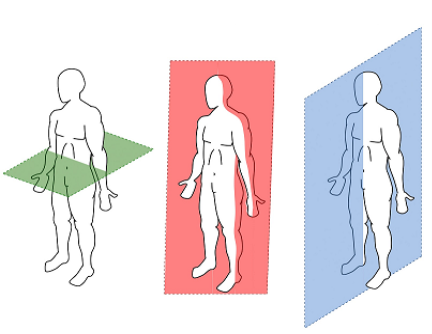
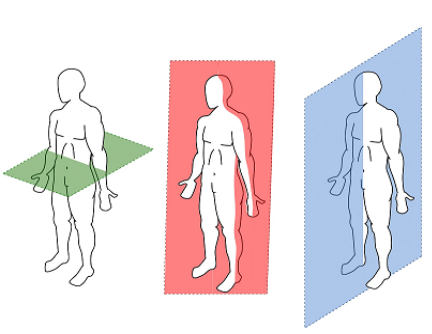
What body plane is this?

a)

Transverse

b)

Midsagittal

c)

Coronal

d)

Air

94.

Divides the body into left and right portions.

a)

Frontal

b)

Transverse

c)

Sagittal.

95.

Divides the body into front and back portions.

a)

Sagittal

b)

Frontal

c)

Transverse

96.

The proper anatomical position the subject is...

a)

Lying down

b)

Arms placed above the head

c)

Standing upright with palms facing backwards

d)

Standing upright with palms facing forward

97.

toward the head end or upper part of a structure or the body; above

a)

inferior

b)

superior

c)

distal

d)

proximal

98.

away from the head end or toward the lower part of a structure or the body; below

a)

inferior

b)

superior

c)

ventral

d)

dorsal

99.

what is another name for ventral

a)

dorsal

b)

posterior

c)

anterior

d)

cuadal

100.
Body cavities are spaces within the body that contain and protect vital organs.
a)
True
b)
False
101.
The diaphragm separates the thoracic and abdominal cavities.
a)
True
b)
False
102.
Which cavity contains the spleen, small intestine, stomach and liver?
a)
pelvic
b)
thoracic
c)
inferior
d)
abdominal
103.

In the _________________________ position, the body is upright, directly facing the observer, feet flat and directed forward. The upper limbs are at the body's sides with the palms facing forward.

a)

inferior

b)

superior

c)

frontal

d)

anatomical

104.

The heart, lungs, and mediastinum are located in what body cavity?

a)

cranial

b)

spinal

c)

abdominopelvic

d)

thoracic

105.

Which organ is located in the PERICARDIAL cavity?

a)

lungs

b)

heart

c)

mediastinum

d)

trachea

106.

Which organ is located in the cranial cavity?

a)

spinal cord

b)

brain

c)

lungs

d)

esophagus

107.
The spaces surrounding each lung are known as the?
a)
pleural cavities
b)
mediastinum
c)
pericardial cavity
d)
cranial cavity
108.

The cavity surrounded by a box is?

a)

Abdominal Cavity

b)

Pelvic Cavity

c)

Pleural Cavity

d)

Cranial Cavity

109.
a)

Cranial Cavity

b)

Pleural Cavity

c)

Pericardial Cavity

d)

Vertebral Canal

110.

The cavity surrounded by a box is?

a)

Thoracic Cavity

b)

Abdominal Cavity

c)

Pelvic Cavity

d)

Vertebral Canal

111.

What quadrant does number 3 Represent?

a)

Right Upper

b)

Left Upper

c)

Right Lower

d)

Left Lower

112.

What is section 1?

a)

Epigastric

b)

Left Hypochondriac

c)

Right Hypochondriac

d)

Right iliac

113.

What is section 2?

a)

Epigastric

b)

Left Hypochondriac

c)

Right Hypochondriac

d)

Right iliac

114.

What is section 3?

a)

Epigastric

b)

Left Hypochondriac

c)

Right Hypochondriac

d)

Right iliac

115.

What is section 7?

a)

Epigastric

b)

Left Hypochondriac

c)

Right Hypochondriac

d)

Right iliac

116.

What is section 4?

a)

Umbilical

b)

Left lumbar

c)

Right lumbar

d)

Right iliac

117.

What is section 5?

a)

Umbilical

b)

Left lumbar

c)

Right lumbar

d)

Right iliac

118.

What is section 6?

a)

Umbilical

b)

Left lumbar

c)

Right lumbar

d)

Right iliac

119.

What is section 8?

a)

Hypogastric

b)

Left iliac

c)

Right iliac

d)

Right lumbar

120.

What is section 9?

a)

Hypogastric

b)

Left iliac

c)

Right iliac

d)

Right lumbar

121.

Number 3

a)

pericardial cavity

b)

pleural cavity

c)

pelvic cavity

d)

abdominal cavity

122.

Number 4

a)

abdominal cavity

b)

pelvic cavity

c)

spinal cavity

d)

cranial cavity

123.

What anatomical structure is labeled e?

a)

lungs

b)

heart

c)

diaphragm

d)

stomach

124.

Which of the following cavities holds the heart AND lungs?

a)

pleural

b)

pericardial

c)

thoracic

d)

abdominal