wayground logo

Free Printable Worksheets

Font size

S
M
L
XL
Worksheets

AP Bio Unit 1&2 Review

Total questions: 135

Worksheet time: 45mins

Name
Class
Date
1.
The cell membrane is solid and rigid.
a)
true
b)
false
2.
Which way would the purple molecules move through the semi-permeable membrane?
a)
From the  A side  to the B-side
b)
From the B side to the A side
c)
none of the purple molecules would move
d)
they would move equally back and forth in a state of dynamic equilibrium
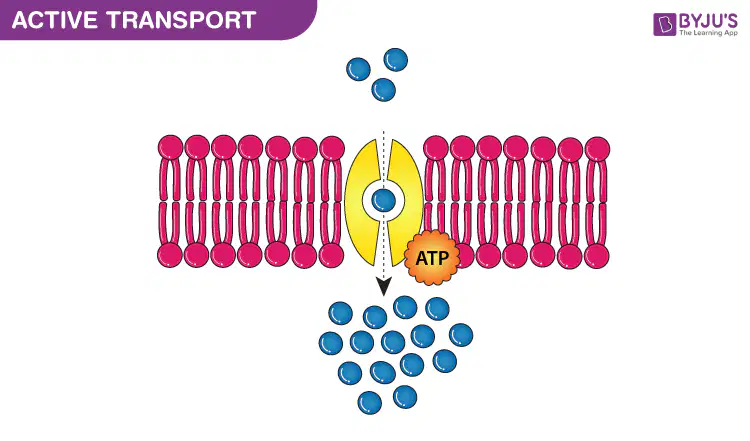
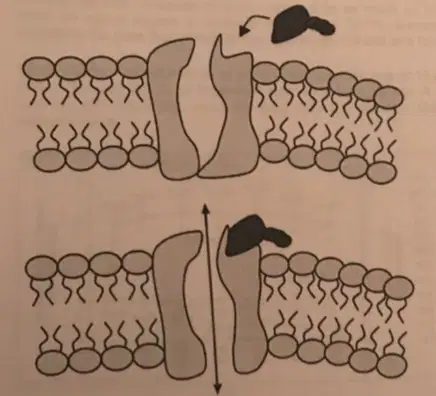
3.
The picture is an example of...
a)
active tranport
b)
passive transport
c)
diffusion
d)
osmosis
4.
Which of the following is responsible for getting large or charged (polar) molecules across the cell membrane?
a)
E
b)
B
c)
C
d)
D
5.
Hydrophobic region of the cell membrane?
a)
E
b)
B
c)
C
d)
6.
When cells are placed in a __________ solution they begin to swell.
a)
Hypertonic
b)
Isotonic
c)
Hypotonic
d)
Equalized
7.
A person would never have pure water put into their veins in a hospital because their cells would...
a)
Shrink/Dehydrate
b)
Expand
8.
Controlling what goes into or out of the cell with the help of energy is called
a)
active transport
b)
endocytosis
c)
passive transport
d)
exocytosis
9.
Which form of active transport is being shown? (Inside of  the cell is tan colored) 
a)
Facilitated Diffusion
b)
Exocytosis
c)
Endocytosis
d)
Receptor-mediated endocytosis
10.
The sodium-potassium pumps requires energy to move ions across the cell membrane against their concentration gradient so it is a type of
a)
active transport
b)
osmosis
c)
diffusion
d)
facilitated diffusion
11.
A saltwater snail is placed in freshwater. What happens to its cells?
a)
They shrink
b)
They swell
c)
Nothing happens
12.
The tails of a phospholipid are...
a)
Hydrophobic
b)
Hydrophilic
13.
 Engulfing of bacteria by white blood cells is called as
a)
Phagocytosis
b)
Pinocytosis
c)
Exocytosis
d)
Endocytosis
14.
The difference in the concentration of a substance from one location to another is called 
a)
diffusion
b)
osmosis
c)
concentration gradient
d)
passive transport
15.
Osmosis is the diffusion of _____ across a selectively permeable membrane.
a)
food
b)
air
c)
water
d)
oxygen
16.
The picture  is an example of _________________.
a)
isotonic
b)
diffusion
c)
osmosis
d)
active transport
17.

If a cell containing 5% salt is placed into a glass of water with 20% salt, the fluid in the glass is _______ compared to the fluid in the cell.

a)

hypertonic-

b)

hypotonic

c)

isotonic

18.
If you looked at red blood cells under a microscope and saw the blood cells exploded, what would you say happened?
a)
The cells were placed in a hypotonic solution.
b)
the solution was isotonic.
c)
The solution was hypertonic.
19.
Water will move?
a)
Into the cell
b)
Out of the cell
c)
Neither into or out of the cell
20.
Biological membranes are composed primarily of 
a)
nucleotides and nucleosides
b)
enzymes, electron acceptors, and electron donors
c)
monosaccharides and diasaccharides
d)
lipids
21.
In biological membranes, the phospholipids are arranged in a _______, with the_______.
a)
bilayer; fatty acids pointing toward each other
b)
bilayer; fatty acids facing outward
c)
single layer; fatty acids facing the interior of the cell
d)
single layer; phosphorus-containing region facing the interior of the cell
22.
Which statement about cholesterol molecules is true?
a)
They help hold a membrane together.
b)
They alter the fluidity of the membrane.
c)
They attach to carbohydrates.
d)
They disrupt membrane function.
23.
The LDL receptor is an integral membrane protein that crosses the plasma membrane, with portions of the protein extending both outside and into the interior of the cell. The amino acid side chains (R groups) in the region of the protein that crosses the membrane are most likely
a)
charged
b)
hydrophilic
c)
hydrophobic
d)
carbohydrates
24.
The hydrophilic regions of a membrane protein are most likely
a)
present only in muscle cells
b)
associated with the fatty acid region of the lipids
c)
either on the surface or inserted into the interior of the membrane
d)
exposed on the surface of the membrane
25.
When a mouse cell and a human cell are fused, the membrane proteins of the two cells become uniformly distributed over the surface of the hybrid cell. This occurs because
a)
many proteins can move around within the bilayer.
b)
all proteins are anchored within the membrane.
c)
all proteins in the plasma membrane are peripheral.
d)
different membranes contain different proteins.
26.
Which of the following functions as a recognition site for interactions between cells?
a)
Phospholipids
b)
Cholesterol 
c)
Fatty acids
d)
Glycolipids
27.
The difference between osmosis and diffusion is that
a)
diffusion is passive transport, whereas osmosis is active transport
b)
only in diffusion do molecules move from areas of high concentration to areas of low concentration
c)
osmosis is the opposite of diffusion and only involves the movement of water
d)
osmosis refers specifically to the movement of water, whereas diffusion refers to the movement of any type of molecules
28.
Which of the following is the driving force for simple diffusion?
a)
Concentration gradient
b)
ATP hydrolysis
c)
ADP hydrolysis
d)
Phosphorylation
29.

What is the process called when the cell controls what goes into or out of the cell with the help of energy?

a)

passive transport

b)

osmosis

c)

diffusion

d)

active transport

30.

What is the term used to describe the difference in the concentration of a substance from one location to another?

a)

concentration gradient

b)

substance gradient

c)

concentration difference

d)

location variance

31.

What are the critical functions of cell membrane in sustaining life?

a)

Regulating passage of substances, maintaining cell shape and structure, facilitating cell communication

b)

Maintaining cell temperature, producing enzymes for cell metabolism, storing excess nutrients

c)

Transporting oxygen to the cell, removing waste products from the cell, regulating cell division

d)

Producing energy for the cell, storing genetic information, protecting the cell from external threats

32.

Explain the process of osmosis.

a)

Osmosis is the process of solvent molecules passing through a semipermeable membrane from an area of lower solute concentration to an area of higher solute concentration.

b)

Osmosis is the process of solvent molecules passing through a semipermeable membrane from an area of equal solute concentration to an area of higher solute concentration.

c)

Osmosis is the process of solvent molecules passing through a semipermeable membrane from an area of higher solute concentration to an area of lower solute concentration.

d)

Osmosis is the process of solute molecules passing through a semipermeable membrane from an area of higher solute concentration to an area of lower solute concentration.

33.

How do cells control what goes into or out of the cell?

a)

Selective permeability

b)

Active transport

c)

Osmosis

d)

Passive transport

34.

Describe the structure of a biological membrane.

a)

A biological membrane is composed of a protein bilayer with embedded phospholipids.

b)

A biological membrane is composed of a phospholipid bilayer with embedded proteins.

c)

A biological membrane is composed of a single layer of phospholipids.

d)

A biological membrane is composed of carbohydrates and nucleic acids.

35.

This a picture of an animal and plant cell placed in a solution. Describe the solution?

a)

Isotonic

b)

Hypotonic

c)

Hypertonic

36.

This a picture of an animal and plant cell placed in a solution. Describe the solution?

a)

Isotonic

b)

Hypotonic

c)

Hypertonic

37.
Which of the following statements regarding the mitochondria is correct?
a)
Mitochondria contain their own ribosomes and thus produce some of their own proteins.
b)
Mitochondria are involved in the transport that occurs as a part of the endomembrane system.
c)
Mitochondria rely on the DNA of the eukaryote cell in order to function correctly.
d)
Mitochondria produce ATP only used by themselves.
38.

Which structures are found prokaryotes and eukaryotes?

a)

cell membrane and cytoplasm

b)

chloroplasts and mitochondria

c)

a cell wall and nucleus

d)

chloroplasts and cell wall

39.
In what part of the plant cell does the process of photosynthesis take place?
a)
nucleus
b)
mitochondria
c)
chloroplasts
d)
vacuoles
40.
I am a protein packaging and shipping machine! Who am I?
a)
vacuole
b)
ribosome
c)
mitochondrion
d)
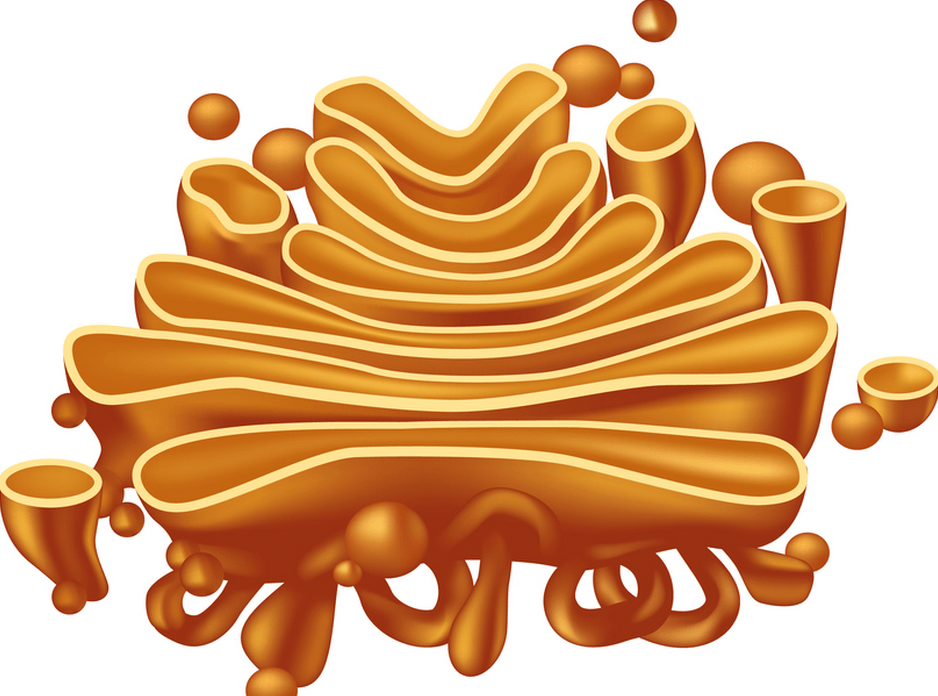
golgi apparatus
41.
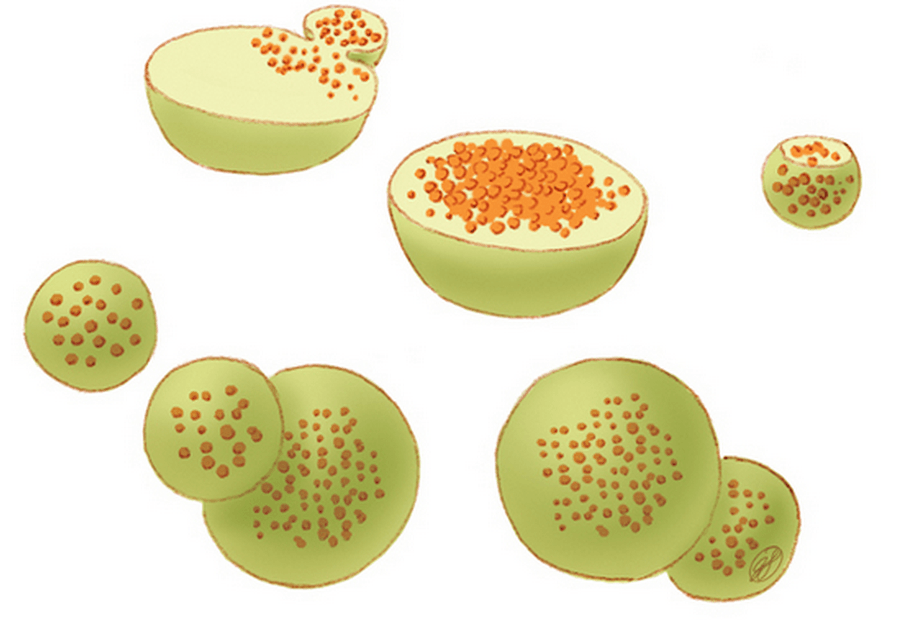
You might think of me as the trash collector, but recycler is maybe more accurate. What am I?
a)
mitochondria
b)
lysosome
c)
vacuole
d)
ribosome
42.
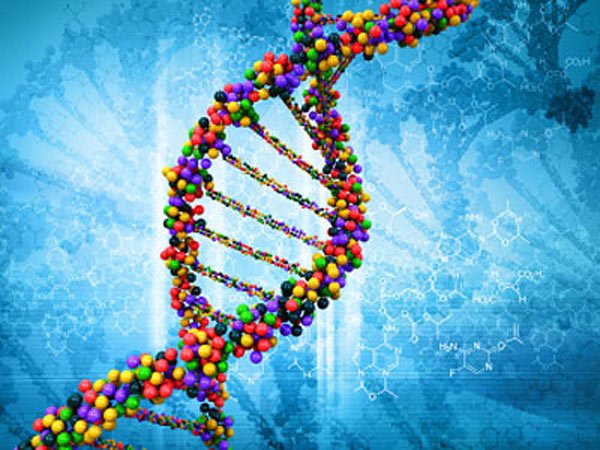
What is the name of the genetic material that is inside the nucleus?
a)
ER
b)
ATP
c)
YOLO
d)
DNA
43.
I am the outer most layer of an animal cell. What am I?
a)
cell wall
b)
nucleus
c)
cell membrane 
d)
cell skin
44.
What is the gel-like substance inside of cells called?

a)
photoplasm
b)
photosynthesis
c)
cytoskeleton
d)
cytoplasm
45.
No nucleus
a)
Eukaryote
b)
Prokaryote
c)
Both
46.
Bacteria
a)
Eukaryote
b)
Prokaryote
c)
Both
47.
Which type of cell?
a)
Prokaryote
b)
Eukaryote
48.

Which organelle provides structure and protection to plant cells?

a)

cell membrane

b)

ribosome

c)

golgi apparatus

d)

cell wall

49.

Storage space for water, wastes, food, and other cellular material

a)

mitochondria

b)

cell membrane

c)

cell wall

d)

vacuoles

50.

Where are the ribosomes attached in a cell?

a)

Smooth ER

b)

Cell Membrane

c)

Mitochondria

d)

Rough ER

51.

The "powerhouse" of the cell; breaks down food to make energy for the cell.

a)

organelles

b)

cell

c)

mitochondria

d)

cytoplasm

52.

Plants and animal cells are examples of ___ cells

a)

prokaryotic cells

b)

eukaryotic cells

c)

both eukaryotic and prokaryotic

d)

neither

53.

What type of cell has a nucleus?

a)

eukaryotic

b)

prokaryotic

c)

neither

d)

both

54.

The Endosymbiotic Theory explains

a)

the origin of prokaryotes

b)

how bacteria lives

c)

the origin of eukaryotes

d)

how species develop

55.

_____ and _____ are organelles that arose from endosymbiosis

a)

nucleus and cell membrane

b)

mitochondria and chloroplasts

c)

cell wall and chloroplasts

d)

mitochondria and nucleus

56.

Which of the following is evidence to support the endosymbiotic theory?

a)

Mitochondria and chloroplasts have their own DNA, which is similar to prokaryotic DNA.

b)

Fossil evidence shows that the first forms of life were prokaryotic cells.

c)

All eukaryotic cells have a double-layered membrane composed of phosplipids and proteins.

d)

Prokaryotes have the same number and types of enzymes as eukaryotes.

57.
Which cells are more efficient at obtaining nutrients?
a)
Small Cells
b)
Medium Size Cells
c)
Large Cells
d)
X-Large Cells
58.
The absorption of nutrients is determined by...
a)
The cell's volume
b)
The cell's surface area
c)
The cell's ribosomes
d)
The cell's DNA
59.
As a cell becomes larger, its
a)
surface area increases faster than its volume.
b)
volume increases faster than its surface area
60.
The larger a cell is, the more difficult it is for the cell to move enough nutrients and wastes across its cell membrane to maintain its normal functions.
a)
True
b)
False
61.
As a cell’s size increases, its ratio of surface area to volume decreases.
a)
True
b)
False
62.
Define Surface area
a)
The total area on the surface of an object
b)
Length X Width 
c)
6 X (length X width)
d)
Add up the sides and divide by 4
63.
The amount of space something takes up is called the.... 
a)
Surface area
b)
Perimeter 
c)
Volume
d)
Weight
64.

Which of the following is least efficient?

a)

A

b)

B

c)

C

d)

D

65.

Active Transport moves from ____ to ____ concentration.

(a)  

66.

The three types of endocytosis

a)

Phagocytosis

Pinocytosis

Receptor-mediated

b)

Phagocytosis

Exocytosis

Active Transport

c)

Passive

Pinocytosis

Receptor-Mediated

d)

Receptor-Mediated

Active

Passive

67.

The cell membrane is composed of _________ head and _________ tail.

a)

Hydrophobic

Hydrophilic

b)

Hydrophilic

Hydrophobic

68.

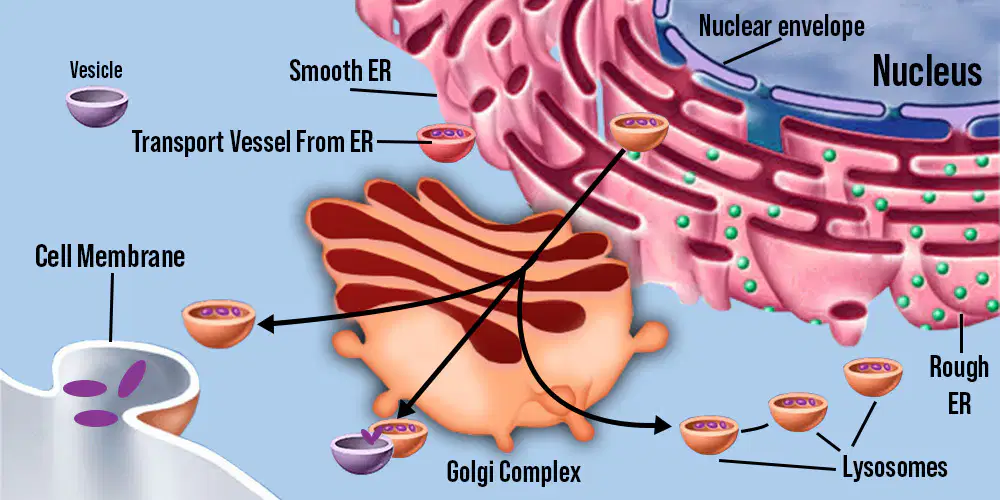
Cystic fibrosis is a genetic condition that is associated with defects in the CFTR protein found in the membrane. Which organelle synthesized the protein?

a)

Golgi Bodies

b)

Rough ER

c)

Smooth ER

d)

Lysosome

69.

The following data was collected by observing subcellular structures of three different types of eukaryotic cells. Identify a function of Cell Y.

a)

Detoxification

b)

Secretion of Proteins

c)

Motility

d)

Storage

70.

The following data was collected by observing subcellular structures of three different types of eukaryotic cells. Identify a function of Cell X.

a)

Detoxification

b)

Secretion of Proteins

c)

Motility

d)

Storage

71.

Cells in the pancreas will incorporate radioactively labeled amino acids into proteins. This "tagging" of newly synthesized proteins enables a researcher to track their location. Predict the most likely pathway of an enzyme secreted by pancreatic cells.

a)

Rough ER -> lysosomes -> vesicles that fuse with the plasma membrane

b)

Smooth ER -> Golgi apparatus -> vesicles that fuse with the plasma membrane

c)

Nucleus -> Smooth ER -> Golgi apparatus

d)

Rough ER -> Golgi apparatus -> vesicles that fuse with the plasma membrane

72.

Match the following organelles to their descriptions:

a)

Mitochondria

1.

Present in large numbers in cells that have high energy demands, such as muscles

b)

Golgi apparatus

2.

Has a receiving (cis) and shipping (trans) face: packaging and secretion center

c)

Lysosomes

3.

Membrane-bound structure containing hydrolytic enzymes

d)

Smooth ER

4.

An organelle with extensive, folded membranes: abundant in cells that detoxify poisons

73.

Match the following cells in solutions to their outcomes:

a)

Animal cell placed in hypertonic solution

1.

Shrivel

b)

Animal cell placed in hypotonic solution

2.

Lyse

c)

Plant cell placed in hypertonic solution

3.

Plasmolysis

d)

Plant cell placed in hypotonic solution

4.

Turgid

e)

Plant cell placed in isotonic solution

5.

Flaccid

74.

Mutations in which gene causes cystic fibrosis?

a)

HTT

b)

PINK1

c)

CFTR

d)

HBB

75.

Select all the characteristics associated with CF.

a)

Sickled red blood cells

b)

Sticky mucus buildup on the lungs

c)

Salty skin

d)

Tremors

76.

Which ion is unable to move across the membrane in CF?

a)

Chloride

b)

Hydrogen

c)

Fluoride

d)

Sodium

77.

CFTR is an example of what protein channel?

a)

Ion Gated

b)

Ligand Gated

c)

Receptor Mediated-Endocytosis

d)

Active Transport Channel

78.

What is the function of the rough endoplasmic reticulum?

a)

Detoxification of harmful chemicals

b)

Production of lipids

c)

Production of proteins

d)

Packaging and distribution of cell products

79.

_ are made by the ER/Golgi and important to digesting substances that have been brought in via endocytosis. When a substance enters the cell (via endocytosis) it is wrapped in phospholipids and vesicle forms around the substance. The cell part (that is the answer) fuses with the newly-formed vesicle and its enzymes break down the substance inside.

(a)  

80.
The monomer, building block, of proteins
a)
Amino Acid
b)
Fatty Acid
c)
Nucleotide
d)
monosaccharide
81.
Combines with 3 fatty acid chains to make up a triglyceride; part of the monomer of lipids
a)
Amino Acid
b)
Fatty Acid
c)
Glycerol
d)
Nucleotide
82.
The monomer, building block, of DNA and RNA; made up of a sugar, phosphate, and nitrogenous base
a)
Amino Acid
b)
Fatty Acid
c)
Nucleotide
d)
Monosaccharide
83.
The process/reaction used to link compounds/monomers together.  Releases water.
a)
Dehydration
b)
Hydrolysis
c)
Enzomatic
d)
Tetratonic
84.
The monomer, building block, of carbohydrates; simple sugar
a)
Amino acid
b)
Fatty Acid
c)
Nucleotide
d)
Monosaccharide
85.
The process used to split polymers; this is done by adding water
a)
Dehydration
b)
Hydrolysis
c)
Enzomatic
d)
Tetratonic
86.

Which of the following is not a job of a protein

a)

Act as hormones and enzymes

b)

Do much of the work in cells and transport materials

c)

Build tissues and muscles

d)

Store and transmit genetic information

87.
What is a substance called if it speeds up a chemical reaction?
a)
reusable
b)
catalyst
c)
specific
d)
fragile
88.
Where do substrates bind on an enzyme?
a)
voltage-gated channels
b)
surface receptor
c)
calcium channels
d)
active site
89.
Which is not a use or function of protein?
a)
forms enzymes and hormones
b)
forms transport channel in cell membrane
c)
forms structural proteins in the body
d)
quick energy
90.
These organic molecules are used by the body for long term storage of energy and make up the structure of cell membranes.
a)
Carbohydrates
b)
Lipids
c)
Proteins
d)
Nucleic Acids
91.
___________ are some functions of lipids.
a)
storing energy and  cell membrane structure
b)
providing actin & providing myosin
c)
cellulose structure and digestive assistance
d)
storing & transferring genetic info
92.
What 3 letters do enzymes typically end in?
a)
-ose
b)
-ase
c)
-ese
d)
-tic
93.
Changes in pH and temperature can damage an enzymes active site.  What is this called?
a)
reusable
b)
catalyst
c)
specific
d)
denature
94.
The energy needed to start a reaction
a)
activation energy
b)
adhesion energy
c)
chemical energy
d)
cohesion energy
95.
Which property makes water molecules stick to other water molecules?
a)
adhesion
b)
cohesion
c)
capillary action
d)
polarity
96.
All organic compounds contain the element
a)
carbon
b)
nitrogen
c)
phosphorus
d)
sulfur
97.
Which of the following elements make up nucleic acids?
a)
C, H, O
b)
C, H, O, N
c)
C, H, O, N, P
d)
C, H, O, Ca, S
98.
Carbohydrates are made of... 
a)
C H O
b)
C H O N
c)
C H O N P
d)
C H O N S
99.
Which macromolecule is shown?
a)
lipid
b)
protein
c)
nucleic acid
d)
carbohydrate
100.
The diagram shows a bond forming between two amino acids. What is the name of this reciprocation?
a)
Dehydration Synthesis
b)
Hydrolysis
c)
Pepysis
d)
Oxidation
101.
Is this hydrocarbon saturated or unsaturated? 
a)
saturated
b)
unsaturated
102.
The bond that joins amino acids are called:
a)
Peptide Bonds
b)
Ester Bonds
c)
Glycosidic Linkages
d)
Phosphodiester Bonds
103.
Which of the following is NOT a function of lipids?
a)
long term energy
b)
provides flavor in food
c)
used to make hormones
d)
building of muscles
104.
Amino acids all have the same general morphology except for the:
a)
Amino Group
b)
Carboxyl Group
c)
'R' Group
d)
Carbonyl Group
105.

All of the following atoms make up Carbohydrates EXCEPT which one?

a)

Carbon

b)

Phosphate

c)

Oxygen

d)

Hydrogen

106.

Which of the answers below is an example of a monosaccharide?

a)

Glucose

b)

Starch

c)

Lactose

107.

What are two examples of polysaccharides?

a)

Glucose and Sucrose

b)

Fructose and Starch

c)

Cellulose and Starch

108.

If two glucose molecules are being added together (reactants) they must go through which process for the PRODUCT to be Maltose and WATER

a)

Hydrolysis

b)

Dehydration Sysnthesis

109.

The picture above is considered what kind of carbohydrate?

a)

Disaccharide

b)

Polysaccharide

c)

Monosaccharide

110.

Combination of two monosaccharides forms a disaccharide

a)

True

b)

False

111.

I have single carbon bonds, my tails are straight as a board and I am solid at room temperature. What am I?

a)

Protein

b)

Unsaturated Fat

c)

Saturated Fat

112.

How many amino acids are there for the body to combine together to form certain proteins?

a)

12

b)

10

c)

20

113.

The above picture is representing which organic molecule?

a)

Carbohydrates

b)

Lipids

c)

Protein

114.

Carbs, Lipids and Proteins share all the same elements EXCEPT which one?

a)

Carbon

b)

Hydrogen

c)

Nitrogen

115.

The picture above is representing which monomer?

a)

Amino Acid

b)

Monosaccharide

c)

Fatty Acids

116.

What process is taking place in the picture above?

a)

Hydrolysis

b)

Dehydration Synthesis

c)

Cellular Respiration

117.

What is the purpose of monosaccharides in our bodies?

a)

Stored Energy

b)

Cell Membrane

c)

Immediate Energy

118.

These are very large chemical structures made from smaller chemical structures called monomers. They are the 4 main groups for which our body is built and survives.

a)

Macromolecules

b)

Carbohydrates

c)

Lipids

119.

The macromolecule is important to all of our cells. It's information can be found in the nucleus of the cell. Its monomer is a nucleotide

a)

Lipid

b)

Nucleic Acid

c)

Fats

120.

The monomer of DNA and RNA (Nucleic Acids)

a)

Monosaccharide

b)

Amino Acid

c)

Nucleotide

121.

This is a type of simple carbohydrate that consists of two sugars.

a)

Polysaccharide

b)

Disaccharide

c)

Monosaccharide

122.

An example of a disaccharide would be

a)

Glucose

b)

Glycogen

c)

Lactose

123.

A monomer of lipids

a)

Amino Acids

b)

Molecule

c)

Fatty Acids

124.

Cellulose is a polysaccharide that can be found where?

a)

In animal cells

b)

In the plant cell wall

c)

No where

125.

Proteins make which of the following for your body

a)

Cell Membrane

b)

Enzymes

126.

Any time you notice "ose" on the end of a word it is likely referring to which organic molecule?

a)

Lipids

b)

Nucleic Acids

c)

Carbohydrates

127.

Nucleic Acids make up what in your cells?

a)

DNA

b)

Cytoplasm

c)

Golgi Body

128.

For something to be considered organic it must contain what?

a)

Carbon

b)

Oxygen

c)

Nitrogen

129.

Attraction of molecules between the same substance

a)

Adhesion

b)

Cohesion

c)

Polarity

130.

Water has a pH level of ?

a)

1

b)

5

c)

7

131.

The hydrogen and oxygen atoms are held together by what kind of bond?

a)

Hydrogen

b)

Covalent

c)

Polysaccharide

132.

It takes a lot of energy to break apart water molecules, there for meaning water has a

a)

high chance of evaporation

b)

high specific heat

c)

never freezes

133.

When water molecules attach to each other this is through a

a)

Covalent bond

b)

Polypeptide

c)

Hydrogen Bond

134.

Attraction of molecules of different substances

a)

Adhesion

b)

Cohesion

135.

An example of an unsaturated fat would be?

a)

Butter

b)

Olive Oil

c)

Crisco