wayground logo

Free Printable Worksheets

Font size

S
M
L
XL
Worksheets

Biology Midterm Review

Total questions: 100

Worksheet time: 33mins

Name
Class
Date
1.
How are photosynthesis and cellular respiration related processes?
a)
Both provide plant cells with energy
b)
Both provide animal cells with energy
c)
The reactants of respiration are the products of photosynthesis.
d)
The reactants of respiration are the reactants of photosynthesis.
2.
What is an enzyme?
a)
A biological catalyst that works in living cells to speed up chemical reactions.
b)
A biological catalyst that works outside living cells to speed up chemical reactions.
c)
A protein that increases activation energy
d)
A product of chemical reactions.
3.
What is the difference between passive and active transport?
a)
Active transport does not require energy.
b)
Passive transport does require energy.
c)
Passive transport does not require ATP energy, but active transport does.
d)
Active transport does not require ATP energy, but passive transport does.
4.
Facilitated diffusion allows large molecules to pass through the cell membrane with the help of protein channels, but does not require energy. It is a ________ process.
a)
Passive
b)
Active
c)
ATP
d)
Protein
5.
Which organelle provides your body the energy it needs to function?
a)
Chloroplast
b)
Lysosome
c)
Mitochondria
d)
Golgi apparatus
6.
Ultimate source of energy on earth
a)
rotation of the earth
b)
moon
c)
sun
d)
none of the above
7.
Light energy is converted to chemical energy through this process
a)
fermentation
b)
photosynthesis
c)
cell respiration
d)
glycolysis
8.
Molecules that are too large are transported into the cell by using
a)
endocytosis
b)
exocytosis
c)
osmosis
d)
diffusion
9.
Which of the following is a form of active transport?
a)
facilitated diffusion
b)
diffusion
c)
osmosis
d)
sodium-potassium pump
10.
Diffusion of water
a)
diffusion
b)
endocytosis
c)
osmosis
d)
exocytosis
11.
The process by which plants capture light energy and make their own food
a)
homeostasis
b)
evolution
c)
photosynthesis
d)
development
12.
Only eukaryotic cells has
a)
DNA
b)
membrane bound organelles
c)
cytoplasm
d)
ribosomes
13.
Biology is the study of __________
a)
life
b)
minerals
c)
weather
d)
energy
14.
The organelle that is associated with photosynthesis
a)
vesicle
b)
vacuole
c)
mitochondria
d)
chloroplast
15.
Unlike passive transport, active transport
a)
requires energy
b)
moves substances down their concentration gradient
c)
does not involve carrier proteins
d)
all of the above
16.
All living organisms are composed of
a)
cellulose
b)
cells
c)
diatoms
d)
mitochondria
17.
Which of the following does not require energy?
a)
endocytosis
b)
exocytosis
c)
diffusion
18.

The major atmospheric by-product of photosynthesis is

a)

nitrogen

b)

carbon dioxide

c)

water

d)

oxygen

19.

All of the following are found in both plant and animal cells except

a)

a cell wall

b)

a cell membrane

c)

mitochondria

d)

endoplasmic reticulum

20.

The name of the process that takes place when organic compounds are broken down in the absence of oxygen

a)

respiration

b)

oxidation

c)

fermentation

d)

all of the above

21.

In a cell proteins are made on the

a)

mitochondria

b)

ribosomes

c)

nucleus

d)

cell membrane

22.

Molecules of DNA are composed of long chains of

a)

amino acids

b)

fatty acids

c)

monosaccharides

d)

nucleotides

23.

Cells produce ATP most efficiently in the presence of

a)

water

b)

carbon dioxide

c)

oxygen

d)

glucose

24.

The cell membrane

a)

encloses the contents of the cell

b)

allows materials to enter and leave the cell

c)

is selectively permeable

d)

all of the above

25.
What characteristic differentiates a prokaryote from a eukaryote?
a)
presence of ribosomes
b)
ability to reproduce
c)
presence of a nucleus/nuclear membrane
d)
ability to remain stable
26.
What is the monomer of a carbohydrate (polysaccharide)?
a)
amino acids
b)
glycerol + fatty acids
c)
monosaccharaides
d)
nucleotides
27.
What is the equation for cellular respiration?
a)
glucose + oxygen → carbon dioxide + water + energy
b)
oxygen + water → glucose + carbon dioxide
c)
carbon dioxide + water → glucose + oxygen
d)
glucose + carbon dioxide → water + oxygen
28.
Which macromolecule stores energy, insulates us, and makes up the cell membrane?
a)
lipids
b)
proteins
c)
carbohydrates
d)
nucleic acids
29.
DNA and RNA are examples of...
a)
proteins
b)
nucleic acids
c)
carbohydrates
d)
lipids
30.
Another name for fats and oils
a)
proteins
b)
sugar
c)
lipids
d)
nucleic acids
31.
What is the function of nucleic acids?
a)
Stores energy
b)
Stores genetic information
c)
Movement
d)
Physical structure
32.
What is the monomer of proteins?
a)
amino acids
b)
polypeptides
c)
nucleotides
d)
monosaccharides
33.
Most enzymes:
a)
speed up the chemical reaction
b)
have no effect on the rate of the chemical reaction
c)
slow the rate of the chemical reaction
d)
keep the rate of the chemical reaction the same
34.
The attraction that causes water and other liquids to form drops on thin films (like wax paper) is called ________________. This is also water’s ability to be attracted to other water molecules.
a)
adhesion
b)
capillary action
c)
cohesion
d)
surface tension
35.
What word describes when water is attracted to other substances?
a)
cohesion
b)
adhesion
c)
capillary action
d)
surface tension
36.
Which organelle is only found in a plant cell? 
a)
nucleus
b)
chloroplast
c)
mitochondria
d)
cell membrane
37.
Directs all cell activities through the DNA located there.
a)
Lysosomes
b)
Nucleus
c)
ribosomes
d)
Mitochondria
38.
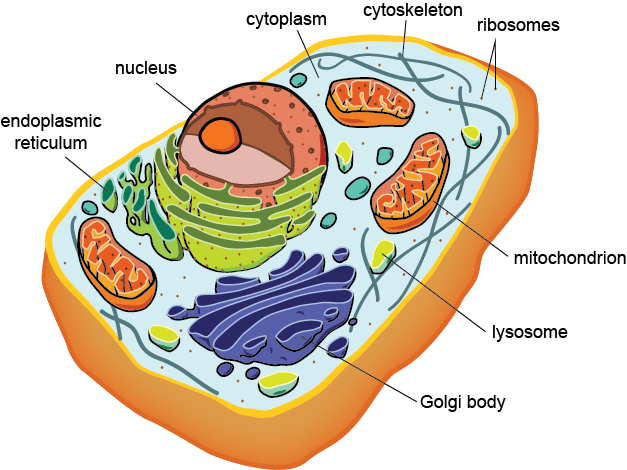
What is the name of the structure shown in the diagram where cellular respiration takes place?
a)
Chloroplast
b)
Mitochondrion
c)
Nucleus
d)
Vacuole
39.
I am a protein packaging and shipping machine! Who am I?
a)
vacuole
b)
ribosome
c)
endoplasmic reticulum
d)
golgi apparatus
40.
What is found in both plant and animal cells but is much larger in plant cells?
a)
Nucleus
b)
Mitochondrion
c)
Chloroplast
d)
Vacuole
41.
Osmosis is the movement of _____ across a membrane.
a)
food
b)
energy
c)
oxygen
d)
water
42.
This picture represents which type of cellular transport?
a)
passive transport
b)
endocytosis
c)
exocytosis
d)
osmosis
43.
Large particles of food can be moved into the cell by ________________________.
a)
endocytosis
b)
pinocytosis
c)
exocytosis
d)
osmosis
44.
The most important part of the cell in cell transport
a)
E.R.
b)
cytoplasm
c)
nucleus 
d)
cell membrane
45.
What are the reactants (what is needed) for photosynthesis?
a)
glucose and oxygen
b)
light, water, and carbon dioxide
46.
What PIGMENT absorbs sunlight for photosynthesis?
a)
chloroplast
b)
thylakoid
c)
grana
d)
chlorophyll
47.
Which living things do NOT use photosynthesis to make their own food?
a)
grass
b)
animals
c)
trees
d)
plant cells
48.
What is one of the reactants of cellular respiration?
a)
energy
b)
glucose
c)
carbon dioxide
d)
water
49.
What type of respiration requires oxygen?
a)
Aerobic
b)
Anaerobic
50.
What process is represented by the diagram?
a)
diffusion
b)
active transport
c)
endocytosis
d)
exocytosis
51.

Autotrophs

a)

Make their own food

b)

Get their food from others

c)

are Fungi

d)

are none of the above

52.

If water were to move through one of the large proteins in this cell membrane, that would be considered which form of transport?

a)

Osmosis

b)

Facilitated diffusion

53.

When water moves across the semipermeable membrane, it is considered:

a)

Osmosis

b)

Active transport

54.

Which is true about passive transport in a cell?

a)

It does not require energy

b)

It requires ATP

55.

In which organelle are sugars converted into ATP energy?

a)

Cell Membrane

b)

Nucleus

c)

Mitochondria

d)

Vacuole

56.

Which letter represents a reaction using an enzyme?

a)

A because it adds energy to the reaction

b)

B because it lowers the amount of energy needed for the reaction to occur

57.

A type of cell that is very complex and has many internal structures that perform different jobs, including a nucleus that holds DNA.

a)

Prokaryotic

b)

Eukaryotic

c)

Autotroph

d)

Heterotroph

58.

A type of cell that is very complex and has many internal structures that perform different jobs, including a nucleus that holds DNA.

a)

Prokaryotic

b)

Eukaryotic

c)

Autotroph

d)

Heterotroph

59.

What is the gas we breathe out and that plants use for photosynthesis?

a)

sulfur

b)

carbon dioxide

c)

oxygen

d)

hydrogen

60.

Which is one way cellular respiration and photosynthesis almost opposite processes?

a)

Photosynthesis releases energy, and cellular respiration stores energy

b)

Photosynthesis uses carbon dioxide, and cellular respiration produces it

c)

Photosynthesis uses oxygen, and cellular respiration produces it

d)

they are not connected

61.

Amino acids are the monomer of which macromolecule?

a)

nucleic acid

b)

carbohydrate

c)

lipid

d)

protein

62.

What type of materials will be transported using the method shown in the picture?

a)

small, nonpolar

b)

large, complex

c)

small charged ions

63.

Which is NOT true of active transport?

a)

It requires energy

b)

it moves substances from high to low concentration

c)

It moves substances against the concentration gradient

d)

it moves material from low to high concentration

64.
The release or use of chemical energy refers to the body's
a)
condensation
b)
metabolism
c)
photosynthesis
d)
cooperation
65.
Diffusion is the movement of 
a)
water from low to high concentration
b)
molecules from low to high concentration
c)
water from high to low concentration
d)
molecules from high to low concentration
66.

What are the products of cellular respiration?

a)

Energy (ATP) + Water + Carbon Dioxide.

b)

Water + Oxygen

c)

Oxygen + Carbon Dioxide

d)

Water + Energy (ATP)

67.

Which is a reactant of photosynthesis?

a)

oxygen gas

b)

water

c)

glucose

d)

ATP

68.

Which macromolecule makes up the cell membrane?

a)

phospholipids

b)

proteins

c)

carbohydrates

d)

glucose

69.
DNA and RNA are examples of...
a)
proteins
b)
nucleic acids
c)
carbohydrates
d)
lipids
70.
Enzymes are an example of a 
a)
Lipids
b)
Carbohydrate
c)
Protein
d)
Nucleic Acid
71.

Cellular Respiration is aerobic because _____ is a reactant.

a)

carbon dioxide

b)

oxygen

c)

glucose

d)

water

72.
The basic unit of life is called a(n)
a)
atom
b)
compound
c)
cell
d)
energy
73.

Broken down to use as energy in cells.

a)

nucleic acid

b)

protein

c)

lipid

d)

carbohydrate

74.
Which of the following statements is not part of the cell theory?
a)
Cells are the basic unit of structure and function in all living things.
b)
All cells are produced from other cells.
c)
Only animal cells are composed of cells.
d)
All living things are composed of cells.
75.
Nucleotides are monomers of
a)
Carbohydrates
b)
Lipids
c)
Proteins
d)
Nucleic Acids
76.
Monosaccharides are monomers of
a)
Carbohydrates
b)
Lipids
c)
Proteins
d)
Nucleic Acids
77.
Which of the following organic compounds is the main source of energy for living things?
a)
carbohydrates
b)
lipids
c)
nucleic acids
d)
proteins
78.
Which macromolecule stores energy, insulates us, and makes up the cell membrane?
a)
lipids
b)
proteins
c)
carbohydrates
d)
nucleic acids
79.

Enzymes belong to which class of macromolecules?

a)

lipids

b)

carbohydrates

c)

proteins

d)

nucleic acids

80.
What is the purpose  of an enzyme?
a)
give permission for the reaction
b)
raise activation energy
c)
speed up reactions
d)
control how many reactions occur
81.

Which organelle controls what goes in and out of the cell?

a)

nucleus

b)

nucleolus

c)

cell membrane

d)

nuclear membrane

82.

This organelle digests dead cell parts and contains enzymes

a)

lysosome

b)

golgi body

c)

smooth ER

d)

Rough ER

83.

During the process of photosynthesis, plants use energy from the Sun to transform carbon dioxide from the air into

a)

oxygen gas and molecules of sugar.

b)

protein and minerals.

c)

minerals and liquid carbon dioxide.

84.
Osmosis is a form of ______________. 
a)
Passive Transport
b)
Active Transport
85.
What is it called when molecules move across the cell membrane from an area of high concentration to an area of low concentration through a carrier protein?
a)
Diffusion
b)
Osmosis
c)
Active Transport
d)
Facilitated Diffusion
86.
This picture represents which type of cellular transport?
a)
passive transport
b)
endocytosis
c)
exocytosis
d)
osmosis
87.
Which of the following is the correct equation for PHOTOSYNTHESIS?
a)
CO+ light + H2O --> O+ Sugar
b)
CO+ sugar + H2O --> O+ light
c)
O2 + light + H2O --> CO+ Sugar
d)
CO+ O2 + H2O --> Light+ Sugar
88.
What is the correct equation for cellular respiration?
a)
6O2 + C6H12O6 -> 6CO2 + 6H2O + Energy
b)
6O2 + C6H12O6 + Energy -> 6CO2 + 6H2O
c)
6CO2 + 6H2O -> 6O2 + C6H12O6 + Energy
d)
6CO2 + 6H2O + Energy -> 6O2 + C6H12O6
89.
What is one of the reactants of cellular respiration?
a)
energy
b)
glucose
c)
carbon dioxide
d)
water
90.
This process releases chemical energy from sugars and other carbon-based molecules to make ATP when oxygen is present.
a)
photosynthesis
b)
light-independent reaction
c)
cellular respiration
d)
light-dependent reaction
91.
Fermentation is cellular respiration without which molecule?
a)
CO2
b)
O2
c)
C6H12O6
92.

If a students runs an experiment where they grow plants with more or less carbon dioxide in the environment, which would you expect to happen?

a)

Plants grown with less CO2 grow faster and larger

b)

Plants grown with more CO2 grow faster and larger

c)

Plants grown with less CO2 do not grow at all

d)

Plants grown with more CO2 grow slower and smaller

93.

What is Homeostasis?

a)

the changes that take place during the life of an organism.

b)

an organisms regulation of its internal environment to maintain conditions suitable to its survival.

c)

the changes that take place during the life of an organism

d)

inherited structures, behaviors, and processes that enable an organism to respond to environmental factors and live to produce offspring.

94.
A tiny cell structure that carries out a specific function within a cell.
a)
organelle
b)
cell
c)
nucleus
d)
ribosomes
95.
Which of the following is directly involved in the transportation of materials inside/within the cell?
a)
Endoplasmic Reticulum
b)
Vacuole
c)
Lysosome
d)
Mitochondria
96.
molecule in which opposite ends have opposite electric charges
a)
cohesion
b)
polar molecule
c)
hydrogen bond
d)
solution
97.
Attractions between the negative Oxygen atom of one water molecule and the positive Hydrogen atom of another water molecule are called
a)
Covalent bonds
b)
Ionic bonds
c)
Polar bonds
d)
Hydrogen bonds
98.
What is the function of a cell wall?
a)
to protect and support the cell
b)
to perform different functions in each cell
c)
to prevent water from passing through it
d)
to prevent oxygen from entering the cell
99.
To convert the energy of glucose into  the  usable form of ATP is a function of _________.
a)
Cell Wall
b)
Cytoplasm
c)
Nucleus
d)
Mitochondria
100.

A student noticed that the freshwater plant, Elodea, produced bubbles when placed in direct light. What could the student most likely conclude?

a)

Bubbles of carbon dioxide were produced as a result of photosynthesis.

b)

Bubbles of oxygen were produced as a result of photosynthesis.

c)

Bubbles of carbon dioxide were produced as a result of cellular respiration

d)

Bubbles of oxygen were produced as a a result of cellular respiration