
 Worksheets
Cell Organelles & Transport
Total questions: 121
Worksheet time: 2hrs 53mins
The cell will not allow nonpolar molecules to pass through.
No substances will get through
Some substances may pass and others may not.

What is a sac-like structure used to store water and nutrients? There is a much larger one in plant cells.
Lysosomes
Mitochondria
Vacuoles
Golgi Body
Turgor Pressure

plasmolyze

plasmolyze


You might think of me as the waste or trash collector, but recycler is maybe more accurate. What am I?
cytoplasm
lysosome
vacuole
ribosome


hold/store water, are larger in plant cells
nuclolus
ribosomes
golgi bodies
vacuoles

What am I?
cell wall, converts sugar into sunlight
mitochondria, converts sunlight into sugar for energy
cytoplasm, converts sugar into sunlight
chloroplast, converts sunlight into sugar for energy

What will happen to an egg if it is left in a container of pure water?
shrink
expand
stay the same
change color


None of the choices
All of the following are principles of the cell theory EXCEPT _____.
the cell is the smallest unit of life
water is the main ingredient in every cell
all new cells come from preexisting cells
all living things are made of one or more cells

Which letter best represents where nucleic acids would be found?
A
B
C
D
What scientist did NOT contribute to the development of the cell theory?
Theodor Schwann
Matthias Schleiden
Robert Hooke
Carl Sagan
Which best explains the function of a cell membrane?
offers protection from the outside environment
provides a framework to help the cell move
transforms energy in the cell into ATP
removes viruses from inside the cell
Photosynthesis occurs at the cell level. Which organelle is necessary for photosynthesis?
Golgi Apparatus
Chloroplasts
Mitochondrion
Rough Endoplasmic Reticulum
What is the main difference between active transport and passive transport?
During active transport the water inside the cell is used to transport substances throughout the cell. Passive transport uses the cell’s cytoplasm to move substances around the cell.
Passive transport moves substances throughout the cell without using the cell’s energy and active transport moves substances using the cell’s energy.
Active transport moves substances from higher concentrations to lower concentrations and passive transport moves substances from lower concentrations to higher concentrations.
Passive transport moves substances that are too large to get through the cell membrane by forming a vesicle inside the cell and active transport forms the vesicle on the outside of the cell.
Substances too large to pass through the cell membrane enter the cell in a process called ____.
endocytosis
passive transport
exocytosis
active transport
The passive transport of water through a membrane is ____.
osmosis
fermentation
equilibrium
active transport
Small grain-shaped organelles that produce proteins for the cell
Cytoplasm
Ribosomes
Lysosomes
Mitochondria
Rigid layer that surrounds the cell of plants and some other organisms such as fungi
Cell Wall
Golgi Apparatus
Chloroplast
Cell Membrane
Large oval structure that acts as the control center of the cell, directing all of the cells’ activities
Vacuole
Ribosome
Golgi Apparatus
Nucleus
Thick, clear, gel-like fluid that fills the region between the cell membrane and the nucleus
Mitochondria
Cytoplasm
Chloroplast
Nucleus
Rod-shaped organelles that convert energy in food molecules to energy the cell can use to carry out its functions
Mitochondria
Golgi Apparatus
Ribosomes
Endoplasmic Reticulum
An organelle that forms a maze of passageways in which proteins and other materials are carried from one part of the cell to another
Cell Wall
Endoplasmic Reticulum
Golgi Appartus
Cytoplasm
Organelle in a cell that receives proteins and other newly formed materials from the endoplasmic reticulum, packages them, and distributes them to other parts of the cell
Golgi Apparatus
Lysosome
Endoplasmic Reticulum
Chloroplast
Organelle in the cells of plants and some other organisms that captures energy from sunlight and changes it to an energy form that cells can use in making food
Cell Wall
Chloroplast
Cell organelle which contains chemicals that break down large food particles into smaller ones that can be used by the rest of the cell
Lysosome
Ribosome
Nucleus
Cytoplasm
Semipermeable membrane, surrounding a cell that controls what goes into and out of the cell
Cell Wall
Lysosome
Nucleus
Cell Membrane

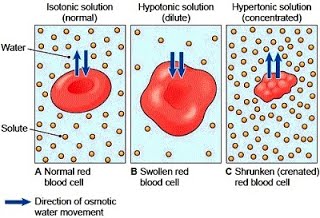
The solution surrounding the cell in Diagram B, would be defined as:
hypertonic
hypotonic
isotonic

The solution surrounding the cell in Diagram C, would be defined as
hypertonic
isotonic
hypotonic


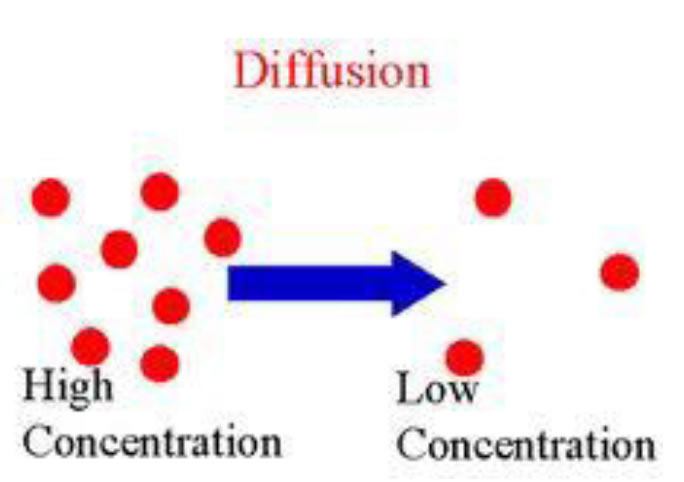
Diffused

If the dots represent sugar what direction will the water flow?
Into the cell
Out of the cell
Both equally (equilibrium)

What will happen to the cell in the given solution?
Swell up
Shrink
Stay the same


Movement of SOLUTE through the cell membrane from high to low concentration is called.....
diffusion
active transport
facilitated diffusion
osmosis

Which Type of solution is the middle cell placed in?
Hypertonic
Hypotonic
Isotonic
Robotonic

Which molecule is in equilibrium? How can you tell?
Molecule A; equal amounts inside and outside
Molecule B; passive movement into the cell
Molecule C; equal amounts inside and outside
Molecule C; all molecules are inside the cell


This arrangement within the cell membrane allows it to

The _______________ of the phospholipids in a cell membrane face inward towards each other.
heads
tails
stems
sticks

Passive Transport is the movement of particles across the membrane from an area of [ ___ ] to an area of [ ___ ]
high to low
low to high
low to low
high to high

The type of transport that requires the use of transport proteins
Passive Transport
Facilitated Diffusion
Active Transport
Vesicular Transport

The energy molecule that powers some modes of transport
ADP
ATP
AGP
ABP


