
 Worksheets
Earth Science U1 S24 Review Qs
Total questions: 100
Worksheet time: 1hrs 15mins
The southern hemisphere reaches its highest temperature around...
January
April
July
November
The northern hemisphere reaches its highest temperature around...
January
April
July
November
The Earth rotates on its ...
axis
equator
hemisphere
orbit
The Earth's axis of rotation is tilted... degrees.
23
14
60
90
The Earth rotates on its axis every...
365 days
hour
12 hours
24 hours
The Earth's movement around the sun is called its...
Rotation
Orbit
Axis
Hemisphere
The Earth completes its orbit around the sun every...
365.25 days
12 hours
24 days
24 hours
Are the change in seasons (changes in temperature and day length) caused by the distance between Earth and the Sun?
Yes
No
Does the Earth and Sun change distances from each other throughout the year?
Yes
No
Are the change in seasons (change in temperature and day length) caused by Earth’s axial tilt?
Yes
No
Latitude is the distance (measured in degrees) North or South from the Earth's ...
north pole
south pole
tropic of cancer
equator
The equator is at latitude...
25
90
0
-20
Due to Earth’s axial tilt, what time of year does the Northern Hemisphere point more towards the sun?
March 21 (Spring/Vernal equinox)
June 21 (Summer solstice)
September 22 (Autumnal equinox)
December 21 (Winter solstice)
Due to Earth’s axial tilt, what time of year does the Southern Hemisphere point more towards the sun?
March 21 (Spring/Vernal equinox)
June 21 (Summer solstice)
September 22 (Autumnal equinox)
December 21 (Winter solstice)
When the Northern Hemisphere points more towards the sun (such as in June), the further you go North in latitude the _____ hours of sunlight you receive during a day.
The same
More
Less
No change
When the Northern Hemisphere points more towards the sun (such as in June), the further you go SOUTH in latitude the _____ hours of sunlight you receive during a day.
The same
More
Less
No change
What is unique about the hours of sunlight during the day on the Spring equinox and Autumnal equinox?
The Northern hemisphere receives less hours of sunlight
The Southern hemisphere receives less hours of sunlight
All latitudes on Earth receive 12 hours of sunlight
All latitudes on Earth receive 24 hours of sunlight
When the Southern Hemisphere points more towards the sun (such as in December), the further you go North in latitude the _____ hours of sunlight you receive during a day.
The same
More
Less
No change
Since we know sunlight provides warmth, we would expect an _____ in temperature when there is an increase in the hours of sunlight received during a day.
Increase
Decrease
No change
Constant
In Sacramento (latitude 38 degrees North), the sun's altitude (how high the sun appears in the sky) is lowest during...
March
June
September
December
When the sun’s altitude is highest, it means the sun’s rays are hitting that part of Earth the most directly (or the most concentrated amount of sunlight), and therefore expect the temperature to be the _____ time of year for that part of Earth.
Most variable
Coldest
Warmest
Darkest
When the sun’s altitude is lowest, it means the sun’s rays are hitting that part of Earth at a low angle (or the most diluted amount of sunlight), and therefore expect the temperature to be the _____ time of year for that part of Earth.
Most variable
Coldest
Warmest
Darkest

According to the temperature data, what time of year does Sacramento have the coldest temperature?
March
June
September
December
Besides Earth's tilt and the angle and amount of sunlight, what other factors can affect the climate of an area?
Atmospheric Circulation
Topography
Water Bodies
All of these
Throughout the year the Northern and Southern hemispheres alternate in how much daylight hours, how much direct sunlight, and therefore how much heat they receive.
True
False
If Earth’s axis of rotation was NOT tilted, would there still be seasonal changes throughout the year?
True
False
During some months of the year, the equator receives 24 hours of daylight.
True
False
During some months of the year, the North Pole receives 24 hours of daylight.
True
False
The latitude on Earth that receives the most direct rays of sunlight changes throughout the year.
True
False
Summer occurs when the Earth and Sun are closest to each other in Earth's elliptical orbit.
True
False
A[n] ___________ tide occurs when the sun, Earth, and the moon are inline.
spring
high
low
neap


What is a high tide?
Sea pulled TOWARD the moon where Earth is CLOSEST to the moon
Sea pulled AWAY from the moon where Earth is FARTHEST to the moon
Sea pulled AWAY from the moon where Earth is CLOSEST to the moon
You visited the beach at 12 pm (lunchtime) and it is low tide. If you return 6 hours later, what tide will you see?
high
low
none
spring
_______are daily changes in ocean water.
Waters
Tides
Colors
Earths
The moon is mainly responsible for the tides on Earth because it is _________ _________.
much closer
far away
behind the sun


Which of the Moon phases shown are false
New Moon
Waling
Waxing
Dark Moon
Which discription matches the definition for full moon?
Momentum energy
Creative energy
Purifying
Completely illuminated
What is the order of the moons?
New moon, first quarter, full moon, last quarter
first quarter, full moon, new moon, last quarter
full moon last quarter, new moon, first quarter
last quarter, new moon, first quarter, full moon
We can see both sides of the moon
True
False
How many phases does the moon have?
9
10
8
7
What are the main two types of tides?
Spring Tides, Neapel Tides
Summer Tides Neao Tides
Spring Tides Neap Tides
Spring Tides Neao Tides
How many hours is the tide rise and recede
6-8
6-9
6-6
5-4
What is the strongest type of tide?
Spring Tides
Neap Tides
Which tide has the smaller difference in time?
Spring Tides
Neap Tides
Tide pods (pls don't eat)
True or False: the gravitational pull on the moon affects the ocean tides
True
False
Mass is defined as _____
the amount of matter in an object
speed of an object
the weight of an object
the color of an object
The sum of all the forces that are acting on an object
Force
Net Force
Friction
Gravity
The (a) force is the force that opposes the sliding motion between two touching surfaces
The attractive force between two objects that depends on the masses of the object and the distance between them
Friction
Gravity
Mass
Net Force
The gravitational force exerted on an object is its____
Mass
Weight
Force
Color
Draw a ball falling to the ground. Show the the 2 forces acting on it using arrows.

Match the following
Newton's 1st Law
an object moves at a constant velocity unless acted on by an unbalanced force
Newton's 2nd Law
an object accelerates in the same direction as the net force
Newton's 3rd Law
when an object exerts a force on a second object, the second object exerts a force on the first
Inertia
tendency of an object to resist any change in its motion
Weight
gravitational force exerted on an object
Weight
gravitational force exerted on an object
Mass
amount of matter in an object
Force
a push or pull exerted on an object
Net Force
sum of all the forces acting on an object
(a) and distance affect the gravitational force of two objects
Friction is caused by _____
Microwelds
Ice
gravity
water


Heliocentric
Sun Centered
Geocentric
Earth Centered
Rotation
Spinning on axis
Revolution
Path around an object
The force holding our galaxy together.
Quantum Physics
Gravity
Inertia
Sun

Kepler's first law dismissed the Aristotelian idea of the heavens moving in perfect circles.
True
False

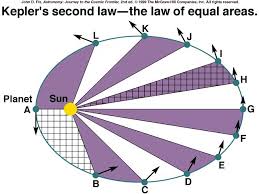
Kepler's second law states that a planet will sweep out equal areas in equal intervals of time.
True
False

Kepler's second law also states that a planet will speed up or slow down in its orbit.
True
False

Kepler's third law states that the square of a planet’s orbital period equals one A.U. cubed or
P3 = a2.
P2 = a3.
A.U. = astronomical unit.
P3 = a3.

Kepler's third law also predicts the
shape of the ellipse or orbit.
time it takes to reach an orbiting object.
different ways in which orbiting objects affect each other.
orbital time period of an object orbiting another object.

