
Font size
 Worksheets
Review for unit exam
Total questions: 76
Worksheet time: 2hrs 45mins
During DNA replication, a DNA strand that has the bases CTAGGT produces a strand with the bases:
AGCTTG
GATCCA
TCGAAC
GAUCCA
In both prokaryotes and eukaryotes, DNA replication happens
before cell division.
in the nucleus
only to telomeres
around the histones
What nucleotide is going to be opposite from thymine?
adenine
cytosine
guanine
uracil
During replication, what enzyme is responsible for building the complementary strand?
histones
nucleosomes
DNA polymerase
chromatin
In eukaryotes, DNA
is located in the nucleus
floats freely in the cytoplasm
is located in the ribosomes
is circular
What type of sugar is in DNA?
glucose
lactose
deoxyribose
ribose
Which of the following forms a base pair with guanine?
uracile
cytosine
thymine
adenine
Which of the following is a nucleotide found in DNA?
ribose + phosphate group + thymine
ribose + phosphate group + uracil
deoxyribose + phosphate group + uracil
deoxyribose + phosphate group + cytosine
What type of bonds hold the two nitrogen base pairs together in the middle of DNA?
ionic
polar
hydrogen
covalent
Which enzyme proofreads the new strands to make sure they are a copy of the original?
DNA polymerase
DNA amylase
DNA primase
DNA ligase
To begin DNA replication, we first need to unzip the double helix ladder of DNA. What enzyme is responsible for unzipping the DNA strands?
histones
DNA helicase
DNA polymerase
chromatin
ATG TGA CAG
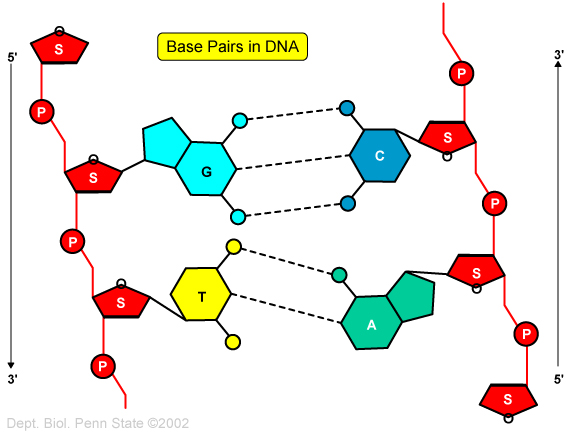

How do the leading and the lagging strands differ?
The leading strand is synthesized in the same direction as the movement of the replication fork, and the lagging strand is synthesized in the opposite direction.
The leading strand is synthesized at twice the rate of the lagging strand.
The leading strand is synthesized in short fragments that are ultimately stitched together, whereas the lagging strand is synthesized continuously.
The leading strand is synthesized by adding nucleotides to the 3' end of the growing strand, and the lagging strand is synthesized by adding nucleotides to the 5? end.


AATCATGGA
The building blocks of DNA is
Sugar
Phosphate
Nucleotide
Muskrat
Which of the these bases are the Purines


Which bases are the Pyrimidines


If there is 22% Cytosine, how much of all the other bases are there?
22% C, 22% G, 28% A, and 28%T
28% C, 28% G, 28% A, and 28%T
22% C, 28% G, 22% A, and 28%T
22% C, 22% G, 22% A, and 22%T
How many nucleotide bases are there?
1
2
6
4
What is the DNA compliment of this sequence?
AGGCGA
TCCGCT
AGGCGA
TCCTTA
What is the DNA compliment of this sequence?
GCAATCA
CGTTAGT
CGAAATC
CGTTTAG
Which letter pairs with - T
C
A
G
What is the mRNA complement to the following strand?
TTT-ATC-GAG-CGT
(a)
In what process is mRNA synthesized?
Transcription
Translation
DNA Replication
Mitosis

Why must transcription occur in the nucleus?
because DNA can't leave the nucleus
because ribosomes are in the nucleus
because DNA polymerase is found there
because helicase unzips the DNA
Choose the sequence of the mRNA strand that would match up with to the following DNA strand:
GTACAT
CATGTA
GAUCUA
CAUGUA
CUTGTU
How many nucleotides code for 1 amino acid?
1
2
3
4
When these bond together, they form a protein
Amino Acids
Peptide Bonds
Ribose
Nucleotides

Which process does this diagram illustrate?
transcription
DNA replication
translation
What determines the shape and function of a protein?
The sequence of amino acids
The type of ribosome that assembles the protein
The cell that manufactures the protein

True or False: mRNA contains anticodons and tRNA contains codons.
True
False
A short sequence of nucleotides reads GGACAGAGCGCAGACGA. In which type of molecule could this sequence be found?
DNA molecule only
RNA molecule only
Both in a DNA and an RNA molecule
In double-stranded DNA only
For which discovery about DNA do Watson and Crick receive credit?
DNA is the molecule that genes are made of.
The amount of adenine equals the amount of thymine in an organism.
Phosphate–pentose bonding along the nucleotide backbone is covalent.
The shape of DNA is a double helix.
The base sequence of a fragment of DNA is:
ACC GTG CAG GAT
What is the base sequence on the messenger RNA (mRNA) molecule transcribed from it?
TGG CAC GTC CTA
TGG CUC GTC CTU
UGG CTC GUC CUT
UGG CAC GUC CUA

What is the sequence of the amino acids that is being translated from the following mRNA sequence?
5' AUGGGUGCUUAUUGGUAA 3'
Met-Pro-Arg-Ile-Thr
Met-Cys-Ser-Tyr-Trp
Met-Gly-Ala-Tyr-Trp
Met-Gly-Tyr-Ala-Thr
What is the function of RNA polymerase?
Adds DNA nucleotides to the 3' end of a growing strand
Adds RNA nucleotides to the 3' end of a growing strand
Adds DNA nucleotides to the 5' end of a growing strand
Adds RNA nucleotides to the 5' end of a growing strand

GGG GCA CAT CAC

ATC AAT CGT TAG

AUG AAU UGU UGA

TAT GGC ACT

The process represented in the diagram produces a molecule that is complementary to the template strand of DNA. What type of molecule is produced?
new DNA
polypeptide
messenger RNA
carbohydrate

Which of the following is true regarding the process shown?
The process shown above is known as transcription and involves the production of proteins from DNA.
The process shown above is known as replication and involves the production of DNA from RNA.
The process shown above is known as cloning and involves the production of RNA from protein molecules.
The process shown above is known as translation and involves the production of proteins from RNA.
Protein Synthesis is…
Transcription and translation
The process of duplicating DNA
Where DNA is copied to mRNA in the nucleus
Where mRNA is read to make a protein at the ribosome
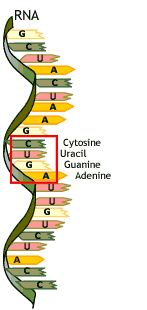
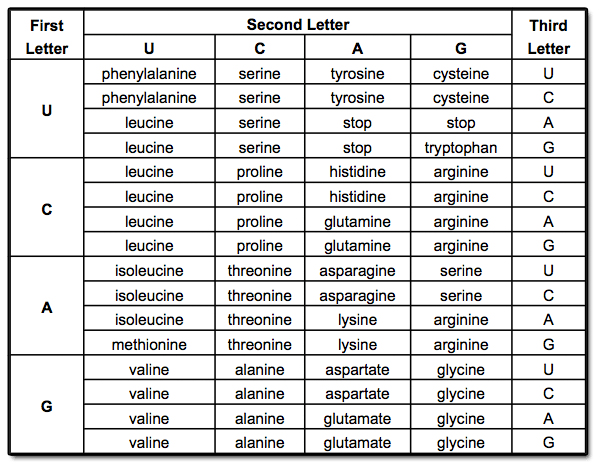

What type of RNA carries amino acids?
Messenger
Ribosomal
Transfer
What type of RNA carries genetic information?
Messenger
Ribosomal
Transfer
What does RNA stand for?
(a)
What is the chain of amino acids called?
(a)

