wayground logo

Free Printable Worksheets

Font size

S
M
L
XL
Worksheets

3rd 9 Weeks Review

Total questions: 81

Worksheet time: 3hrs 32mins

Name
Class
Date
1.

Organisms with a ___________ gene pool have a __________ chance of surviving

a)

smaller, lesser

b)

larger,greater

c)

smaller, greater

d)

larger, smaller

2.

Biodiversity is the ____________ and variability of __________ on earth

a)

variety

b)

life

c)

diversity

d)

difference

3.

Why is biodiversity in an ecosystem so important?

a)

Because it can help humans where to determine good places to develop farm land.

b)

Because places that have a healthy biodiversity are unaffected by major disturbances.

c)

Because having a high biodiversity allows ecosystems to withstand major changes.

d)

Because having a high biodiversity allows for fewer opportunities of competition for similar resources.

4.
What term best describes this group of bison?
a)
Species
b)
Community
c)
Ecosystem
d)
Population
5.
What term best describes all the plants and animals in this image?
a)
Species
b)
Population
c)
Ecosystem
d)
Community
6.
This image shows both living and non living things in an area.  What term best describes this?
a)
species
b)
community
c)
population
d)
ecosystem
7.
One individual living thing
a)
organism
b)
population
c)
community
d)
ecosystem
8.
succession that occurs in an area with no soil
a)
ecological succession 
b)
primary succession 
c)
secondary succession
d)
pioneer speciles
9.
succession that occurs in an area where soil is already present
a)
ecological succession 
b)
primary succession 
c)
secondary succession
d)
pioneer speciles
10.
Plant life starting to grow on a volcano
a)
primary succession
b)
secondary succession
c)
tertiary succession
d)
variable succession
11.
A pioneer species is...
a)
a large organism
b)
the first organisms to adapt to a new environment 
c)
The best organism 
d)
Abiotic organisms 
12.
An organism that is killed and eaten by another organism
a)
Predator
b)
Prey
c)
Competition
d)
Adaptation
13.
A consumer that hunts is called:
a)
a producer.
b)
an omnivore.
c)
a predator.
d)
a herbivore.
14.

A group of individuals belonging to the same species living in the same general area at the same time.

a)

population

b)

community

c)

ecosystem

d)

biosphere

15.

Pictured is a food web.


Which of the following animals might compete with the coyote for food?

a)

A deer that eats grass

b)

A snake that eats mice

c)

A tree that uses the sun to produce energy

d)

A bird that eats worms

16.

An example of competition in the picture would be...

a)

The clouds and rocks competing for sunlight

b)

The tree and grass competing for soil nutrients

c)

The fox and river competing for water

d)

The fox and grass competing for food

17.
largest number of individuals of a population that the environment can support  
a)
carrying capacity
b)
primary succession 
c)
denitrification
d)
mutualism
18.
Any factor that limits population growth
a)
Limiting Factor
b)
Immigration
c)
Succession
d)
Abiotic Factor
19.
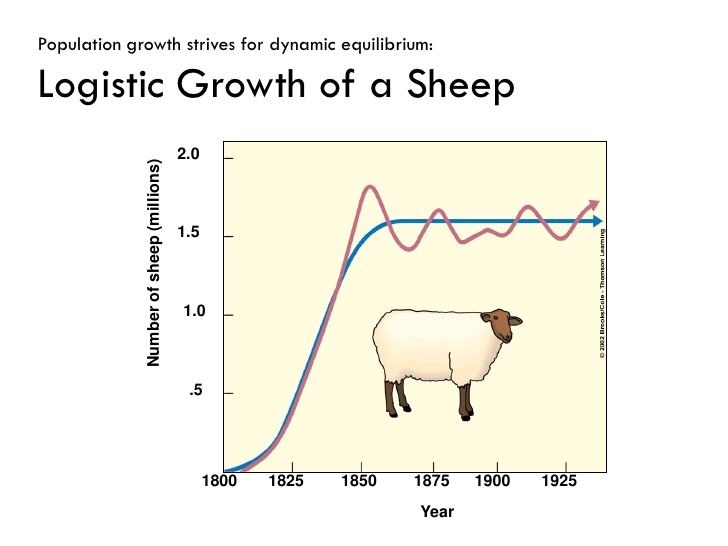
What is the carrying capacity for this sheep population?
a)
1.8 million
b)
1.25 million
c)
1.6 million
d)
1.o million
20.

What happens if a population grows past its carrying capacity?

a)

The population keeps growing

b)

The population starts to die off

c)

The entire species will go extinct

d)

The carrying capacity just increases

21.

This may cause a population to increase

a)

increase of food supply

b)

removal of predators

c)

removal of disease

d)

all of these

22.

What is the carrying capacity of the graph?

a)

1000

b)

8000

c)

800

d)

600

23.
An organism that is killed and eaten by another organism
a)
Predator
b)
Prey
c)
Competition
d)
Adaptation
24.
Camouflage is an example of an ______________________ that a prey might have to survive.
a)
Niche
b)
Prey
c)
Competition
d)
Adaptation
25.

Predator population lags behind prey population because......

a)

Increase in predators leads to decrease in prey

b)

Increase in predators leads to increase in prey

c)

Increase in predators leads to decrease in producers

d)

Increase in producers leads to increase in prey

26.

What is the biggest danger to the world's ecosystem?

a)

trash

b)

humans

c)

factories

d)

ocean pollution

27.

Pollution can be found __________________________.

a)

in the air

b)

on the land

c)

in the water

d)

all of these answers

28.

Pollution that comes from MANY different places and is hard to identify its source.

a)

Point

b)

Non-Point

29.

Pollution that comes from a single source

a)

Point

b)

Non-Point

30.

Disposing of paint and other household hazardous materials down the drain

a)

Point

b)

Non-Point

31.

What is an invasive species?

a)

An organism that is new to an environment that has positive effects on the environment.
b)

An organism that is native to an environment that has negative effects on the environment.

c)

An organism that is new to an environment that has negative effects on the environment.

d)

An organism that is native to an environment that has positive effects on the environment.

32.
Why do the populations of invasive species grow so quickly? 
a)
Invasive Species are native to an area. 
b)
Invasive species are prey to many animals.
c)
Invasive species have no predators.
d)
Invasive species keep the ecosystems in equilibrium.
33.
Where the better adapted organisms survive to pass traits along to offspring.
a)
Evolution
b)
Natural Selection
c)
Extinction
d)
Artifical Selection
34.
Why are advantageous traits more likely to be passed onto offspring?
a)
Because they are more likely to survive and reproduce.
b)
Because they come from dominant alleles.
c)
Because they come from recessive alleles.
d)
Because the trait is an acquired phenotype.
35.
Where the better adapted organisms survive to pass traits along to offspring.
a)
Evolution
b)
Natural Selection
c)
Extinction
d)
Artifical Selection
36.
Natural selection is when ____________ decides who survives and who doesn't
a)
nature
b)
humans
c)
animals
d)
years
37.
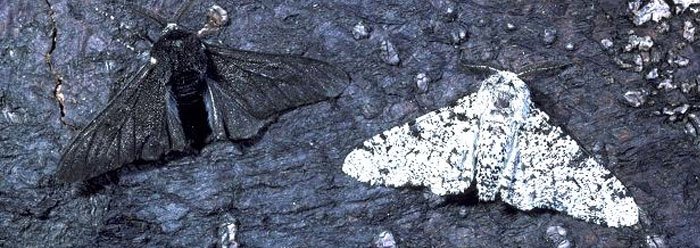
The trees these moths used to live on were white, but have been covered in soot from coal factories. Which moth will be more successful in this environment?
a)
Dark moth
b)
Light moth
c)
Both will be equally successful
d)
Neither will be successful
38.
Change over time
a)
Natural Selection
b)
Selective Breeding
c)
Homeostasis
d)
Evolution
39.
Which best describes mutations?
a)
Always helpful
b)
Always harmful
c)
Can be helpful or harmful
d)
Always neutral
40.
The diagram shows fossils in different rock layers. Which of these statements about the age of these fossils is most likely correct?
a)
Fossil A and C are the same age
b)
Fossil B is older than fossil C
c)
Fossils A is older than fossil B
d)
Fossil D is older than fossil C
41.
Genetic differences between organisms of the same species
a)
Variation
b)
Adaptation
c)
Behavior
d)
Environment
42.
This is a process in which organisms gradually change over time.
a)
Environment
b)
Competition
c)
Evolution
d)
Fossils
43.
This is the variation of living organisms.
a)
Biological diversity
b)
Evolution
c)
Environment
d)
Natural selection
44.
This is an inherited trait that helps an organism survive and reproduce in its environment.
a)
Evolution
b)
Population
c)
Environment
d)
Adaptation
45.
The death of every member of a species.
a)
Competition
b)
Population
c)
Extinction
d)
Evidence
46.
Charles Darwin’s observation that finches of different species on the Galápagos Islands have many similar physical characteristics supports the hypothesis that these finches 
 
a)
have the ability to interbreed.
b)
acquired traits through use and disuse.
c)
all eat the same type of food.
d)
descended from a common ancestor.
47.
Darwin theorized that individuals having an advantage due to their traits or abilities will be more likely to survive and reproduce.  This theory is known as
a)
evolution
b)
speciation
c)
adaptation
d)
natural selection
48.

What is Darwin famous for studying?

a)

Penguins

b)

Beagles

c)

Fishes

d)

Finches

49.

Which set of Islands had a strong influence on Darwins ideas?

a)

Hawaii

b)

Galapagos

c)

Samoa

d)

Florida Keys

50.

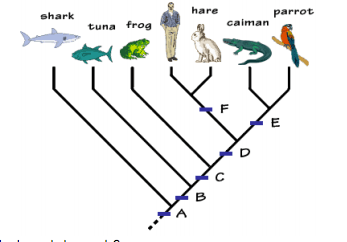
On the cladogram, which organism is the closest relative of the parrot?

a)

Frog

b)

Hare

c)

Caiman

d)

Parrot

51.

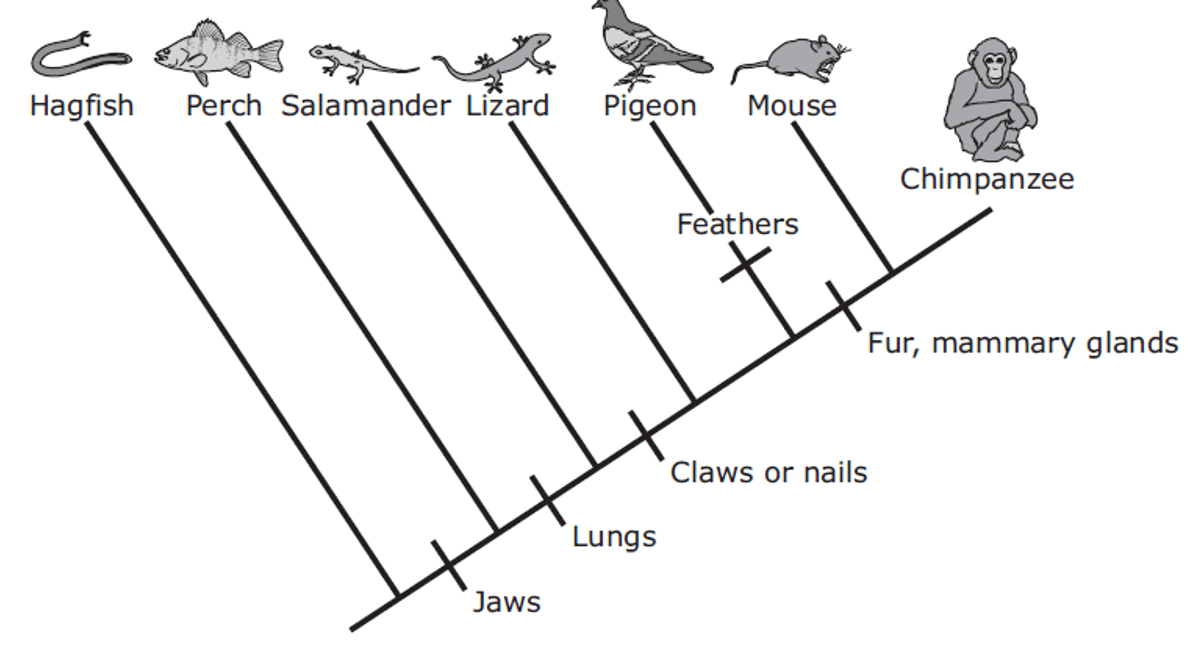
All the animals to the right of the salamander would have the common characteristic of...

a)

Fur

b)

Claws or nails

c)

Lungs

d)

Jaws

52.
Why are advantageous traits more likely to be passed onto offspring?
a)
Because they are more likely to survive and reproduce.
b)
Because they come from dominant alleles.
c)
Because they come from recessive alleles.
d)
Because the trait is an acquired phenotype.
53.
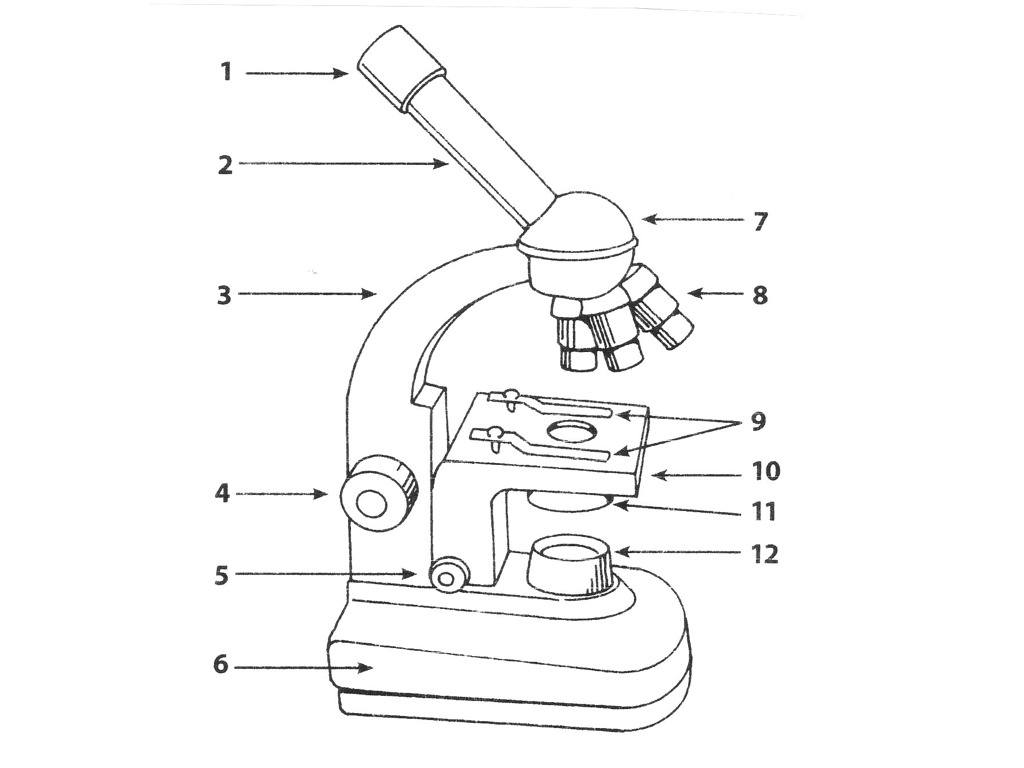
A microscope is an instrument that.
a)
makes faraway objects look closer.
b)
makes small objects appear larger.
c)
decreases the size of small objects.
d)
increases the size of small objects.
54.

Which statement was NOT included in cell theory?

a)

All living things are composed of cells.

b)

Living cells come only from other living cells.

c)

Each cell contains a cell membrane, cytoplasm, nucleus, mitochondria, and endoplasmic reticulum.

d)

Cells are the smallest structure of living things that can perform the functions necessary for life.

55.

Which instrument is credited for helping scientists develop cell theory?

a)
b)
c)
d)
56.

Who discovered and named cells while looking at cork?

a)

Captain Hook

b)

Robert Hooke

c)

Matthais Schleiden

d)

Rudolf Virchow

57.

All living things are made up of...

a)

cells

b)

tissues

c)

organ

d)

organ systems

58.

What is the basic structural and functional unit of all living things?

a)

atom

b)

cell

c)

bacteria

d)

animalcules

59.

The ___________ is the basic structure of life

a)

atom

b)

molecule

c)

cell

d)

organism

60.

All cells come from ___________ cells

a)
dead cells
b)
non-living matter
c)
pre-existing cells
d)
plants
61.

A cell that contains a nucleus is a ___________.

a)
Prokaryotic cell
b)
Virus
c)
Bacteria
d)
Eukaryotic cell
62.

A cell that does not have a nucleus is a __________.

a)
Eukaryotic cell
b)
Animal cell
c)
Plant cell
d)
Prokaryotic cell
63.

All of the following apply to eukaryotic cells except:

a)
They contain a nucleus
b)
They have membrane-bound organelles
c)
They are smaller than prokaryotic cells
d)
They contain DNA
64.
Which is an example of a single-celled organism?
a)
bird
b)
cricket
c)
snake
d)
bacteria
65.
Which is an example of a multicellular organism?
a)
amoeba
b)
bacteria
c)
worm
d)
fungi
66.
5. Based on this image is the Euglena multicellular or unicellular?
a)
1. Multicellular
b)
2. Unicellular
67.
7. Classify the following examples (pictures) as unicellular or multicellular
a)
1. Unicellular
b)
2. Multicellular
68.

A scientist is trying to decide whether an organism is unicellular or multicellular. Which information would help the scientist most to make her decision?

a)

size of the cells of the organism

b)

what the organism eats

c)

how many types of cells are in the organism

d)

how fast the organism grows

69.
Fungi, Plants, and Animals
a)
Unicellular organisms 
b)
Multicellular organisms
70.
This organelle takes food and turns it into ENERGY for plant and animal cells.
a)
Chloroplast
b)
Mitochondria
c)
Lysosome
d)
Ribosome
71.
Which organelle controls what comes in and out of a cell?
a)
cell membrane
b)
nucleolus
c)
cell wall
d)
ribosomes
72.
Which organelle receives proteins and materials from the ER and packages them and distributes them?
a)
ribosomes
b)
lysosome
c)
nucleolus
d)
golgi body
73.

Which organelle assembles amino acids to create proteins?

a)

nucleus

b)

ribosomes

c)

lysosome

d)

chloroplast

74.

Which organelle is the center of the cell and contains DNA?

a)

cytoplasm

b)

lysosome

c)

golgi body

d)

nucleus

75.

Which organelle is the rigid outer layer of a plant cell?

a)

cell wall

b)

cell membrane

c)

cytoplasm

d)

chloroplast

76.

Which organelle produces the energy a cell needs to carry out its functions? (The mighty power house)

a)

lysosome

b)

mitochondria

c)

vacuoles

d)

ribosomes

77.
Which organelle stores food, waste, and other materials?
a)
cytoplasm
b)
ribosomes
c)
vacuoles
d)
golgi body
78.

Which organelle captures sunlight and uses it to make food in plant cells?

a)

nucleus

b)

vacuoles

c)

ribosomes

d)

chloroplast

79.
Which organelle uses chemicals to break down food and worn out cell parts?
a)
cytoplasm
b)
ribosomes
c)
lysosome
d)
mitochondria
80.
Which organelle is the gel like fluid where organelles are found?
a)
golgi body
b)
cytoplasm
c)
mitochondria
d)
cell membrane
81.

This cell part is in ALL cells. It is the gel-like substance that provides cell shape.

a)

Chloroplasts

b)

Cell membrane

c)

Cytoplasm

d)

Nucleus