
 Worksheets
Final Exam Review Ch 6-10
Total questions: 58
Worksheet time: 58mins
What is facilitated diffusion in cellular processes?
The movement of molecules against their concentration gradient using energy.
The movement of molecules along their concentration gradient without any assistance.
The movement of polar and charged molecules along their concentration gradient, facilitated by protein channels or carriers.
The random movement of particles in a gas or liquid.
What role do channel proteins play in the cell membrane?
They bind to specific molecules and transport them across the membrane.
They function as enzymes to speed up chemical reactions.
They serve as receptors for signaling molecules.
They form tunnels that allow specific molecules to pass through the membrane.
What is the primary function of carrier proteins in the cell membrane?
To provide structural support to the membrane.
To bind some substances and speed their diffusion through the bilayer.
To catalyze the decomposition of substances.
To act as cell surface markers for cellular recognition.
What is the function of a uniporter in active transport across membranes?
Moves two substances in one direction
Moves two substances in opposite directions
Moves one substance in one direction
Does not move substances but changes their structure
Which type of protein moves two substances in opposite directions during active transport?
Uniporter
Symporter
Antiporter
Carrier protein
What is the role of a symporter in the process of active transport?
Moves one substance in one direction
Moves two substances in opposite directions
Moves two substances in one direction
Filters substances without transport
What is the role of receptors in chemical signaling systems?
To transport chemical signals to the secreting cell
To receive and initiate a response to chemical signals
To prevent the attachment of chemical signals
To produce chemical signals
What distinguishes a target cell from a non-target cell in chemical signaling systems?
Presence of a nucleus
Presence of receptors
Ability to secrete chemical signals
Location near a circulatory vessel
What is the function of the circulatory vessel in hormone/ endocrine signaling?
To secrete signaling molecules
To receive signals from target cells
To transport signaling molecules
To eliminate waste products from cells
What is the first step in the signal transduction pathway?
The signal molecule binds to a receptor protein on the cell surface.
The activated receptor activates a signal transduction pathway.
A signal arrives at a target cell.
The signal transduction pathway activates a cell response.
What occurs when the signal molecule binds to the receptor protein in the signal transduction pathway?
The receptor loses its active site.
The receptor changes its three-dimensional shape and exposes its active site.
The receptor deactivates the signal molecule.
The receptor detaches from the cell surface.
What is a direct result of the receptor being activated in the signal transduction pathway?
The cell immediately undergoes division.
The receptor deactivates and releases the signal molecule.
The activated receptor activates a signal transduction pathway.
The signal molecule is destroyed.
Which of the following is a long-term change induced by the signal transduction pathway?
Enzyme activation
Cell movement
Altered DNA transcription
Immediate destruction of the receptor
What is the role of ligands in the interaction with receptor proteins according to the text?
They permanently alter the receptor protein's shape.
They bind irreversibly to the receptor.
They fit into a three-dimensional site on the receptor and cause it to change shape.
They destroy the receptor after binding.
Is the binding of a ligand to its receptor protein reversible or irreversible?
Reversible
Irreversible
Permanent
Temporary but unchangeable
What type of ligands bind to membrane receptors?
Small or nonpolar ligands
Large or polar ligands
Gaseous ligands
No ligands bind to membrane receptors
Which type of receptor is suitable for ligands that can diffuse across the cell membrane?
Membrane receptors
Intracellular receptors
External receptors
Fixed receptors
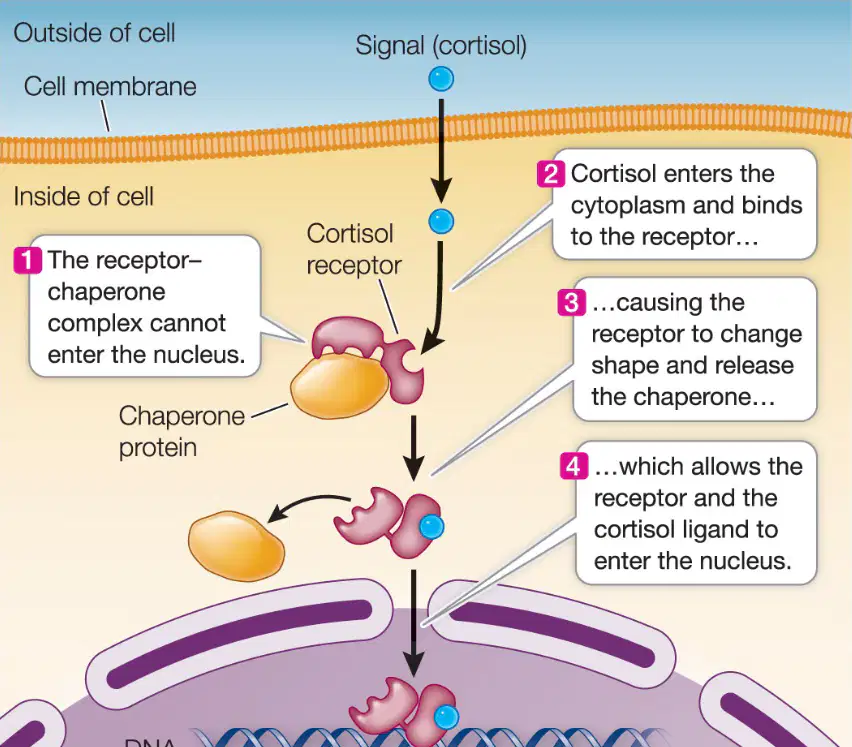
What is the initial step in the mechanism depicted for cortisol affecting a cell?
Cortisol binds to DNA in the nucleus.
Cortisol enters the cytoplasm and binds to the receptor.
mRNA is synthesized.
The receptor-chaperone complex enters the nucleus.

What occurs immediately after cortisol binds to its receptor in the cytoplasm?
The receptor enters the nucleus.
mRNA is synthesized.
The receptor changes shape and releases the chaperone.
DNA replication begins.
What are gap junctions primarily composed of in multicellular organisms?
Lipid bilayers
Connexons
Glycoproteins
Phospholipids
What is the primary function of gap junctions between adjacent cells?
To transport large proteins
To facilitate communication through ions and small molecules
To prevent any substances from passing between cells
To link the nuclei of adjacent cells
Gap junctions link the cytoplasms of two cells by spanning which area?
The extracellular matrix
The gap between the cells
The cell nuclei
The entire cell membrane
Which structure in plant cells is analogous to gap junctions in animal cells?
Cell membrane
Desmotubule
Plasmodesmata
Smooth endoplasmic reticulum
What are the reactants in an enzymatic reaction called?
Products
Substrates
Catalysts
Coenzymes
What determines the specificity of an enzyme?
The size of the enzyme
The active site of the enzyme
The pH level of the environment
The temperature of the reaction
How do substrate molecules interact with enzymes?
They bind to the active site of the enzyme
They detach from the enzyme immediately
They are repelled by the enzyme
They change the shape of the enzyme permanently
What factors influence enzyme activity according to the text?
pH and temperature only
pH, enzyme concentration, and substrate concentration
pH and enzyme concentration only
Substrate concentration and temperature only
At what condition is an enzyme said to be working at its maximum rate?
At low substrate concentration
At high enzyme concentration
At saturation when all enzyme is bound to substrate
At the lowest pH

Refer to the graph labeled 'pH'. Which enzyme has its optimal activity at the most acidic pH value?
Chymotrypsin
Pepsin
Arginase
None of the above

Based on the temperature graph, what happens to the enzyme activity as it reaches the optimal temperature?
It decreases sharply
It remains constant
It increases to maximum rate
It fluctuates
What is potential energy as described in the context of chemical transformations?
Energy released during chemical reactions
Energy stored as chemical bonds, concentration gradient, or charge imbalance
Energy required to start a chemical reaction
Energy absorbed during chemical reactions
What type of energy is referred to as the energy of movement?
Thermal energy
Potential energy
Kinetic energy
Chemical energy
According to the concept of energy transfers in chemical transformations, how can energy be converted?
Only from kinetic to potential
From one form to another
Only within the same form
Cannot be converted
What type of metabolic reaction involves the synthesis of complex molecules from simpler ones, requiring energy?
Catabolic reactions
Anabolic reactions
Oxidative reactions
Hydrolytic reactions
Which type of metabolic reaction results in the breakdown of complex molecules into simpler ones, releasing energy?
Anabolic reactions
Catabolic reactions
Reductive reactions
Condensation reactions
According to the First Law of Thermodynamics, what happens to energy during a transformation?
Energy is created
Energy is lost
Energy remains the same
Energy is converted to matter
What does the Second Law of Thermodynamics state about the energy available to do work after a transformation?
It increases
It decreases
It remains unchanged
It is completely lost
What is a key phenomenon associated with the Second Law of Thermodynamics in a closed system?
Decrease in entropy
Increase in entropy
Conservation of mass
Increase in total energy
What occurs during oxidation in chemical reactions?
An electron is gained
A proton is lost
An electron is lost
A neutron is gained
What is the result of reduction in chemical reactions?
Loss of a neutron
Gain of a proton
Gain of an electron
Loss of an electron
Which of the following correctly represents the conversion of NADH in a reaction?
NADH to NAD+ + H+
NAD+ to NADH + H+
NADH to NAD+ + Neutron
NAD+ to NADH + Proton
What is cellular respiration?
The process of breaking down sugar to get energy
The movement of cells in the body
The division of cells
The synthesis of proteins
Where does cellular respiration occur?
Only in animal cells
Only in plant cells
In both plant and animal cells
Outside the cells
What are the inputs required for aerobic respiration?
Glucose and oxygen
Carbon dioxide and water
Lactic acid and alcohol
ATP and glucose
What are the main products of aerobic respiration?
Energy (ATP), carbon dioxide, and water
Glucose, oxygen, and lactic acid
Alcohol and carbon dioxide
ATP and glucose
What does fermentation produce?
Energy (not as much ATP), carbon dioxide, lactic acid or alcohol
ATP, carbon dioxide, and water
Oxygen and glucose
Proteins and nucleic acids
What is the primary function of the electron transport chain?
Synthesis of glucose
Breakdown of ATP
Production of ATP
Absorption of nutrients

Which molecule is the final electron acceptor in the electron transport chain shown in the diagram?
Oxygen (O2)
Carbon dioxide (CO2)
NADH
FADH2
What creates the proton-motive force necessary for ATP synthesis?
The movement of electrons through the inner mitochondrial membrane
The synthesis of carbon dioxide
The direct transfer of electrons to ATP synthase
The breakdown of glucose in the cytoplasm
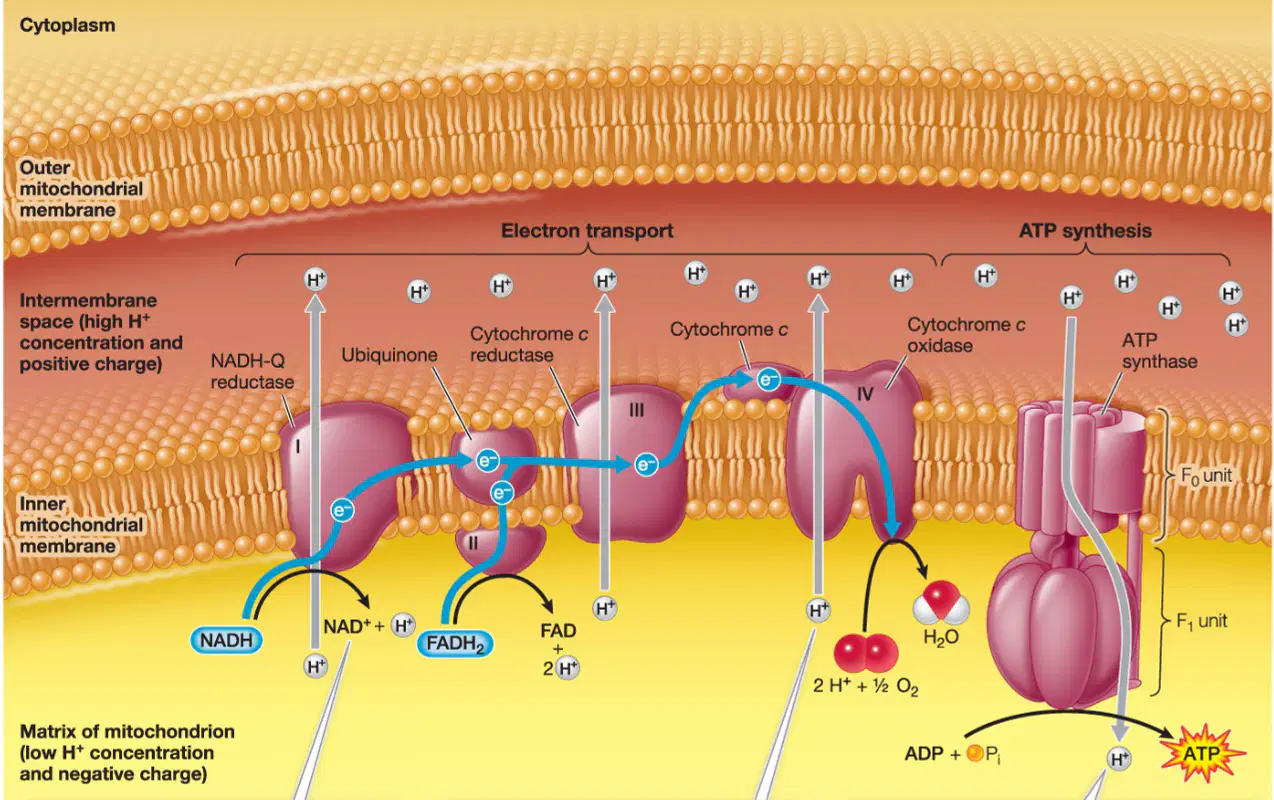
What role does ATP synthase play in the process illustrated in the diagram?
It breaks down glucose to release energy.
It transfers electrons across the mitochondrial membrane.
It synthesizes ATP using the proton-motive force.
It captures light energy to produce ATP.
In alcoholic fermentation, what gas is produced as a byproduct?
Oxygen
Nitrogen
Carbon dioxide
Hydrogen
What is the role of NADH in the fermentation processes?
It is oxidized to NAD+
It is reduced to form ATP
It acts as a substrate for pyruvate
It converts glucose into pyruvate
What is the primary source of oxygen (O₂) released during photosynthesis as indicated by experiments using oxygen isotopes?
Carbon dioxide (CO₂)
Glucose (C₆H₁₂O₆)
Water (H₂O)
Sunlight
What type of reaction is photosynthesis, where 6 CO₂ + 12 H₂O → C₆H₁₂O₆ + 6 O₂ + 6 H₂O?
Endergonic
Exergonic
Anabolic
Catabolic

What is the primary function of the Calvin cycle in photosynthesis as depicted in the diagram?
Production of ATP
Splitting of water molecules
Fixation of carbon dioxide into sugars
Release of oxygen

According to the diagram, where does the electron transport chain occur within the chloroplast?
Stroma
Thylakoid
Chlorophyll
Calvin cycle

What is the byproduct of the light reactions in photosynthesis as shown in the diagram?
CO2
ATP
NADPH
O2

Which molecule is indicated as being regenerated in the ATP cycle within the diagram?
NADP+
ADP + Pi
NADPH
Glucose

