wayground logo

Free Printable Worksheets

Font size

S
M
L
XL
Worksheets

Fourth Form End-of-Year Exam Revision

Total questions: 164

Worksheet time: 3hrs 54mins

Name
Class
Date
1.
Alkali metals are found in which group of the periodic table?
a)
Group 1
b)
Group 2
c)
Group 7
d)
group 8 
2.
Which group of the periodic table is composed of inert (not reactive)  gases?
a)
alkali metals
b)
alkaline earth metals
c)
halogens
d)
noble gases
3.
Which group of elements are the most reactive metals?
a)
alkali metals
b)
alkaline earth metals
c)
halogens 
d)
noble gases
4.
Rows on the period table are called _____ while columns are called _____.
a)
groups, families
b)
groups, periods
c)
periods, groups
d)
families, groups
5.
The most reactive nonmetals on the periodic table are
a)
metalloids
b)
alkaline earth
c)
halogens
d)
noble gases
6.
What is the symbol equation for the reaction between sodium hydroxide and water?
a)
2Na + 2H2O → 2NaOH + H2
b)
Na + H2O → NaOH + H
c)
Na + H20 → NaCl + CO2
d)
2Na + 2H2O → 2NaH2 + O2
7.

What is the correct name for this polyatomic ion: OH

a)

hydrogen carbonate

b)

oxonium

c)

hydroxide

d)

acetate

8.

What is the correct name for this polyatomic ion: NO3

a)

carbonate

b)

hydroxide

c)

nitrite

d)

nitrate

9.

What is the correct formula for the polyatomic ion called sulphate?

a)

SO32–

b)

HSO4

c)

SO42–

d)

CH3COO

10.

What is the correct formula for the polyatomic ion called ammonium?

a)

NH3+

b)

NH3

c)

CN+

d)

NH4+

11.
Which of the following is nitrate?
a)
NO-
b)
NO2-
c)
NO3-
d)
NO4-
12.
Ammonium
a)
NH4+
b)
NO3-
c)
NO2-
d)
MnO4-
13.
Carbonate
a)
Cr2O4-2
b)
CH3COO-
c)
CO3-2
d)
CN-
14.
Hydroxide
a)
Cr2O4-2
b)
Cr2O4-2
c)
O3-2
d)
OH-
15.

Iron(II)

a)

Fe+

b)

Fe+2

c)

Fe-2

d)

Fe-

16.

Lithium

a)

Li+

b)

Li+2

c)

Li-2

d)

Li-

17.

Chloride

a)

Cl+

b)

Cl+2

c)

Cl-2

d)

Cl-

18.

Silver

a)

Ag+

b)

Ag+2

c)

Ag-2

d)

Ag-

19.

Copper

a)

Cu+

b)

Cu+2

c)

Cu-2

d)

Cu-

20.

Lead

a)

Pb+

b)

Pb+2

c)

Pb-2

d)

Pb-

21.

Zinc

a)

Zn+

b)

Zn+2

c)

Zn-2

d)

Zn-

22.

Hydrogen

a)

H+

b)

H+2

c)

H-2

d)

H-

23.

Aluminium

a)

Al+

b)

Al+2

c)

Al3+

d)

H-

24.

Which option best describe test for hydrogen gas?

a)

Lighted splint; there will be a squeaky pop sound

b)

Glowing splint, there will be a squeaky pop sound

c)

Burning splint, there will be a squeaky pop sound

d)

Litmus paper, hydrogen gas will turn red litmus paper blue

25.

What does catalyst do to a reaction?

a)

Slows down the reaction

b)

Nothing changes

c)

Speeds up the reaction

26.

What do you call the energy that is required to start a reaction?

a)

Alternative energy

b)

Activation energy

c)

Atmospheric energy

27.

Which of the reaction pathway shows the catalysed reaction?

a)

1

b)

2

28.

What is the colour of methyl orange an acid ?

a)

Red

b)

Yellow

c)

Orange

d)

Colourless

29.

What is the colour of litmus in an acid ?

a)

Pink

b)

Yellow

c)

Red

d)

Colourless

30.

What is the colour of litmus in a base ?

a)

Pink

b)

Blue

c)

Red

d)

Colourless

31.

What is the colour of phenolphthalein in a base ?

a)

Pink

b)

Blue

c)

Red

d)

Colourless

32.

What is the colour of methyl orange in a base ?

a)

Pink

b)

Blue

c)

Yellow

d)

Colourless

33.

Universal indicator solution is usually green to begin with. What does this mean?

a)

It is acidic

b)

It is alkaline

c)

It is neutral

34.

A liquid has a pH of 8. What does this mean?

a)

it is neutral

b)

It is weakly acidic

c)

it is weakly akline

35.

A liquid has a pH of 1. What does this mean?

a)

It must be sodium hydroxide solution

b)

It is strongly acidic

c)

It is weakly akline

36.

How does a catalyst work in speeding up a reaction?

a)

By lowering the activation energy or reaction

b)

by making them more available

c)

by giving them more energy

37.

What is the name given to a catalyst in the human body?

a)

Saliva

b)

Lipid

c)

Enzyme

d)

Catalyst

38.

A ______________ is a substance that increases the rate of a reaction without being used up during the reaction.

a)

catalyst

b)

reactant

c)

product

d)

solute

39.

How is this equipment being used to measure the rate of reaction?

a)

The gas syringe measures how much gas is produced in a certain time

b)

The reaction mixture will increase in volume in a certain time

40.

The steeper the slope is the ... the reaction.

a)

faster

b)

slower

41.

What piece of equipment is essential to determine the rate of reaction?

a)

Stopclock

b)

Beaker

c)

Measuring cylinder

d)

Gas syringe

42.

Grinding a effervescent tablet into powder increases the rate of reaction due to increased

a)

concentration

b)

surface area

c)

temperature

d)

reactants

43.
What happens at the positive electrode?
a)
Positive non-metal ions are attracted
b)
Positive metal ions are attracted
c)
Negative non-metal ions are attracted
d)
Negative metal ions are attracted
44.
Positive ions (cations) will move towards the cathode (-) where they will discharge by....
a)
Breaking apart
b)
Losing electrons
c)
Clumping together.
d)
Gaining electrons
45.

In an aqueous solution of copper chloride, which substance is produced at the negative electrode

a)

copper

b)

chlorine

c)

oxygen

d)

chloride

46.
In an aqueous solution of copper chloride, which substance is produced at the positive electrode
a)
copper
b)
chlorine
c)
oxygen
d)
chloride 
47.
When NaCl solution is electrolysed what has forms at the anode?
a)
Hydrogen
b)
Oxygen
c)
Chlorine
d)
Sodium
48.

Oxidation is

a)

the loss of electrons

b)

the gain of electrons

49.

Reduction is

a)

the loss of electrons

b)

the gain of electrons

50.

Which statement is true:
Mg2+ + 2e → Mg

a)
Mg gains 2 electrons
b)
Mg2+ loses 2 electrons
c)
Mg loses 1 electron
d)
Mg loses 2 electrons
51.
Which of the following half reactions correctly represents a reduction half reaction?
a)
Fe →Fe2+ + 2e-
b)
Pb4+ + 2e- →Pb2+
c)
2O-2 →O2 + 4e-
d)
Fe + 3e- →Fe3+
52.

The electrolyte is Sodium Chloride solution: NaCl (aq)

The ions inside are: Na+ Cl- and H+ OH-

What will be made at the anode?

a)

H2 - hydrogen gas

b)

Na - sodium metal

c)

O2 - oxygen gas

d)

Cl2 - chlorine gas

53.

The electrolyte is Sodium Chloride solution: NaCl (aq)

The ions inside are: Na+ Cl- and H+ OH-

What will be made at the cathode?

a)

H2 - hydrogen gas

b)

Na - sodium metal

c)

O2 - oxygen gas

d)

Cl2 - chlorine gas

54.

The electrolyte is Potassium Chloride solution: KCl (aq)

The ions inside are: K+ Cl- and H+ OH-

What will be made at the cathode?

a)

H2 - hydrogen gas

b)

K - potassium metal

c)

O2 - oxygen gas

d)

Cl2 - chlorine gas

55.

The electrolyte is Potassium Chloride solution: KCl (aq)

The ions inside are: K+ Cl- and H+ OH-

What will be made at the anode?

a)

H2 - hydrogen gas

b)

K - potassium metal

c)

O2 - oxygen gas

d)

Cl2 - chlorine gas

56.

The electrolyte is Potassium Sulfate solution: K2SO4 (aq)

The ions inside are: K+ SO4- and H+ OH-

What will be made at the anode?

a)

O2 - oxygen gas

b)

K - potassium metal

c)

S - Sulphur

d)

Cl2 - chlorine gas

57.

Zinc Nitrate solution contains:

Zn+ NO3- and H+ OH-

Which ion will be changed at the anode?

a)

OH-

b)

NO3-

c)

Zn+

d)

H+

58.

Copper Sulfate solution contains:

Cu2+ SO42- and H+ OH-

Which ion will be changed at the anode?

a)

OH-

b)

SO42-

c)

Cu2+

d)

H+

59.

Zinc Nitrate solution contains:

Zn+ NO3- and H+ OH-

Which ion will be changed at the cathode?

a)

OH-

b)

NO3-

c)

Zn+

d)

H+

60.

Copper Sulfate solution contains:

Cu2+ SO42- and H+ OH-

Which ion will be changed at the cathode?

a)

OH-

b)

SO42-

c)

Cu2+

d)

H+

61.

Silver Bromide solution contains:

Ag+ Br - and H+ OH-

Which ion will be changed at the Cathode?

a)

OH-

b)

Br -

c)

Ag+

d)

H+

62.

Silver Bromide solution contains:

Ag+ Br - and H+ OH-

Which ion will be changed at the anode?

a)

OH-

b)

Br -

c)

Ag+

d)

H+

63.

Silver sulfate solution contains:

Ag+ SO42 - and H+ OH-

Which ion will be changed at the anode?

a)

OH-

b)

SO42 -

c)

Ag+

d)

H+

64.

Iron sulfate solution contains:

Fe2+ SO42 - and H+ OH-

Which ion will be changed at the cathode?

a)

OH-

b)

SO42 -

c)

Fe2+

d)

H+

65.

Calcium nitrate solution contains:

Ca2+ NO3 - and H+ OH-

Which two ions will be changed at the electrodes?

a)

OH-

b)

NO3 -

c)

Ca2+

d)

H+

66.

Lithium Chloride solution contains:

Li+ Cl - and H+ OH-

Which two ions will be changed at the electrodes?

a)

OH-

b)

Cl -

c)

Li+

d)

H+

67.

Silver Chloride solution contains:

Ag+ Cl - and H+ OH-

Which two ions will be changed at the electrodes?

a)

OH-

b)

Cl -

c)

Ag+

d)

H+

68.

Copper Nitrate solution contains:

Cu2+ NO3 - and H+ OH-

Which two ions will be changed at the electrodes?

a)

OH-

b)

NO3 -

c)

Cu2+

d)

H+

69.
What precipitate forms when you mix lead (II) nitrate with sodium chloride?
a)
sodium nitrate 
b)
lead (II) chloride 
c)
sodium lead
d)
chloride nitrate 
70.
Which of the following does NOT form a precipitate?
a)
Pb(NO3)2(aq) + 2KI(aq) 
b)
Sr(NO3)2 (aq) + K2SO4(aq) →
c)
AgNO3(aq) + Na2S(aq) →
d)
 Pb(NO3)2(aq) + AgNO3(aq) →
71.
In this equation,
CuCl2 + NaOH  → Cu(OH)2 + NaCl
Which product is insoluble?
a)
copper(II) hydroxide
b)
sodium chloride
c)
sodium hydroxide
d)
copper(II) chloride
72.
Which of these results in the formation of a precipitate?
a)
AgNO3(aq)  +  NaOH(aq)→
b)
BaNO3(aq)  +  CaCl2(aq)→
c)
NaNO3(aq)  +  KOH(aq)→
d)
More than one of these form precipitates
73.
Which of these results in formation of a precipitate?
a)
BaNO3(aq)  +  NaCl(aq)→
b)
KNO3(aq)  +  LiOH(aq)→
c)
Zn(NO3)2(aq)  +  NaOH(aq)→
d)
NaNO3(aq)  +  Ba(OH)2(aq)→
74.
Which of these lists contains only soluble substances?
a)
sodium nitrate, potassium chloride, calcium carbonate
b)
lead nitrate, lead chloride, lead sulfate
c)
calcium nitrate, copper chloride, ammonium phosphate
d)
silver nitrate, barium sulfate, copper carbonate
75.
Which is the name of the kind of solid substance formed in this figure?  
a)
aqueous 
b)
precipitate
c)
acid
d)
synthesis 
76.

Which of the following pairs of solutions produces a precipitate when combined?

a)

Cu(NO3)2 and NaCl

b)

Fe(NO3)3 and MgCl2

c)

Cu(NO3)2 and K2CO3

d)

CaCl2 and NaNO3

77.
What is the precipitate formed between potassium bromide and ammonium sulfide
a)
potassium sulfide
b)
ammonium bromide
c)
potassium ammonium
d)
no ppt is formed
78.

When solutions of two ionic compounds are combined and a solid forms, the process is called

a)

hydration

b)

solvation

c)

dissociation

d)

precipitation

79.

Precipitation reactions: when chemicals in a solution react to form ___

a)

a gas

b)

a liquid

c)

a solid

d)

rain

80.

Which of the following compounds is SOLUBLE?

a)

copper carbonate

b)

calcium carbonate

c)

potassium carbonate

d)

strontium carbonate

81.
Subatomic particle with a charge of 0
a)
neutron
b)
proton
c)
electron
d)
quark
82.

Subatomic particles with a negative charge

a)

Electrons

b)

Neutrons

c)

Protons

d)

Quarks

83.
Subatomic particles with a positive charge
a)
neutrons
b)
atomic mass
c)
protons
d)
isotopes
84.
These will determine what element an atom is. 
a)
number of neutrons
b)
number of electrons
c)
number of atoms 
d)
number of protons 
85.

The number 16 for the atomic element sulfur is the

a)

ionic number

b)

isotope

c)

atomic mass

d)

atomic number

86.

How many protons does sulfur have?

a)

32

b)

16

c)

48

d)

12

87.

How many electrons does sulfur have

a)

16

b)

32

c)

48

d)

12

88.

In an atom, the number of protons is equal to the number of ____________.

a)

energy levels

b)

neutrons

c)

neurons

d)

electrons

89.
What is the atomic mass of "F"
a)
9
b)
18
c)
17
d)
19
90.
An atom of the element with atomic number 6 always has _____.
a)
six protons in its nucleus
b)
an atomic mass of six
c)
more than six neutrons
d)
six electron clouds
91.
A particle that orbits around the nucleus is a(n)...
a)
Proton
b)
Neutron
c)
Electron
d)
Quark
92.

What does the nucleus of an atom contain?

a)

Electrons and neutrons

b)

Protons and neutrons

c)

Neutrinos and positrons

d)

Electrons and megatrons

93.
What are the 3 subatomic particles that make-up the atom?
a)
protons, neutrons, and isotopes
b)
neutrons, isotopes, and electrons
c)
positives, negatives, and electrons
d)
protons, neutrons, and electrons
94.
This subatomic particle has basically no mass
a)
protons
b)
neutrons
c)
electrons
d)
protons and neutrons
95.
Which letter represents an electron?
a)
A
b)
B
c)
C
d)
D
96.
Which letter represents a neutron?
a)
A
b)
B
c)
C
d)
D
97.
Which letter represents a proton?
a)
A
b)
B
c)
C
d)
D
98.

Where are the Eelectrons found in the structure of an atom?

a)

In the nucleus

b)

In shells around the nucleus

99.
How many neutrons does the isotope of lithium have?
a)
8
b)
3
c)
4
d)
5
100.

Isotopes of an element have a different number of...

a)

Protons

b)

Neutrons

c)

Electrons

d)

Mass

101.

9 protons and 9 neutrons

a)

Fluorine-18

b)

Fluorine-9

c)

Fluorine-16

d)

Fluorine-18.998

102.

Rubidium has two common isotopes, 85Rb and 87Rb. If the abundance of 85Rb is 72.2% and the abundance of 87Rb is 27.8%, what is the average atomic mass of rubidium?

a)

85.468 amu

b)

37 amu

c)

85.6 amu

d)

86.4 amu

103.

There are two primary isotopes found in any sample of copper: copper-63 and copper-65. The isotope 65Cu composes 69.2% of the sample and 63Cu comprises the other 30.8%. Based on this data, what is the atomic mass of copper?

a)

29 amu

b)

63.546 amu

c)

64.4 amu

d)

63.6 amu

104.

Potassium and Sulfur create...

a)

KS

b)

KS2

c)

K2S

d)

K2S2

105.

How do potassium and nitrogen bond together?

a)
KN
b)
KN3
c)
K3N3
d)
K3N
106.
How do the following two elements bond together?
Al3+  O2-         
a)
AlO
b)
Al2O3
c)
Al3O6
d)
Al3O2
107.
What is the FORMULA for...
calcium arsenide
a)
Ca3As2
b)
CaAs2
c)
Ca3As
d)
Ca3Ar2
108.

Li and P create...

a)
Li3P
b)
LiP3
c)
LiP
d)
Li2P
109.
Fe +2  and  SO4 -2
a)
FeSO4
b)
Fe4(SO4)2
c)
FeSO2
d)
correct answer is not given
110.
Ca +2  and  OH -
a)
Ca2OH
b)
CaOH2
c)
Ca(OH)2
d)
correct answer is not given
111.
How many electrons does Si contain? (click to see image)
a)
14
b)
28
c)
2
d)
4
112.
How many electrons can the first energy level hold?
a)
1
b)
2
c)
8
d)
0
113.

What charge do electrons have?

a)

Positive

b)

Neutral

c)

Negative

114.

How many electrons can the third shell have?

a)

Two

b)

Eight

c)

Five

d)

Three

115.
In an electron dot diagram, two pairs of shared electrons represents a ...
a)
single bond
b)
double bond
c)
triple bond
d)
quadruple bond
116.
A Nitrogen molecule (N2) has one triple bond. How many electrons do the nitrogen atoms share?
a)
1
1
b)
3
c)
4
d)
6
117.
Compared to ionic compounds, molecular compounds generally have...
a)
good conductivity
b)
greater densities
c)
more chemical bonds
d)
a low boiling point
118.

What two types of atoms make a covalent bond?

a)

2 non-metals

b)

1 metal and 1 non-metal

c)

2 metals

119.

Correct diagram for HF

a)
b)
c)
d)
120.

Correct diagram for CF4

a)
b)
c)
121.
Zinc Hydroxide
a)
Soluble 
b)
Insoluble
122.
Zinc Carbonate
a)
Soluble 
b)
Insoluble 
123.
NiCl2
a)
Soluble 
b)
Insoluble
124.
K2CO3
a)
soluble
b)
insoluble
125.
BaSO4
a)
soluble
b)
insoluble
126.
Ca(OH)2
a)
soluble
b)
insoluble
127.
K2SO4
a)
soluble
b)
insoluble
128.
AgCl
a)
soluble
b)
insoluble
129.
NH4NO3
a)
soluble
b)
insoluble
130.

What of these is always soluble?

a)

Nitrates

b)

Phosphates

c)

Carbonates

d)

Hydroxides

131.

What is the empirical formula of a substance with the molecular formula C2H4?

a)

C2H2

b)

C2H2

c)

C1H1

d)

CH2

132.

The molecular formula gives

a)

simplest ratio of atoms

b)

actual whole number ratio of atoms

c)

whole number ratio of atoms

d)

natural number ratio of atoms

133.

You are given the following percentages: 40.05% S and 59.95% O. Find the empirical formula for these elements.

a)

SO

b)

SO2

c)

SO3

d)

SO4

134.

Given the following: 42.07% Na, 18.89% P, and 39.04% O, determine the empirical formula.

a)

NaPO2

b)

Na2PO3

c)

Na3PO4

d)

NaPO4

135.

A compound consists of 72.2% magnesium and 27.8% nitrogen by mass. What is the empirical formula?

a)

Mg4N3

b)

MgN2

c)

Mg3N2

d)

MgN

136.

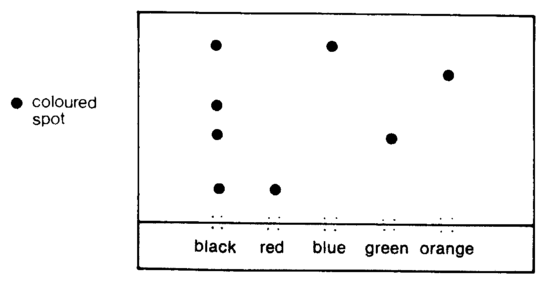
Ink can be separated by a method of -----------------------------------------------

a)

distillation

b)

filtration

c)

chromatography

d)

sedimentation

137.
chromatography separates the mixture of dyes on the basis of their ----------------------------
a)
density
b)
solubility
c)
gravity
d)
boiling point
138.
On the chromatogram given -------------- is mixture.
a)
red
b)
orange
c)
green
d)
black
139.
The substance in the mixture that has the greatest affinity for the stationary phase will travel
a)
fastest
b)
slowest
140.

A substance is soluble if it can be dissolved.


In paper chromatography, the most soluble solute _____________________ .

a)

does not move from the start point

b)

stays closest to the start point

c)

travels furthest away from the start point

d)

can be found in the middle of the chromatogram

141.

What method would you use to separate a mixture of salt and water so that you can get keep the salt AND the water?

a)

sorting by hand

b)

distillation

c)

chromatography

142.
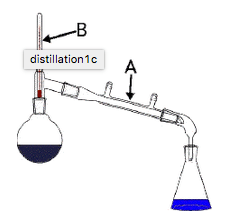
In the distillation apparatus shown, what are the parts labelled A and B?
a)
A = funnel, B = thermometer
b)
A = thermometer, B = funnel
c)
A = condenser, B = flask
d)
A = condenser, B = thermometer
143.
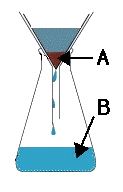
The diagram shows the apparatus for separating soil and water. What are the labelled parts?
a)
A = distillate, B = filtrate
b)
A = filtrate, B = residue
c)
A = residue, B = filtrate
d)
A = residue, B = distillate
144.
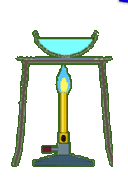
Which one of the following is the name for separation technique in the picture below
a)
distillation
b)
dissolving
c)
evaporation
d)
decanting
145.
What salt is produced if you react sodium hydroxide with hydrochloric acid?
a)
sodium hydroxide
b)
sodium sulfate
c)
sodium nitrate
d)
sodium chloride
146.
A salt is formed when nitric acid combines with sodium hydroxide. What is the name of the salt?
a)
Sodium chloride
b)
Sodium nitrate
c)
Hydrogen Nitrate
d)
Nirate
147.
The products of a neutralisation reaction are lithium sulfate and water. What is the name of the acid used to neutralise the alkali lithium hydroxide?
a)
hydrochloric acid
b)
sulfuric acid
c)
nitric acid
d)
phosphoric acid
148.
What is the formula for nitric acid?
a)

HNO3

b)

H2SO4

c)
HCl
d)

H3PO4

149.
Which reactants are used to produce sodium chloride (salt and water)
a)
sodium hydroxide and nitric acid
b)
sodium hydroxide and sulfuric acid
c)
sodium hydroxide and phosphoric acid 
d)
sodium hydroxide and hydrochloric acid
150.
Mg(OH)2
a)
magnesium hydroxide acid
b)
hydromagnesium acid
c)
magnesium oxygen hydride
d)
magnesium hydroxide
151.
sulfuric acid
a)
HSO3
b)
H2SO3
c)

H2SO4

d)

H3SO4

152.
NaOH
a)
sodium oxide
b)
sodium hydrogen
c)
sodium hydroxide
153.

Complete the following word equation:

Metal + acid -->

a)

Salt + water

b)

Salt + hydrogen

c)

Salt + water + carbon dioxide

154.

Complete the following word equation:

Metal carbonate + acid -->

a)

Salt + hydrogen

b)

Salt + water + carbon dioxide

c)

salt + water

155.
Salts that are made with hydrochloric acid are called ______________.
a)
chlorides
b)
sulfates
c)
nitrates
d)
carbonates
156.
Salts that are made with nitric acid are called ______________.
a)
chlorides
b)
sulfates
c)
nitrates
d)
carbonates
157.
Iron + Hydrochloric acid --> ?
a)
iron sulfate + water
b)
iron + hydrogen
c)
iron chloride + hydrogen
d)
iron chloride + water
158.
Magnesium + sulphuric acid --> ?
a)
magnesium sulfate + water
b)
magnesium sulfate + hydrogen
c)
magnesium chloride + hydrogen
d)
magnesium chloride + water
159.
Zinc + nitric acid --> ?
a)
zinc sulfate + water
b)
zinc sulfate + hydrogen
c)
zinc nitrate + hydrogen
d)
zinc chloride + water
160.

nitric acid + magnesium carbonate --> ..........+...........+............

a)

magnesium nitrate + water

b)

magnesium oxide + water

c)

magnesium oxide + water + hydrogen

d)

magnesium nitrate + water + carbon dioxide

161.

Name the salt formed from iron and nitric acid

(a)  

162.

Name the salt formed from iron and sulfuric acid

(a)  

163.

Name the salt formed from iron and hydrochloric acid

(a)  

164.

Name the salt formed from potassium and hydrochloric acid

(a)