
 Worksheets
Organic Molecules Quiz Review
Total questions: 81
Worksheet time: 1hrs 1mins
Circle the active site


In the diagram, what is letter A?
product
enzyme-substrate complex
substrate
active site
Most enzymes end in the following suffix: _ _ _
(a)
Enzymes are an example of
lipids
carbohydrates
protein
nucleic acid
Each enzyme only has 1 substrate that will fit its active site. What is this called?
reusable
catalyst
fragile
specific

Letter B...
substrate
active site
enzyme
products
What is a substance called if it speeds up a chemical reaction?
reusable
catalyst
specific
fragile
An enzyme speeds up a reaction by
raising the activation energy
lowering the activation energy
releasing energy
absorbing energy.

Letter E...
active site
products
substrate
enzyme
What happens when enzymes are heated to a high temperature?
The shape of the enzyme are changed and it denatures
The enzymes die
The enzymes' amino acid sequence changes
The enzymes remain the same
What happens to an enzyme when it is denatured?
Activation energy is lowered
It becomes stronger
It loses its shape
Activation energy is raised

Letter C...
products
substrate
enzymes
active site
Substances that are changed during a chemical reaction
reactants
products
Active site
the region of an enzyme that attaches to a substrate
a change in the shape of a protein (such as an enzyme) that can be caused by changes in temperature or pH (among other things).
substance that can bind to an enzyme and prevent the substrate from properly binding
macromolecules that contain carbon, hydrogen, oxygen, and nitrogen, include enzymes
Substrate
the substances changed during a chemical reaction (goes into the process)
the substances made by a chemical reaction (comes out of the process)
substance that speeds up the rate of a chemical reaction
reactant of an enzyme-catalyzed reaction

Letter D...
enzyme
active site
substrate
products
Denature
the region of an enzyme that attaches to a substrate
a change in the shape of a protein (such as an enzyme) that can be caused by changes in temperature or pH (among other things).
substance that can bind to an enzyme and prevent the substrate from properly binding
macromolecules that contain carbon, hydrogen, oxygen, and nitrogen, include enzymes
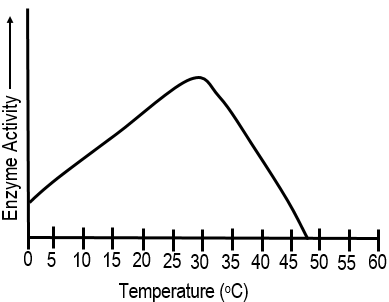
Based on the graph, what is the optimal temperature for this enzyme?
15oC
40oC
30oC
35oC
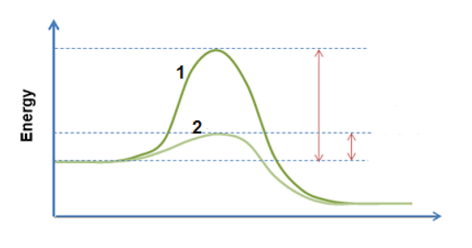
Which line represents an enzyme-catalyzed reaction?
Line 1
Line 2
Which of the following can be used to determine the rate of enzyme-catalyzed reactions?
Rate of disappearance of the enzyme
Rate of disappearance of the substrate
Rate of disappearance of the product
Change in volume of the solution

What happens to the pepsin enzyme in alkaline conditions
The reaction rate increases
The enzyme collides with more substrate
The enzyme will denature and no longer work
The shape of the enzyme does not change and still has activity

Why has this enzyme activity decreased so much?
The enzyme has become saturated
The temperature is too low
The enzyme has become denatured
Circle the substrate
Based on the graph, what is the optimal temperature for this enzyme?
15oC
40oC
30oC
35oC

Which macromolecule is structured this way?
Carbohydrate
Lipid
Protein
nucleic acid
What is the building block molecule of starch?
1 glycerol, 3 fatty acids
Simple sugar
Amino acids
Nucleotides
My building blocks are glycerol and fatty acids. What macromolecule am I?
Carbohydrate
Protein
Lipid
Nucleic acid
My building blocks are nucleotides.
Carbohydrates
Proteins
Proteins
Nucleic acids
Which building blocks are correctly matched to the macromolecule they form?
Fatty acid chains make nucleic acids.
Amino acids make proteins.
Glucose molecules make lipids.
Nucleotides make carbohydrates.
A lipid is made up of...?
Nucleotides
1 glycerol, 3 fatty acids
Simple sugars
Amino acids
This macromolecule has amino acids as building blocks.
Proteins
Lipids
Carbohydrates
nucleic acids
Which of the following is an inorganic molecule?
H2O
Starch
Enzyme
Glucose
Circle the enzyme
The four organic compounds found in all living things are?
Carbohydrates, Lipids, Nucleic Acids, and Oxygen
Carbohydrates, Lipids, Proteins, and Carbon
Carbohydrates, Lipids, Proteins, Nucleic Acids
Carbon, Lipids, Proteins, Nucleic Acids
How does glycogen compare with starch?
Glycogen is carbohydrate storage in animals, while starch is
carbohydrate storage in plants.
Glycogen is carbohydrate storage in plants, while starch is
carbohydrate storage in animals.
Glycogen is composed of nucleic acids, while starch is composed of
amino acids.
Glycogen is composed of amino acids, while starch is composed of
nucleic acids.
Which best describes how the shape of an enzyme affects its function?
It determines the specific reaction it will catalyze.
It determines the raw products needed for the reaction.
It determines whether a reaction will be slowed or sped up.
It determines the products that will result from the reaction.
Which is an example of a carbohydrate?
amylase
cellulose
glycerol
polypeptide
Match the biomolecule with the example:
Carbohydrates
DNA and RNA
Fats, oils, and waxes
Enzymes
Glucose
Match the biomolecule with the example:
Lipids
DNA and RNA
Fats, oils, and waxes
Enzymes
Glucose
Match the biomolecule with the example:
Proteins
DNA and RNA
Fats, oils, and waxes
Enzymes
Glucose
Match the biomolecule with the example:
Nucleic Acids
DNA and RNA
Fats, oils, and waxes
Enzymes
Glucose

The table below lists the type of proteins and their possible functions. Which function could best be substituted for number 1?
binds to oxygen in red blood cells
used as a chemical messenger
speeds up chemical reactions
helps to lower blood sugar
What happens to an enzyme after it has completed a reaction?
The enzyme is folded.
The enzyme is reused.
The enzyme is denatured.
The enzyme is destroyed.
Which elements are found in all organic molecules?
nitrogen, carbon, and hydrogen
carbon, hydrogen, and oxygen
hydrogen, sulfur, and nitrogen
phosphorus, oxygen, and carbon
Why are nucleic acids important to humans?
Nucleic acids store heredity information.
Nucleic acids break down fats into fatty acids.
Nucleic acids help digest food in the stomach.
Nucleic acids metabolize carbohydrates into glucose.
In which organic molecules is nitrogen a component?
nucleic acid and lipid
lipid and carbohydrate
protein and nucleic acid
carbohydrate and protein
How does the structure of nucleic acids differ from the structure of proteins?
Nucleic acids make up nucleotides, and proteins make up amino
acids.
Nucleic acids contain amino acids, and proteins contain nucleotides.
Nucleic acids make up amino acids, and proteins make up nucleic
acids.
Nucleic acids contain nucleotides, and proteins contain amino acids.
How are monosaccharides and polysaccharides different?
Monosaccharides are made up of only one polysaccharide.
Polysaccharides are made up of two or more monosaccharides bonded together.
Monosaccharides are made up of two or more polysaccharides bonded together.
Polysaccharides are made up of one amino acid, and monosaccharide are made up of two or more amino acids.
What is the function of carbohydrates?
store genetic information
store energy (long-term)
store energy (short-term)
build skin, hair, nails, muscles
What is the function of proteins?
store genetic information
store energy (long-term)
store energy (short-term)
build skin, hair, nails, muscles
The basic unit of life is a ____________.
atom
molecule
organelle
cell
Another word for a building block is a __________________.
polymer
monomer
dimer
What is the function of lipids?
store genetic information
store energy (long-term)
store energy (short-term)
build skin, hair, nails, muscles
_____________.
Which compound is a polysaccharide?
glucose
maltase
ribose
starch
All carbohydrates are compounds that contain the elements
iron, magnesium, and carbon
oxygen, hydrogen, and nitrogen
carbon, oxygen, and nitrogen
carbon, hydrogen, and oxygen
Cells in the stomach produce pepsin, and enzyme, to help digest food. Pepsin works best at a pH of 2? Which of these graphs most likely shows what will happen to the activity of pepsin as the PH of the stomach is increased?


Carb

Lipid

Nucleic Acid

Protein
DNA is a polymer consisting of repeating units known as
dipeptides
nucleotides
amino acids
organic acids
Which molecule supplies the energy for cellular functions?
ATP
oxygen
DNA
water

According to the table, at what temperature would enzyme D most likely be denatured?
15°C
20°C
25°C
89°C
Glucose is a building block of carbohydrates. Which of these best describes glucose?
nucleotide
protein
monosaccharide
lipid
A student is preparing to run in a school track competition. For the quickest source of energy, the student should eat a food that contains a high percentage of?
carbohydrates
fat
proteins
sodium
Lemurs' bodies are adapted to efficiently store energy for times when food is scarce. THis adaptation may help to explain how lemur ancestors survived the trip across the Mozambique Channel from mainland Africa to Madagascar.
Which of the following types of molecules are primarily used for long-term energy storage in the lemur?
lipids
monosaccharides
nucleic acids
proteins

The diagram shows a reaction that forms a polymer from two monomers. What is this type of reaction called?
glycolysis
hydrolysis
photosynthesis
dehydration synthesis
Label the picture
The protein (a) breaks down the carbohydrate (b)
Label the parts of this nucleotide
Base
Phosphate
Sugar
Match the characteristic to the organic molecule type
Don't mix with water
Lipid
Long, complex chains
Carb
Fold into Shapes
Protein
Bases make a code
Nucleic Acid
Match the function to the organic molecule type
Long-Term Energy
Lipid
Short-Term Energy
Carb
Controlling Reactions
Protein
Storing Information
Nucleic Acid
Match the example to the organic molecule type
Phospholipid
Lipid
Glucose
Carb
Lactase
Protein
DNA
Nucleic Acid
Match the monomer to the organic molecule type
Fatty Acid
Lipid
Monosaccharide
Carb
Amino Acid
Protein
Nucleotide
Nucleic Acid
Muscle cells need to quickly convert energy from food molecules into a usable form. For this reason, which of the following do muscle cells have in greater numbers than most other types of cells?
Chromosomes
Mitochondria
Smooth ER
Cytoplasm
What is the monomer for a protein called? _ _ _ _ _ _ _ _ _
(a)
Match the following organic molecule to it's proterty
Used by plants to build their structures (stems, trunks, etc)
Cellulose
Used by plants for their short term energy storage
starch
Used by animals to build their structures
protein
Used by animals for their short term energy storage
glycogen
Used by plants and animals to recharge their ATP energy carrier molecules
glucose
Type of lipid that sends messages throughout the body, is usually 4 carbon rings, and hydrophobic
Triglyceride
Steroid
Fatty Acid
Phospholipid

