
Font size
 Worksheets
Practice for Changes in the Earth's Surface
Total questions: 60
Worksheet time: 45mins

What is weathering?
Breaking rock into smaller pieces
Moving material around the Earth's surface
The build up of land
Features on the surface of the Earth
What is erosion?
Breaking rock into smaller pieces
Moving broken pieces of rock around the Earth's surface
The build up of land
Features on the surface of the Earth
What is deposition?
Breaking rock into smaller pieces
Moving broken pieces of rock around the Earth's surface
The build up of land
Features on the Earth's surface
What are landforms?
Breaking rock into smaller pieces
A triangle shaped landform at the mouth of a river
A deep gorge with steep sides formed by moving water
Features on the Earth's surface
What is a delta?
A triangle shaped landform at the mouth of a river
A deep gorge with steep sides that can be formed by moving water
Features on the Earth's surface
The movement of rock and sand around the Earth
What is a canyon?
A triangle shaped landform at the mouth of a river
A deep gorge with steep sides that can be formed by moving water
The build up of land by depositing soil
The movement of weathered material around the Earth's surface
How is a sand dune formed?
Wind erosion and deposition
Water weathering and deposition
Wind weathering and erosion
Ice erosion and deposition
How is a U-shaped Valley formed?
A river flowing
A glacier sliding
A volcanic eruption
Deposition of rock
How is a V-shaped Valley formed?
A Glacier sliding
A River flowing
Wind carrying dirt
Deposition
What is a glacier?
Wind erosion carving out rock
A block of snow on top of water
A moving block of ice on top of land
Water weathering breaking down rock
Does a volcano change the Earth's surface quickly or slowly?
Quick
Slow
Does an earthquake change the Earth's surface quickly or slowly?
Quick
Slow
What other event can change the Earth's surface quickly?
Weathering
Erosion
Deposition
Landslide






A delta is an example of
Erosion
Weathering
Sediment
Deposition

This picture of a delta is an example of
Weathering
Erosion
Deposition
Abrasion

Sand dunes are example of
dryness
wind
weathering
deposition
_____________________ happens when rocks on Earth's surface break apart or change without moving anywhere.
Erosion
Weathering
Deposition
_____________________ is the movement of soil and rock by wind, water, ice, and gravity.
Weathering
Erosion
Deposition
______________________ occurs when eroded materials stop moving and begin to build up.
Weathering
Erosion
Deposition
Eroded materials are called _______________________.
constructive
chemical weathering
sediments

The Grand Canyon was caused by _____________________ erosion from the Colorado River.
water
wind

Landslides erode and ____________ dirt and rock because what gets moved must get dropped off.
move
dissolve
deposit

The movement of water in a river causes the rocks to become ______________ over time.
smaller/smoother
larger/rougher

How can a volcano be both constructive and destructive?
It's both constructive and destructive because it can form sand dunes and cause erosion.
It's both constructive and destructive because the plate tectonics push the land forward and breaks apart other land.
It's both constructive and destructive because it builds up land like islands and destroys land and vegetation from the lava.
It is not both constructive and destructive.

Is a sea arch created by a constructive or destructive process?
Constructive
Destructive

Are canyons created by a constructive or destructive process?
Constructive
Destructive

Are river deltas created by a constructive or destructive process?
Constructive
Destructive

Students are studying the constructive and destructive processes that shape Earth's surface. The teacher separates the students into five groups. She asks each group to build a model that represents either a constructive or a destructive process. Which description best summarizes the process shown in group Z's model?
a constructive process of sand being deposited by gravity
a constructive process of sand being deposited by wind
a destructive process of sand being removed through erosion
a destructive process of sand being removed through weathering

Which statement is correct about the modeled picture?
It shows a destructive process formed through deposition.
It shows a destructive process formed through erosion.
It shows a constructive process formed through erosion.
It shows a constructive process formed through deposition.
A student claims that some landforms can be created quickly through constructive processes. Which example should she choose as an argument to BEST support her claim?
She should choose a canyon that can be created by flowing water carving through rock.
She should choose an island that can be created by cooling lava from a volcano eruption.
She should choose a delta that can be created by depositing sand at the mouth of a flowing river.
She should choose a valley that can be created by a glacier changing the landscape as it retreats.
Hailey has to design a model for science class. Her model must show a destructive process that changes the surface of the Earth. From which of the following choices could Hailey choose to show destructive processes for her model?
canyon, sea arch, mountain, erosion
mountain, river delta, weathering, deposition
canyon, sea arch, weathering, erosion
canyon, sea arch, weathering, deposition

Naomi looks at pictures of a beach shoreline before and after a major hurricane. She notices that after the hurricane, the ocean seems closer to the mountain. What could explain the difference between the two pictures?
The hurricane caused erosion on the beach.
The hurricane increased the sand on the beach.
The sand evaporated after the hurricane.
The water evaporated after the hurricane.

A group of students were observing the land around the creek near their school. Each student was asked to explain the natural processes that had shaped the creek and the land around it. Which is the best argument to explain what happened?
It was a fast constructive process caused by the wind.
It was a fast destructive process caused by a glacier.
It was a slow destructive process caused by the movement of water.
It was a slow constructive process caused by earthquakes.

The image is a picture of Horseshoe Bend in Arizona. Which of the following best explains how Horseshoe Bend was created?
Horseshoe Bend was created by constructive forces. Over time, soil was deposited on the edges of the Colorado River to build up the surrounding land.
Horseshoe Bend was created by constructive forces. Wind brought sediment from the surrounding desert to build giant sand dunes around the Colorado River.
Horseshoe Bend was created by destructive forces. The Colorado River slowly weathered the surrounding area and eroded its sediment down the river.
Horseshoe Bend was created by destructive forces. Ancient glaciers melted and left behind a huge cavern and the Colorado River.
Which of the following changes to the Earth is caused by moving water?
A new island forms in the middle of an ocean.
A plain becomes a deep canyon with steep walls.
A sand dune shifts from one location to another.
A mountain grows taller over a thousand years.
How do glaciers change land?
They can wear away mountains and leave behind valleys.
They stop erosion of land by blocking rivers and streams.
They drop off sediment and form river deltas.
They move very quickly and break everything in their path.

A scientist was studying a type of event that occurred on Earth in various places within a 30-day period. The circles indicate where the events happened.
What type of event do the circles on the map most likely represent?
Landslides, because they are all located along ocean coastlines.
Volcanoes, because they occur only near the equator.
Floods, because heavy rains can make riverbeds deeper and create deltas.
Earthquakes, because they occur on land and on the ocean floor.

A group of students is building a model to show how water from melting glaciers moves toward the ocean. They put clay, water, and ice cubes into a plastic bin. They place a heat lamp next to the bin. Which of the following would most likely help them show how water from melting glaciers moves in their model?
using colored water to represent the water in the ocean
using colored water to make the ice cubes that represent the glaciers
using different colors of clay to represent dry land and the bottom of the ocean
using different colors of light to represent sunlight shining on the glaciers and dry land

Where is one most likely to find rocks that have become smooth and rounded?
At the bottom of an ocean
Deep within Earth
On the top of a hill
In a fast-moving river
Which of these is an example of deposition?
Acids eating into rock
Landslides falling down mountain sides
Plant roots breaking apart rock
Wind building sand dunes
What causes Earth’s surface to shake during an earthquake?
The downhill movement of rocks and soil
A fault disappearing into Earth’s crust and soil
The release of energy along a fault
A tsunami crashing into a coastline
Why is weathering a destructive process?
It moves material from one place to another.
It wears down Earth’s surface.
It builds up Earth’s surface
It involves energy.

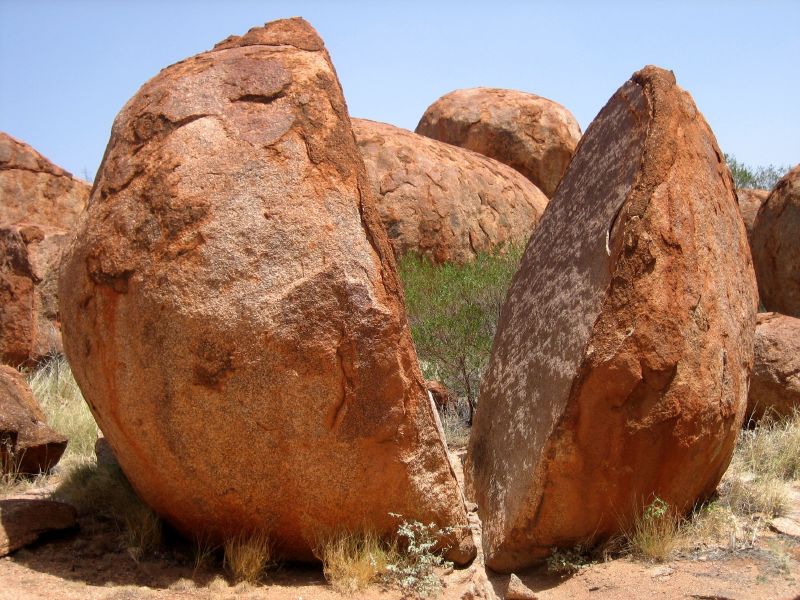
The strange shape of the rock formation shown below is most likely the result of which of the following?
A landslide
Gradual weathering
A volcanic eruption
An earthquake

This natural formation has been eroded out of the face of a cliff by marine (water) processes.
Sea Arch
Canyon
Sand Dune
Alluvial Fan

(a) can be both constructive and destructive when they erupt.
What is the name of a place where tectonic plates meet and show movement?
Glacier
The core
Fault
Deposition

