

Wayground logo

Free Printable Worksheets

Font size

S
M
L
XL
Worksheets

Cumulative Semester 1

Total questions: 102

Worksheet time: 5hrs 16mins

Name
Class
Date
1.

Which scientist discovered the electrons?

a)

Dalton

b)

Thomson

c)

Atristotle

d)

Bohr

2.

Bohr discovered that electrons are located in

a)

the nucleus

b)

inside protons

c)

electron cloud

d)

circular orbits around the nucleus

3.

What is a particle with one negative charge called?

a)

electron

b)

proton

c)

quark

d)

neutron

4.

The smallest particle of an element that still represents that element.

a)

Nucleus

b)

electron

c)

proton

d)

atom

5.

What is the center of an atom called?

a)

nucleus

b)

electron cloud

c)

proton center

d)

photon center

6.

What is the neutral particle found in the nucleus called?

a)

proton

b)

neutron

c)

electron

d)

quark

7.

All matter is made of

a)

energy

b)

atoms

c)

electrons

d)

compounds

8.

Round the following numbers to the number indicated: 345 (2 s.f.)

(a)  
9.
Which of the following numbers have four significant figures?
a)
56.75 g
b)
40.01 g
c)
0.6000 g
d)
all of the choices
10.
Calculate 923 g ÷ 20312 cm3 and give your answer with the correct number of significant figures.
a)
0.04 g/cm3
b)
0.045 g/cm3
c)
0.0454 g/cm3
d)
0.05 g/cm3
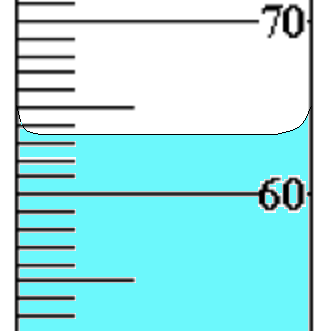
11.

Volume?

a)

63.50 mL

b)

63.5 mL

c)

63.55 mL

d)

6 mL

12.

7,000 mL = ____ L

a)

70 L

b)

700 L

c)

7 L

d)

0.07 L

13.
Ice melting
a)
Chemical Change
b)
Physical Change
14.
Wood burned in a fireplace
a)
Chemical Change
b)
Physical Change
15.
Copper roof changing color
a)
Chemical Change
b)
Physical Change
16.
Rust on an iron fence
a)
Chemical Change
b)
Physical Change
17.
Shredding a piece of paper
a)
Chemical Change
b)
Physical Change
18.
Boiling water
a)
Chemical Change
b)
Physical Change
19.
The electron configuration of an atom is 1s22s22p6.  The number of electrons in the atom is 
a)
3
b)
6
c)
8
d)
10
20.
Which electron configuration belongs to Chlorine (Cl)?
a)
1s2 2s2 2p6 3s2 3p5
b)
1s2 2s2 2p6 3s2 3p6
c)
1s2 2s2 2p6 3s2 3p7
21.
What atom matches this electron configuration?
1s22s22p63s23p64s23d10
a)
Zinc
b)
Copper
c)
Nickel
d)
Germanium
22.
What electron configuration matches an oxygen atom?
a)
1s22s22p63s2, 3p64s23d104p5
b)
1s22s22p4
c)
1s22s22p6
d)
1s22s22p63s23p64s23d1
23.
How many electrons can the d sublevel hold?
a)
14
b)
10
c)
2
d)
6
24.
How many electrons can the s sublevel hold?
a)
14
b)
10
c)
2
d)
6
25.
What atom matches this electron configuration?
1s22s22p63s2
a)
Neon
b)
Magnesium
c)
Aluminum
d)
Potassium
26.

Which area on the periodic table represents the electrons in the "d" sublevel?

a)

representative elements

b)

columns 3-8

c)

rare earth elements

d)

transition elements

27.

Each row on the periodic table represents:

a)

an energy level

b)

a sublevel

c)

an electron

d)

an orbital

28.
What's a valence electron?
a)
electrons in the second energy level
b)
electrons in the outermost energy level
c)
the atomic number
d)
electrons in the first level
29.
A particle that orbits around the nucleus is a(n)...
a)
Proton
b)
Neutron
c)
Electron
d)
Quark
30.
The atomic number of an atom is the number of 
a)
protons in its electron cloud
b)
protons in its nucleus
c)
neutrons in its nucleus
d)
electrons and neutrons in the nucleus
31.
Which letter represents a proton?
a)
A
b)
B
c)
C
d)
D
32.
Which letter represents a neutron?
a)
A
b)
B
c)
C
d)
D
33.
Which letter represents an electron?
a)
A
b)
B
c)
C
d)
D
34.

What is the overall charge when there are 5 protons, 4 electrons, and 5 neutrons?

a)

Zero (neutral)

b)
  • +1

c)

-1

35.

What is the mass number when there are 5 protons, 5 neutrons, and 6 electrons?

a)

10

b)

11

c)

6

d)

5

36.
As you move down a group, atomic radius increases because - 
a)
you add more and more neutrons
b)
you add more and more protons
c)
you add more and more shells (energy levels)
d)
you add more atomic mass
37.

Of the halogens, which has the smallest radius?

a)

F

b)

Br

c)

He

d)

At

38.

What is the amount of energy required to remove an electron from an atom?

a)

atomic energy

b)

ionization energy

c)

ionic energy

d)

electron energy

39.
Which atom has the largest atomic radius?
a)
potassium
b)
rubidium 
c)
francium
d)
cesium
40.

How many valence electrons does B have?

a)

5

b)

11

c)

3

d)

6

41.

What type of compound is SiF6?

a)

ionic because it starts with a metal

b)

covalent because it starts with a metal

c)

ionic because it starts with a nonmetal

d)

covalent because it starts with a nonmetal

42.

What type of compound is C2H8?

a)

ionic because it starts with a metal

b)

covalent because it starts with a metal

c)

ionic because it starts with a nonmetal

d)

covalent because it starts with a nonmetal

43.

If something burns in the presence of oxygen, that is considered a...

a)

chemical property

b)

physical property

44.

If something rusts, that is considered a...

a)

chemical property

b)

physical property

45.

In P2O5, what kind of bond is this?

a)

Ionic

b)

Covalent

c)

Mettalic

46.

In P2O5, who are the metals & nonmetals?

a)

P = Metal

O = Nonmetal

b)

P = Nonmetal

O = Nonmetal

c)

P = Metal

O = Metal

d)

P = Nonmetal

O = Metal

47.

What elements are in FeCl3?

a)

Iron, Carbon, Iodine

b)

Iron, Chlorine

c)

Phosphorous, Carbon, Iodine

48.

In FeCl3, who are the metals & nonmetals?

a)

Fe = Metal

Cl = Nonmetal

b)

Fe = Nonmetal

Cl = Nonmetal

c)

Fe = Metal

Cl = Metal

d)

Fe = Nonmetal

Cl = Metal

49.

Classify the bonds in MgO

a)

Covalent

b)

Ionic

c)

Metallic

50.

Classify the bonds in N2O3

a)

Covalent

b)

Ionic

c)

Metallic

51.

How many valence electrons do group 3A elements have?

(a)  

52.

How many valence electrons do group 6A elements have?

(a)  

53.

What is a valence electron?

a)

electron found in a middle shell

b)

electron found in outermost shell

c)

electron found in innermost shell

d)

electron not found in a shell

54.

Ionic bonding involves

a)

transfer of electrons

b)

sharing of electrons

c)

holding onto electrons

d)

electrons are not involved

55.

What do atoms that form positive ions tend to do?

a)

lose electrons

b)

gain electrons

c)

lose protons

d)

gain protons

56.
This is a correct dot diagram for oxygen (O)
a)
true
b)
false
57.

Which of these is the correct Lewis structure for NH3?

a)
b)
c)
d)
58.

When drawing Lewis structures, only __________ electrons are used.

a)

inner shell

b)

core

c)

valence

d)

stable

59.

Which is the correct molecular structure for carbon dioxide?

a)
b)
c)
d)
60.
Which of the following is the correct Lewis structure for water?
a)
A
b)
B
c)
C
61.
Which of the following is the correct Lewis structure for the compound PBr3?
a)
structure A
b)
structure B
c)
structure C
d)
structure D
62.
What is the correct formula for this molecule?
a)
Si4F
b)
SiF4
c)
SiF
d)
Si4F4
63.

CCl4 has how many double bonds?

a)

0

b)

1

c)

2

d)

3

64.
The theory that is used to predict the arrangement of atoms about a central atom is called?
a)
Valence shell repulsion
b)
Valence shell electron sharing
c)
Valence shell electron pair repulsion
d)
Valence electron shell repulsion pair
65.
A molecule of methane has what shape?
a)
Tetrahedral
b)
Triangular
c)
Pyramidal
d)
Octahedral
66.
A molecule of water has what shape?
a)
Linear
b)
Tetrahedral
c)
Bent
d)
Triangular
67.
Each line in a Lewis Structure represents __________ electron(s).
a)
3
b)
2
c)
1
d)
4
68.

CaS

a)

Calcium sulfide

b)

Calcium (II) sulfide

c)

Calcium (2) sulfide

d)

Calcium sulfur

e)

Calcium (II) sulfide (II)

69.

Mg3N2

a)

Magnesium nitride

b)

Magnesium (II) nitride

c)

Magnesium (2) nitride

d)

Manganese nitrogen

e)

Magnesium (II) nitride (III)

70.

FeF3

a)

Iron fluoride

b)

Iron (III) fluoride

c)

Iron (3) fluoride

d)

Iron (I) fluoride (III)

e)

Iron (III) fluoride (I)

71.

Cu3P

a)

Copper phosphide

b)

Copper (I) phosphide

c)

Copper (I) phosphoride

d)

Copper (III) phosphide (I)

e)

Copper (I) phosphide (III)

72.

AlP

a)

Aluminum phosphide

b)

Aluminum (III) phosphide

c)

Aluminum (I) phosphoride

d)

Aluminum (III) phosphide (I)

e)

Aluminum (I) phosphide (I)

73.

Sn2Se3

a)

Tin selenide

b)

Tin (III) selenide

c)

Tin (II) selenide

d)

Tin (III) selenide (II)

e)

Tin (II) selenide (III)

74.

V3N2

a)

Vanadium nitride

b)

Vanadium (II) nitride

c)

Vanadium (III) nitride

d)

Vanadium (III) nitride (II)

e)

Vanadium (II) nitride (III)

75.

KI

a)

Potassium iodide

b)

monopotassium iodide

c)

Potassium monoiodide

d)

Potassium (I) iodide (I)

e)

Potassium (I) iodide

76.
How do the following two elements bond together?
K1+  S2- 
a)
KS
b)
K8S
c)
K6S3
d)
K2S
77.
How do the following two elements bond together?
Al3+  O2-         
a)
AlO
b)
Al2O3
c)
Al3O6
d)
Al3O2
78.
The proper formula for magnesium hydroxide:
a)
MgOH
b)
Mg2OH
c)
Mg(OH)2
d)
Mg2OH2
79.
Name the following ionic compound: MgSO4
a)
magnesium sulfoxide
b)
magnesium sulfide
c)
magnesium sulfate
d)
magnesium oxide
80.
What would be the proper chemical formula for combining Al3+ and Cl- :
a)
AlCl3
b)
Al3Cl
c)
AlCl
d)
Al3Cl3
81.
The chemical formula of iron (III)bromide is
a)
FeBr
b)
Fe(III)Br
c)
FeBr₃
d)
Fe₂Br₃
82.
What is the formula for calcium phosphide?
a)
CaP
b)
Ca2P3
c)
Ca3P2
d)
Ca2P
83.

If oxygen (O) and calcium (Ca) were to bond, what type of bond would they form?

a)

Metallic

b)

Ionic

c)

Covalent

d)

They would not bond

84.

What is the name of a compound with the formula NaCl?

a)

Sodium chlorine

b)

Sodium chloride

c)

Sodide chloride

d)

Chloride sodium

85.

What is the correct formula for the compound Magnesium bromide ?

a)

MgBr

b)

Mg2Br

c)

MgBr2

d)

Br2Mg

86.

What is the correct formula for the compound Lithium sulfate ?

a)

LiS

b)

Li2S

c)

Li2SO4

d)

LiSO4

87.

Na3PO4

a)

sodium phosphide

b)

sodium(I) phosphate

c)

sodium phosphate

d)

trisodium phosphate

e)

sodium(I) phosphide

88.

Mg(NO3)2

a)

magnesium(II) nitrate

b)

magnesium(I) nitrate

c)

magnesium nitride

d)

magnesium nitrate

e)

magnesium(II) nitride

89.

Name: (NH4)2CO3

a)

Ammonium carbonate

b)

Ammonium(II) carbonate

c)

Ammonium(I) carbonate

d)

Ammonium carbon trioxide

90.

MgI2

a)

Magnesium Iodine

b)

Monomagnesium di-iodide

c)

Magnesium iodide

d)

Magnesium tetraiodide

91.

N2O

a)

Nitrogen Oxide

b)

Dinotrogen dioxide

c)

Nitrous dioxide

d)

Nitrogen Oxygen

92.
phosphorus trichloride
a)
KCl3
b)
PCl3
c)
K3Cl
d)
P3Cl
93.
SiCl4
a)
silicon tetrachloride
b)
silicon quadchloride
c)
monosilicon tetrachloride
d)
silicon chloride
94.

P₄S₁₀

a)

tetrapotassium decasulfide

b)

phosphorus decasulfide

c)

tetraphosphorus decasulfide

d)

phosphorus (X) sulfide

95.

SO₃

a)

sulfate

b)

sulfur oxide

c)

sulfur trioxide

d)

monosulfur trioxide

96.

tetraphosphorus heptoxide

a)

K₄O₁₀

b)

P₄O7

c)

KO

d)

P₁₀O₄

97.

N2O3

a)
Nitrogen trioxide
b)
Dinitrogen oxide
c)
Dinitrogen trioxide
d)
Nitrogen oxide
98.

C3Cl8 

a)
Carbon octachloride
b)
Tricarbon octachloride
c)
Carbon trichloride
d)
Octacarbon trichloride
99.
SiCl6
a)
Monosilicon hexachloride
b)
Silicon hexachloride
c)
Silicon heptachloride
d)
Monosilicon heptachloride
100.

Is this molecule polar or non-polar?

a)

Polar

b)

Non-polar

101.

Is this molecule polar or non-polar?

a)

Non-polar

b)

Polar

102.

Polar or nonpolar?

a)

Nonpolar

b)

Polar
