
 Worksheets
Chapters 8 & 9 Review
Total questions: 80
Worksheet time: 40mins
Most ocean waves form as a result of _______.
seismic events
winds blowing across the ocean surface
landslides
density differences between water layers
Earth's rotation
An internal wave might form _______.
at a density boundary within the ocean
at the boundary between the atmosphere and the ocean
at the boundary between the ocean and the seafloor
close to shore as it moves into shallow water
only as a result of tidal activity
_______ occur only in the upper part of the ocean.
Sea waves
Internal waves
Surface waves
Body waves
Splash waves
Which of the following causes ocean tides to occur?
Moon and sun
Earthquakes
Volcanoes
Landslides
Wind
Tidal movement, turbidity currents, wind stress, and even passing ships at the surface create _______ waves.
internal
ocean
splash
tidal
turbidity
The uplift or downdropping of large areas of the sea floor creates _______ waves.
internal
ocean
tsunami
splash
tidal
Waves at the ocean surface are ________ waves.
longitudinal
orbital
reflective
refractive
transverse
________ waves also known as interface waves.
Longitudinal
Orbital
Reflective
Refractive
Transverse
The ratio of wave height to wavelength is called the ________.
frequency
period
wave height
wavelength
wave steepness
The time between two successive waves is called the ________.
crest
frequency
height
period
trough
Wave celerity is equal to ________.
wave height divided by frequency
wave height divided by period
wavelength divided by fetch
wavelength divided by frequency
wavelength divided by period
The circular motion of water molecules extends to a depth that is equal to ________.
wave height/wavelength
wave height/wave period
wavelength/wave height
wavelength/2
wavelength/20
The diameter of a wave orbital at the surface is equal to _______.
wave height
wave height/wavelength
wavelength
wavelength/wave period
wave period
A deep-water wave occurs when the water depth is equal to at least _______.
the fetch
wave height
wavelength
1/2 of the wavelength
1/20 of the wavelength
The speed of a deep-water wave is proportional to _______.
water depth
wave frequency
wave height
wave speed or celerity
wavelength
The speed of a shallow-water wave is proportional to _______.
water depth
wave frequency
wave height
wave period
wavelength
The _______ is the vertical distance between a crest and a trough.
wavelength
wave base
wave steepness
still water level
wave height
Halfway between the crests and the troughs is the _______.
still water level
wave base
wavelength
wave height
wave steepness
The high parts of the waves are called _______.
breakers
bumps
crests
hills
tops
The low parts of the waves are called _______.
bottoms
breakers
holes
hollows
troughs
The horizontal distance between wave crest to crest is called the _______.
wave frequency
wave height
wave period
wave steepness
wavelength
The number of wave crests passing a fixed location per unit of time is called the _______.
wave base
wave frequency
wave period
waveform
wavelength
Wave speed of deep-water waves depends only on _______.
wave period
wavelength
wave drift
waveform
wave frequency
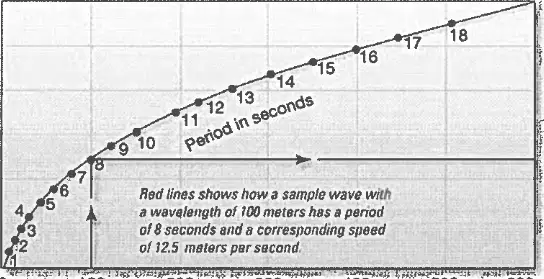
Based on the graph, what is the approximate speed, in meters per second, of a deep-water wave with a wavelength of 300 meters?
8 meters per second
12 meters per second
18 meters per second
22 meters per second
27 meters per second
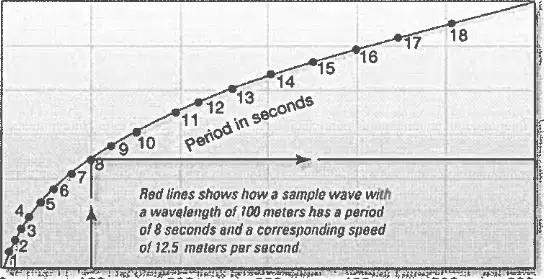
Based on the graph, what is the approximate period of a deep-water wave with a speed of 25 meters per second?
3.5 seconds
6.7 seconds
10 seconds
13 seconds
16 seconds
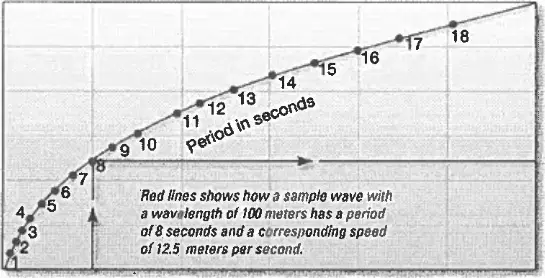
Based on the graph, a deep-water wave with a period of 16 seconds should have a speed of _______ meters per second and a wavelength of _______ meters.
12.5; 100
18.0; 200
22.0; 300
25.0; 400
27.0; 500
The first wave that forms when the wind begins to blow across the ocean surface is a _______.
tide
tsunami
wind waves
seiche
capillary wave
In general, the restoring force for most wind-generated waves is _______.
cohesion of water molecules
gravity
seismic activity
surface tension of water molecules
wind
The height of a wave depends upon _______.
fetch
fetch and wind speed
fetch, wind duration, and wind speed
wind duration
wind duration and wind speed
The fetch refers to _______.
a method of shoreline erosion control
a type of wave-cut platform
the circular pattern made by water particles when a wave passes
the distance between the trough of a wave and the still water level
the distance over which the wind blows without interruption
Rogue waves tend to occur _______.
in areas where wind belts converge
in coastal areas with weak sea breezes
in upwelling zones
only in the southern ocean below 60°S latitude
where storm waves move against strong surface currents
Rogue waves are created along the "Wild Coast" off the southeast coast of _______, where the Agulhas Current flows directly against large Antarctic storm waves.
South America
Antarctica
China
Africa
Australia
Waves from separate sea areas move away as swell and produce an interference pattern when they come together. If Sea A has wave heights of 1.5 meters and Sea B has wave heights of 3.5 meters, what would be the height of waves resulting from constructive interference?
1.5 meters
3.5 meters
5 meters
5.25 meters
6 meters
Waves from separate sea areas move away as swell and produce an interference pattern when they come together. If Sea A has wave heights of 1.5 meters and Sea B has wave heights of 3.5 meters, what would be the height of waves resulting from destructive interference?
1.5 meters
2 meters
3.5 meters
5 meters
6 meters
As a wave begins to feel bottom near a shoreline, its wave height _______.
decreases and its steepness decreases
decreases and its wavelength increases
increases and its frequency decreases
increases and its wavelength decreases
increases and its wavelength remains the same
Waves in the surf zone begin to behave like shallow-water waves when _______.
distance from shore < wavelength
steepness = 1:7
water depth = wave height
water depth = wavelength/20
wavelength < wave height
Waves that are breaking along the shore and are forming a curling crest over an air pocket are called _______.
gravity waves
plunging breakers
spilling breakers
surf
swells
Waves converge on headlands due to _______.
constructive interference
destructive interference
wave diffraction
wave reflection
wave refraction
Which of the following, from earliest to latest, represents the typical wave formation?
Sea, surf, swell
Sea, swell, surf
Surf, swell, sea
Surf, sea, swell
Swell, sea, surf
_______ is a turbulent mass of air and water that runs down the front slope of the wave as it breaks.
Spilling breaker
Plunging breaker
Surging breaker
Shoaling breaker
Most waves generated in the sea area by storm winds move across the ocean as _______.
surf
swell
wave break
surf zone
wedge
Which type of breaker forms on moderately steep beach slopes?
Plunging breaker
Spilling breaker
Standing breaker
Surging breaker
Swelling breaker
Which type of breaker forms when the ocean bottom has an abrupt slope?
Plunging breaker
Spilling breaker
Standing breaker
Surging breaker
Swelling breaker
Which type of breaker forms when the waves build up and break right at the shoreline?
Plunging breaker
Spilling breaker
Standing breaker
Surging breaker
Swelling breaker
Refraction causes headlands to be areas of _______ surfing and sites of _______.
good; deposition
good; erosion
poor; deposition
poor; erosion
An unintended consequence of the jetty that protects the harbor entrance at Newport Harbor, California is a wave pattern that has crippled and killed many body surfers due to
destructive interference
standing waves
tsunami
wave reflection
wave refraction
A tsunami may result from _______.
a large deep-water wave
a storm surge
an intense storm
constructive wave interference
tectonic activity on the seafloor
A tsunami is considered to be a _______.
capillary wave
deep-water wave
reflected wave
refracted wave
shallow-water wave
What is the PTWC?
Pacific Tsunami Watch Center
Pacific Tsunami Warning Center
Pacific Tsunami Watch Capital
Pacific Tsunami Warning Capital
Where do most tsunami occur?
Atlantic Ocean
Pacific Ocean
Indian Ocean
Southern Ocean
Arctic Ocean
Which tsunami event had the greatest fatalities?
Nicaragua
Samoa
Chile
Sumatra, Indonesia
Northern Chile
Which of the following must endure more tsunami than any other place?
Australia
South America
Africa
North America
Japan
A vast majority of all large tsunami are generated in the _______ Ocean.
Antarctic
Atlantic
Indian
Pacific
Southern
The world currently produces about _______ from all sources.
10 terawatts
12 terawatts
14 terawatts
16 terawatts
Conditions for the development of wave energy are most optimal along _______ shores in the _______ Hemisphere.
eastern; Northern
eastern; Southern
western; Northern
western; Southern
Conditions for the development of wave energy are least optimal along _______ shores in the _______ Hemisphere.
eastern; Northern
eastern; Southern
western; Northern
western; Southern
The center of mass of the Earth-Moon system is called the _______.
perigee
apogee
perihelion
aphelion
barycenter
How long is a lunar day?
24 hours
24 hours 20 minutes
24 hours 30 minutes
24 hours 50 minutes
25 hours
Which of the following best explains why there is a difference between a lunar day and a solar day?
During one Earth rotation, the Moon has continued orbiting Earth.
The Moon must rotate an additional 50 minutes to catch up to Earth.
The solar day and lunar day are measured from different meridians.
The Sun has a stronger pull on the larger Earth versus the smaller Moon.
The tide-generating forces of the Sun and Moon are working at right angles.
The force that creates two simultaneous ocean bulges on opposite sides of Earth, directed toward or away from the Moon, is called the _______ force.
barycentric
nadir
oceanographic
tide-generating
zenith
The vertical difference between consecutive high and low tides is called the _______.
ebb tide
flood tide
tidal bore
tidal height
tidal range
When the Earth is at its greatest distance from the Sun, it is said to be at _______.
perihelion
aphelion
proxigean
apogee
perigee
The center of an open ocean tidal system is called a(n) _______.
amphidromic point
cotidal center
rotary center
seiche
tidal flux
An area that experiences semidiurnal tides will have _______.
one high tide and one low tide daily
one high tide and two low tides daily
one low tide and two high tides daily
two high tides and two low tides of nearly equal height daily
two unequal low and high tides daily
An area that experiences diurnal tides will have _______.
one high tide and one low tide daily
one high tide and two low tides daily
one low tide and two high tides daily
two high tides and two low tides of nearly equal height daily
The most common tidal pattern around the world are _______.
diurnal tides
mixed tides
proxigean tides
semidiurnal tides
In the United States, semidiurnal tides commonly occur along the _______.
Atlantic coast
Gulf of Alaska
Gulf of Mexico coast
Florida Keys
In the United States, mixed tides commonly occur along _______.
the Atlantic coast
Cape Cod
the Gulf of Mexico coast
the Florida Keys
Pacific Coast
Diurnal tides have a tidal period of _______.
24 hours
24 hours 30 minutes
24 hours 50 minutes
25 hours 30 minutes
Semidiurnal tides have a period of _______.
12 hours
12 hours 25 minutes
12 hours 50 minutes
13 hours
Mixed tides have a period of _______.
12 hours
12 hours 25 minutes
12 hours 50 minutes
13 hours
The Bay of Fundy is well known for which tidal characteristic?
A diurnal tide
Two amphidromic points
Very large seiche
Very low tidal range
Very high tidal range
Water flowing out of an enclosed basin due to the tides is called a(n) ________.
ebb current
flood current
tidal bore
spring tide
Which of the following produces a tidal current?
Both ebb tides and flood tides
Both neap tides and spring tides
Ebb tide
Flood tide
Spring tide
Where are the largest tidal bores in the world located?
Europe
China
Africa
United States
Australia
The Maelstrom off the coast of ________ is one of the strongest whirlpools in the world.
Canada
Italy
Japan
Norway
Scotland
Whirlpools can be created in some restricted shallow passages due to ________.
a vertically mixed estuary
reversing tidal currents
tidal bores up low-lying rivers
tsunamis or tidal waves
wave refraction
In 2011, which country installed a tidal power plant capable of producing 254 megawatts of electricity?
North Korea
South Korea
China
Asia
Italy
Which of the following rivers is the second largest tidal range in the world?
Severn River
Thames River
Ure River
Trent River
Fleet River
Which of the following statements comparing a tidal power electricity-generating with a conventional thermal power plant is correct?
The initial cost of building a tidal power electricity-generating plant may be lower.
The operating costs of a tidal power electricity-generating plant are higher.
The periodicity of the tides is an advantage of a tidal power electricity-generating plant.
Tidal power initially requires fossil or nuclear fuels to get started.
Tidal power is considered a cleaner and renewable resource.

