
 Worksheets
AP World History Units 5-6 Review
Total questions: 75
Worksheet time: 50mins

Which country had the largest sphere of influence in Latin America during the Age of Imperialism?
United States
Spain
Mexico
England

What was Japan's response to foreign interference in the nineteenth century?
Adapt to Western politics and culture (Meiji Restoration)
Isolate themselves further by resisting and fighting
Became allies with the Chinese to become the dominant power in the region
Adapt to the ideas of the islanders and tribal people to resist

Why, in the time period c. 1750-1900, did European states fight to acquire overseas colonies?
To acquire raw materials to fuel their industrialization
To spread Enlightenment ideas
To abolish slavery worldwide
To stop the spread of Islam throughout the world

Which company took over other European states colonies in India?
British East India Company
British West India Company
Dutch East India Company
French East India Company

Why did European powers divide Africa by diplomatic agreements between each other?
Fear of going to war because of fierce competition
Rapid population increase in European colonies in Asia
Atlantic revolutions lead Europeans states to seek new troops
Creation of transnational business fostered exchange of raw materials
At what conference did the Europeans divide up Africa for their colonization?
Egypt Conference
London Conference
Belgium Conference
Berlin Conference
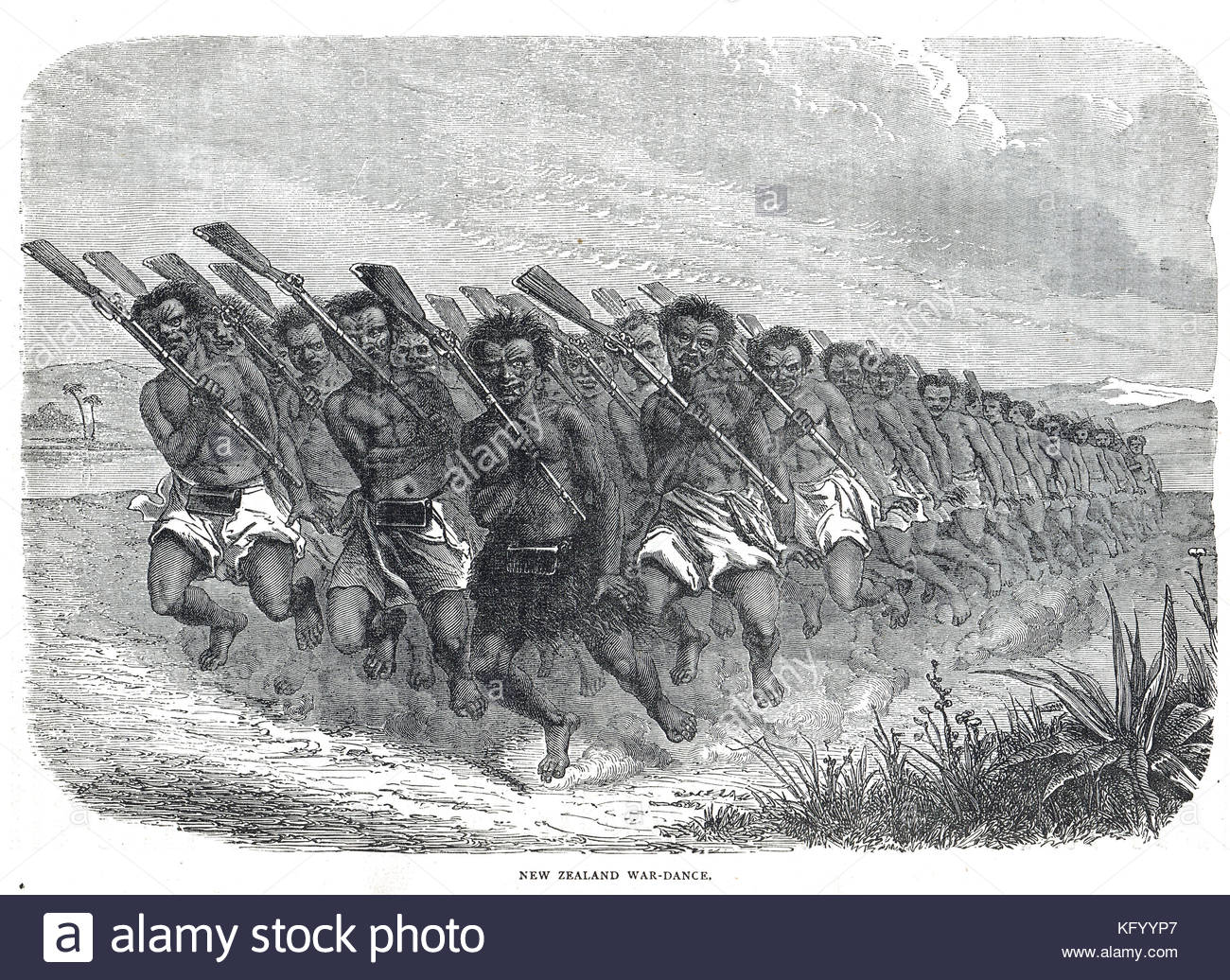
These Maori are going to war in
Australia
Indonesia
Kenya
New Zealand
France was most active in empire buiding in
North Africa
South Africa
China
The East Indies
The Monroe Doctrine
supported US Imperial ambitions
supported the British control of India
solved the "Scramble for Africa" issue
made the Opium Wars worse

The Enlightenment is...
the revival of art and literature under the influence of classical models in the 14th–16th centuries.
movement that aims to highlight racism, discrimnation, and racial inequality
a series of religious wars between Christians and Muslims to secure holy sites
an intellectual movement that advocated the use of reason to reconsider accepted ideas

John Locke's theory of government is based on which idea?
Absolute monarchy is the only legitimate form of rule
State should control religion and education
Governments derive authority from divine right and continue in doing so because it is God's will
People are born with natural rights such as life, liberty, and property
Which Enlightenment thinker is most closely associated with the idea of life, liberty, and property?
Thomas Jefferson
John Locke
Jean-Jacques Rousseau
Voltaire
Which Enlightenment thinker is most closely associated with his wit and advocacy of civil liberties?
Thomas Jefferson
John Locke
Jean-Jacques Rousseau
Voltaire
Which Enlightenment thinker is most closely associated with the idea of the use of checks on powers and separate branches of government?
Thomas Jefferson
Montesquieu
Jean-Jacques Rousseau
Voltaire
Which of the following best describes the Enlightenment philosophers' view of the ideal government?
a democracy with a strong military force
a power sharing agreement between civil and religious leaders
an absolute monarchy deriving authority from religion
a contract between the leader and people
Simon Bolivar attempted to
create a confederation states in South America modeled after the United States of America
convince creole leaders to abandon their fight against Spanish rulers in South America
suppress independence movements in Venezuela and Peru
lead a revolution against colonial rule in Mexico

Which generalization applies to all the revolutions listed in the table?
All resulted in newly independent countries.
All advocated racial equality.
All were reversed within a generation of their completion.
All were inspired by Enlightenment ideals.
What is the name of the movement that promotes the interests of a particular nation due to intense pride?
A revolution
Protestantism
Enlightenment
Nationalism
Which nations unified in the 1750s to 1900s due to nationalistic movements?
Italy
America
Germany
France
Which of the following revolutions were based on discontent with imperial and monarchist rule?
The American Revolution
The French Revolution
The Haitian Revolution
Ottomanism
Bolivar's "Letters from Jamaica" focused on gaining rights in Latin America for:
All landowning men
Creoles
Slaves
Which nation was the first to industrialize?
Britain
France
Germany
Japan
What effect did specialization of labor have on the workplace?
It led to more unskilled labor in factories
It led to more skilled labor in factories
All of the following helped countries to industrialize except:
Access to waterways
Natural resources like coal
Access to foreign resources and markets
Being colonies of other nations
After Britain industrialized, all of these nations followed suit, except:
Japan
America
Russia
India
All of the following were reactions to industrialization's negative effects on workers except:
Labor unions
Communism
The invisible hand
Utilitarianism
Crop rotation and the seed drill led to
increased food production.
the use of machinery in production.
the economic collapse in British agriculture.
allowed more than one thread to be spun at a time
spinning jenny
water frame
flying shuttle
Before the industrial revolution cotton was being woven in Britain by
women in their own cottages
children in orphanages
slave labor
What system created by Eli Whitney allowed for industrial machines to be repaired and serviced more easily?
interchangeable parts
assembly line
division of labor
In the 20th century Henry Ford improved the division of labor in factories when he introduced
the assembly line.
interchangeable parts.
the water frame.
Which of the following was NOT an industrial power in the second wave of industrialization?
France
Germany
the United States
Japan
the Mughal Empire
What had the largest impact on Russian success in industrialization?
Trans-Siberian Railroad
end of serfdom
unification of fragmented small states
Besides India, what other country saw its textile industry devastated by European (especially English) production?
Egypt
Japan
Russia
the United States
Which of the following was NOT a reason that Britain led the world in industrialization?
mineral resources in Britain and resources from colonies
a large slave labor force
abundant rivers for transportation
growing population and urbanization
a government that protected private property
What does the Industrial Revolution describe?
The transition from the medieval period to the modern period.
The transition from agrarian to industrial economies
The transition from a religiously oriented society to a secular society.
The transition from mercantilism to capitalism.
Which social class grew significantly as a result of the Industrial Revolution?
Nobility
Middle class
Peasantry
Clergy
What was the primary industry that first experienced major changes during the Industrial Revolution?
Agriculture
Textile
Mining
Transportation
What was the main source of power for factories during the early Industrial Revolution?
Wind
Water
Steam
Electricity
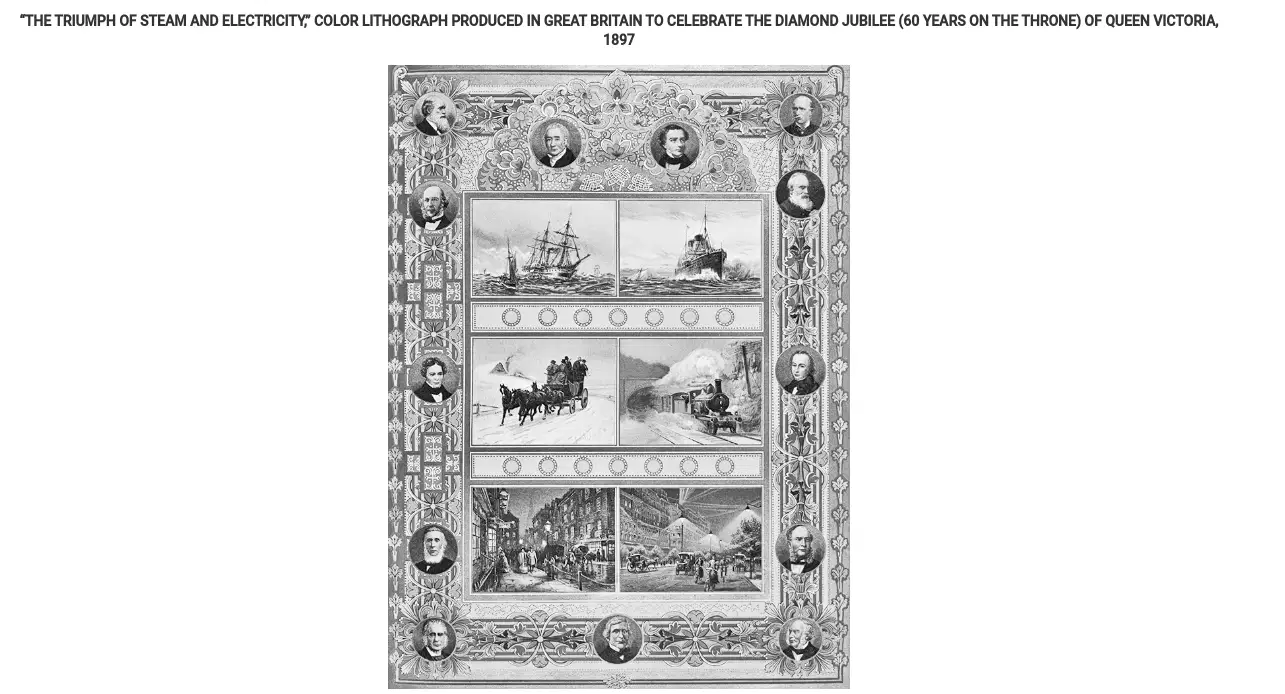
In the period circa 1750–1900, the historical process illustrated by the image led directly to all of the following major global transformations EXCEPT
The outbreak of the Atlantic revolutions and the emergence of new states in the Americas
A significant increase in transregional trade and migration
The transition from human- and animal-powered economies to fossil fuel-powered economies
The increasing use of electricity in industrial and consumer applications
Which ideology justified European imperialism by suggesting it was the duty of Europeans to civilize other parts of the world?
Nationalism: The belief in a nation's superiority and the promotion of its interests
Social Darwinism: Applying "survival of the fittest" to justify domination by stronger nations
The White Man's Burden: a concept derived from a poem by Rudyard Kipling, promoting the idea that Europeans had a duty to civilize non-European peoples
Manifest Destiny: The belief that Americans were destined to expand across North America
How did Social Darwinism serve as a rationale for imperialism?
By promoting the idea of racial equality
By applying the concept of "survival of the fittest" to human societies
By encouraging economic cooperation among nations
By advocating for the preservation of indigenous cultures
Which economic motive drove European powers to pursue imperialism in the late 19th century?
The need for new markets and raw materials
The desire to spread democratic ideals
The goal of establishing religious uniformity
The ambition to create military alliances
What role did nationalism play in the expansion of imperialism during the 19th century?
It led to the unification of African tribes against European invaders
It fostered competition among European nations to acquire colonies
It promoted isolationist policies in Asian countries
It encouraged the spread of socialist ideologies
Which of the following best describes the concept of "civilizing mission" as a justification for imperialism?
The strategy of using military force to dominate other nations
The practice of establishing trade agreements with indigenous populations
The effort to preserve and protect native traditions and customs
The belief that imperial powers had a duty to spread their superior culture and religion
How did technological advancements such as steamships, railroads, and the telegraph contribute to the expansion of imperialism in the 19th century?
They made it easier for indigenous populations to resist colonization
They led to the decline of European military capabilities
They enabled European powers to navigate and control distant territories more effectively
They promoted equal power dynamics between colonizers and the colonized
Which of the following ideologies was used to justify the dominance of stronger nations over weaker ones during the age of imperialism?
Liberalism
Romanticism
Social Darwinism
Marxism
What was a common religious justification for imperialism in the 19th century?
The belief in the superiority of indigenous spiritual practices
The desire to convert non-Christian populations to Christianity
The promotion of secularism and separation of church and state
The encouragement of religious pluralism and tolerance
Which economic theory supported imperialism by emphasizing the accumulation of wealth through the control of colonies?
Capitalism
Socialism
Mercantilism
Communism
How did the concept of "The White Man's Burden" rationalize imperialism?
By arguing that Europeans had a moral obligation to civilize and uplift non-European societies
By promoting the idea of racial equality and mutual respect
By encouraging isolationist policies to avoid foreign entanglements
By advocating for the preservation of indigenous cultures and traditions
Which of the following was a political motive for imperialism in the late 19th century?
The pursuit of international alliances for peacekeeping
The desire to gain strategic military bases and increase national prestige
The effort to reduce domestic industrial production
The aim to promote global disarmament
How did industrialization influence the expansion of imperialism during the 19th century?
It decreased the demand for raw materials from colonies
It led to a focus on domestic markets, reducing interest in foreign territories
It promoted self-sufficiency, diminishing the appeal of colonial acquisitions
It created a need for new markets and sources of raw materials, driving imperial expansion
Which ideology justified imperialism by suggesting that European powers were bringing progress and enlightenment to "backward" societies?
Nationalism
Social Darwinism
The civilizing mission
Isolationism
What was a common cultural justification for imperialism in the 19th century?
The belief in the cultural superiority of European societies
The recognition of the value of indigenous traditions
The promotion of cultural relativism and diversity
The acceptance of equal cultural exchange between nations
How did economic interests drive imperialism in the period from 1750 to 1900?
By focusing solely on domestic economic growth
By promoting fair trade practices and equal partnerships
By encouraging the development of local industries in colonized regions
By seeking new markets for manufactured goods and sources of raw materials
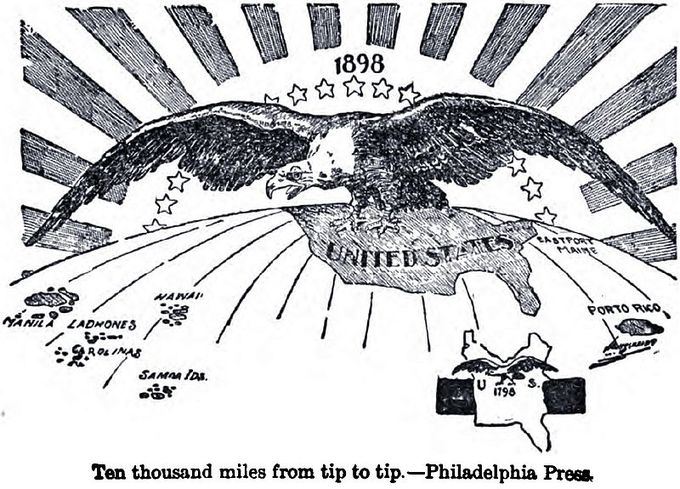
This image is a representation of...
US Exploration
US Diplomacy
US War Relations
US Imperialism
What was the name of the meeting of European countries where they decided on how to divide up Africa?
Conference of Paris
Treaty of Versailles
Berlin Conference
Which country controlled French Indochina?
United States
Great Britain
France
Italy
Which of the following phrases describes the threat of force using a strong navy?
“Captain’s Catch”
“Captain Crunch”
“Gunboat diplomacy”
“What’s A Madda with My Armada”
Why did the United States acquire Hawaii?
The US wanted volcanoes
To use the islands as a naval base, and for its sugar
to create a naval base during World War II
to assist Queen Liliuokalani take control of the islands
The Opium War was caused by Britain continuing to sell opium to China.
True
False
What does the phrase "the sun never sets over the British Empire" mean?
it's always sunny in Britain
it shows how large their empire was
it shows how dangerous they were
is a reference to the shiny money they had

What caused the Taiping and Boxer rebellions?
Foreign economic involvement in China
British selling opium to China
Indians refusing to touch the gunpowder pouches
Americans moving into West North America
Imperialism is
ONLY economic control over peoples
ONLY political control over peoples
Policy or ideology of extending the rule over peoples and other countries
The Monroe Doctrine
supported US Imperial ambitions
supported the British control of India
solved the "Scramble for Africa" issue
made the Opium Wars worse
What was a negative impact of Chinese migration during the period 1750-1900?
Chinese immigrants moved into factories, boosting industries.
The Chinese Exclusion Act was passed restricting immigrants from entering the Unites States.
Newer trade markets were established as immigrants flooded to cities.
All of these are positive impacts.

