
 Worksheets
ES FinalB G10
Total questions: 125
Worksheet time: 1hrs 3mins
What happens to ocean water that absorbs more of the gas carbon dioxide?
It becomes more acidic.
It reduces the number of jellyfish.
It becomes more basic.
It promotes more coral reef growth.
Which of the following affects surface currents the LEAST?
Earth's rotation
major overall wind patterns
salinity
shape of ocean basins
What major process was a source of water for Earth’s oceans?
just meteors
comets and meteors
volcanic outgassing
glaciers
What is the difference between a brinicle and an evaporite?
A brinicle is made of very cold and salty water, an evaporite is the salt formation left after water changes to the gas phase.
A brinicle is made of very cold and salty water, an evaporite is the salt formation that evaporates into the air.
A brinicle is a very dense and warm icicle of water in the arctic, and an evaporite is the salt formation left after water changes to the gas phase.
A brinicle is a very dense and warm icicle of water in the arctic, and an evaporite is the salt formation that evaporates into the air.
Which way do ocean gyres rotate in the Northern Hemisphere?
they only move north
they do not rotate
counterclockwise
clockwise
What is the most common substance that is dissolved in ocean water?
calcium
magnesium
chlorine
argon
Where might a richer ecosystem with more biomass, biodiversity, and better fishing be located?
Near the Western shores of a continent that experiences upwelling
Near the Eastern shores of a continent that experiences downwelling
Near the Subtropical zones in locations of higher salinity
Near the Poles in cold water
What are the two major types of currents found in the ocean?
salinity and density (deep)
electrical and density (deep)
surface and salinity
surface and density (deep)
When is the biggest tidal range over the course of a month?
neap tide
low tide
spring tide
high tide
Which of the following would decrease the salinity of seawater?
seawater located near the mouth of a river
low rates of precipitation
increased evaporation
heating seawater
Which of the following factors would contribute to a BIGGER wave?
the distance the wind blows is long
the wind is slow and weak
the distance the wind blows is short
the wind blows for a short period of time
What is a wave?
a disturbance that transfers energy through matter or space
a type of energy
a disturbance that must have matter to travel through
a “V” shaped pattern
Which of the following is a way that salt is removed from the ocean?
water evaporates out of the ocean
sediment is carried into the ocean via rivers
sea creatures use the salt ions to build their shells
salt from the soil is dissolved in water
Which hemisphere is 80% ocean?
Southern
Northern
Eastern
Western
What is true about gases dissolving in ocean water?
Water that contains a lot of oxygen is called hypoxic.
The carbon dioxide dissolved in the ocean does not affect the climate.
Oxygen, nitrogen, and carbon dioxide gases can dissolve and they affect ocean properties.
As depth increases, it is easier for oxygen to enter the water.
Which statement about the oceans is false?
Oceanographers study the ocean.
All of Earth’s oceans are connected in one global ocean.
Ocean water heats up and cools down more slowly than land.
The biomass is small in the ocean compared to on land.
Why would Earth be a very different planet without its oceans?
All of the these describe how the Earth would be different without oceans.
Oceans are an essential part of the water cycle.
Oceans help to keep temperatures fairly constant worldwide.
Oceans contain the majority of Earth’s biomass.
Approximately how many high tides happen each day?
3
4
2
1
Why is water called the universal solvent?
It doesn’t dissolve very much.
It is found everywhere on all planets everywhere.
It dissolves a lot of substances.
It solvates nonpolar compounds.
What is the name for the deep currents that are driven by differences in salinity and temperature?
salinhaline circulation
salinthermo circulation
thermohaline circulation
thermomagnetic circulation
Which term describes the vertical height of a wave?
wavelength
amplitude
velocity
frequency
What are the main factors for the cause of tides?
gravitation attraction of the Sun and Moon
the salinity and density of ocean water
thermohaline circulation
the density of water
What kind of tide is expected when the Moon is quarter phase, or perpendicular with the Earth and Sun?
spring
neap
high
fall
Which of the following is NOT dissolved in the ocean?
gases
fish
salt
pollutants
Which water mass would be the most dense?
warmest, least salinity
warmest, highest salinity
coldest, highest salinity
coldest, least salinity
Which statement about seafloor exploration is true?
Scientists have directly visited most of the seafloor.
Scientists have explored most of the seafloor remotely.
About half of the seafloor has been explored by ROVs.
Vast regions of the seafloor have not yet been explored.
Which of the following is NOT one of the main obstacles preventing humans from studying the depths of the ocean?
absence of light
cold temperatures
high pressure
lack of ability and interest
What is the major physical characteristic used to separate the photic from the aphotic zone?
salinity
density
volume
light
What fishing method involves a net that scrapes the ocean floor?
bottom trawling
line casting
bottom feeding
dredging
Which organism would NOT be found in the aphotic zone?
fish that eats nutrients that fall from the surface
photosynthetic seaweed
shark
squid
Which are a result of climate change and the ocean?
changing weather patterns
falling sea levels
lower water temperatures
higher salinity
Why is the deep ocean a difficult environment for organisms to live in?
extremely high salinity
little to no light
cold and changing temperatures
all of these
What is light created from a chemical reaction in an organism called?
biological lighting
bioluminescence
night lighting
ledinescence
What is the name of the deep ocean floor? It is relatively flat and covered in sediment over the oceanic crust.
benthic floor
pelagic zone
abyssal plain
hydrothermal vent
Which zone makes up the majority of the ocean?
aphotic zone
photic zone
deep sea
intertidal zone
What is one adaptation that enables extremophiles to function in difficult environments?
hydrothermal vents
chemosynthesis
water pressure
photosynthesis
Which of the following statements accurately describes marine invertebrates?
They are animals with no spinal column.
They can only be found in the photic zone.
They are the most abundant life forms in the ocean.
They are cold-blooded and have hard skulls.
Which is true about zooplankton?
engage in photosynthesis
are plant-like plankton
only found in the deep ocean
eat phytoplankton
Which is NOT a characteristic of the photic zone?
Lack of sunlight.
Goes down to a depth of 200m
Found at the surface of the ocean
Has sunlight.
Which is true about resources in the oceans?
They are both living and nonliving.
They are scarce.
They are virtually impossible to obtain.
They are mostly at the surface.
They are mostly at the surface.
Plastic products that end up in the ocean
Sewage and waste that is dumped into the ocean
Fishing nets and lines that are cut loose into the ocean
Large fish that die of natural causes
Which accurately describes an invasive species?
An organism whose population is under control
An organism that has many natural predators
A non-native species in an area
A native species that attack other species
Which type of pollution is caused by runoff from fertilizers and livestock waste?
nutrient pollution
noise pollution
plastic pollution
chemical pollution
What do scientists use to measure ocean depth?
SONAR
submarines
light
divers
Which is true of organisms in the intertidal zone?
found in the neritic zone
found between the high and low tide marks
found in relatively stable conditions
found in high-pressure areas
What are the most valuable nonliving resources taken from the ocean floor?
oil and natural gas
manganese nodules
fish
medicines
Where does the continental slope meet the abyssal plain?
continental shelf
active continental margin only
volcanic island
continental rise
How deep can submarines typically dive?
1000m
750m
500m
250m
Which organism forms the base of the ocean food web?
phytoplankton
zooplankton
small invertebrates
large whales
Which of the following are in decline due to human disturbances?
seagrass meadows
coral reefs
mangrove forests
all of these
What was the mission of the Apollo program?
to launch a satellite into Earth’s orbit
to send a human to Mars and back
to explore the outer edges of the solar system
to land a human on the Moon
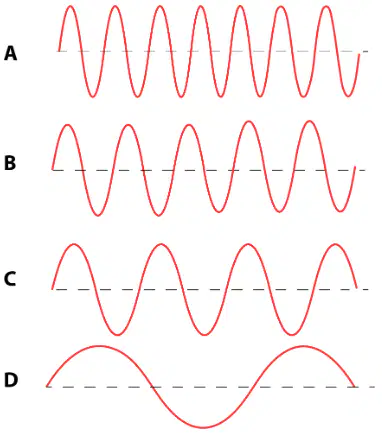
Use the image below to answer the following question.
Which of these waves has the highest frequency?
B
A
D
C
Which type of electromagnetic radiation do the hottest stars primarily emit?
visible light
microwaves
radio waves
X rays and gamma rays
Which statement is true of a reflecting telescope?
It absorbs light from space.
It collects radio waves.
It uses lenses to bend light.
It uses mirrors to focus light.
What is the main reason that space telescopes can gather more information than telescopes on Earth’s surface?
They only detect visible light.
They are optical telescopes.
They are farther from objects in space.
They are above Earth's atmosphere.
What country launched the first space station, Salyut 1, into orbit?
Brazil
the Soviet Union
Japan
USA
What is wavelength?
The distance from one crest to another crest.
Is the same as the electromagnetic spectrum.
The vertical distance from one crest to one trough.
The same thing as the frequency of a wave.
Which of Newton's laws can be clearly observed when applied to the lift-off of a rocket?
The rocket only needs to be filled with fuel and ignited for it to lift off.
Force equals mass multiplied by acceleration.
An object in motion will remain in motion unless acted upon by a force.
For every action, there is an equal and opposite reaction.
Which planet has been studied using rovers?
Jupiter
Mars
Mercury
Venus
Describe the location of visible light on the electromagnetic spectrum.
It has wavelengths shorter than gamma waves.
It is not on the electromagnetic spectrum.
It is made of multiple colors of light in the middle of the spectrum.
It is next to the radio waves.
The Whirlpool Galaxy is about 23 million light-years from Earth. Which is true of the image of the galaxy we see through a telescope on Earth?
The image is as it looks today.
The image is as it was 23 million years ago.
The image is as it will be 23 million years in the future.
The image is as it was at the beginning of the universe.
What type of satellites are used for GPS (Global Positioning System)?
communication satellites
navigational satellites
imaging satellites
the International Space Station
Which of the following was the first U.S. space station?
Mir
Salyut 1
International Space Station
Skylab
What is the primary purpose of the International Space Station?
International cooperation
Scientific research
Developing space technology
Learning how to live in space
Approximately how long does it take sunlight to get from the Sun to Earth?
8 days
8 minutes
8 hours
8 seconds
Which part of the electromagnetic spectrum do optical telescopes use?
visible light
infrared rays
gamma rays
X-rays
Which statement is false about space shuttles?
The orbiter is part of a space shuttle that can be navigated like an airplane.
The Challenger and Columbia were space shuttle disasters.
All parts of the space shuttle are reusable.
Space shuttles can haul cargo into space.
What event started the Space Race between the USSR and the USA?
Challenger Disaster
the Apollo Mission
Launch of Explorer 1
Launch of Sputnik 1
What type of telescope uses only lenses to bend light to make distant objects seem nearer and larger?
reflecting telescope
space telescope
radio telescope
refracting telescope
Which best describes the use of imaging satellites?
used for scientific research with human inhabitants
used to study and make maps of the Moon and other planets
used for navigation and GPS
used to send signals for telephone and television
Space satellites are used for which of the following?
take detailed images of the Earth
all of theses are uses of space satellites
monitor climate change
study the oceans, atmosphere, and other Earth Systems
Which of the following is a benefit of radio telescopes?
They can be linked together by a computer to collect more data on a single object.
They are relatively small so they can be put in many different places.
They are inexpensive and easy to use for amateur astronomers.
They are best for putting into space above Earth’s atmosphere.
Which of the following is NOT a benefit of artificial satellites?
reduce the cost of space missions
for navigation such as GPS
sending signals to help with communication
take pictures of Earth’s surfaces
Which of the following space projects was the first case of the United States and Russia (formerly USSR) working together?
Mir Space Station
International Space Station
Salyut 1
Apollo Program
What is thrust?
the image produced by a refracting telescope
the image produced by a reflecting telescope
the movement of a satellite across the sky
the force pushing a rocket
What is the name of the accepted model of our solar system with the Sun at the center?
heliocentric model
geocentric model
elliptical model
Aristotelian model
Which part of the Sun can get up to 15 million degrees Celsius?
corona
photosphere
radiative zone
core
When does an equinox occur?
June 21 and December 21
March 21 and September 21
September 21 and December 21
December 21 and March 21
Which statement is true of all lunar eclipses?
The Moon casts its shadow on Earth.
Earth is between the Sun and the Moon.
They can only be seen from a specific location on Earth.
They occur only during the first or last quarter Moon.
What is the outer part of the shadow of the Moon called?
penumbra
umbra
lunar eclipse
solar eclipse
Which describes when the Moon’s phases are waning?
first quarter to a full moon
last quarter to a new moon
first quarter to a new moon
new moon to a full moon
What kind of reaction powers the Sun?
light reaction
cheminuclear reaction
chemical reaction
nuclear reaction
Which of the following best explains why it is warmer at the Equator than at the North Pole?
The Equator has a larger area than the North Pole.
The Equator is closer to the Sun than the North Pole.
The Equator receives more direct sunlight than the North Pole.
The Equator has more hours of daylight per year than the North Pole.
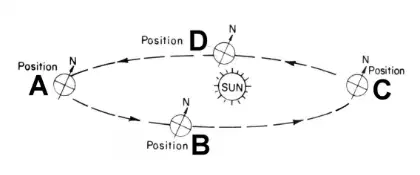
Which position of the Earth represents summer for the Northern hemisphere?
A
B
C
D
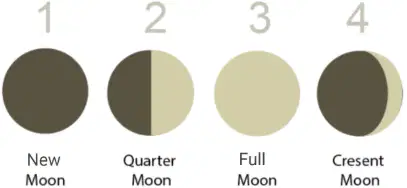
Which image shows the appearance of the Moon when a solar eclipse occurs?
3
2
1
4
Which fact is FALSE about the Sun?
The Sun’s mass makes up 99.8% of the entire mass of the Solar System.
The Sun is mostly made of gas, the 4th phase of matter.
New elements are made inside of stars, like the Sun.
Solar Flares from the Sun can disrupt power or communications on Earth.
Which of the following statements best describes one way that the Moon is different from Earth?
The Moon is not solid.
The Moon has almost no atmosphere.
The Moon has no gravity.
The Moon receives almost no solar light.
What shape describes Earth’s motion around the Sun?
a perfect circle
a straight line
a nearly circular path
an irregular path
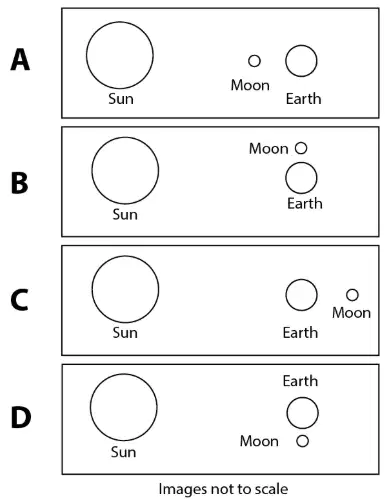
Which image depicts the relative position of the Sun, Earth, and Moon during a solar eclipse?
A
B
C
D
Why does Earth stay in orbit?
the lunar cycle
Earth's rotation
the tilt of Earth on its axis
the gravitational pull of the Sun
Imagine that you work for a satellite company. Which of the following would cause the most damage to your equipment, possibly?
solar flare
solar prominence
sunspot
broken magnetic field on the Sun
What is the spinning of Earth on its axis called?
rotation
revolution
gravity
nuclear fusion
What term describes the day on which Earth’s rotation axis is the most toward or away from the Sun?
solstice
equinox
waning phase
waxing phase
What is the Moon called when it is more than half-lit?
harvest moon
blue moon
crescent
gibbous moon
Why does the same side of the moon always face Earth?
because the Moon rotates on its axis once for every orbit it makes around Earth
because the Earth’s gravity pulls on one side more
because the Moon does not move
both the Moon and Earth are always in the same position
Suppose Earth was tilted much less on its axis. What effect would this have on the planet?
Winters would be warmer.
A day would be much longer.
Eclipses would not take place.
Tides would not occur as often.
Which is NOT an effect of the motions of the Moon?
solar eclipses
the lunar cycle
seasons on Earth
high and low tide
What causes the Moon to change phases?
its small diameter
its rotation on its axis
its movement around Earth
How long does it take for Earth to complete one revolution around the Sun?
24 hours
12 hours
1 day
365 days
Why are solar eclipses rare?
The Sun casts a big shadow.
The Moon casts a small shadow.
The Moon is far away.
The Earth is stationary.
When do comets form a glowing tail?
when they combine with a meteor (falling star)
when they are at the farthest point from the Sun
when the Sun’s heat turns their ice into a gas
comets always have a glowing tail
Which planet in the solar system is the largest?
Jupiter
Saturn
Neptune
Uranus
Which best describes small, rocky objects that orbit the Sun between Mars and Jupiter?
comets
asteroids
meteorites
meteors
What do scientists think the solar system formed from?
a nebula
a black hole
a star
a galaxy
Which color indicates a star with the highest temperature?
red
orange
yellow
blue
AU stands for __________ and it is the distance between __________.
astronomical units; Earth and the Sun
astrology units; Earth and the nearest star outside our solar system
astrology units; Earth and the Sun
astronomical units; Earth and the nearest star outside our solar system
What are the atmospheres of the outer planets mostly composed of?
gases like hydrogen and helium
metals like iron and zinc
layers of rocks
layers of ice and dust
Which describes stars in an open cluster?
old
densely packed
blue
millions of stars
Which of the following best describes Pluto?
planet
dwarf planet
comet
asteroid
What is the correct order of the inner planets starting at the Sun?
Venus, Mercury, Mars, Earth
Mars, Venus, Earth, Mercury
Earth, Mercury, Venus, Mars
Mercury, Venus, Earth, Mars
Which of the following statements describes a planet but not a dwarf planet?
It has enough mass to form a spherical shape.
It has cleared its orbit of smaller objects.
It is not a moon of a larger planet.
It orbits around a star.
Which is true of the inner planets?
all have several moons
they are rocky and solid
they are gaseous balls
all have rings
Which scenario below most likely describes the events in the formation of the solar system?
A black hole forms, the black hole emits matter which forms planets, the planets begin to spin.
A nebula contracts, the contracting nebula spins as it contracts, planets form from small dense areas within the nebula.
A black hole begins to spin, a nebula spins out of the black hole, planets spin out of the nebula.
Planets form, planets attract other matter which forms a nebula, the nebula contracts in the middle to make a star.
What force is most likely responsible for a nebula contracting to form a solar system?
gravity
magnetic force
electric force
strong nuclear force
The disk-shape caused by the spinning of the nebula explains what property of our solar system?
All planets are found in the same plane.
All planets have large masses.
All planets have rings.
All planets are made of gas.
What is the temperature range of a yellow star?
10,000 - 30,000 K
7,500 - 10,000 K
5,500 - 6,000 K
3,500 - 5,000 K
What is the difference between a meteor and a meteorite?
A meteor burns up in the atmosphere but a meteorite never makes it to the atmosphere.
A meteor burns up in the atmosphere but a meteorite makes it through the atmosphere and strikes Earth.
A meteor burns in the atmosphere but a meteorite burns up in the Sun.
A meteor strikes Earth but a meteorite strikes the Moon.
Most of the asteroids of our solar system move around the Sun between the orbits of which planets?
Jupiter and Saturn
Venus and Earth
Earth and Mars
Mars and Jupiter
Which is true about our solar system?
more than 500 moons
three dwarf planets
nine planets
many asteroids and small objects
The force of gravity between objects depends on their _______ and ______.
volume; their acceleration
mass; the distance between them
size; their gravitational potential energy
density; kinetic energy
What is a nebula?
the material that was left over from the Big Bang
a giant cloud of dust and gas
a newly formed star
a mixture of Sun and planets
The largest star in the sky, Sirius A has a smaller companion star known as Sirius B. What best describes Sirius A and Sirius B?
binary stars
open cluster
globular clister
galaxy
The planets are all very far from the Sun, but they continue to orbit the star because ____.
the Sun and the planets are very massive
the Sun’s gravity increases with distance from it
centrifugal forces continue to operate even when two objects are too far for gravity
space has fibers that keep the planets orbiting the Sun
How does the orbital radius of the outer planets compare to the inner planets?
much larger
equal in size
slightly smaller
much smaller
Which statement is false about galaxies?
made of millions to billions of stars
can be spiral, elliptical, or irregular in shape
the Milky Way is an example
there is only one known galaxy

