wayground logo

Free Printable Worksheets

Font size

S
M
L
XL
Worksheets

Grade 10 Digestive system revision

Total questions: 115

Worksheet time: 1hrs 3mins

Name
Class
Date
1.

Which organ releases digestive enzymes into the small intestine?

a)

pancreas

b)

small intestine

c)

esophagus

d)

salivary glands

2.

What organ is responsible for the majority of the absoption that occurs in the digestive system?

a)

large intestine

b)

small intestine

c)

stomach

d)

oral cavity

3.

Which of the following is an accessory organ of the digestive system?

a)

stomach

b)

small intestine

c)

esophagus

d)

liver

4.

Which organ stores and releases bile?

a)

liver

b)

gallbladder

c)

pancreas

5.

Which organ makes bile?

a)

liver

b)

gallbladder

c)

pancreas

6.

What organ is responsible for the absorption of water and movement of waste?

a)

large intestine

b)

small intestine

c)

stomach

d)

oral cavity

7.

What carries food from the pharynx to the stomach?

a)

larynx

b)

trachea

c)

esophagus

d)

bronchioles

8.

What enzyme is found in saliva that starts digesting carbohydrates?

a)

amylase

b)

chyme

c)

pepsin

d)

bile

9.

What are the rhythmic muscular contractions of your esophagus called to help food move along?

a)

swallowing

b)

peristalsis

c)

inertia contractions

d)

paralysis

10.

What does the pancreas do?

a)

produces digestive enzymes to break down proteins and fats

b)

produces sodium bicarbonate to neutralize stomach acid

c)

regulates our blood sugar levels

d)

all answers are correct

11.

Which action takes place in the stomach ?

a)

Large fat molecules are digested into smaller molecules

b)

Proteins are broken down

c)

Amylase breaks down starches into smaller sugar molecules

d)

Insulin is secreted for use in the small intestine

12.

Which row in the chart contains the words that best complete this statement? The (1) produces (2) which is secreted into the (3).

a)

Row A

b)

Row B

c)

Row C

d)

Row D

13.

A person complaining of digestion problems is not digesting fats well .Which is a reasonable explanation for this condition ?

a)

The stomach is secreting too much acid

b)

The person is secreting excess bile

c)

the bile duct is blocked

d)

the pyloric sphincter is blocked

14.

A person is taking a medication for 5 days .Which of the following is likely to be a consequence of this medication ?

a)

Enzymes secreted by the pancreas would not function well

b)

Amylase would not be able to break down starch

c)

Pepsin would not be able to break down proteins

d)

Bile would not be able to be produced

15.

The organ that produces BILE is

a)

B

b)

C

c)

E

d)

A

16.

Organ B is called the .............and is used to produce hormones ............and .............

a)

liver : bile : gall bladder

b)

pancreas : insulin : glucagon

c)

small intestine : pancreas : amylase

d)

liver : pepsin : amylase

17.

The process that is taking place there is

a)

peristalsis

b)

digestion

c)

absorption

d)

excretion

18.

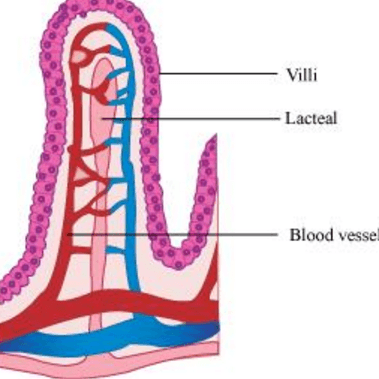
This structure is called the

a)

intestine

b)

stomach

c)

villus

d)

gall bladder

19.

What is the function of this structure ?

a)

To digest the food

b)

To digest the food mechanically

c)

To absorb all the digested food particles

d)

To excrete the wastes

20.
Which is NOT a function of the Digestive System?
a)
To rid the body of solid waste
b)
Absorb nutrients for energy & growth
c)
Break down nutrients from food
d)
Pump blood around the body
21.
What is the correct order of digestion?
a)
Mouth - pharynx - stomach - esophagus - L.I. - S.I. - anus - rectum
b)
Pharynx - mouth - esophagus - stomach - gall bladder - S.I. - rectum - anus - L.I.
c)
Mouth - pharynx - pancreas - stomach - rectum - gall bladder - S.I. - rectum - anus
d)
Mouth - pharynx - esophagus - stomach - S.I. - L.I. - rectum - anus
22.
The chewing and grinding of food into smaller pieces is an example of...
a)
Mechanical Digestion
b)
Chemical Digestion
23.
What is one secondary (helper) organ of the digestive system?
a)
Small Intestine
b)
Esophagus
c)
Gallbladder
d)
Stomach
24.
Bile is made by which digestive organ?
a)
Gallbladder
b)
Stomach
c)
Rectum
d)
Liver
25.
Which digestive organ makes digestive juices to help the small intestine absorb nutrients?
a)
Liver
b)
Gallbladder
c)
Pancreas
d)
Esophagus
26.
Nutrients from digested food are absorbed in which digestive organ?
a)
Small Intestine
b)
Stomach
c)
Large Intestine
d)
Gallbladder
27.
Which of the following is NOT part of the digestive tract?  (Hint:  Identify the secondary organ.)
a)
Mouth
b)
Esophagus
c)
Small Intestine
d)
Liver
28.
As waste moves through the digestive system, the ______ absorbs water before storing waste in the rectum.
a)
Small intestine
b)
Stomach
c)
Esophagus
d)
Large intestine
29.
Bile is stored in which secondary digestive organ?
a)
Stomach
b)
Liver
c)
Gallbladder
d)
Pancreas
30.
What is the substance found in the stomach that allows for chemical digestion to take place?
a)
Gastric Juices
b)
Saliva
c)
Bile
31.
Enzymes (chemicals) in your saliva help break down food while chewing.  This is...
a)
Mechanical digestion
b)
Chemical digestion
32.
What does saliva do?
a)
Chemically digests food in the mouth.
b)
Chemically digests food in the stomach
c)
Protects the stomach from digesting iteself
d)
Absorbs nutrients from food so the body has energy.
33.
What do the villi do?
a)
Digests food in the mouth.
b)
Digests food in the stomach
c)
Protects the stomach from digesting iteself
d)
Absorbs nutrients from food so the body has energy.
34.
Where does digestion begin?
a)
Mouth
b)
Esophagus
c)
Stomach
d)
Small Intestine
35.
What is the name of the molecule in saliva that chemically digests food?
a)
bile
b)
stomach acid
c)
enzymes
d)
chyme
36.
Which of the following chemicals is secreted in the stomach?
a)
Amylase 
b)
Synthase 
c)
pepsin 
d)
lipase
37.

What is organ R?

(a)  

38.

What is organ L?

(a)  

39.

What is organ J?

(a)  

40.

Define the term ingestion

a)

The movement of nutrients from the digestive system into the blood

b)

The removal of undigested food from the body

c)

The breaking down of large insoluble molecules into small soluble molecules

d)

The taking in of nutrients.

41.

Define the term digestion

a)

The movement of nutrients from the digestive system into the blood

b)

The removal of undigested food from the body

c)

The breaking down of large insoluble molecules into small soluble molecules

d)

The taking in of nutrients.

42.

What gland produces amylase?

a)

Liver

b)

Gall bladder

c)

Salivary gland

d)

stomach

43.

Define the term mechanical digestion

a)

The breaking down of large food molecules by the use of enzymes.

b)

The physical break down of food done by the teeth or the muscles in the stomach.

44.

What is the pH in the stomach?

a)

pH 1-2

b)

pH 3-4

c)

pH 11-12

d)

ph 13-14

45.

What part of the small intestine does the digestion of nutrients finish?

a)

Ilium

b)

Duodenum

c)

Gall Bladder

d)

Liver

46.

What is absorbed into the blood from the large intestine?

a)

Digested nutrients

b)

Fibre

c)

Water

d)

Chyme

47.

What is the role of bile in digestion?

a)

Emulsifies fat

b)

Kills bacteria

c)

Acidifies stomach acid

d)

Turns food into a bolus

48.

What is the job of the pancreas in digestion?

a)

Produces acid

b)

Produces bile

c)

Produces digestive enzymes

d)

Produces chyme

49.

Where does absorption occur?

a)

Stomach

b)

Duodenum

c)

Ilium

d)

Liver

50.

Which of the following is NOT involved in the process of digestion?

a)

Kidney

b)

Liver

c)

Pancreas

d)

Gallbladder

51.

What is the correct order of the following processes?

a)

ingestion, digestion, elimination, absorption

b)

digestion, ingestion, absorption, elimination

c)

ingestion, digestion, absorption, elimination

d)

digestion, elimination, ingestion, absorption

52.

What is the function of the gallbladder?

a)

produce bile

b)

store bile

c)

absorb vitamins

d)

digest protein

53.

What are the two major functions of the digestive system?

a)

ingestion and circulation

b)

ingestion and elimination

c)

digestion and circulation

d)

digestion and absorption

54.

wave-like contractions are called...

a)

esophagus

b)

pancreas

c)

peristalsis

d)

epiglottis

55.
Rhythm-like smooth muscle contractions in the walls of the GI tract?
a)
De-glutition
b)
Reverse Peristalsis
c)
Peristalsis
d)
Cardiac activity
56.
The digestion of starch begins in the ?
a)
stomach
b)
mouth
c)
small intestine 
d)
gall bladder
57.
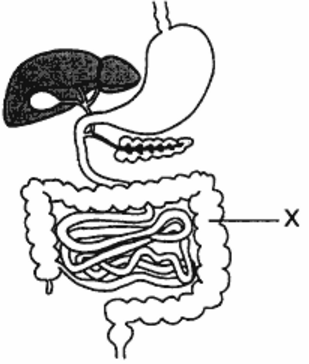
The diagram represents a portion of a human body. The principal function of structure X  is to
a)
produce salivary enzyme
b)
produce sex hormone
c)
absorb water and waste removal
d)
absorb nutrients
58.
Choking on food is most likely caused by an interference with the proper functioning of the
a)
diaphragm
b)
nasal cavity
c)
bronchial tubes
d)
epiglottis
59.
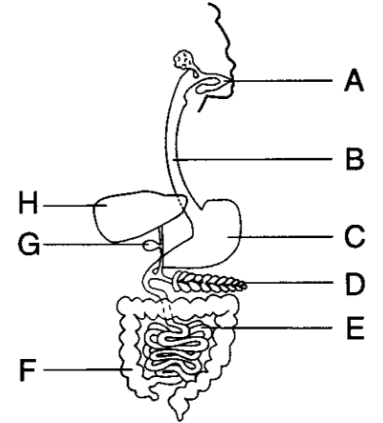
The diagram represents human digestive system. From which structure are glucose and amino acids normally absorbed into the circulatory system?
a)
F - Large Intestine
b)
H - Liver
c)
C - Stomach
d)
E - Small Intestine
60.
Look at the diagram. In which structure does the initial digestion of carbohydrates occur?
a)
A - Mouth
b)
E - Small Intestine
c)
C - Stomach
d)
D - Pancreas
61.
Bile is a secretion which aids in the digestion of
a)
Fats (Lipids) and Protein
b)
Sugars
c)
Starch
62.
Which structures secrete chemicals utilized for the completion of digestion within the small intestine?
a)
Liver and pancreas
b)
glomerulus and villi
c)
esophagus and alveoli
d)
gallbladder and pharynx
63.
The dotted line digestive enzyme is found in what part of the digestive system?
a)
Large Intestine
b)
Stomach
c)
Small intestine
d)
Mouth
64.
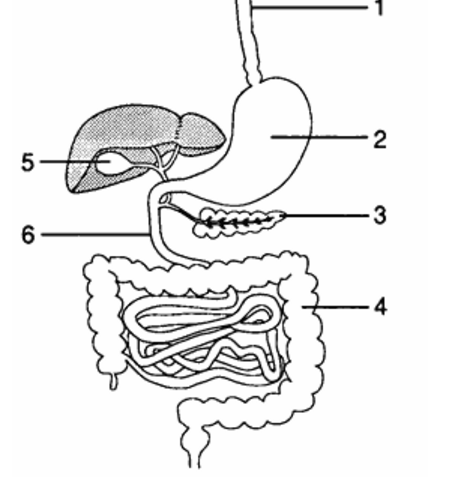
A painful condition results from erosion of the surface of this organ by gastric juices. Select the organ, from the diagram, that most closely relates to that malfunction.
a)
1-Mouth
b)
3-Pancreas
c)
2-Stomach
d)
4-Large Intestine
65.
Which structure represented in the diagram below absorbs most of the fatty acids and glycerol .This structure is present in 
a)
Stomach
b)
Mouth
c)
small intestine 
d)
large intestine
66.
Which structure is responsible for water absorption and production of Vitamin K?
a)
epiglottis
b)
Stomach
c)
Large intestine
d)
Small intestine
67.
Which structure is a 'trapdoor' that prevents food from entering the trachea?
a)
epiglottis
b)
esophagus
c)
pharynx
d)
appendix
68.
Which structure makes bile?
a)
Stomach
b)
Pancreas
c)
Liver
d)
mouth
69.
What is secreted in the stomach to kill bacteria?
a)
amylase
b)
Hydrochloric acid
c)
Sodium bicarbonate
d)
bile
70.
Which organ makes enzymes (lactase, amylase, protease, maltase) to break down the food that you eat?
a)
gallbladder
b)
liver
c)
pancreas
d)
rectum
71.
Where does physical digestion occur in the digestive system?
a)
pancreas and liver
b)
mouth and small intestine
c)
stomach and small intestine
d)
mouth and stomach
72.

What type of digestion takes place in the stomach?

a)

mechanical

b)

chemical

c)

both mechanical and chemical

73.
Name this structure
a)
spleen
b)
gall bladder
c)
pancreas
d)
jejunum
74.
What  does not occur here?
a)
mechanical digestion
b)
chemical digestion
c)
absorption
d)
all occur here
75.
Mechanical digestion does NOT occur in the.....
a)
mouth
b)
stomach
c)
small intestine
d)
large intestine
76.

Proteins break down to:

a)

fatty acids

b)

nucleic acids

c)

amino acids

d)

hydrochloric acids

77.

Which of the following would be considered an essential nutrient?

a)

fat

b)

carbohydrates

c)

proteins

d)

fiber

e)

sugar

78.

Which of the following would not provide carbohydrates to the body?

a)

bread

b)

fruit

c)

candy

d)

chicken

79.

What is this organ (the one in red)?

a)

Pancreas

b)

Kidney

c)

Liver

d)

Stomach

80.

What is the acidic fluid that passes from the stomach following churning?

a)

Bolus

b)

Chyme

c)

Hydrochloric acid

d)

Enzymes

81.

What are these structures call that are found on the lining of the small intestine?

a)

Gallbladder

b)

Villi

c)

Sphincter

d)

Duodenum

82.

Where does the digestion of carbohydrates take place?

a)

Mouth

b)

Mouth and Stomach

c)

Mouth and small Intestine

d)

Mouth and large intestine

e)

Stomach

83.

Where is the bile produced?

a)

Liver

b)

Pancreas

c)

Salivary glands

d)

Gall bladder

84.
This is the enzyme that works on protein.
a)
pepsin
b)
HCl
c)
Bicarbonate
d)
Lactase
85.

Which of the following is NOT a nutrient?

a)

Fats

b)

Water

c)

Fiber

d)

Vitamins

86.

Enzymes are catalysts. What is a catalyst

a)

speeds up a chemical reaction

b)

slows down a chemical reaction

c)

has no effect on a chemical reaction

d)

it slows dow and speeds up a chemical reaction

87.

what are enzymes made up of?

a)

sugars

b)

proteins

c)

fats

d)

fiblre

88.

Where does the digestion of carbohydrates take place?

a)

Mouth

b)

Mouth and Stomach

c)

Mouth and small Intestine

d)

Mouth and large intestine

e)

Stomach

89.

Where does the digestion of lipids take place?

a)

Stomach

b)

Stomach and small intestine

c)

Small intestine

d)

Mouth, stomach and small intestine

e)

Mouth and small intestine

90.

What are the two components of the gastric juice?

a)

Pepsine and hydrochloric acid

b)

Saliva and bile

c)

Bile and hydrochloric acid

d)

Amyase and hydrochloric acid

91.

Which are the three juices released in the duodenum (small intestine)?

a)

Bile, pancreatic juice and gastric juice

b)

Bile, pancreatic juice and intestinal juice

c)

Bile, gastric juice and saliva

d)

Bile, intestinal juice and pancratic juice

92.

Which are the nutrients digested in the mouth?

a)

Carbohydrates and proteins

b)

Proteins

c)

Carbohydrates

d)

Fats

e)

All the abov

93.

. Which are the nutrients digested in the stomach?

a)

Carbohydrates

b)

Proteins

c)

Carbohydrates and proteins

d)

Fats

e)

All the above

94.

Which are the nutrients digested in the small intestine?

a)

Carbohydrates and proteins

b)

Proteins

c)

Carbohydrates, proteins and lipids

d)

Lipids and proteins

e)

Lipids

95.

What is the enzyme contained in the saliva?

a)

Amylase

b)

Pepsine

c)

Hydrochloride acid

d)

Lipase

96.

Where is the bile stored?

a)

Liver

b)

Gall bladder

c)

Pancreas

d)

Small intestine

97.

Which is the nutrient that bile facilitates its digestion?

a)

Proteins

b)

Lipids

c)

Carbohydrates

d)

Protein and lipids

98.

Where is the pancreatic juice released?

a)

Small intestine

b)

Stomach

c)

Large intestine

d)

Mouth

99.

Where is the gastric juice released?

a)

Stomach

b)

Small intestine

c)

Mouth

d)

Large intestine

100.

What is the function of the villi?

a)

To increase the absorption surface

b)

To digest the last nutrients

c)

To form feces

d)

To comb the small intestine

101.
If the liver is not functioning properly, what would most likely be the result?
a)
food would not be able to move into the small intestsine
b)
fats would not be digested
c)
water would not be absored
d)
it would not affect digestion
102.
_______ is the condition in which the sphincter between the esophagus and stomach lets stomach acid go into the esophagus.  The esophagus is not adequately protected against stomach acid, so it burns and irritates the esophagus.  Causes could be increased production of stomach acid, weak sphincter, etc. 
a)
Heartburn
b)
Ulcer
c)
Appendicitis
d)
Diarrhea
103.
All of the following are examples of lipids EXCEPT
a)
Olive oil
b)
Butter
c)
Coconut oil
d)
Legumes
104.
All of the following are examples of carbohydrates EXCEPT
a)
Steak
b)
Fruits
c)
Vegetables
d)
Grains
105.
Fish, beans, eggs, peanut butter, and chicken are all good sources of which biomolecule?
a)
Protein
b)
Carbohydrate
c)
Lipids
d)
Nucleic Acid
106.
Bile is responsible for the breakdown of __________.
a)
Lipids
b)
Proteins
c)
Starches
d)
Pepsin
107.
__________ is produced by the pancreas and is necessary for the movement of glucose into cells.
a)
Bile
b)
Chymotripsin
c)
Insulin
d)
Trypsin
108.
Micronutrients, such as _______________ are needed in ________ quantities in the body.
a)
Vitamins and minerals; small
b)
Proteins and carbohydrates; large
c)
Proteins and carbohydrates; small
d)
Vitamins and minerals; large
109.
__________ are organic compounds that are necessary for the body to function
a)
Vitamins
b)
Minerals
c)
Micronutrients
110.
__________ are inorganic compounds that are necessary for the body to function
a)
Vitamins
b)
Minerals
c)
Micronutrients
111.
__________ is the condition that is characterized by decreased water absorption and increased peristaltic activity of the large intestine.
a)
Peristalsis
b)
Microvilli
c)
Diarrhea
d)
Constipation
112.
____________ are an erosion of the surface of the alimentary canal generally associated with some kind of irritant.
a)
Appendicitis
b)
Gall stones
c)
Heartburn
d)
Ulcers
113.
_________ is a condition in which the large intestine is emptied with difficulty. 
a)
Constipation
b)
Diarrhea
c)
Heartburn
d)
Gall stones
114.
Each of the following is a section of the small intestine EXCEPT
a)
Jejunum
b)
Ileum
c)
Colon
d)
Duodenum
115.
Bile is produced in the ________ and stored in the __________.
a)
Liver; gall bladder
b)
Liver; pancreas
c)
Gall bladder; liver
d)
Pancreas; gall bladder