
 Worksheets
G Proteins and Signal Transduction
Total questions: 83
Worksheet time: 42mins
What is the primary function of G proteins in cells?
To act as molecular switches and transmit signals inside cells
To synthesize proteins from amino acids
To store genetic information
To break down glucose for energy
Which nucleotide is bound to G proteins when they are in the 'on' state?
ATP
GTP
GDP
CTP
What happens to G proteins when they are bound to GDP?
They are 'on'
They are 'off'
They are degraded
They are phosphorylated
Which of the following is NOT a subunit of heteromeric G-protein complexes?
Alpha (Gα)
Beta (Gβ)
Gamma (Gγ)
Delta (Gδ)
What is the main difference between the two classes of G proteins?
One class is found only in plants, the other in animals
One class functions as monomeric small GTPases, the other as heteromeric complexes
One class binds DNA, the other binds RNA
One class is always active, the other is always inactive
Which type of receptor activates heterotrimeric G proteins within the cell?
Ion channel receptors
G-protein coupled receptors (GPCRs)
Enzyme-linked receptors
Nuclear receptors

What is the role of the beta and gamma subunits in heteromeric G-protein complexes?
They form a stable dimeric complex known as the beta-gamma complex
They hydrolyze ATP
They bind to DNA
They act as receptors for hormones
Why are G proteins classified as GTPases?
Because they synthesize GTP
Because they hydrolyze GTP to GDP
Because they transport GTP across membranes
Because they are only active in the presence of calcium
Which of the following best describes the primary function of G protein-coupled receptors (GPCRs) in cell signaling?
They directly synthesize proteins.
They transmit signals from hormones and neurotransmitters to trigger cellular responses.
They store genetic information.
They break down metabolic enzymes.
What is the main role of small GTPases in the cell?
To act as large structural proteins
To function as small molecular switches regulating various cellular processes
To store energy in the form of ATP
To degrade ribosomes
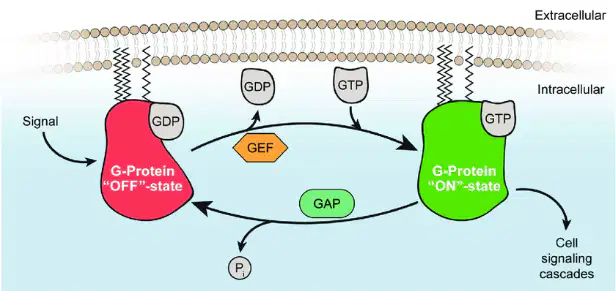
Which molecule is bound to a G-protein when it is in the "OFF" state?
GTP
ATP
GDP
ADP
Which of the following statements about the activation and inactivation of G-proteins is correct?
G-proteins are active when bound to GDP and inactive when bound to GTP.
G-proteins are always active regardless of what is bound.
G-proteins are active when bound to GTP and inactive when bound to GDP.
G-proteins are only active in the presence of calcium ions.
Which protein accelerates the hydrolysis of GTP to GDP in small GTPases?
GEF (Guanine nucleotide exchange factor)
GAP (GTPase activating protein)
GDI (Guanine nucleotide dissociation inhibitor)
ATPase
Small GTPases are responsible for which of the following cellular processes? (Select the most comprehensive answer.)
Only protein synthesis
Only lipid vesicle movement
Growth, cellular differentiation, lipid vesicle movement, and cell movement
Only cell division
The first and prototypical small GTPases were identified as proteins encoded by which type of viral oncogenes?
Influenza virus oncogenes
RAt Sarcoma (Ras) virus oncogenes
HIV virus oncogenes
Adenovirus oncogenes
Which of the following best explains the role of guanine nucleotide exchange factors (GEFs) in the regulation of small GTPases?
They inhibit the binding of GTP to G-proteins.
They catalyze the exchange of GDP for GTP, activating the G-protein.
They degrade G-proteins.
They prevent the hydrolysis of GTP.
Which of the following is NOT one of the five main families of the Ras superfamily?
Arf
Rho
Ran
Myc
What is the primary function of G-proteins when bound to GTP?
They degrade proteins
They undergo a conformational change and can transport cargo
They synthesize DNA
They break down glucose
What induces the 'off' state in G-proteins?
Binding to ATP
Hydrolysis by a GAP
Phosphorylation by a kinase
Binding to calcium ions

What does the diagram illustrate about the state of G-proteins?
G-proteins are always active regardless of nucleotide binding
G-proteins switch between 'on' and 'off' states depending on whether they are bound to GTP or GDP
G-proteins only function in the presence of calcium
G-proteins are not involved in cellular transport
Which of the following is an example of an effector regulated by small GTPases?
DNA polymerase
Protein kinases
Hemoglobin
Amylase
Why is the two-state structural change of small GTPases fundamental for their biological function?
It allows them to bind to DNA
It enables them to switch between high and low affinity for effectors, regulating signaling pathways
It helps them break down glucose
It allows them to synthesize proteins
How do Ras superfamily members act as transporters in the cell?
By synthesizing ATP
By recognizing receptors or markers, binding to effectors, and transporting them to their destination
By breaking down proteins
By producing hormones
Which of the following small GTPases require prenylation to be anchored to the plasma membrane?
Arf family members
Rab and Ras family members
Ran family members
All GTPases
What is the function of the 'CaaX' box at the carboxy terminal end of the Ras protein?
It binds GTP
It is the recognition site for prenylation
It anchors the protein to the nucleus
It initiates protein synthesis
Which enzyme is responsible for Rab protein prenylation?
Farnesyl transferase
Geranylgeranyl transferase
Protease
Methylase
What is myristoylation?
Addition of a phosphate group to a protein
Covalent attachment of a myristoyl group to an N-terminal glycine residue
Addition of a methyl group to a protein
Removal of a fatty acid from a protein
Which of the following statements about Arf proteins is TRUE?
They are always membrane-bound by prenylation
They are anchored to membranes via N-terminal myristoylation
They do not regulate vesicular trafficking
They are not affected by cholera toxin
Explain how Arf proteins regulate vesicular trafficking and actin remodeling in eukaryotic cells.
By directly synthesizing vesicles
By recruiting specific protein effectors to the membrane surface in their GTP-bound form
By degrading actin filaments
By inhibiting GTP binding and hydrolysis

Which of the following best describes the primary function of ARF-1 in cellular trafficking?
It regulates COPI coat recruitment and acts as a molecular scaffold for actin assembly.
It synthesizes proteins in the endoplasmic reticulum.
It degrades vesicles in the lysosome.
It transports DNA between the nucleus and cytoplasm.
What is the role of actin in vesicle trafficking as described in the text?
Actin acts as a molecular scaffold, providing force to deform membranes and facilitate vesicle movement.
Actin synthesizes proteins for vesicle formation.
Actin degrades vesicles after they reach their destination.
Actin prevents vesicle formation in the Golgi.
Which protein does activated Arf1 interact with to help facilitate actin polymerization?
CDC42
RhoA
Myosin
Tubulin
What is the main function of Rho GTPase proteins in animal cells?
They help regulate changes in cell shape throughout the cell life cycle.
They synthesize DNA during cell division.
They transport vesicles to the plasma membrane.
They degrade proteins in the cytoplasm.
Why is cell polarity important before cells undergo processes such as budding, mitosis, or locomotion?
It ensures that cells can properly regulate their shape and function during these processes.
It allows cells to synthesize more proteins.
It increases the rate of DNA replication.
It prevents the cell from undergoing apoptosis.
Explain how ARF GTPases contribute to the regulation of cytoskeletal factors and membrane lipid composition.
By recruiting coat proteins for cargo sorting and enzymes that regulate cytoskeletal factors and membrane lipid composition.
By directly synthesizing cytoskeletal proteins.
By degrading membrane lipids.
By transporting DNA across the nuclear envelope.
Which of the following best describes the primary function of Rho family members in the cell?
They regulate the coupling of extracellular signals with intracellular signal transduction pathways.
They synthesize proteins for the extracellular matrix.
They degrade cytoskeletal proteins.
They transport ions across the cell membrane.
What is the role of GDI in the regulation of Rho family proteins?
It activates Rho proteins by binding GTP.
It prevents premature activation of Rho proteins by binding to RhoGDP.
It degrades Rho proteins in the cytoplasm.
It phosphorylates Rho proteins to activate them.
Which member of the Rho family is primarily involved in the regulation of the cell cycle and actin reorganization?
Rac1
RhoA
Cdc42
Ras
Rac1 is most directly involved in which of the following cellular processes?
Regulation of actin stress fibers and contractility
Translocation of GLUT4 and cytoskeleton reorganization
Inhibition of cell migration
Degradation of extracellular matrix proteins
Which of the following is NOT a function regulated by Rho family members as listed in the material?
Cell trafficking
Immune response
Protein synthesis
Cell cycle progression
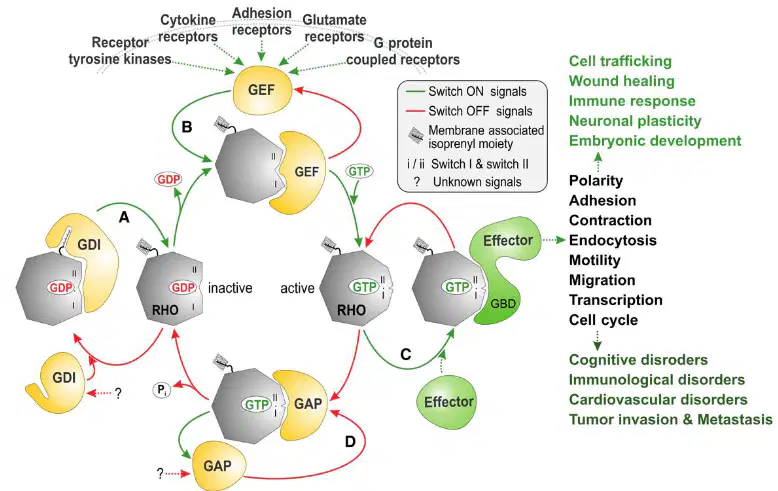
What is the role of GEF in the Rho protein signaling pathway?
It inactivates Rho proteins by promoting GDP binding.
It activates Rho proteins by promoting GTP binding.
It degrades Rho proteins.
It transports Rho proteins to the nucleus.
Which Rho family member is primarily associated with actin stress fiber formation and actomyosin contractility?
Rac1
Cdc42
RhoA
Ras
Which of the following best summarizes the overall function of Rho family members in the cell?
They regulate cytoskeleton dynamics, cell shape, and cell migration.
They synthesize DNA during cell division.
They transport glucose into the cell.
They degrade signaling proteins.
Which of the following is a central function of Rho GTPases in cellular processes?
DNA replication
Actin reorganization
Protein translation
Lipid synthesis
What is the role of RhoGEF in the regulation of RhoA?
It inactivates RhoA by hydrolyzing GTP.
It activates RhoA by facilitating the exchange of GDP for GTP.
It transports RhoA to the nucleus.
It degrades RhoA.
Which cellular processes are influenced by Rho GTPases according to the provided material?
Cell migration, wound healing, cell adhesion, cell polarity, membrane trafficking, and cytokinesis
Protein folding, DNA repair, and RNA splicing
Glycolysis, Krebs cycle, and oxidative phosphorylation
Photosynthesis and nitrogen fixation
What is the function of Ran GTPase in the cell?
Regulating glycolysis
Controlling nuclear import and export
Synthesizing proteins
Degrading mRNA

Based on the diagrams, which proteins are involved in the nuclear import and export processes regulated by Ran GTPase?
Importin-α/β, Exportin/Crm1, NPC
Myosin II, Profilin, LIMK
GPCR, Integrin, ECM
Actin, Tubulin, Keratin

Explain how RhoA activation leads to actin (de)polymerization and actomyosin assembly. Use evidence from the diagram to support your answer.
RhoA activates mDia and ROCK1/2, which regulate actin (de)polymerization and actomyosin assembly through downstream effectors such as Profilin, LIMK, Cofilin, MLCP, and MLC.
RhoA directly binds to actin filaments and causes their breakdown.
RhoA inhibits all actin-related processes.
RhoA only affects cell membrane synthesis.
Which family of proteins do Ran (RAs-related Nuclear) proteins belong to?
Myosin family
Ras superfamily
Tubulin family
Actin family
What is the primary function of Ran proteins in the cell?
DNA replication
Translocation of nucleic acids and proteins through the nuclear pore complex (NPC)
Protein synthesis in the cytoplasm
Lipid metabolism
Which form of Ran is converted to RanGTP by the action of RCC1?
RanGDP
RanADP
RanATP
RanGMP
What is another name for RCC1?
RanGAP
RanGEF
RanBP
RanGDP
What is the role of RanGAP in the Ran cycle?
It binds to importin
It converts RanGTP to RanGDP
It synthesizes DNA
It transports proteins into the nucleus
Why does the concentration of RanGTP and RanGDP differ inside and outside the nucleus?
Because RanGTP is only produced in the cytoplasm
Because RCC1 and RanGAP are located in different places in the cell
Because RanGDP cannot diffuse through the nuclear membrane
Because importin is only found in the cytoplasm
What signal must a protein have to be imported into the nucleus?
Nuclear export signal (NES)
Mitochondrial targeting signal
Nuclear localization signal (NLS)
Endoplasmic reticulum signal
Describe the process by which proteins are imported into the nucleus, including the roles of importin, RanGDP, and the nuclear pore complex.
Proteins with an NLS bind to importin, which then binds to RanGDP. The complex is brought to the NPC, where the RanGDP/RanGTP gradient drives the cargo through. Inside the nucleus, RanGDP is converted to RanGTP, releasing the protein.
Proteins with an NES bind to exportin, which then binds to RanGTP. The complex is brought to the NPC, where the RanGTP/RanGDP gradient drives the cargo through. Inside the nucleus, RanGTP is converted to RanGDP, releasing the protein.
Proteins with an NLS bind to exportin, which then binds to RanGTP. The complex is brought to the NPC, where the RanGTP/RanGDP gradient drives the cargo through. Inside the nucleus, RanGTP is converted to RanGDP, releasing the protein.
Proteins with an NES bind to importin, which then binds to RanGDP. The complex is brought to the NPC, where the RanGDP/RanGTP gradient drives the cargo through. Inside the nucleus, RanGDP is converted to RanGTP, releasing the protein.
What is the analogous process to nuclear import for exporting proteins into the cytosol?
Proteins with an NLS bind to importin and are exported
Proteins with an NES bind to exportin and are exported with RanGTP
Proteins with an NES bind to importin and are exported with RanGDP
Proteins with an NLS bind to exportin and are exported with RanGDP
What additional cellular process are RanGTPases involved in, besides nucleocytoplasmic transport?
Protein glycosylation
Mitotic spindle assembly
Lipid synthesis
Apoptosis
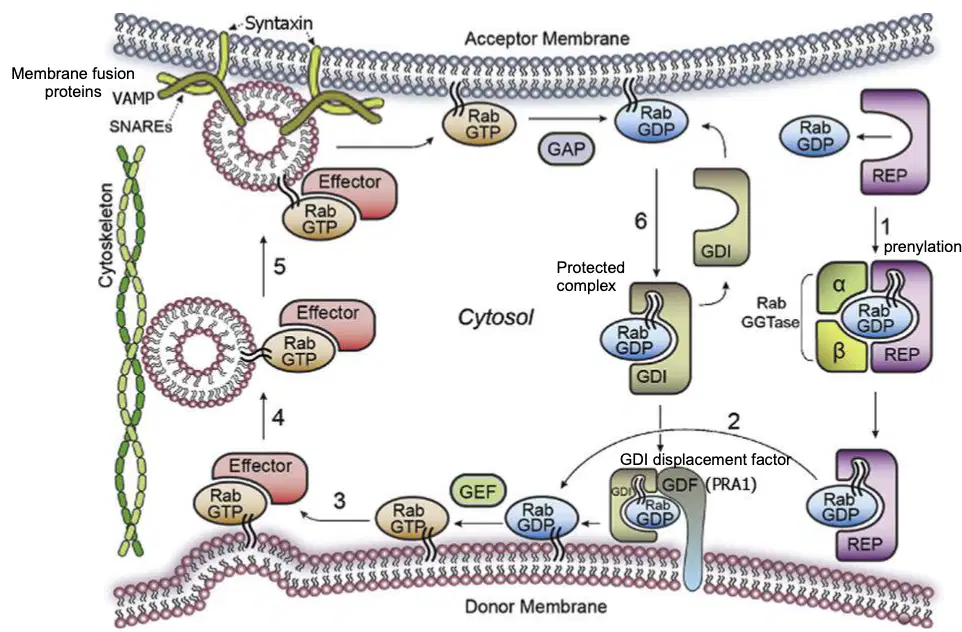
Which of the following is a primary function of Rab GTPases in the cell?
Regulating membrane trafficking and vesicle movement
Synthesizing proteins in the nucleus
Breaking down cellular waste in lysosomes
Producing ATP in mitochondria
What is the role of GEF (Guanine nucleotide Exchange Factor) in the Rab GTPase cycle?
It hydrolyzes GTP to GDP
It replaces GDP with GTP on Rab
It anchors Rab to the membrane
It fuses vesicles with the acceptor membrane
Which protein helps protect inactivated Rab from activation as it returns to the donor membrane?
GAP
GEF
GDI
REP
Rab proteins are anchored to membranes via which type of modification?
Phosphorylation
Glycosylation
Prenylation
Ubiquitination
Explain the sequence of events that occur from Rab protein activation to vesicle fusion with the acceptor membrane.
RabGDP is prenylated, GEF activates RabGTP, RabGTP binds effector, vesicle buds and travels, VAMP fuses vesicle, RabGTP hydrolyzed by GAP, RabGDP protected by GDI
RabGTP is hydrolyzed, vesicle fuses, GEF activates Rab, RabGDP is prenylated, VAMP binds effector, GDI protects Rab
RabGDP binds effector, vesicle fuses, GEF hydrolyzes GTP, RabGTP is prenylated, GAP protects Rab
RabGDP is phosphorylated, vesicle fuses, GDI activates Rab, GEF hydrolyzes GTP, VAMP binds effector
Which of the following best describes the primary function of Rab GTPases in the cell?
They regulate intracellular membrane trafficking by orchestrating the biogenesis, transport, tethering, and fusion of membrane-bound organelles and vesicles.
They act as enzymes that break down proteins in the cytosol.
They are responsible for DNA replication in the nucleus.
They function as structural components of the cell membrane.
What is the role of Ras family GTPases in cellular signaling?
They act as dynamic signaling hubs, amplifying signals and regulating gene transcription related to cell growth, differentiation, and survival.
They are responsible for the synthesis of cholesterol in the ER membrane.
They transport oxygen throughout the cell.
They degrade unwanted proteins in the lysosome.
Ras proteins function as binary molecular switches. What determines whether Ras is in its active or inactive conformation?
Binding to guanosine triphosphate (GTP) activates Ras, while binding to guanosine diphosphate (GDP) inactivates it.
Binding to calcium ions activates Ras, while binding to sodium ions inactivates it.
Phosphorylation by kinases activates Ras, while dephosphorylation inactivates it.
Binding to ATP activates Ras, while binding to ADP inactivates it.
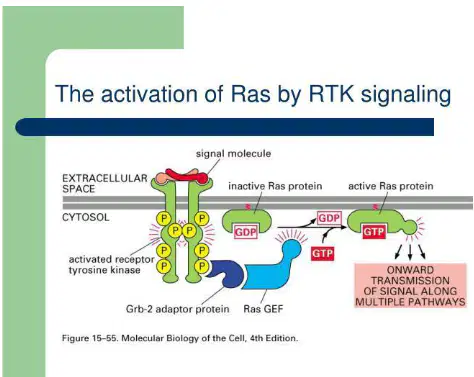
Which step occurs first in the activation of Ras by receptor tyrosine kinase (RTK) signaling?
The RTK is activated by its ligand, leading to autophosphorylation of its cytosolic domain.
Ras binds to GTP and becomes active.
The Grb-2 adaptor protein binds to the activated receptor.
Ras GEF activates Ras.
Which pathway controlled by Ras is directly involved in inhibiting apoptosis?
PI3K/AKT pathway
MAPK/ERK cascade
Cholesterol synthesis pathway
Glycolysis pathway
Why is regulating Ras activity essential for cell fate?
Because Ras controls the expression of genes related to cell proliferation, survival, differentiation, development, cell cycle control, cell motility, and apoptosis.
Because Ras is the main enzyme responsible for DNA replication.
Because Ras is required for the synthesis of all cellular proteins.
Because Ras is the only protein that transports cholesterol in the cell.
Which of the following best describes the normal activation of Ras?
It is permanent and cannot be turned off.
It is transitory and rapidly turned off by a GAP.
It is only activated in the presence of cancer.
It is always inactive in healthy cells.
What is the primary function of Raf kinases in the Ras signaling pathway?
To inhibit cell proliferation
To participate in the RAS-RAF-MEK-ERK signal transduction cascade
To degrade Ras proteins
To block gene expression

Which pathway can Ras activate simultaneously with the MAPK cascade to influence cell survival and proliferation?
JAK/STAT pathway
PI3K/Akt pathway
Wnt/β-catenin pathway
Notch signaling pathway
What is the consequence of mutations that lead to the production of constitutively activated Ras proteins?
Decreased cell growth and division
Unintended and overactive signaling inside the cell, potentially leading to cancer
Enhanced GTP hydrolysis
Increased apoptosis only
Which of the following statements about Ras mutations is correct?
Mutations that permanently activate Ras are rare and found in less than 1% of tumors.
Mutations that permanently activate Ras are found in 20-25% of all tumors and up to 90% in certain tumors.
Ras mutations only occur in non-cancerous cells.
Ras mutations always lead to cell death.
Which three Ras genes are most commonly associated with human cancers?
H-Ras, K-Ras, N-Ras
A-Ras, B-Ras, C-Ras
P-Ras, Q-Ras, R-Ras
X-Ras, Y-Ras, Z-Ras
What is a key feature of the oncogenic forms of H-Ras, K-Ras, and N-Ras proteins?
They have enhanced GTP hydrolysis activity.
They encode constitutively active Ras proteins that prevent GTP hydrolysis.
They are only active in the presence of growth factors.
They are unable to bind GTP.
Explain how mutations in Ras genes can lead to the transformation of a proto-oncogene into an oncogene.
By increasing the rate of apoptosis in cells
By causing Ras proteins to be constitutively active, leading to continuous cell signaling and uncontrolled cell growth
By preventing Ras from binding to the cell membrane
By enhancing the degradation of Ras proteins
Explain why small GTPases can act as molecular switches.
Because they can bind and hydrolyze ATP
Because they can reversibly bind and hydrolyze GTP, switching between active and inactive states
Because they are always active in the cell
Because they are only found in the nucleus
What is the role of guanidine dissociation inhibitors?
They promote the exchange of GDP for GTP
They inhibit the release of GDP from GTPases, keeping them inactive
They activate GTPases by phosphorylating them
They degrade GTPases in the lysosome
Why is the gene encoding the Ras protein in rat sarcoma virus considered to be an oncogene?
Because it codes for a protein that repairs DNA
Because it codes for a protein that is always inactive
Because its overstimulation leads to uncontrolled cell signaling and potential tumor formation
Because it is only expressed in healthy cells
What role do the Ran GTPases play in cells?
They are involved in the regulation of nuclear transport
They synthesize proteins in the ribosome
They break down fatty acids
They repair damaged DNA
Why do Rho, Rab and Ras GTPases need to be prenylated to exert their biological activity?
Prenylation allows them to bind to DNA
Prenylation targets them to cellular membranes, which is essential for their function
Prenylation increases their enzymatic activity in the cytosol
Prenylation causes them to be degraded faster

