Wayground logo

Free Printable Worksheets

Font size

S
M
L
XL
Worksheets

Static and Current Electricity

Total questions: 123

Worksheet time: 2hrs 8mins

Name
Class
Date
1.
Define physics.
a)

The study of living things.

b)

The study of matter and its interactions.

c)

The study of space.

d)

The study of matter and energy.

2.

Electricity is created by the flow of electrons through a conductor.

a)
True
b)
False
3.

Which subatomic particle is transferred to create a charge?

a)

Protons

b)

Electrons

c)

Neutrons

4.

The study of static electricity is known as electrostatics.

a)
True
b)
False
5.
Static electricity is created on an object.
a)
True
b)
False
6.
Static electricity has an unpredictable path.
a)
True
b)
False
7.
An object that stops the flow of electricity is known as a(n)
a)
Circuit
b)
Conductor
c)
Insulator
d)
Resistor
8.
An object that does not allows electricity to flow through it is known as a(n)
a)
Circuit
b)
Conductor
c)
Insulator
d)
Resistor
9.

An object that slows the flow of electricity is known as a(n)

a)
Circuit
b)
Conductor
c)
Insulator
d)
Resistor
10.
The predictable path that electricity flows through it is known as a(n)
a)
Circuit
b)
Conductor
c)
Insulator
d)
Resistor
11.
An object that allows electricity to flow through it is known as a(n)
a)
Circuit
b)
Conductor
c)
Insulator
d)
Resistor
12.
Copper is a(n)
a)
Conductor
b)
Insulator
13.
Pure water is a(n)
a)
Conductor
b)
Insulator
14.
Glass is a(n)
a)
Conductor
b)
Insulator
15.
Rubber is a(n)
a)
Conductor
b)
Insulator
16.
Mineral water is a(n)
a)
Conductor
b)
Insulator
17.
Which of these statements correctly explains the Law of Electric Charges?
a)
Opposite charges repel; similar charges repel.
b)
Opposite charges repel; similar charges attract.
c)
Opposite charges attract; similar charges attract.
d)
Opposite charges attract; similar charges repel.
18.
The triboelectric series explains an object's ability to gain or lose electrons.
a)
True
b)
False
19.
Use the triboelectric series. If ebonite is rubbed by fur. Ebonite will get a positive charge.
a)
True
b)
False
20.
Use the triboelectric series. If glass is rubbed with silk, the silk will end up with a positive charge.
a)
True
b)
False
21.
Use the triboelectric series. Plastic wrap will cling better to
a)
Hands
b)
Plastic container
c)
Glass container
22.
The instrument that is used to detect the presence of a static electric charge.
a)
Triboelectric Series
b)
Laws of Electric Charges
c)
Electroscope
23.
The instrument that is used to determine which charge an object will obtain.
a)
Triboelectric Series
b)
Laws of Electric Charges
c)
Electroscope
24.
Two objects are rubbed together and there is a transfer of charge. This is known as
a)
Charging by Friction
b)
Charging by Conduction
c)
Charging by Induction
d)
Grounding
25.
A charged object transfers a charge to neutral object through touch,. This is known as
a)
Charging by Friction
b)
Charging by Conduction
c)
Charging by Induction
d)
Grounding
26.
A charged object comes near a neutral and grounded object. The neutral object gathers a charge without contact. This is known as
a)
Charging by Friction
b)
Charging by Conduction
c)
Charging by Induction
d)
Grounding
27.
The process of removing the excess charge on an object by means of the transfer of electrons between it and another object This is known as
a)
Charging by Friction
b)
Charging by Conduction
c)
Charging by Induction
d)
Grounding
28.
The loss of static electricity as electric charges moves off an object is known as static discharge,
a)
True
b)
False
29.
Which statement explains charging by induction?
a)
A negatively-charged object causes a neutral object to be positively-charged.
b)
A negatively-charged object causes a neutral object to become negatively-charged.
c)
A positively-charged object causes a neutral object to become positively-charged.
30.
Which statement explains charging by conduction?
a)
A negatively-charged object transfers a positive charge to a neutral object.
b)
A negatively-charged object transfers a negative charge to a neutral object.
c)
A positively-charged object transfers a negative charge to a neutral object.
31.
Through friction, two neutral objects are rubbed together. Both objects end up with a negative charge.
a)
True
b)
False
32.
Through conduction, an ebonite rod would place a negative charge on the electroscope.
a)
True
b)
False
33.
The law that states that charges are neither created or destroyed is known as....
a)
Law of Electric Charges
b)
Law of Conservation of Charge
c)
Law of Conservation of Mass
34.
A metal sphere is attached to an insulating stand. The metal sphere contains an excess of electrons. A student holds various objects and touches the object to the sphere. Which of the following objects below would allow a charge to flow through it when the student touches the object to the sphere? Check all that apply.
a)
Steel Key
b)
Metal Paper Clip
c)
Aluminum Foil
d)
Plastic Straw
e)
Paper
35.
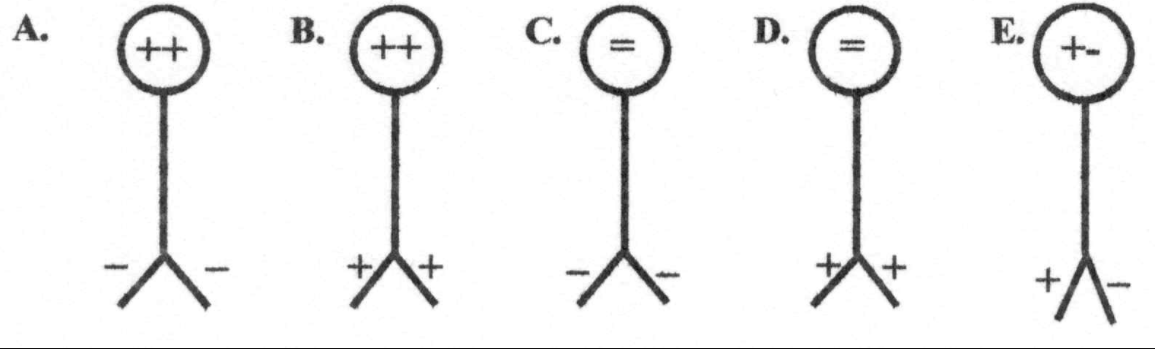
Charged rubber rods are placed near a neutral conducting sphere, causing a redistribution of charge on the spheres. Which of the diagrams below show the proper distribution of charge on the spheres? Check all that apply.
a)
Diagram A
b)
Diagram B
c)
Diagram C
d)
Diagram D
e)
Diagram E
36.
During a physics lab, a plastic strip was rubbed with cotton and became positively charged. The correct explanation for why the plastic strip becomes positively charged is that...
a)
the plastic strip acquired extra protons from the cotton.
b)
the plastic strip acquired extra protons from the charging process.
c)
protons were created as the result of the charging process.
d)
the plastic strip lost electrons to the cotton during the charging process.
37.
Which subatomic particle has a POSITIVE charge?
a)
Proton
b)
Neutron
c)
Electron
d)
Nucleus
38.
Which subatomic particle has a NEGATIVE charge?
a)
Proton
b)
Neutron
c)
Electron
d)
Nucleus
39.

If two objects are attracted...

a)

They are both positively charged.

b)

They are both negatively charged.

c)

One is positive and one is negative.

d)

They are both neutral or no charge.

40.
Rubbing a balloon on hair is an example of static charge build up created by....
a)
conduction
b)
friction
c)
induction
d)
hairduction
41.
If an object has more positive than negative charges, its electrical charge is...
a)
positive
b)
negative
c)
neutral or no charge
d)
opposite
42.
If an object has more negative charges than positive charges, its electrcial charge is...
a)
positive
b)
negative
c)
neutral or no charge
d)
opposite
43.
If an object has the same number of positive and negative charges, its electrical charge is...
a)
positive
b)
negative
c)
neutral or no charge
d)
opposite
44.
One example of static electricity is...
a)
rain
b)
thunder
c)
lightning
45.
Two objects that have opposite charges will...
a)
attract
b)
repel
c)
not move
46.
Two objects that have the same charges will...
a)
attract
b)
repel
c)
not move
47.
True or False
A negatively charged object has lost protons
a)
True
b)
False
48.

Ms Phong rubbed two balloons with a piece of wool. What will happen when the balloons are brought near each other?

a)

The balloons will repel each other.

b)

The balloons will attract each other.

c)

The balloons will become positively (+) charged.

d)

The balloons will pop.

49.
The girl's hair and the comb are attracting  one another.  The hair and the comb have
a)
opposite charges
b)
like charges
50.
An object becomes charged when the atoms in the object gain or lose
a)
electrons
b)
protons
c)
neutrons
d)
all of the above
51.

Which pair of charges will REPEL?

a)

+ and -

b)

+ and +

c)

+ and neutral

52.

Which pair of charges will ATTRACT?

a)

+ and neutral

b)

+ and +

c)

neutral and neutral

53.

A neutral (0) comb and neutral (0) paper bits are brought together. The comb and the paper bits will:

a)

attract

b)

repel

c)

do nothing

54.

A comb is charged by rubbing it with fur. What happens to the comb and paper bits when they are brought together? They...

a)

attract

b)

repel

c)

do nothing

55.

The charged comb has a ___ charge. (Hint: see the number of - vs. + charges on the comb).

a)

positive (+)

b)

negative (-)

c)

neutral (0)

56.

The paper bits have a ___ charge.

a)

positive (+)

b)

negative (-)

c)

neutral (0)

57.

This shows that a charged object ___ attract a neutral object.

a)

does

b)

does not

58.
Which of these is the best definition of polarization?
a)
The object gains a positive or negative charge from another object.
b)
The charges in a neutral object separate due to a nearby charged object.
c)
Charges on a neutral object jump off onto a charged object due to attraction of opposite charges.
d)
Two objects attract each other because they are both charged.
59.

During induction, grounding is necessary in order for the neutral object to become charged.

a)

true

b)

false

60.
Removing a static charge by providing a path to the ground is called __.
a)
electric transfer
b)
grounding
c)
switching
d)
seperation
61.

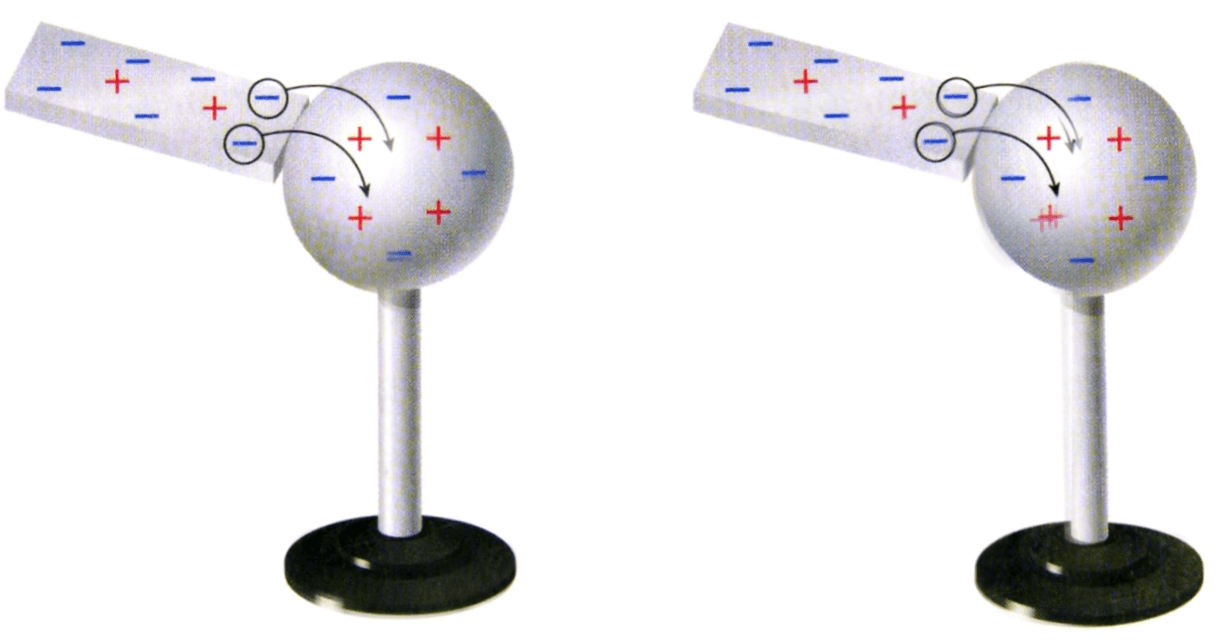
A positively charged rod is touched to the top of an electroscope. Which shows the resulting charge?

a)

A

b)

B

c)

C

d)

D

e)

E

62.
Charging by contact results in both objects having the same charge.
a)
True
b)
False
63.
Charging by Friction results in two objects with the same charge.
a)
True
b)
False
64.
If you rub a glass rod with a piece of silk, the rod becomes positively charged. This means that
a)
friction destroyed electrons in the rod.
b)
the silk has become negatively charged.
c)
protons have moved to the rod.
d)
glass attracts more protons.
65.
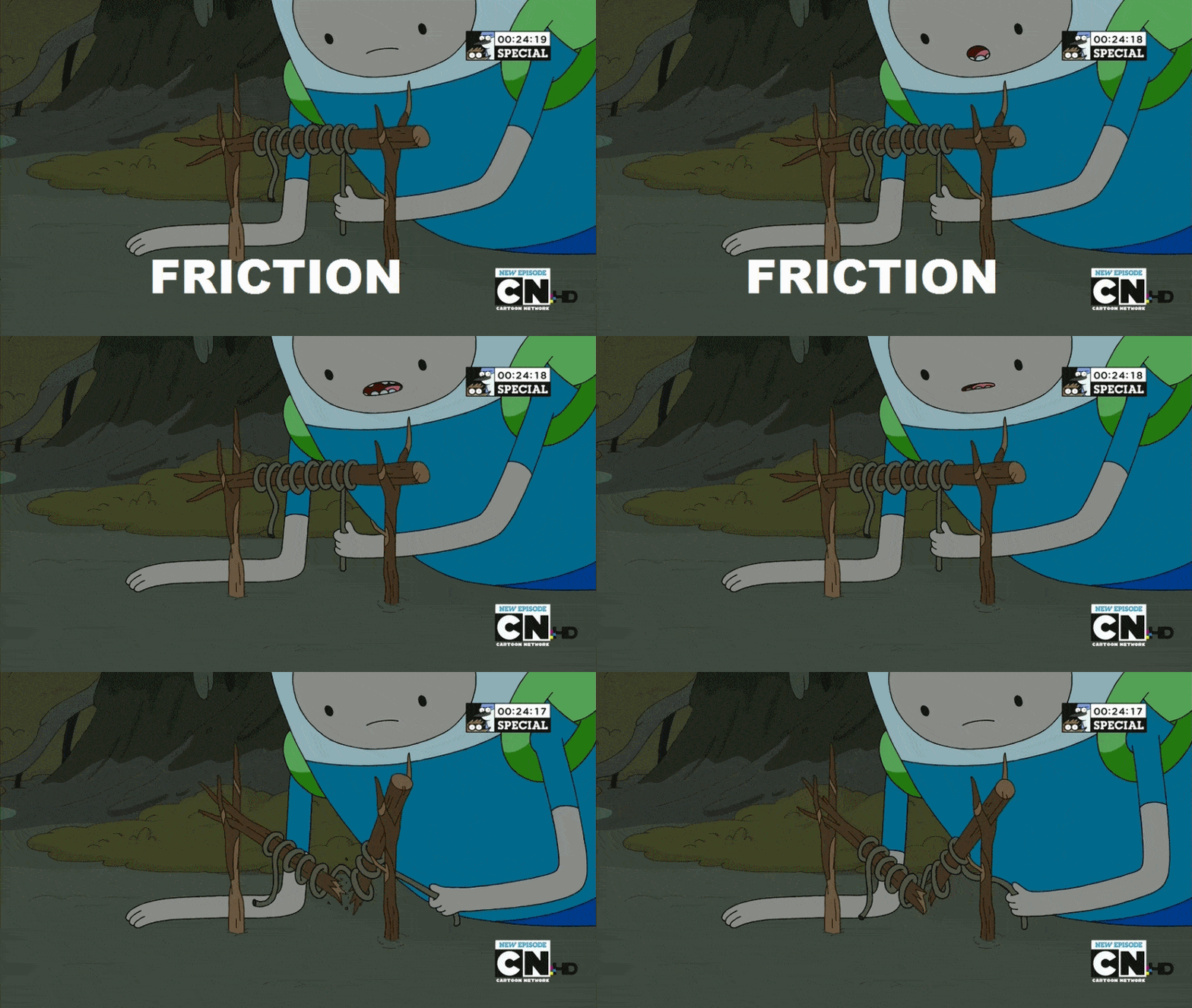
What method of static charging is shown in this picture
a)
Polarization
b)
Friction
c)
Induction
d)
Conduction
66.
Charging by friction requires rubbing. Charging by contact requires ...
a)
rubbing
b)
touching
c)
no contact
67.
An object becomes positively charged by
a)
losing protons
b)
gaining electrons
c)
losing electrons
d)
gaining protons
68.
An object becomes negatively charged by
a)
losing protons
b)
gaining electrons
c)
losing electrons
d)
gaining protons
69.
The process of transferring charge between objects by touching or rubbing
a)
charging by induction
b)
static discharge
c)
charging by contact
d)
proton
70.
Current electricity is created on the device that will receive the charge.
a)
True
b)
False
71.
Current electricity has a predictable path.
a)
True
b)
False
72.
A circuit contains
a)
source, switch, battery, and wires
b)
wires, source, light, and load
c)
conductors, switch, source, and wires
d)
source, switch, load, and conductors
73.
The part of the circuit that transports electricity.
a)
Conductor
b)
Load
c)
Source
d)
Switch
74.
The part of the circuit that is powered by the electricity.
a)
Conductor
b)
Load
c)
Source
d)
Switch
75.
The part of the circuit that stops the power flowing through the circuit.
a)
Conductor
b)
Load
c)
Source
d)
Switch
76.
The part of the circuit that provides electricity.
a)
Conductor
b)
Load
c)
Source
d)
Switch
77.

Which part of a circuit is not essential?

a)
switch
b)

source

c)

load

d)

conductors

78.
If the circuit is open, the lights are...
a)
On
b)
Off
79.
Electricity flowing through a circuit is known as
a)
voltage
b)
current
c)
resistance
80.
The force that moves electricity through a circuit is known as
a)
voltage
b)
current
c)
resistance
81.

What is the unit used for current?

(a)  

82.

What is the unit used for resistance?

(a)  

83.

What is the unit used for a circuit's source?

(a)  

84.
Something that allows electricity to flow through it.
a)
Insulator
b)
Conductor
c)
Resistor
85.
Something that stops electricity from flowing.
a)
Insulator
b)
Conductor
c)
Resistor
86.
Something that slows the flow of electricity.
a)
Insulator
b)
Conductor
c)
Resistor
87.

Electricity meets resistance in a circuit. The four types of energy produced are

(a)  

88.
The wire that carries electricity into a house is known as the
a)
neutral wire
b)
ground wire
c)
negative wire
d)
live wire
89.
The wire that carries electricity out of a house is known as the
a)
neutral wire
b)
ground wire
c)
negative wire
d)
live wire
90.
The wire that has a direct path out of the home is known as the
a)
neutral wire
b)
ground wire
c)
negative wire
d)
live wire
91.
In a battery powered circuit, the electrons flow from positive (cathode) to negative (anode).
a)
True
b)
False
92.

True or False: Conductors allow electrons to pass through easily.

a)

True

b)

False

93.

Which one of these would be a good example of a load in a circuit

a)

Copper Wires

b)

Light switch

c)

Power Button

d)

Light bulb

94.

What is an electric current?

a)

a build up of electrons

b)

the difference in charge between 2 points

c)

the flow of electrons over a circuit

d)

the opposition to flow of electrons

95.
An example of an insulator is:
a)
iron
b)
silver
c)
copper wire
d)
rubber
96.

What is the unit of measurement for resistance?

a)

Voltage

b)

Ampere

c)

Watts

d)

Ohms

97.
As the resistance of a circuit increases, the current will
a)
increase
b)
decrease
c)
stay the same
98.

What energy changes take place to make a fan spin?

a)

Electrical energy changes to heat energy.

b)

Electrical energy changes to mechanical energy.

c)

Wind energy changes to electrical energy.

d)

Heat energy changes to mechanical energy.

99.

Which of these is designed to primarily produce heat from electricity?

a)

a camera

b)

a television

c)

a blender

d)

a toaster

100.
Resistance is measured in what unit?
a)
ohms
b)
amps
c)
watts
d)
volts
101.

The symbol for resistance is ...

a)

Ω\Omega  

b)

θ\theta  

c)

A

d)

V

102.

The symbol for current is _____ and the unit is _______.

a)

A, Amps

b)

I, Volts

c)

C, Ohms

d)

I, Amps

103.

The live wire is the wire that does what?

a)

Provides a path to the ground

b)

Take electricity out of the home

c)

Bring electricity into the home

d)

Provides protection for the wire

104.

Direct Current tends to be used over long distances and used for big sources.

a)

True

b)

False

105.
An example of a conductor is :
a)
a glass paperweight
b)
a plastic cap
c)
a metal screw
d)
a wooden handle
106.
An example of an insulator is:
a)
iron
b)
silver
c)
copper wire
d)
rubber
107.
All wires used in electric circuits should be covered with:
a)
a colored material.
b)
a conducting material.
c)
an insulating material.
d)
none of these.
108.

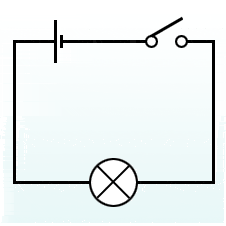
Is this circuit closed or open?

a)
Closed
b)
Open
109.

What is another name for the wires in a circuit?

a)

Conductor

b)

Load

c)

Power Source

110.

True or False: Conductors allow electrons to pass through easily.

a)

True

b)

False

111.

What effect do like (similar) charges have on each other?

a)

They attract

b)

They repel

c)

No effect

d)

They reverse each other

112.

What is an electric current?

a)

a build up of electrons

b)

the difference in charge between 2 points

c)

the flow of electrons over a circuit

d)

the opposition to flow of electrons

113.
The flow of electricity in a circuit-
a)
current
b)
flow
c)
circuit
114.
Electricity that flows in a closed path is called a
a)
path
b)
current
c)
circuit
115.

Which parts are necessary for a circuit to work?

a)

battery or other power source

b)

an outlet to plug in

c)

light bulb or other resistor

d)

wires to connect

116.

If the switch is closed, your bulb will

a)

turn on

b)

turn off

117.
this is the symbol for a _____?
a)
switch
b)
light 
c)
battery
d)
wires
118.
this circuit is .....?
a)
open
b)
parallel
c)
closed
d)
The cutest little circuit evah!
119.
a)
Closed switch
b)
Push switch
c)
Trap door
d)
AC Power supply
120.

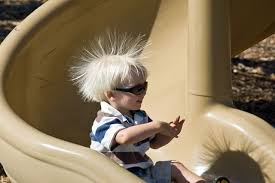
How can it be explained that someone's hair can stick to a balloon?

a)

There is static electricity.

b)

There is too much dust in the air.

c)

The person needs to wash his hair.

121.
The force that pushes the electricity through a circuit is called...
a)
resistance
b)
voltage
c)
current
d)
switch
122.
The flow of electricity through a conductor is called...
a)
resistance
b)
voltage
c)
current
d)
source of electric current
123.
What slows down the flow of electricity in a circuit?
a)
resistance
b)
voltage
c)
current
d)
source of electric current