
 Worksheets
Genetics Final Summer 2025
Total questions: 67
Worksheet time: 4hrs 6mins
At the gardening section at Home Depot you find a pea plant with yellow and round peas. What are all the possible genotypes this plant could have?
Yy;Rr
Yy;RR
YY;RR
YY;Rr
yy;Rr
What type of cross would you perform to determine the genotype of the pea plant?
cross-examination
test-cross
complementation test
self-cross
If you complete a test-cross and 50% of the progeny plants have yellow round peas and 50% have yellow wrinkled peas, what is the genotype of the plant you found at Home Depot?
Yy;Rr
YY;RR
Yy;RR
YY;Rr
What phenotypic ratio corresponds with complete dominance for a dihybrid cross (Mendelian inheritance?)
9:3:3:1
15:1
9:3:4
12:3:1
What phenotypic ratio corresponds with Recessive Epistasis?
9:3:3:1
15:1
9:3:4
12:3:1
What phenotypic ratio corresponds with Dominant Epistasis?
9:3:3:1
15:1
9:3:4
12:3:1
What phenotypic ratio corresponds with Duplicate Recessive Epistasis?
9:7
15:1
1:2:1
13:3
What phenotypic ratio corresponds with Duplicate Dominant Epistasis?
9:7
15:1
1:2:1
13:3
Label the Genotypes
Draw the biochemical pathway from the given genotypic ratios (The same as the last problem)
Given the prompt, assign the genotypes.
Given the following genotypes. Draw the biochemical pathway
Assign Genotypes
Draw the biochemical pathway

Properly write the test - cross
EeGgNn x eeggnn
EGN/egn x egn/egn
Ee;Gg;Nn x ee;gg;nn
EGn/egN x egn/egn

Are the genes linked or unlinked? How do you know?
They are linked because the ratio of each progeny genotype is 1:1:1...
They are unlinked because the chi square analysis shows a P - value of around 0.2, which means there is a 20% chance they are unlinked
They are unlinked because we can see many more progeny with the EGn and egN genotypes. The expected ratio for unlinked is 1:1:1:1 .. but there is some deviation from this expected ratio
They are linked because we can observe that progeny with the EGn and egN genotypes occur much more frequently than other genotypes. This means that EGn and egN are the parentals and the others are the recombinants.
Can the null hypothesis for this scenario (the same as the previous questions) be refuted?

What is the order of the genes E, G, and N?
GEN or NEG
ENG or GNE
EGN or NGE
Draw the linkage map
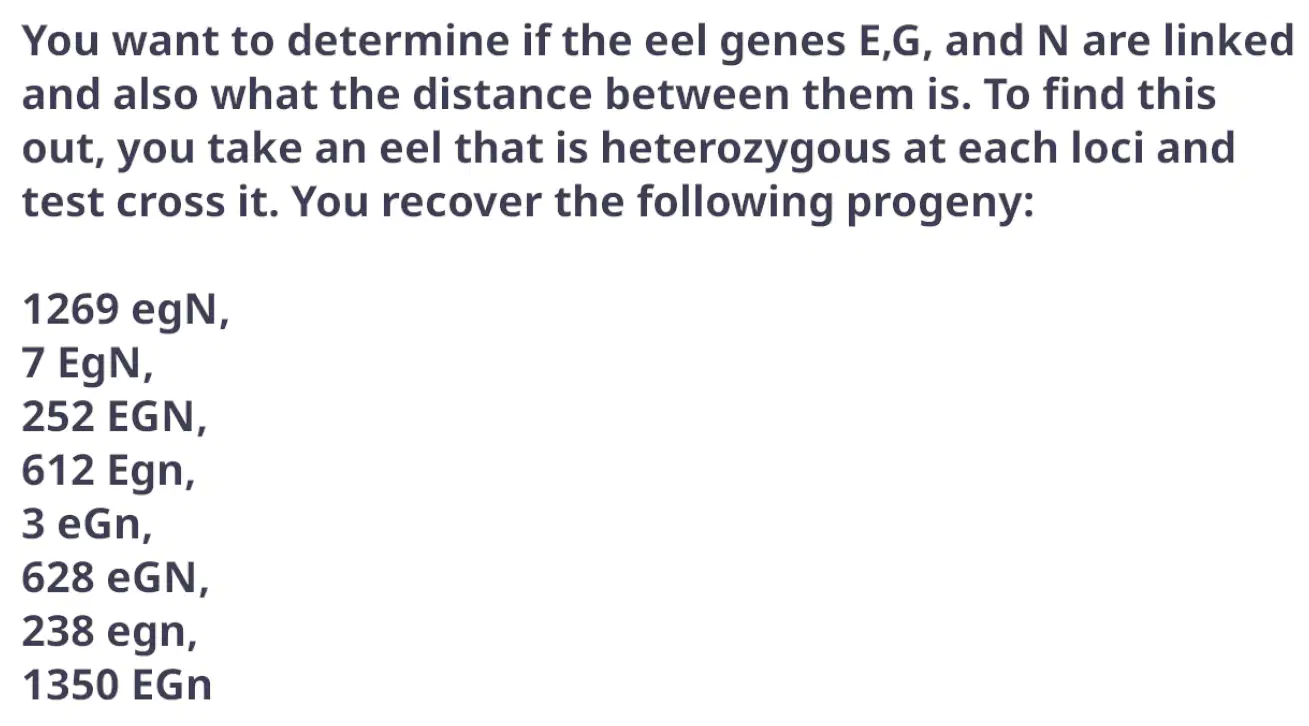
If the genes are linked, is there any evidence of interference?
I = 0.39, there is moderate interference
I=0.06, there is a little interference
I = 0.93, there is a lot of interference
I = 0.67, there is moderate interference
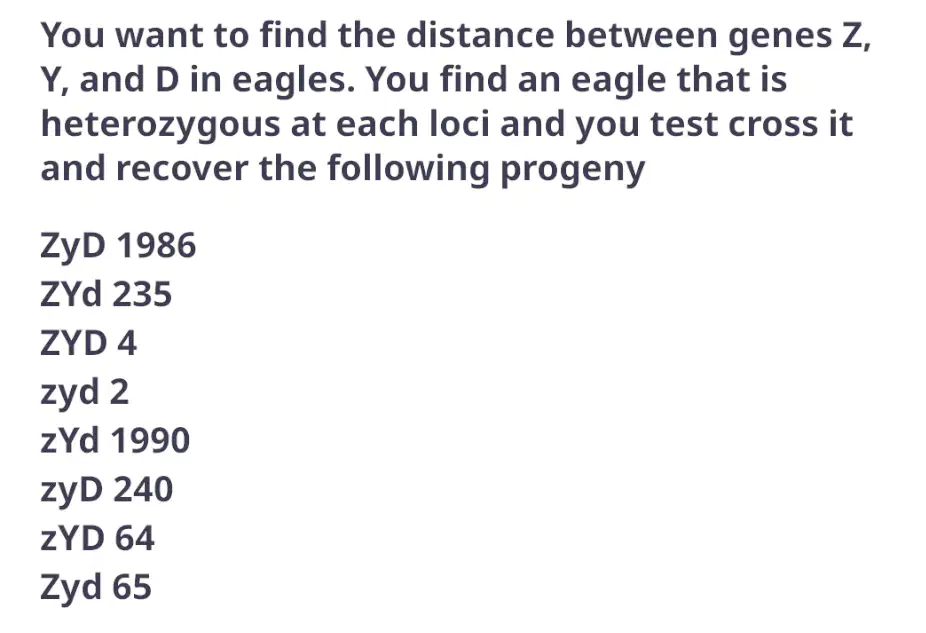
Write out the cross
ZYD/zyd x zyd/zyd
Zz;Yy;Dd x zz;yy;dd
ZyD/zYd x zyd/zyd
ZzYyDd x zzyydd
Draw the Linkage Map
Imprinting
Let's assume we are dealing with a gene where only the allele from the mother is expressed and the father's allele is always silenced. Let's say we have a male offspring. Which parental allele will he express?
The father's
The mother's
Both
Neither
Imprinting
Let's assume we are dealing with a gene where only the allele from the mother is expressed and the father's allele is always silenced. Let's say we have a female offspring. Which parental allele will she express?
The father's
The mother's
Both
Neither
Imprinting
Let's assume we are dealing with a gene where only the allele from the mother is expressed and the father's allele is always silenced. If there is a female offspring, what will happen when her germ line cells give rise to gametes?
All gametes will be methylated and inactivated
The silencing imprint will be initially removed, but then readded so all gametes carry silenced alleles
Half of the gametes will have the silenced allele and have with have the active allele because that's how it is in the somatic cells.
The silencing imprint is removed and then not re-added for all alleles in the germ line cells so all the resulting gametes carry active alleles.
Imprinting
Let's assume we are dealing with a gene where only the allele from the mother is expressed and the father's allele is always silenced. If there is a male offspring, what will happen when his germ line cells give rise to gametes?
All gametes will be methylated and inactivated
The silencing imprint will be initially removed, but then re-added to both chromosomes in the germ line cell so then all resulting gametes carry silenced alleles
Half of the gametes will have the silenced allele and have with have the active allele because that's how it is in the somatic cells.
The silencing imprint is removed for all alleles in the germ line cells so all the resulting gametes carry active alleles.
This is IGF2. Which allele will the offspring NOT express? The one from the father or the one from the mother?
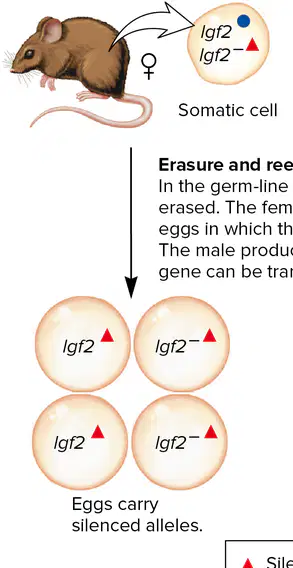
This is IGF2. What's happening here?
The silencing imprint is removed
The silencing imprint is added
All silencing imprints are removed and then re-added to all alleles of IGF2 in the germ-line cells
All silencing imprints are removed and then not re-added. So all allele of IGF2 in the germ-line cells are active
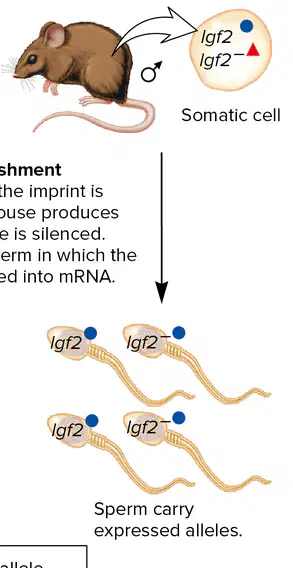
This is IGF2. What is happening here?
All silencing imprint is removed and not re-added. So all alleles of IGF2 in the germ-line cells are active
All silencing imprint is removed and then re-added. So all alleles of Igf2 in the germ-line cells are silenced.
All silencing imprints are removed
All silencing imprints are added

What happens when the Imprinting Control Region (ICR) is methylated at the H19/IGF2 locus?
The shared enhancer directs RNA Polymerase to IGF2
The shared enhancer directs RNA Polymerase to H19
It inhibits transcription of IGF2
It silences the entire locus

What happens when the Imprinting Control Region (ICR) is bound by CTCF insulator proteins at the H19/IGF2 locus?
The shared enhancer directs RNA Polymerase to IGF2
The shared enhancer directs RNA Polymerase to H19
It inhibits transcription of IGF2
It silences the entire locus
Write out the correct reading frame (put dashes where the spaces are) if the following sequence represents the middle of a gene
5’ ATGCTAGCTGATCGATCGAACTAGACATGTGCC 3’
(a)
Identify the coding strand and the template strand
Write out the mRNA sequence with dashes to seperate the codons in the right reading frame
5’GG-CAC-ATG-TCT-AGT-TCG-ATC-GAT-CAG-CTA-GCA-T3’
(write the sequence in the 5' -> 3' direction)
(a)

Write the protein sequence
5’GG CAC AUG UCU AGU UCG AUC GAU CAG CUA GCA U3’
(a)
Write out the new mRNA sequence if the bold and underlined guanine was mutated to adenine (with dashes to show the right reading frame)
5’GG-CAC-ATG-TCT-AGT-TCG-ATC-GAT-CAG-CTA-GCA-T3’
(a)
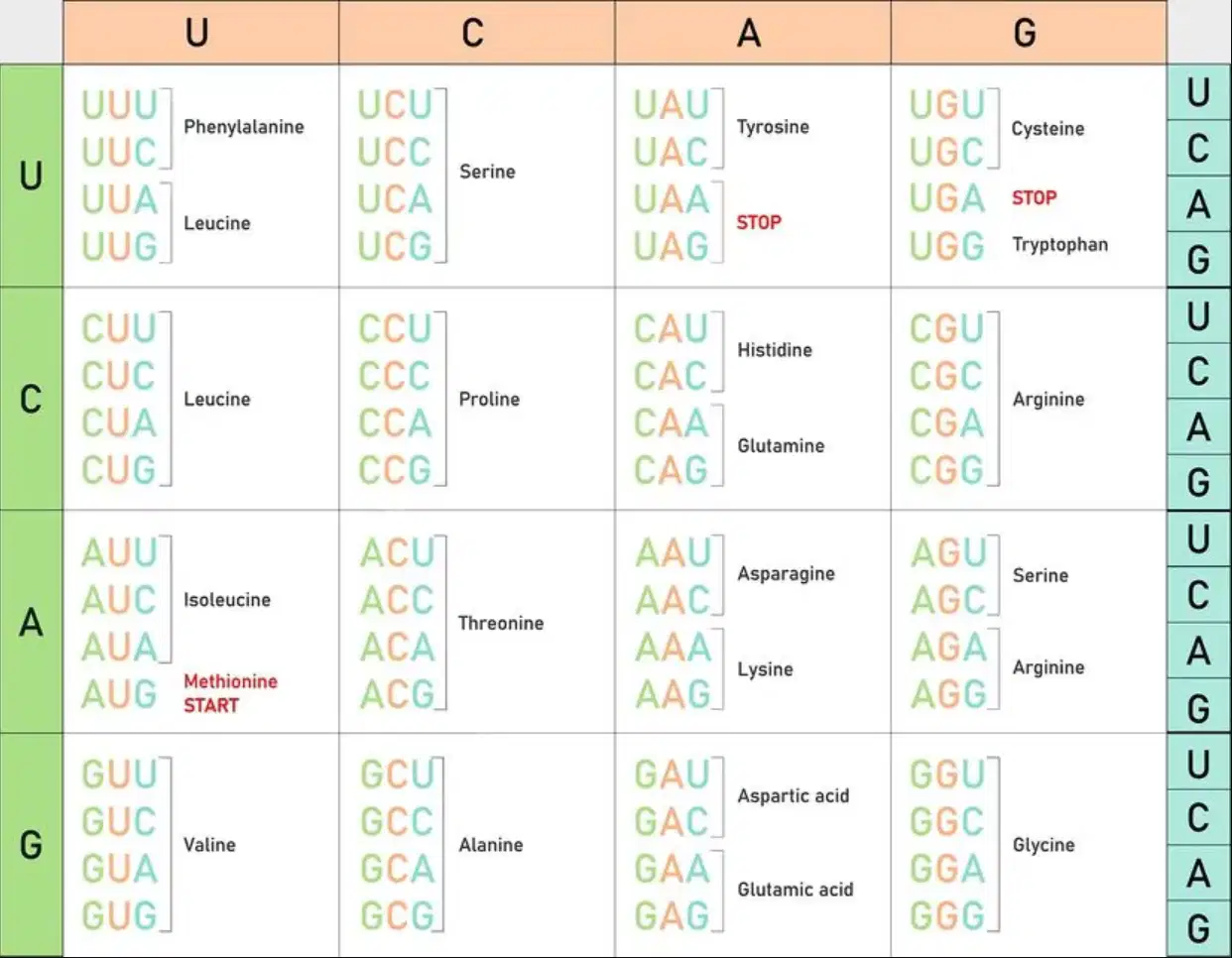
Write out the new protein sequence if the bold guanine was mutated to adenine (with dashes to show the right reading frame)
5’GG-CAC-ATG-TCT-AGT-TCG-ATC-GAT-CAG-CTA-GCA-T3’
(a)
If the bold guanine was mutated to adenine (with dashes to show the right reading frame), what type of mutations occured here?
5’GG-CAC-ATG-TCT-AGT-TCG-ATC-GAT-CAG-CTA-GCA-T3’
Transition
Transversion
Frameshift
Base substitution
Missense
The two main functions of the large subunit of the ribosome are as follows: (a) the polypeptide bond from the tRNA at the (b) site. (c) the peptide bond formation with the peptide chain from the P site with the (d) carried by the tRNA in the (e) site.

Which of the following most accurately describes how RNA scaffolds can be used to expedite biochemical pathways?
The RNA scaffold acts only as a guide for multiple proteins towards a substrate.
RNA scaffold brings multiple proteins so they can all act on the same substrate at the same time
RNA scaffold brings multiple enzymes to a substrate, and then the first enzyme reacts with and hands the substrate to the next enzyme which does the same until the substrate has been worked on by all the proteins within scaffold.
RNA scaffold can release signals that call other RNA molecules and then all of the RNA molecules will form super complex that is capable of a variety of biological processes.
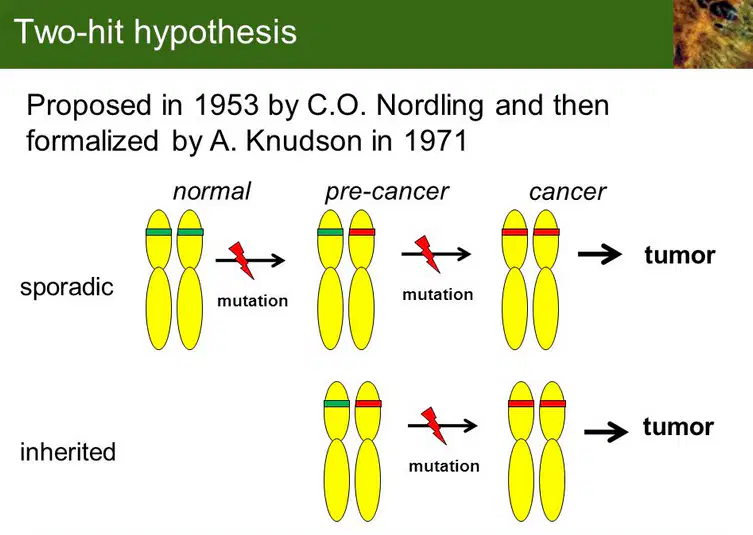
Describe the two hit hypothesis
The two hit hypothesis states that two tumor suppressor mutations are needed to initiate cancer development.
What is Ras/GTP?
It's a tumor suppressor, it holds onto GTP to stop the cell from dividing
It's an oncogene, it uses GTP turn on the MAPK pathway.
It's an oncogene, It destroys capsases which are responsible for apoptosis
It's an oncogene, both Ras genes need to be mutated for cancer to occur. It activates compensatory cell growth.
What is Rb/CDK4?
It's a tumor suppressor. Rb releases E2F if it is phosphorylated by Cyclin-D/CDK4. E2F activates pro mitotic genes
It's an oncogene, it activates transcription factors to start mitosis.
It's a tumor suppressor, it activates P53.
It's an oncogene, it activates the MAPK pathway to start cell division
What cells would you sequence to determine if someone had inherited a cancerous mutation on a tumor suppressor gene?
Red blood cells because they don't have a nucleus so no mutations would be seen so there's no cancer!
Hair follicle cells. Rapidly dividing cells are less prone to mutations so those would be similar to the early zygotic cells.
The individual's mother (yo mama)
White blood cells in the bone marrow. Stem cells in the bone marrow are numerous and are generally shielded from carcinogens, preserving the zygotic genotype.
How will a mutation in the promoter affect gene expression?
RNA polymerase will not be able to bind to the promoter. Gene expression will cease entirely.
Transcription factors will not be able to bind to the enhancer, depressing gene expression.
Transcription will not be affected but translation will not be able to start.
Transcription and translation will proceed but the resulting protein will be non functional
How will a mutation in exon 3 affect gene expression?
A mutation in exon 3 will alter transcription and mRNA won't be produced
A mutation in exon 3 will not affect translation or transcription, but the resulting protein may be nonfunctional.
A mutation in exon 3 will only affect translation and the ribosome will not be able to complete the protein.
How will a mutation in the enhancer affect gene expression?
Mutations in enhancers only affect translation. The resulting protein will have mutations and therefore may not be functional.
Mutations in the enhancer will affect transcription because enhancers are where RNA polymerase binds. Therefore, RNA polymerase will not recognize the enhancer and therefore protein production would be totally stopped.
A mutation in the enhancer will likely mean that transcription factors will not be able to bind and recruit RNA Polymerase. RNA Polymerase could still sometimes find the promoter. Protein production is reduced, but not terminated.
How will a mutation in the start codon affect gene expression?
Mutation in the start codon will affect translation as the ribosome will not begin translation at the correct reading frame and will start translating at different start codon that its not supposed to.
Mutation in the start codon will affect transcription because transcription starts at the start codon
Mutation in the start codon will affect translation because the start codon is at the very top of the mRNA.
Mutations in the start codon will affect translation because the ribosome will not know when to stop translating.
An individual can inherit a chromosome that carries a mutated tumor suppressor. It would take another 30 years for the other chromosome to become mutated. This is known as (a) cancer
An individual can have tumor suppressor genes mutated on both chromosomes over the course of ~70 years. This is driven by the molecular clock theory (mutations accumulate over time). This is called (a) cancer.
What does Lac I do?
Codes for inducer.
Codes for Allolactose
Codes for Beta - Galacto
Codes for repressor
What does the CAP site do?
Caps the lac operon
Provides a site for the CAP protein to bind and call RNA poylmerase
Provides a site for the repressor to bind and stop transcription of the operon.
It dimerizes the CAP protein using cAMP
What does Lac P do?
It's where the CAP protein binds.
It's where permease binds.
It's where the ribosome binds.
It's where RNA polymerase binds.
What does Lac O do?
It codes for the repressor to stop transcription.
It codes for Beta galactosiamd
It contains a DNA sequence that the repressor can bind to and inhibt transcription.
It contains a DNA sequence that calls RNA polymerase to start transcription.
What does Lac Z code for?
Permease
Beta-Galactosidase
Transacetylase
Acetylcholine
What does Lac Y code for?
Beta-Galactosidase
Transacetylase
Repressor
Permease
What does Beta - galactosidase do?
Cleaves lactose (a dissacharide) into glucose and galactose. It also converts some lactose into allolactose.
It brings lactose into the cell
It catalyzes the formation of the CAP protein so it can bind to the CAP site.
It binds to the operator DNA sequence to inhibit gene expression
What happens to the Lac Operon if glucose is present?
B - gal breaks up the glucose into galactose
Permease will turn glucose into Allolactose. Allolactose will then act as the effector molecule to repress the operon.
The CAP protein is activated and binds to the CAP site to call RNA Polymerase. This results in very high expression of the Lac Operon.
Andenylyl cyclase is inhibited and cannot turn ATP to cAMP. Therefore, the CAP protein is not activated and does not call RNA Polymerase to the promoter.

B - gal with glucose: (a)
B - gal with lactose: (b)
Permease with glucose: (c)
Permease with lactose (d)

B - gal with glucose: (a)
B - gal with lactose: (b)
Permease with glucose: (c)
Permease with lactose (d)

B - gal with glucose: (a)
B - gal with lactose: (b)
Permease with glucose: (c)
Permease with lactose (d)

B - gal with glucose: (a)
B - gal with lactose: (b)
Permease with glucose: (c)
Permease with lactose: (d)
3 Ways a Cell can stop protein production
1. Stopping transcription: (a) are added to (b) near the promoter and enhancer. This prevents transcription factors and (c) from transcribing the gene. Furthermore, (d) are attracted by the methyl groups and can call co-repressors like (e) to remove acetyl groups from histones, causing the gene to be inaccessible for transcription.
3 Ways a Cell can stop protein production
1. Stopping translation: Non-coding RNA is transcribed that is complementary to the rogue mRNA. The Non coding RNA is processed by (a) , exported out of the nucleus, processed by (b) , and then associates with the (c) . If the non-coding RNA is fully complentary to the rogue mRNA, RISC will (d) the mRNA. If the non-coding RNA is partially complementary to the rogue mRNA, RISC will (e) translation by blocking the movement of the ribosome.
3 Ways a Cell can stop protein production
1. Destroying proteins: Proteins that need to be destroyed can undergo post-translational modifications like phosphorylation to expose the (a) . E3, a type of ligase, can only attach a (b) to a protein it is complementary to. If E3 finds the protein it is complementary to, and if the degron of that protein is exposed, then E3 will add an initial ubiquitn tag and then E1 and E2 will continously add ubiquitin to make (c) . The (d) will recognize polyubiquitination and will destroy the protein.
Match each component of the CRISPR CAS-9 system with it's respective function
Cuts a segment of viral DNA and insert it into the CRISPR gene as a spacer. These act when the bacteria is infected by an unfamiliar virus.
CAS-1 and Cas-2
The endonuclease that is guided towards the viral DNA to cause a double strand break
CAS - 9
A type of RNA that holds an endonuclease with a part of RNA that is complementary to viral DNA
tracr RNA
Initially transcribed to create an RNA strand of repeats and spacers. It needs to be processed before it can be used.
CRISPR gene
A piece of RNA that is complementary to viral DNA. It's physically attached to another piece of RNA that is complementary to the tracr
spacer
Compare and contrast the two types of DNA double-strand break repair mechanisms
Slow
Usually only occurs during G2 and S phase because thats the only time the Sister Chromatids
Fast
Accurate
Error-prone
Preferred for somatic cells because those cells are easily replaced
Preferred for germ-line cells to maintain genetic integrity of offspring
Repairs DNA with no regard to what was there before

