wayground logo

Free Printable Worksheets

Font size

S
M
L
XL
Worksheets

Billings Unit 1 Test Review

Total questions: 121

Worksheet time: 3hrs 15mins

Name
Class
Date
1.
What units are used to measure mass of an object?
a)
cm
b)
cm3
c)
g
d)
g/cm3
2.
What is the volume of Object X?
a)
10.0 cm3
b)
15.0 cm3
c)
20.0 cm3
d)
25.0 cm3
3.
If a block of wood has a density of 0.6 g/cm3 and a mass of 120 g, what is its volume?
a)
200 cm3
b)
0.005 cm3
c)
200.0 ml
d)
72 ml
4.

All matter is made up of tiny _______________

a)

energy

b)

particles (atoms and molecules)

c)

bits

d)

antimatter

5.

The tool pictured here is...

a)

a buret

b)

an erlenmeyer flask

c)

a graduated cylinder

d)

a beaker

6.

This tool is used to measure...

a)

volume

b)

mass

c)

density

d)

moles

7.

In this image, the MASS of A is _____ the mass of B

a)

equal to

b)

greater than

c)

less than

8.

In this image, the VOLUME of A is _____ the volume of B

a)

equal to

b)

greater than

c)

less than

9.

In this image, the DENSITY of A is _____ the density of B

a)

equal to

b)

greater than

c)

less than

10.

Mass is the amount of _______ an object has

a)

Matter

b)

weight

11.

The unit for volume is

a)

grams

b)

milliliters (mL)

c)

Newton

d)

Centimeters Cubed

12.


What two types of measurements make up DENSITY

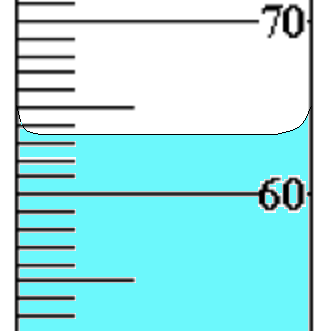
a)

Volume and Weight

b)

Temperature and Mass

c)

Mass and Volume

13.

What is the density of water?

a)

34 g/mL

b)

1 g/mL

c)

29 g/mL

d)

6 g/mL

14.
Why do some substances float on water?
a)
they are warmer than water
b)
they are cooler than water
c)
they are more dense than water
d)
they are less dense than water
15.
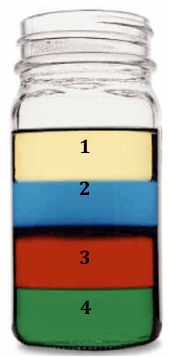
Put the liquids in order from most dense to least dense?
a)
4, 3, 2, 1
b)
1, 2, 3, 4
c)
3, 4, 2, 1, 
d)
4, 3, 1, 2
16.

What is the formula for Volume?

a)

Mass/Volume

b)

Density x Volume

c)

Mass/Density

d)

Volume/Mass

e)

Density/Mass

17.

What is the mass of a 100mL liquid if it has a density of 3 g/mL?

a)

300 g

b)

33.3 g

c)

.03 g

d)

103 mL

18.

What is the mass of a 25 cm3  liquid if it has a density of 5 g/cm3?

a)

125 g

b)

5 g

c)

30 g

d)

.2 mL

19.
Jack has a rock. The rock has a mass of 14g and a volume of 2cm3. What is the density of the rock?
a)
7 mL
b)
7 g/cm3
c)
28 g/cm3
d)
1/7 g/cm3
20.
Helium balloons rise on earth because
a)
helium is less dense than air
b)
helium is more dense than air
c)
helium is cooler than air
d)
helium is warmer than air
21.
Solids are described as having a 
a)
definite shape and indefinite volume
b)
indefinite shape and indefinite volume
c)
definite shape and definite volume
d)
indefinite shape and definite volume
22.
Liquids are described as having a 
a)
definite shape and indefinite volume
b)
indefinite shape and indefinite volume
c)
definite shape and definite volume
d)
indefinite shape and definite volume
23.
Gases are described as having a 
a)
definite shape and indefinite volume
b)
indefinite shape and indefinite volume
c)
definite shape and definite volume
d)
indefinite shape and definite volume
24.
Which state of matter has a definite shape?
a)
solid
b)
liquid 
c)
gas
d)
plasma
25.
A substance that has a definite shape and volume.
a)
evaporation
b)
gas
c)
liquid
d)
solid
26.
Is sand a solid, liquid or gas?
a)
Solid
b)
Liquid
c)
Gase
27.

In which state of matter are particles moving slowest?

a)

solid

b)

gas

c)

liquid

d)

gummy bears

28.

The picture shows...

a)

a solid

b)

a liquid

c)

a gas

29.

The picture shows...

a)

a solid

b)

a liquid

c)

a gas

30.

The picture shows...

a)

a solid

b)

a liquid

c)

a gas

31.

NaCl

a)

Element

b)

Compound

c)

Mixture

32.

H2

a)

Element

b)

Compound

c)

Mixture

33.

H2 + Mg

a)

Element

b)

Compound

c)

Mixture

34.

MgCl2

a)

Element

b)

Compound

c)

Mixture

35.

Mg

a)

Element

b)

Compound

c)

Mixture

36.

H2O

a)

Element

b)

Compound

c)

Mixture

37.
a)

Element

b)

Compound

c)

Mixture

38.
a)

Element

b)

Compound

c)

Mixture

39.
a)

Element

b)

Compound

c)

Mixture

40.
a)

Element

b)

Compound

c)

Mixture

41.
a)

Element

b)

Compound

c)

Mixture

42.
a)

Element

b)

Compound

c)

Mixture

43.
How many sig. fig. are in the number below:
350.540
a)
4
b)
5
c)
6
d)
7
44.
How many sig. fig. are in the number below:
350.540
a)
4
b)
5
c)
6
d)
7
45.
How many sig. fig. are in the number below:
0.0005
a)
1
b)
2
c)
3
d)
4
46.
Which measurement contains 3 sig figs?
a)
200 mL
b)
20.0 mL
c)
0.02 mL
d)
0.020mL
47.
Round 1047.78 to three sig figs
a)
104
b)
105
c)
1050
d)
1050.00
48.
Round 1009 to three sig figs
a)
100
b)
101
c)
1010
d)
1000
49.
How many Significant Figures in the number below?
4.56 x 10³
a)
5
b)
4
c)
6
d)
3
50.
How many Significant Figures in the number below?
0.456
a)
3
b)
4
c)
2
d)
1
51.
How many Significant Figures in the number below?
4,500
a)
3
b)
4
c)
2
d)
1
52.
How many Significant Figures in the number below?
400,506
a)
5
b)
4
c)
6
d)
3
53.
How many Significant Figures in the number below?
4,560
a)
5
b)
4
c)
6
d)
3
54.
How many significant figures does 10.1 cm have?
a)
1
b)
2
c)
3
d)
4
55.
How many significant figures does 0.010 m have?
a)
1
b)
2
c)
3
d)
4
56.
How many significant figures does 10,080 sec have?
a)
3
b)
4
c)
5
d)
6
57.
How many significant figures does 0.025 kg have?
a)
1
b)
2
c)
3
d)
4
58.
Determine the number of sig figs in the following measurement: 
0.036653 m
a)
7
b)
5
c)
2
d)
0
59.
Determine the number of sig figs in the following measurement: 
72,100 g
a)
5
b)
3
c)
6
d)
4
60.
Determine the number of sig figs in the following measurement: 
3,000 mm
a)
1
b)
4
c)
2
d)
3
61.
Determine the number of sig figs in the following measurement: 
25.03 L
a)
4
b)
3
c)
2
d)
1
62.
How many significant figure in 0.007?
a)
4
b)
3
c)
1
d)
0
63.
How many significant figures in 10,097?
a)
3
b)
5
c)
2
d)
0
64.
Multiply:
(3.4 x 10⁵)(1.2 x 10⁻³)
a)
4.08 x 10⁻⁸
b)
4.8 x 10²
c)
4.08 x 10²
d)
4.08 x 10⁻¹⁵
65.
Divide:
(6.9 x 10⁷) / (2.3 x 10⁻³)
a)
3 x 10¹⁰
b)
3 x 10⁴
c)
3 x 10⁻⁴
d)
3 x 10-11
66.
Multiply:
(9.4 x 10⁶)(3.2 x 10⁵)
a)
30.08 x 10¹¹
b)
3.8 x 101
c)
3.008 x 10¹²
d)
2.9375 x 101
67.
Solve:
(2.1×10²​​× (3.0×10⁴)
a)
5.1 x 10²
b)
6.3 x 10⁶
c)
5.1 x 10⁶
d)
6.3 x 10⁸
68.
Solve:
(6 x 10⁶) / (2 x 10³)
a)
12 x 103
b)
3 x 10⁹
c)
1.2 x 10⁴
d)
3 x 10³
69.
Solve:
(9 x 10⁻⁶) / (3 x 10⁻³
a)
27 x 10-9
b)
3 x 10⁻³
c)
3 x 10⁻⁹
d)
27 x 10-3
70.
Write the answer in scientific notation.
7.3 x 10⁵  +   3.7 x 105  =
a)
11.0 x 10⁵
b)
1.1 x 10¹⁰
c)
1.10 x 10¹¹
d)
1.1 x 10 6
71.
Write the answer in scientific notation.
5 x 10⁸ -   3.4 x 108  =
a)
2.4 x 10⁸
b)
2.4 x 100
c)
1.6 x 100
d)
1.6 x 10⁸
72.
Write the answer in scientific notation.
4.1 x 10⁵ +   5.5 x 106  =

a)
5.91 x 10⁶
b)
9.6 x 10⁵
c)
9.6 x 10¹¹
d)
4.65 x 10⁵
73.
What is the simplified version of
a)
3.9 x 10⁶
b)
4 x 10²⁰
c)
4 x 10⁶
d)
3.9 x 10²⁰
74.
(2.3 x 10²)+(4.1 x 10²)=
a)
6.4 x 10⁴
b)
6.4 x 10²
c)
6.4 x 100
d)
.64 x 101
75.
(7.7 x 10²) + (1.1 x 10²)=
a)
8.8 x 10⁴
b)
6.6 x 10⁴
c)
8.8 x 10²
d)
6.6 x 10²
76.
You know 16 cups = 1 gallon. Convert 3.5 gallons into cups.
a)
56 cups
b)
0.21875 cups
c)
19.5 cups
d)
48 cups
77.
You know 1000 mg = 1 g.  Convert 2.5 grams into milligrams.
a)
25 mg
b)
25,000 mg
c)
250 mg
d)
2500 mg
78.

How many minutes are in a year?

a)

I can't count that high.

b)

500,000min

c)

525,600min

d)

600,000min

79.

How many inches are in 1 mile?

a)

63360in

b)

60000in

c)

53660in

d)

50000in

80.

How many gallons are in a pool that holds 758,000 Liters?

(1 gallon = 3.79 Liters)

a)

2,872,820

b)

2.87x10⁶

c)

2.00x10⁵

d)

200,000

81.

Elijah earn $200 for 8 hours of work. What is the unit rate (in dollars per hour)?

a)

$50 per hour

b)

$12 per hour

c)

$25 per hour

d)

$30 per hour

82.
Gas costs $3.05 a gallon, and your car travels at 27 miles for each gallon of gas. How far can you travel in your car with $95 in your pocket?
a)
11 miles
b)
840 miles
c)
7800 miles
d)
870 miles
83.

Complete the statement:

5 cm/min = ______ m/day

(100 cm = 1 m)

a)

70

b)

72.0

c)

7.2

d)

72

84.
The Olympic record for the high jump is just over 2.6 yards. What is that distance in feet?  (3 ft=1 yd)
a)
0.867 ft
b)
7.8 ft
c)
8.07 ft
d)
8.27 ft
85.

A bicycle has a speed of 6 m/s. What is its speed in km/h? (1 km=1000 m)

a)

20 km/h

b)

16.67 km/h

c)

21.6 km/h

d)

10 km/h

86.
The tool used to measure the mass of a substance or object is a ______________.
a)
balance
b)
graduated cylinder
c)
ruler
d)
thermometer
87.

Convert 62 miles/hour to feet/second

a)

910 feet/second

b)

90.9 feet/second

c)

91 feet/second

d)

909 feet/second

88.

Convert 700 centiliters/day to Liters/year

a)

3,000 Liters/year

b)

2,555 Liters/year

c)

25.55 Liters/year

d)

30 Liters/year

89.

32,190 inches/year to yards/day

a)

4.945 yards/day

b)

2.4 yards/day

c)

2.450 yards/day

d)

4.9 yards/day

90.

Convert 9,500 feet/year to inches/day

a)

31 inches/day

b)

310 inches/day

c)

312.3 inches/day

d)

31.23 inches/day

91.

Americans drink 5,604,000 gallons of sweet tea each day. How many liters is that? (1 gal = 3.79 L)

a)

21,200,000 L

b)

21,240,000 L

c)

21,207,190.2 L

d)

21,000,000 L

92.
Convert 300 meters to centimeters:
a)
3000 cm
b)
0.3 cm
c)
30,000 cm
d)
3 cn
93.

The length of a desk is 3.5 feet. How many centimeters is the length?

(there are 2.54 cm in an inch)

a)

106.68

b)

120

c)

110

d)

117.12

94.
The prefix "milli" means:
a)
1000
b)
1/1000
c)
1,000,000
d)
1/1,000,000
95.

What unit is the largest prefix?

a)
hm
b)
cg
c)
g
d)
dm
96.
1 L = _______ mL
a)
1
b)
10
c)
100
d)
1000
97.
What does the term kilo mean?
a)
100
b)
10
c)
.001
d)
1000
98.
m stands for....
a)
millimeter
b)
meter
c)
centimeter
d)
Liter
99.
convert 9 km to mm
a)
900,000
b)
9,000,000
c)
9,000
d)
90,000
100.
How many gallons are in 64 quarts?
a)
16gal
b)
.25gal
c)
.75gal
d)
1.5gal
101.

Which unit is the largest?

a)

Mm

b)

km

c)

dam

d)

m

102.

Convert 63.71 km to Dm.

a)

6.371 Dm

b)

637.1 Dm

c)

63.71 Dm

d)

6371 Dm

103.

The human esophagus us about 250 mm log. How long is that in inches?

a)

9.84 in

b)

9.8 in

c)

8.8 in

d)

8.84 in

104.

Convert 14 gal/50 sec to quarts/hour

a)

225 qt/hr

b)

4000 qt/hr

c)

200 qt/hr

d)

4032 qt/hr

105.

An adult cheetah can run up to 70 miles per hour. About how fast is this in feet per second?

a)

100 feet per second

b)

360 feet per second

c)

105 feet per second

d)

400 feet per second

106.
It is a measure of how close measurements come to each other when they are made in the same way
a)
Accuracy
b)
Precision
c)
Error
d)
Extrapolation
107.
a)
Student A
b)
Student B
c)
Student C
d)
Cannot be determined
108.

How close a measurement is to the accepted value is called..

a)

Accuracy

b)

Precision

c)

Significant

d)

Estimate

109.
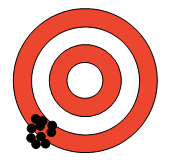
This bullseye demonstrates...
a)
High Accuracy & High Precision
b)
High Accuracy & Low Precision
c)
Low Accuracy & High Precision
d)
Low Accuracy & Low Precision
110.
?
a)
High Accuracy & High Precision
b)
High Accuracy & Low Precision
c)
Low Accuracy & High Precision
d)
Low Accuracy & Low Precision
111.
The students measured length during a science experiement, they got 12 cm. But the actual measurement was 14.25 cm. What was the percent error?
a)
15.79%
b)
18.75%
c)
2.25%
d)
18%
112.
Jessie estimates the weight of her cat to be 8 pounds.  The actual weight of the cat was 10 pounds.  Find the percent error.  
a)
15%
b)
20%
c)
25%
d)
30%
113.

Which is the more precise measurement?

a)

4 mL

b)

4.3 mL

c)

4.30 mL

d)

4.300 mL

114.
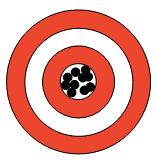
Describe the accuracy and precision of the image
a)
Accurate and Precise
b)
Accurate and not precise
c)
Not Accurate and Precise
d)
not accurate and not precise
115.

How close a measurement is to the true value is called..

a)

Accuracy

b)

Precision

c)

Significant

d)

Estimate

116.
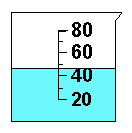
volume?
a)
48 mL
b)
48.2 mL
c)
48.25 mL
d)
4 mL
117.
Volume?
a)
63.5 mL
b)
63 mL
c)
63.55 mL
d)
6 mL
118.
This image is an example of...
a)
precision ONLY
b)
accuracy ONLY
c)
BOTH precision and accuracy
d)
NEITHER precision and accuracy 
119.

Which Student is the most Precise?

a)

Alex

b)

Shandra

c)

Luis

120.
A set of data are all close to each other, but they are not close to the actual value.  This set of data can be described as...
a)
accurate
b)
precise
c)
both precise and accurate
121.
A set of data are all close to each other, and they are close to the actual value.  This set of data can be described as...
a)
accurate
b)
precise
c)
both precise and accurate