
 Worksheets
Seed Germination and Growth Concepts
Total questions: 110
Worksheet time: 1hrs 8mins
How do multicellular organisms primarily increase in size?
By absorbing water into their vacuoles.
Through cell division and the manufacturing of protoplasm.
By specializing cells to carry out specific functions.
Through the production of extracellular materials.
Which method of measuring growth provides the most accurate measure of cellular and extracellular material but requires the organism to be killed?
Height
Length
Wet mass
Dry mass
In a sigmoid growth curve, what is the characteristic of the stationary phase?
Growth is very slow.
Cells are dividing and growing rapidly.
Growth is slowing down.
Cells are dividing and dying at the same rate.
What is the process called when an embryonic plant within a seed begins to grow into a seedling?
Fertilization
Dormancy
Germination
Differentiation
Which part of a dicotyledonous seed is responsible for storing food?
Radicle
Plumule
Cotyledons
Testa
What are the three essential conditions required for a seed to germinate?
Sunlight, carbon dioxide, and suitable temperature
Water, oxygen, and suitable temperature
Nutrients, light, and water
Soil, warmth, and carbon dioxide
What is the primary role of water absorption through the micropyle during seed germination?
To provide structural support to the seed.
To activate enzymes that break down stored food.
To initiate photosynthesis in the cotyledons.
To protect the embryo from external damage.
In the growth curve of a germinating seed, what does the decrease in dry mass during phase X indicate?
The seed is absorbing water and swelling.
The first foliage leaves are developing.
Stored food is being used for respiration.
The plant is beginning to photosynthesize.
What is a key characteristic of meristems in plants?
They have rigid cell walls that restrict division.
They are mature cells found throughout the plant.
They are groups of immature cells with thin walls that actively divide.
They are responsible for transporting water and nutrients.
Which region of a plant root is primarily responsible for its growth in length?
The root cap.
The region of cell division.
The region of cell elongation.
The region of cell differentiation.
Which type of meristem is responsible for the growth in width of roots and stems?
Apical meristems.
Lateral meristems.
Permanent tissue.
Root hairs.
Where does cell division primarily occur in plants?
Throughout most tissues of the plant.
Only in specialized regions called meristems.
Mainly by cells taking water into their vacuoles and expanding.
Only in the vascular cambium and cork cambium.
What is Germination?
the process of a seed growing into a plant
the process of making seeds in a flower
the process of leaves falling from a tree
Which part of the seed protects it before germination?
Cotyledon
Seed Coat
Leaf
What three things does a seed need to germinate?
sunlight, soil and wind
rain, air and shade
water, oxygen and warmth
What happens first when a seed begins to germinate?
the leaves appear
the seed coat splits
the flowers bloom
What is the name of the small plant that grows after germination?
sprout/seedling
Embryo
cotyledon
Which part gives the seed energy to grow?
Seed coat
Scar
Food store
Embryo
Which part of the seed grows in to a new plant?
Embryo
Leaf
Stem
Food store
Lulu's tomato plants are not growing well and the leaves are yellow. Suggest two things that she can do to help her tomato plants to grow better.
Give water and sunlight
Give more soil and water
Give more soil and sunlight
Give more mineral salts
Why seed grow well in sunny day?
They need sunlight
They need warmth
They need cool weather
All of them
The outer cover that protects the seed is ...........
scar
seed coat
embryo
stem
Which one has the biggest seed?
Apple
Snake fruit
Mango
Orange
What is the word that explains something that cause changes?
Factor
Environment
Experiment
Diffuse
During the investigation of seed germination activity, we found that seeds germinated in cup...............
with water and warmth
with water but no warmth
no water but warmth
no water and warmth
What is germination?
When a seed starts to grow
When an egg and pollen join together
When Pollen moves stamen to stigma
When a plant makes its own food.

What makes an avocado a fruit?
An avocado contains a seed.
An avocado is green.
An avocado grows on a tree.
An avocado are edible.
What happens to a seed when it is soaked in water overnight?
It gets bigger and the seed coat comes off.
It gets bigger and rotten
It gets smaller and harder.
It grows into a plant.

Which of the following describes process no.2?
First shoot start to grow
First root start to grow
Seed absorbs water and swell.
Shoot take in sunlight

What is arrow "A" pointing to?
Food store
Seed Coat
Embryo (baby plant)
Seed Fats

What is arrow "B" pointing to?
Embryo (baby plant)
Seed Coat
Seed leaf
Food store

What is arrow "C" pointing to?
Seed Coat
Seed Shell
Food store
Embryo (baby plant)
Sexual reproduction involves gametes
True
False
Pollen grains are transferred from the anthers to the stigma. The pollen grains adhere to the
sticky stigma. The statements describe what happens next.
1 The pollen grain grows a pollen tube.
2 The pollen tube enters the ovule.
3 The pollen tube grows down the style.
4 The male nucleus fuses with an egg cell nucleus.
In which order do these stages occur?
1 → 2 → 4 → 3
1 → 3 → 2 → 4
2 → 3 → 1 → 4
3 → 1 → 4 → 2
Which statement about the methods of reproduction is correct?
All the offspring from sexual reproduction are genetically identical but dissimilar to the parents
Asexual reproduction results in identical zygotes
In asexual reproduction, two nuclei from one parent fuse
In sexual reproduction, one nucleus from each of the two parents fuse
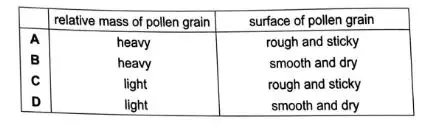
Which features of the pollen grains indicate that they are produced by wind-pollinated flowers?
A
B
C
D
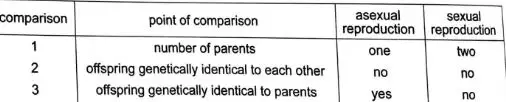
The table compares features of asexual and sexual reproduction. Which comparisons are correct?
Can select more than 1 option
1
2
3
When can self-pollination never occur?
if the anthers are found below stigma
if the female and male parts are on separate plants
if the flowers have no petals
if the pollen grains are carried by wind or water
What is the function of carpel?
produces pollen
produces ovules
What is the function of a petal?
causes pollination
attracts insects
A number of plants are produced using asexual reproduction. Which statement about these plants are correct?
They are produced from one parent and are genetically different
They are produced from one parent and are genetically identical
They are produced from two parents and are genetically different
They are produced from two parents and are genetically identical
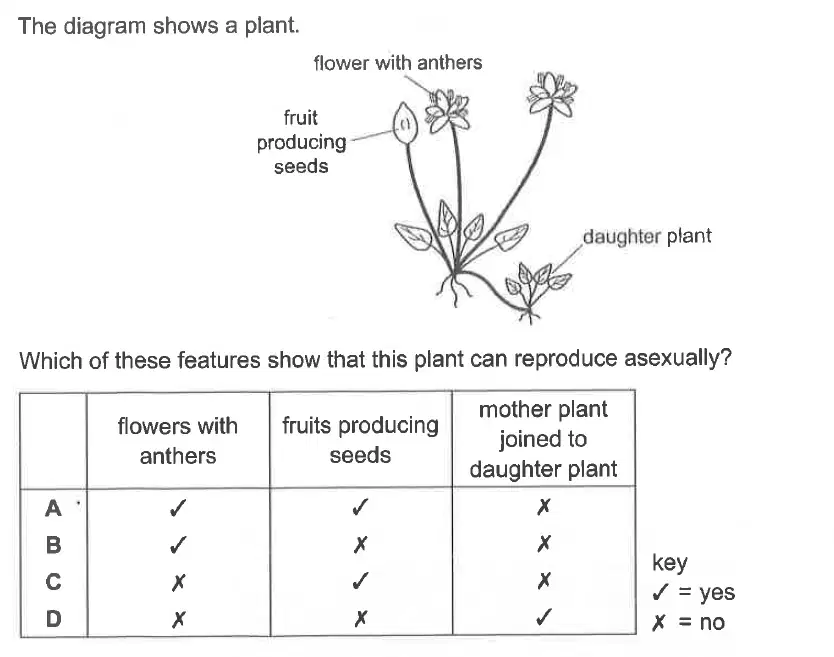
The diagram shows a plant. Which of these features show that this plant can reproduce asexually?
A
B
C
D
In a flower, what is the function of an anther?
making scent to attract insects
producing pollen grains
receiving pollen grains from other flowers
scattering seeds
In which structure in a flower contains the female gamete?
anther
carpel
petal
sepal
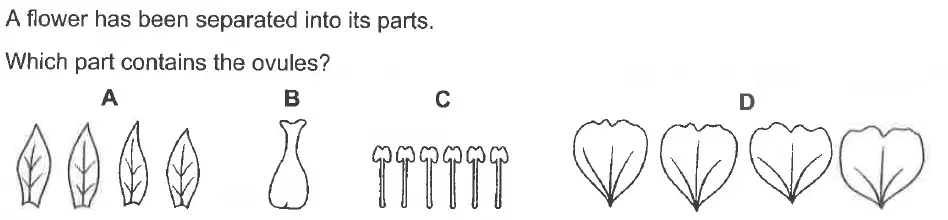
A flower has been separated into its parts.
Which part contains the ovules?
A
B
C
D
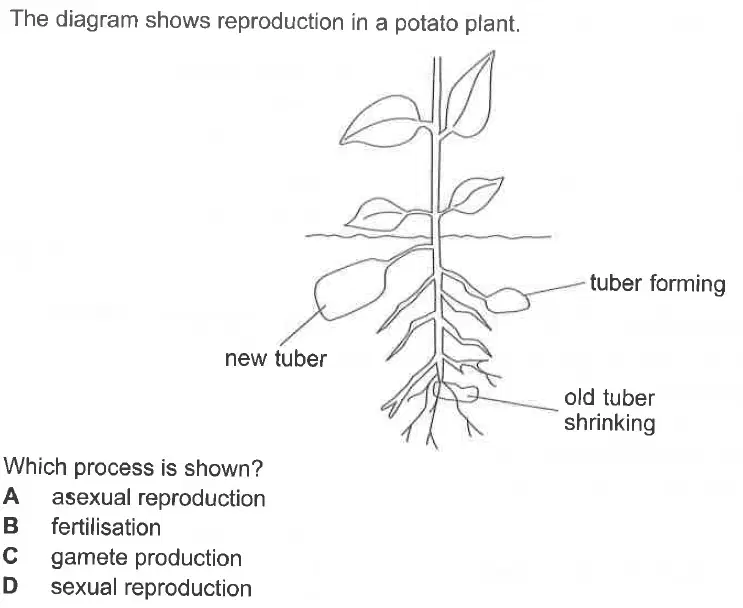
The diagram shows reproduction in a potato plant. Which process is shown?
Asexual reproduction
fertilisation
gamete production
sexual reproduction
Which parts of a flower is required for fertilisation?
carpel and ovule
ovule and pollen
petals and anthers
pollen and sepals
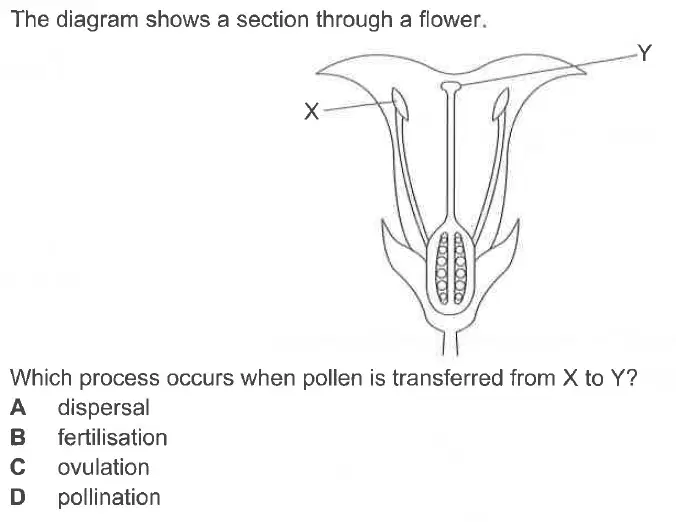
What process occurs when pollen is transferred from X to Y?
dispersal
fertilisation
ovulation
pollination

The diagram shows the human female reproductive system.
Where does fertilisation usually take place?
A
B
C
D
Fishes, frogs, and bees are example of sexual reproduction in .....
viviparous
ovoviviparous
internal oviparous
external oviparous
What is the organs reproduction in woody plants?


Which are the functions of stamen in part of flowers?
protect the flower when it is budding
attracting pollinating animals (bees)
producing egg cell
producing pollen grains for fertilization
male reproduction
Reproduce by budding on stems in the soil. There are in ginger, turmeric, galangal, and temulawak. How do they breeding?
Stolon
The layers
Rhizome
Leaf Advent

What the benefit of plants breeding based on picture?
inherit all the characteristics of only one parent
inherit various characteristics of both parents
inherit some characteristics of only one parent
inherit the best characteristic of parents

A bee perches on the Sun flower and it brings pollen grains into Rose flower. The result of that event is…...
Inherit from flowering plant A will look like flowering plant B
Inherit from flowering plant B will look like flowering plant A
Inherit from flowering plant A will look like flowering plant A and B
Will not be fertilized because stamen come from different flowering plants
Asexual reproduction that the female produce egg cells and it will grow complete without fertilization process. It is called?
Fragmentation
Parthenogenesis
Split up
Form budding
Which are animals that do sexual reproduction?
Platypus
Rabbit
Planaria
Amoeba
Hydra
The embryo develops in uterus is for......
sexual animal : viviparous
asexual animal : viviparous
sexual animal : oviparous
asexual animal : ovoviviparous
An event that happened over fertilization in animal is….
egg cell division
embryo develops
produce sperm cell and egg cell
meeting cell sperm and egg cell
The male parts of a flower are ______________.
Style
Anther
Filament
Ovary
The ___________ of one flower receives pollen grains from another flower.
anther
ovary
style
stigma
The _______________ produces pollen grains.
ovary
anther
stigma
The _________ travels to the __________ during fertilization to form a seed.
anther travels to the ovule
pollen travels to the ovule
anther travels to thestigma
pollen travels to the stigma
The female parts of a flower are ____________________.
ovary
ovule
anther
stigma
In nature, flowers are pollinated by ____________ and _______________.
wind
water
butterflies
humans
The ______ supports the stigma and keeps it high above the plant to receive pollen grains easily.
style
filament
stalk
stem
The plant male sex cell is also called the _______________.
anther
pollen grain
ovary
ovule
Pollination is the process of transferring pollen from the anther of one flower to the ______________ of another flower.
filament
style
stigma
ovary
ovule
After a pollen grain has reached the stigma, it travels through the __________ to reach the ovary.
style
stalk
stigma
stem
After fertilization, each _______forms a seed, while each _________forms a fruit.
ovary ... ovule
ovule ... ovary
egg ... ovary
pollen ... ovary
ovary ... pollen
Fruit X is fleshy and bright-red in colour. The likely dispersal method for its seeds is by ____________.
animal
wind
water
splitting
[Multi-Answer] Which of the following features suit a wind-dispersed fruit/seed?
wing-like structures
light
colourful
can float on water
The process of the pollen fusing with the ovule is called ________________.
pollination
fertilisation
germination
reproduction
[Multi-Answer] Which of the following are possible dispersal methods for fruits?
Wind
Water
Splitting
Animal
Besides eating the fruits and scattering the seeds, animals can also disperse seeds if __________________.
they chew the seeds into small pieces
seeds with stiff spines attach themselves onto the animal
they carry the fruits and plant them into the ground
they throw the seeds into the air
Non-flowering plants e.g. ferns, do not reproduce by seeds. Instead, they reproduce by ____________.
Sperm
Spores
Eggs
Cells
After fertilisation, the seeds are formed inside the _________.
ovule
ovary
flower
stalk
Plants disperse their seeds in many ways to prevent overcrowding. Otherwise, the young plants would compete with each other for _________________________.
sunlight
space
water
air

What do seeds need to germinate (grow into a new plant)? (You may select more than one answer)
Air (oxygen)
Warmth
Water
Light
Food

It is the development of a seed into a plant.
seed dispersal
germination
habitat

Gertrude planted some beans in a pot. After 5 days her pot looked like this. Why?
She watered the seeds but placed the pot in the dark.
She did not water the seeds.
She used yellow-coloured soil.
Why it is better for seeds to be scattered far and wide?
To provide shelter to other animals.
For farmers to see which soil is good for the plants.
For plants to have a better chance of growing healthier.
What does a seedling need energy for?
Photosynthesis
Growth
Movement
Reproduction
The seed is protected by an outer covering called:
food store
embryo
seed coat
germination
Besides the plant embryo, what else is inside the seed?
Food, which it uses until it can make its own food.
grass
life span
source of light
The male part of the flower is________
carpel
sepal
ovaries
stamen
The pollen grains are found in this part of the stamen.
anther
style
carpel
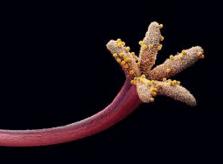
The part of the flower on which the pollen grains land.
carpel
stamen
sepals
stigma
Brightly colored parts of flowers that attract insects.
petals
carpels
stamen
filaments

Small leaf-like structures forming an outer circle at the base of a flower.
petals
sepal
stigma
carpel
Found inside the ovary and contain the ova
ovules
anther
seeds
stamen
The female part of a flower is
carpel
stamen
filament
sepal


The purpose of seed dispersal is for the seeds to __________.
germinate at the same time
move to the same place and grow
move further away from the parent plant
compete with one another for minerals in the soil

How are coconuts dispersed?
by animals
by water
by wind

Why are shorea seeds able to be dispersed by the wind?
It is light and has wing-like structure
It has hooks to hook onto the fur of animals
It has a fibrous husk that makes it float
It has dry pods that split open
A) wind pollination
B) Insect pollination
C) explosive pollination

What is the role of the cotyledon in a germinating seed?
To absorb water from the soil.
To provide nutrients to the developing plant.
To protect the seed from predators.
To initiate the process of photosynthesis.
Which environmental factor is most critical for seed germination?
Soil type
Temperature
Humidity
Wind speed
What is the primary function of the seed's endosperm?
To support the growth of the seed coat.
To provide energy for the embryo during germination.
To protect the seed from disease.
To facilitate water absorption.

