wayground logo

Free Printable Worksheets

Font size

S
M
L
XL
Worksheets

Molecular Biology Practice

Total questions: 112

Worksheet time: 2hrs 55mins

Name
Class
Date
1.

What type of organic molecules are enzymes?

a)

carbohydrates

b)

Lipids

c)

Nucleic Acid

d)

Proteins

2.

What are the subunits of DNA and their function?

a)

nucleotides that store information

b)

monosaccharides that provide quick energy for the cell

c)

lipids that store energy and provide insulation

d)

proteins that provide the building blocks for the structural components of organisms

3.

How does the amount of energy resulting from fermentation compare with that of aerobic respiration?

a)

Aerobic respiration results in less energy

b)

Aerobic respiration results in more energy

c)

Each process results in equal amounts of energy

d)

Each process results in variable amounts of energy

4.

Which type of molecule do whales use for energy storage and insulation?

a)

DNA

b)

Glucose

c)

Fat

d)

Starch

5.

Which most directly controls the rate at which food is broken down to release energy?

a)

Enzymes

b)

Hormones

c)

Nucleic Acids

d)

Vitamins

6.

If energy is needed to move materials into or out of a cell, what is most likely occurring?

a)

Active Transport

b)

Passive Transport

c)

Osmosis

d)

Diffusion

7.

Which factor most affects the order of amino acids in a protein?

a)

the DNA located in the nucleus of the cell

b)

the cell in which the protein is located

c)

the amount of ATP available for the cell’s use

d)

the area in a cell where proteins are produced

8.

Which statement best compares aerobic and anaerobic respiration?

a)

Less ATP is generated during anaerobic respiration than during aerobic respiration

b)

More water is generated during anaerobic respiration than during aerobic respiration

c)

More oxygen is generated during anaerobic respiration than during aerobic respiration.

d)

Less lactic acid is generated during anaerobic respiration than during aerobic respiration

9.

Which would be the best evidence that a cell is using active transport to move a substance across its cell membrane?

a)

Substances are moving rapidly across the cell membrane

b)

ATP is being rapidly consumed near the cellular membrane

c)

Substances are moving from high to low concentrations.

d)

Substances are moving through channels in the cell membrane.

10.

Waxes create a waterproof layer on the outside of some living organisms. To which group of organic molecules do waxes belong?

a)

Carbohydrates

b)

Lipids

c)

Nucleic Acids

d)

Proteins

11.

A student noticed that the freshwater plant, Elodea, produced bubbles when placed in direct light. What could the student most likely conclude?

a)

Bubbles of carbon dioxide were produced as a result of photosynthesis

b)

Bubbles of oxygen were produced as a result of photosynthesis

c)

Bubbles of carbon dioxide were produced as a result of cellular respiration.

d)

Bubbles of oxygen were produced as a result of cellular respiration

12.

Which best summarizes the role of DNA in the production of proteins?

a)

DNA moves to the cytoplasm to build proteins

b)

DNA transports amino acids to the ribosomes to make proteins

c)

DNA contains the instructions used to make proteins

d)

DNA breaks hydrogen bonds between amino acids

13.

Salivary amylase is an enzyme in humans that breaks down starches. What substance would humans have difficulty digesting without this enzyme?

a)

Lipids

b)

Nucleic Acids

c)

Proteins

d)

Carbohydrates

14.

Which best explains why the rate of a biochemical reaction decreases at high temperatures?

a)

The activation energy increases.

b)

The shape of the enzyme changes

c)

The enzyme-substrate complex forms

d)

The bonds between substrates are broken.

15.

A contractile vacuole helps protists eliminate excess liquid. This is a “pumping" process which reduces pressure inside the cell and prevents the cell from bursting. What is most likely the source of energy for this process?

a)

DNA

b)

Lipids

c)

ATP

d)

Ribosomes

16.

Which molecules are joined together to make proteins?

a)

Fatty Acids

b)

Nucleic Acids

c)

Amino Acids

d)

Acetic Acids

17.

Which word equation best represents the process of cellular respiration?

a)

carbon dioxide + glucose → oxygen + water

b)

carbon dioxide + water → glucose + oxygen

c)

glucose + oxygen → carbon dioxide + water

d)

oxygen + water → carbon dioxide + glucose

18.

How does the body of a runner keep up with the demand for energy when cellular oxygen levels are low?

a)

through energy production in the mitochondria

b)

through aerobic respiration in the plasma membrane

c)

through ATP produced directly from sunlight

d)

through anaerobic respiration in the cytoplasm

19.

when two dominant alleles are expressed equally or fully

a)

sex-linked

b)

multiple alleles

c)

codominance

d)

polygenic inheritance

e)

incomplete dominance

20.

when two dominant alleles blend forming an intermediate (mixture) phenotype

a)

sex-linked

b)

multiple alleles

c)

codominance

d)

polygenic inheritance

e)

incomplete dominance

21.
A pattern of inheritance in which a trait is carried on one of the sex-determining chromosomes.
a)
Mendelian Inheritance
b)
Co-dominance
c)
Incomplete dominance
d)
Sex-linked inheritance
22.
A calico cat shows both the traits for orange fur and black fur. What kind of allele expression is this?
a)
Incomplete Dominance
b)
Co dominance
c)
Independent assortment
d)
Recessive inheritance
23.
The different forms of a gene are called
a)
traits
b)
pollinators
c)
alleles
d)
hybrids
24.
Colorblindness is more common in males than in females because the allele for colorblindness is
a)
dominant and located on the X chromosome.
b)
recessive and located on the Y chromosome.
c)
recessive and located on the X chromosome.
d)
recessive and located on the Y chromosome.    
25.
What does heterozygous mean?
a)
An organism that has the same genes for a trait (TT or tt)
b)
An organism that has different genes for a trait (Tt)
c)
When neither gene is fully dominant; offspring is a mixture of both
d)
the different forms of a trait (hair color--> brown, blonde, red
26.
An allele whose trait only shows up when no dominant allele is present.
a)
hidden allele
b)
dominant allele
c)
recessive allele
d)
present allele
27.
having two of the same genes for the trait (sometimes called purebred).
a)
homozygous
b)
hetrozygous
c)
protein
d)
chromosome
28.
Hemophilia is a x-linked disorder.  A woman is a carrier for the disorder.  Which is the correct genotype?
a)
Hh
b)
XHXh
c)
hh
d)
XhXh
29.

G = green, g = yellow

The genotype for a yellow plant is...

a)

GG

b)

Gg

c)

gg

30.

B = brown fur b = white fur

In the punnett square, what is the probability for white fur?

a)

0%

b)

25%

c)

50%

31.
Which of the following genotypes is homozygous dominant?
a)
A
b)
Aa
c)
AA
d)
aa
32.
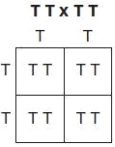
What ratio of the offspring from the cross shown will be homozygous recessive for the trait of tallness? 
a)
0 in 4
b)
1 in 4
c)
2 in 4
d)
4 in 4
33.
Is this trait (the shaded individuals) dominant or recessive?
a)
dominant
b)
recessive
34.
What is the mode of inheritance shown here?
a)
Autosomal Dominant
b)
Autosomal Recessive
c)
Sex Linked Recessive
d)
Co-dominant
35.
What is the mode of inheritance shown here?
a)
 Recessive
b)
Sex Linked
c)
 Dominant
36.

What type of disorder is running in this family?

a)

Autosomal Dominant

b)

Autosomal Recessive

c)

X-linked recessive

37.

What type of trait does this pedigree represent?

a)

Autosomal Dominant

b)

Autosomal recessive

c)

X-linked recessive

38.
Which sequence of DNA bases would pair with this partial strand
ATG TGA CAG
a)
ATG TGA CAG
b)
TAC ACT GTC
c)
GTA AGT GAC
d)
CAT TCA CTG
39.
Which of the following best describes a DNA molecule?
a)
double helix
b)
contains ribose
c)
made of amino acids
d)
contains Uracil
40.
Which of the following units are repeatedly joined together to form a strand of DNA?
a)
amino acids
b)
nucleotides
c)
fatty acids
d)
polysaccharides
41.
In a molecule of double-stranded DNA, the amount of Adenine present is always equal to the amount of
a)
cytosine
b)
guanine
c)
thymine
d)
uracil
42.
Guanine bonds with ______________.
a)
Adenine
b)
Guanine
c)
Cytosine
d)
Thymine
43.
Which 2 molecules form the sides (backbone) of the DNA ladder?
a)
deoxyribose sugar and adenine
b)
deoxyribose sugar and a hydrogen bond
c)
deoxyribose sugar and the nucleus
d)
deoxyribose sugar and phosphate
44.
Which organelle is DNA usually found in?
a)
cell membrane
b)
vacuole
c)
chloroplast
d)
nucleus
45.
The enzyme that unzips the DNA to prepare for replication
a)
helicase
b)
replicase
c)
polymerase
d)
synthase
46.
DNA replication results in two DNA molecules,
a)
each one with two original strands
b)
each one with two new strands
c)
each one with one new strand and one original strand
d)
one with two new strands and the other with two original strands
47.
What are the three components of a nucleotide?
a)
sugar, hydrogen, nitrogen base
b)
sugar, oxygen, nitrogen base
c)
sugar, phosphate, nitrogen base
d)
sugar, phosphate, protein
48.
The enzyme that comes first temporarily gets the single strand ready to add new nucleotides is called "The Initializer" or 
a)
Helicase
b)
Primase
c)
Polymerase
d)
Nuclease
49.
Which enzyme is responsible for adding nucleotides ("The Builder")?
a)
Topoisomerase
b)
DNA Polymerase
c)
Ligase
d)
Primase
50.
Which enzyme is responsible for gluing and connecting parts of newly created DNA fragments together ("The Gluer")? 
a)
Topoisomerase
b)
DNA Polymerase
c)
Ligase
d)
Primase
51.
This Y shaped region where DNA is unwound to start replication is called...
a)
replication fork
b)
Leading strand
c)
Lagging strands
d)
replication splicing
52.
Which enzyme seals okazaki fragments together on the lagging strand?
a)
Topoisomerase
b)
Helicase
c)
Polymerase
d)
Ligase
53.
Which of the following sequences expresses the correct order of enzyme function in DNA replication?
a)
Helicase--primase--DNA polymerase--ligase
b)
ligase--helicase--primase--DNA polymerase
c)
DNA polymerase--primase--helicase--ligase
54.
The _________ contains __________.
a)
Leading Strand / Okazaki Fragments
b)
Lagging Strand / Okazaki Fragments
c)
Leading Strand / Topoisomerase
d)
Lagging Strand / dispersive replication
55.
The ___________________ strand builds continuously.
a)
Lagging
b)
Ligase
c)
Leading
d)
Telomeres
56.
DNA is built in the 
a)
3'-3' direction
b)
5'-5' direction
c)
3'-5' direction
d)
5'-3' direction
57.
Which process is used to make mRNA from the DNA in the nucleus?
a)
transcription
b)
translation
c)
replication 
58.
Which RNA bases would pair with TACGAA in transcription
a)
AUGCUU
b)
ATGCTT
c)
GCATCC
d)
GCAUCC
59.
One difference between DNA and RNA is that....
a)
Only RNA has the base Uracil
b)
only RNA contains the base Thymine
c)
only RNA contains the base Cytocine
d)
only RNA contained the base Guanine
60.
what does mRNA do?
a)
carry info from genes to ribosomes
b)
carry amino acids to ribosomes
c)
help with RNA splicing
d)
make up ribosomes
61.
A triplet of mRNA is called a
a)
codon
b)
anticodon
c)
amino acid
d)
peptide bond
62.

What is the correct order to make a protein?

a)

Protein, DNA, RNA

b)

RNA, DNA, Protein

c)

DNA, RNA, Protein

d)

Protein, RNA, DNA

63.

What enzyme does transcription use?

a)

DNA polymerase

b)

ligase

c)

RNA polymerase

d)

helicase

64.

Which RNA carries the message?

a)

mRNA

b)

rRNA

c)

tRNA

65.
In RNA, Uracil pairs with ______. 
a)
cytosine
b)
adenine
c)
guanine
d)
thymine
66.
The process to go from mRNA to a protein is called ____
a)
transcription
b)
rRNA
c)
replication
d)
translation
67.
The main function of tRNA is to...
a)
carry a message that, when translated, forms proteins
b)
form a portion of ribosomes
c)
string together complementary RNA and DNA strands
d)
bring amino acids from the cytoplasm to the ribosomes
68.
What is the three base sequence of mRNA that codes for a single amino acid?
a)
Anticodon
b)
Codon
c)
Protein
69.
What is the location in the cell for translation?
a)
nucleus
b)
mitochondria
c)
ribosome
d)
chloroplast
70.
RNA polymerase creates RNA in the _________ direction
a)
5' to 3'
b)
3' to 5'
c)
both directions
d)
any direction
71.
The codon 5'-UAC-3' would have an anti-codon match of
a)
3'-AUG-5'
b)
3'-TAC-5'
c)
5'-AUG-3'
d)
5'-CAU-3'
72.
What amino acid is represented by the codon CAG?
a)
Aspartic Acid
b)
Histidine
c)
Glutamine
d)
Methionine
73.
Which of these is NOT a type of RNA?
a)
mRNA
b)
tRNA
c)
snRNP
d)
rRNA
74.
What does mRNA stand for?
a)
messenger
b)
median
c)
modified
d)
magnificant
75.
what does rRNA do?
a)
carry info from genes to ribosomes
b)
carry amino acids to ribosomes
c)
help with RNA splicing
d)
make up ribosomes
76.
What is the name for the coding regions of the pre-mRNA?
a)
anticodons
b)
codons
c)
exons
d)
introns
77.
What is the name for the noncoding regions of the pre-mRNA?
a)
anticodons
b)
codons
c)
exons
d)
introns
78.
A nucleotide does NOT contain
a)
a sugar
b)
polymerase
c)
a nitrogen base
d)
a phosphate group
79.
What type of macro-molecules are DNA and RNA?
a)
Protein
b)
Carbohydrate
c)
Nucleic Acid
d)
Lipid
80.
In eukaryotes, DNA is located in the
a)
cytoplasm
b)
nucleus
c)
cell membrane
d)
ribosome
81.
In prokaryotes, DNA is located in the
a)
cytoplasm
b)
nucleus
c)
cell membrane
d)
ribosome
82.
The four nitrogenous bases of DNA are
a)
Adenine, guanine, cytosine, and uracil
b)
Adenine, guanine, cytosine, and thymine
c)
Adenine, guanine, ribose and deoxyribose
d)
Adenine, deoxyribose, cytosine, and uracil
83.
Which of the following would be a nucleotide found in DNA
a)
Ribose + phosphate + uracil
b)
Deoxyribose + phosphate + uracil  
c)
Deoxyribose + phosphate + adenine
d)
Ribose + phosphate + adenine
84.

Which of the following would complement the mRNA codon for CAG (DNA)

a)

CAG

b)

AUG

c)

GUC

d)

UAC

85.
An RNA molecule is
a)
double helix
b)
always double stranded
c)
usually double stranded
d)
single stranded
86.
An mRNA molecule is produced in the step of protein synthesis:
a)
replication
b)
transcription
c)
duplication
d)
translation
87.

Anticodons on tRNA pair with

a)

mRNA codons

b)

tRNA condons

c)

DNA codons

d)

amino acids

88.
In mRNA, each codon specifies a particular 
a)
nucleotide
b)
amino acid
c)
purine
d)
pyrimidine
89.
All macro-molecules are made of building blocks called monomers. What are the building blocks of nucleic acids, like DNA and RNA, called?
a)
nucleotides
b)
nitrogen bases
c)
sugar-phosphate
d)
A-T-C-G
90.

Cells secrete proteins, often as enzymes, that have been engineered or directed by the DNA in the nucleus. Which processes are involved in protein synthesis?

a)

transfer to RNA, then to amino acids

b)

transcription into RNA, then to amino acids

c)

replication of DNA, then transcription into enzymes

d)

translation into RNA, then replication into DNA

91.
Protein synthesis is a process that uses DNA, RNA and ribosomes to build proteins, The protein are built from their building blocks. What are the building blocks of proteins called? 
a)
nucleotides
b)
proteins
c)
amino acids
d)
carbohydrates
92.

Where in the cell does the first step of protein synthesis take occur?

a)

in the cell membrane

b)

on the rough ER

c)

in the nucleus

d)

at the ribososmes

93.
What is the name given to the first step of protein synthesis?
a)
transcription
b)
translation
c)
translocation
d)
protein synthesis
94.
In addition to mRNA and a ribosome, what other macromolecule is needed in the second step of protein synthesis?
a)
lipids
b)
tRNA
c)
DNA
d)
carbon dioxide
95.
The second step of protein synthesis is best summarized by which of the following?
a)
mRNA to DNA
b)
DNA to protein
c)
mRNA to protein
d)
nucleus to ribosome
96.
Where in the cell does the second step of protein synthesis occur?
a)
in the DNA
b)
in the nucleus
c)
in the Golgi Apparatus
d)
at the ribosome
97.
What is the name of the second step of protein synthesis?
a)
transcription
b)
translation
c)
transportation
d)
protein synthesis
98.
If an mRNA codon is AGU, which of the following would be the appropriate tRNA anticodon?
a)
TCA
b)
UGA
c)
AGU
d)
UCA
99.
Which of the following is the complementary mRNA strand for this strand of DNA? ATT-GCG-AGT
a)
UAA-CGC-TCA
b)
UAA-GCG-UCA
c)
UAA-CGC-AGT
d)
UAA-CGC-UCA
100.
What bonds hold DNA bases together?
a)
nitrogen bonds
b)
hydrogen bonds
c)
phosphorus bonds
d)
carbon bonds
101.
The backbone of DNA molecule is made of:
a)
A-T-C-G
b)
mRNA
c)
sugar and phosphate
d)
ribose sugar
102.
The sugar in RNA is:
a)
Uracil
b)
Thymine
c)
Ribose
d)
Deoxyribose
103.
Using the codon identify the amino acid sequence:
AUG-GGC-ACC-UCA-UGA
a)
MET-GLU-VAL-TYR-STOP
b)
MET-GLY-THR-SER-STOP
c)
MET-SER-THR-GLY-STOP
d)
MET-LYS-ASN-STOP
104.

Which process adds a Guanine to the 5' end?

a)

Polyadenylation

b)

Splicing

c)

Capping

d)

Post transcriptional processing

105.

Which of the following is NOT a stop codon for translation?

a)

UGA

b)

UAA

c)

UAG

d)

TATA

106.

What amino acid does AUG code for?

a)

Pro

b)

Lys

c)

Met

d)

Phe

107.

What bonds are broken during degradation of a protein?

a)

Hydrogen

b)

Covalent

c)

Peptide

d)

Gycosidic

108.

What factors can cause denaturation of proteins?

a)

High temperature

b)

Low pH

c)

High pH

d)

Low temperature

109.

Protein denaturation often leads to formation of new hydrogen bonds. What is the process called?

a)

Denaturation

b)

Degradation

c)

Renaturation

d)

Coagulation

110.

Ligases are the glue of biotechnology. What enzymes act like scissors?

a)

Restriction enzymes

b)

Helicases

c)

Polymerases

d)

Primase

111.

The process of using plasmids to clone genes is known as

a)

Cloning

b)

Transformation

c)

Recombination

d)

Transgenics

112.

mRNA is shorter than hnRNA due to

a)

Capping

b)

Polyadenylation

c)

Splicing

d)

Transcription